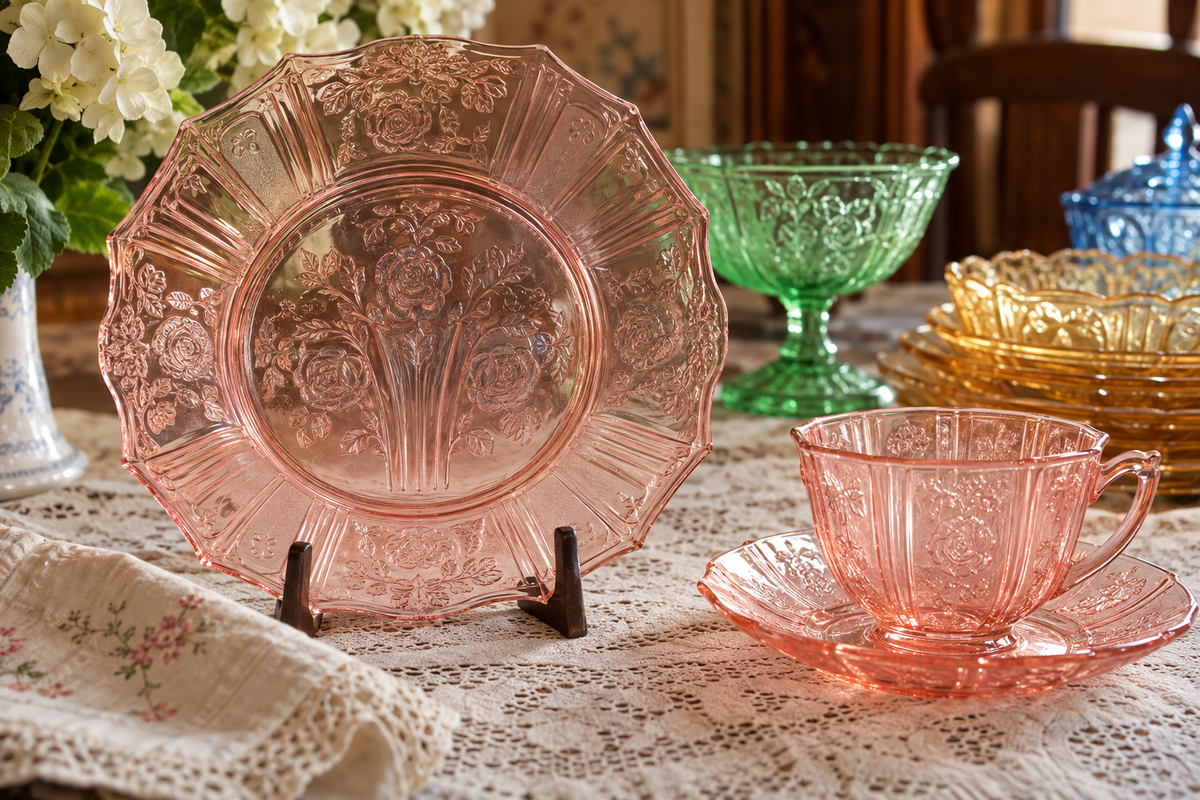
Some Depression glass patterns announce themselves immediately. A rose fills a molded panel. An octagonal plate catches the light. Delicate scrollwork runs around a scalloped rim. Once you learn those visual clues, a shelf of old colored glass stops looking like an assortment of pink and green dishes and begins separating into recognizable families.
That is one of the pleasures of learning Depression glass patterns. Color matters, but pattern is often the stronger identification tool. Mayfair, Princess, Cherry Blossom, Madrid, American Sweetheart, and Royal Lace each developed a visual identity distinctive enough that collectors can often recognize them before turning a piece over.
Mayfair: Hocking’s Open Rose
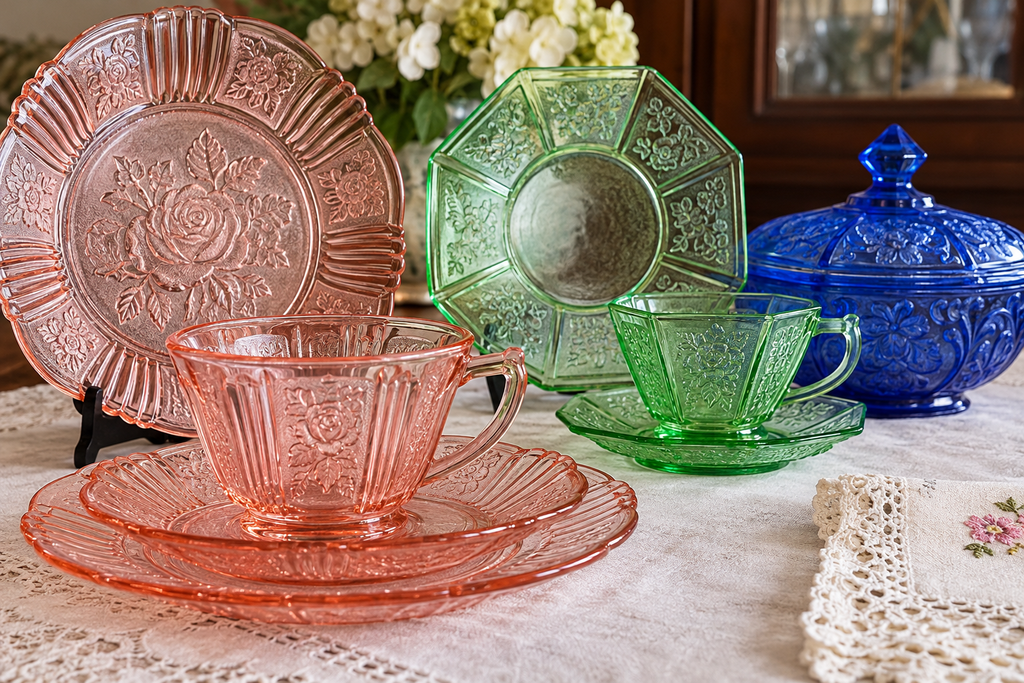
Hocking Glass Company produced Mayfair from 1931 through 1937, and the pattern became better known among many collectors by its nickname, Open Rose. The National Depression Glass Association lists Mayfair among the major patterns of the Depression years, while specialist references identify pink, green, blue, yellow, and limited crystal production.
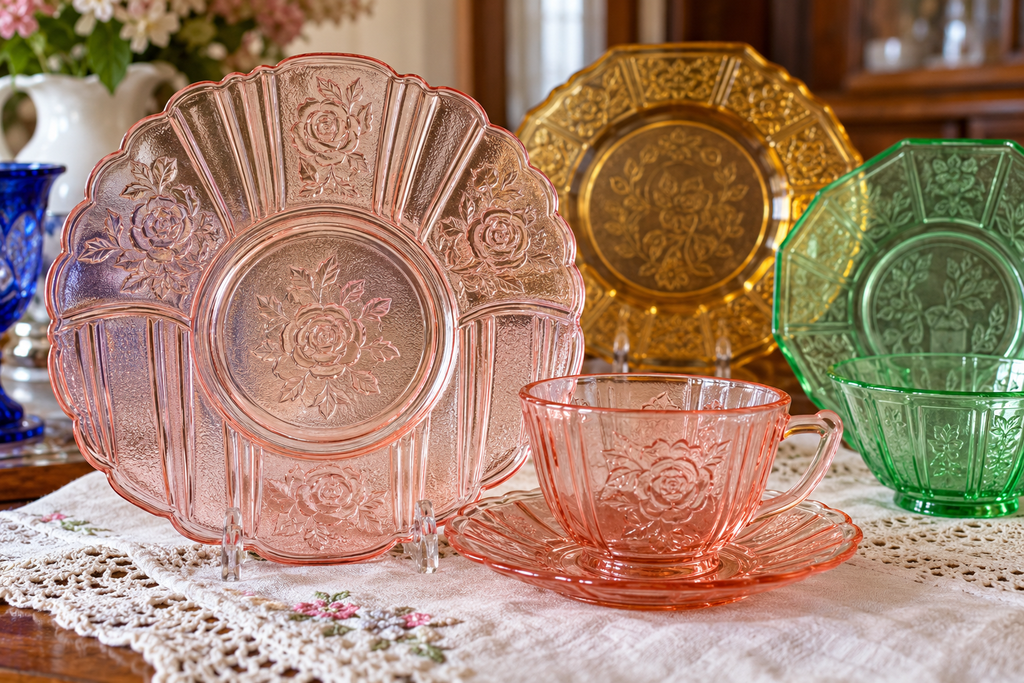
Mayfair is a good pattern for training the eye because its decoration is relatively easy to isolate. Large open roses appear within panels, usually accompanied by rounded vertical ribbing. On many pieces, the molded decoration creates alternating areas of floral detail and simpler vertical structure.
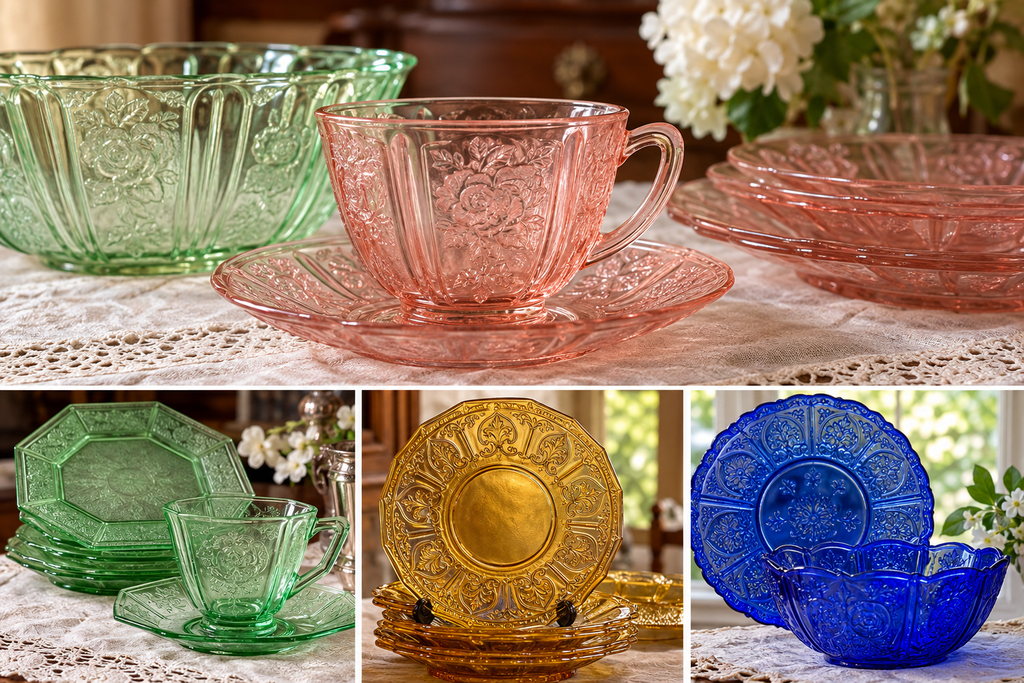
Pink Mayfair is probably the version most likely to turn up in an antique shop or estate assortment. Other colors can change the personality of the pattern considerably. Blue makes the floral molding feel almost architectural, while green emphasizes the strong vertical lines surrounding the roses.
The important lesson is not simply to memorize “pink glass with roses.” Other makers produced floral patterns, and color alone proves very little. Look at the arrangement of the flowers, the surrounding panels, the edge, and the overall form.
Princess: Flowers Meet Geometry
Princess, another Hocking pattern, was produced from 1931 to 1935. A surviving cup and saucer in the Corning Museum of Glass collection shows several of its most useful identification features: angular, octagonal forms combined with molded floral decoration.
That contrast gives Princess its character.
At first glance, the flowers can make it seem soft and traditional. Then the shape takes over. Plates, saucers, and other pieces often have a noticeably geometric outline rather than the simple round forms many people expect from tableware.
Princess was made in multiple colors, including green, pink, and yellow tones. Blue examples are also known. But again, the safest approach is to identify the pattern first and consider color second.
When examining an unfamiliar piece, look for the combination rather than one isolated feature: angular shape, floral molded decoration, and the characteristic arrangement of the design around the piece.
Cherry Blossom: Jeannette’s Garden in Glass
Few names sound more appropriate for their design than Cherry Blossom.
Jeannette Glass Company produced the pattern from 1930 through 1939, giving it a relatively long Depression-era run. Its molded branches, leaves, blossoms, and fruit create an overall naturalistic design rather than a single decorative band around the rim. Pink and green are especially familiar, while other colors and opaque glass variations also exist.
Cherry Blossom remains popular partly because it works well at both distances. Across a room, the colored glass catches the eye. Up close, the molded design provides the detail.
There is one important complication for collectors: Cherry Blossom has been extensively reproduced. That does not mean every suspicious-looking piece is modern, nor does it mean the pattern should be avoided. It means identification should include more than simply matching a photograph. Shapes, mold details, dimensions, known original pieces, and reproduction references all become important.
We will look more closely at the reproduction problem later in this Depression Glass series. For now, Cherry Blossom is worth remembering as one of the patterns where recognition is only the beginning of identification.
American Sweetheart: A Delicate Look From MacBeth-Evans
MacBeth-Evans Glass Company produced American Sweetheart from 1930 to 1936. The pattern combines radiating flutes, elaborate scroll-like ornament, and scalloped forms to create an appearance noticeably lighter and more delicate than many heavier pressed-glass designs.
The Corning Museum of Glass holds an American Sweetheart salver dated 1930–1936, describing its flat rim as having groups of flutes separated by floral decoration.
American Sweetheart also introduces collectors to Monax, the thin translucent white glass associated with MacBeth-Evans. Depending on the light, Monax can show an almost opalescent quality rather than the solid appearance people may associate with ordinary opaque white glass. Pink American Sweetheart is also familiar to collectors.
This is a useful reminder that “Depression glass” does not mean every pattern must look alike—or even be transparent colored glass. Different manufacturers were competing for the same household table while creating very different visual effects.
Madrid: Federal Glass Goes Ornate
If Princess balances flowers with geometry, Madrid leans into ornament.
Federal Glass Company introduced Madrid in 1932 and produced it through 1939. Its design uses scrolls, arches, and repeating decorative elements that can give plates and serving pieces an almost architectural appearance. The National Depression Glass Association records Madrid among Federal’s major patterns of the period.
Amber is strongly associated with Madrid and is useful when learning the pattern, although original examples were produced in other colors as well.
Madrid also belongs on any collector’s mental list of patterns requiring extra care because later reproductions and reissues exist. A piece that looks like Madrid may indeed be Madrid in design without necessarily dating to the original 1930s production period.
That distinction matters. Pattern identification answers what design is this? Dating and authentication answer a different question: when was this particular piece made?
Royal Lace: Hazel-Atlas Makes an Impression
Some Depression glass patterns are remembered primarily for their design. With Royal Lace, design and color have become almost inseparable in the collecting world.
Hazel-Atlas produced Royal Lace from 1934 through 1941. The pattern consists of elaborate molded floral and lace-like ornament. It appeared in several colors, but cobalt blue—called Ritz Blue by Hazel-Atlas—became particularly memorable. The blue version entered production after Royal Lace itself had already been introduced.
Cobalt Royal Lace can be dramatic enough to attract someone who has no idea what the pattern is called. The deep glass color makes the raised decoration stand out under strong light, especially along edges and molded details.
Yet collectors should still resist identifying a pattern solely by its most famous color. Royal Lace also exists in pink, green, and clear glass. What makes it Royal Lace is the molded design, not the cobalt.
That principle applies across the category.
Cameo: A Pattern With a Person in the Design
Hocking’s Cameo, produced from 1930 through 1934, offers one of the easiest motifs to remember once you have seen it.
The pattern incorporates a female figure—often described by collectors as a ballerina—within the decoration. The National Depression Glass Association notes Cameo as unusual among major Depression glass patterns for incorporating a human figure and records a particularly large range of pieces in the line.
Because the figure is so distinctive, Cameo demonstrates an important trick for learning patterns: do not try to memorize an entire piece at once.
Instead, find an anchor.
For Mayfair, make it the open rose.
Princess, remember the floral decoration against angular forms.
For Cherry Blossom, follow the flowering branches.
Royal Lace, look for the dense lace-like molded ornament.
For Cameo, find the figure.
Once that anchor is familiar, the rest of the design becomes easier to recognize.
How to Identify Depression Glass Patterns More Reliably
A collector does not need to memorize dozens of patterns before buying Depression glass. A more practical method is to work through several characteristics in order.
Start with shape. Is the piece round, square, octagonal, scalloped, footed, or divided?
Then study the molded design. Look at flowers, ribs, scrolls, geometric elements, figures, and the way those elements are arranged.
Next consider color, but treat it as supporting evidence. Some patterns appeared in several colors, and not every shape in a pattern was necessarily manufactured in every available color.
Finally, compare the piece with a reliable reference. The National Depression Glass Association’s major pattern reference is a useful starting point, while museum collections such as the Corning Museum of Glass can provide documented examples of specific makers and patterns.
Photographs are useful, but identification becomes much easier when you learn to describe what you are seeing rather than simply asking whether two pieces “look the same.”
Pattern Is Only Part of the Story
Learning the famous Depression glass patterns changes the way you look at a table full of vintage glassware.
A pink cup becomes Mayfair.
An angular green plate becomes Princess.
Branches appear and Cherry Blossom comes into focus.
Dense ornament in deep cobalt suggests Royal Lace.
That recognition is important, but it is only the first step. Color, rarity, unusual forms, condition, and the problem of reproductions can dramatically change the desirability of one piece compared with another.
That is why two dishes from the same pattern can tell very different collecting stories.
If you enjoy learning how everyday objects reveal their history through design, materials, and manufacture, explore more Dear June articles in Collecting & History.
The next time you encounter a shelf of pink, green, amber, or blue glass, look past the color first. Find the rose. Follow the branch. Trace the scroll. Notice the shape.
The pattern may already be telling you its name.
Let’s Make History—one pattern at a time.
Discover more from Dear June Collectibles
Subscribe to get the latest posts sent to your email.