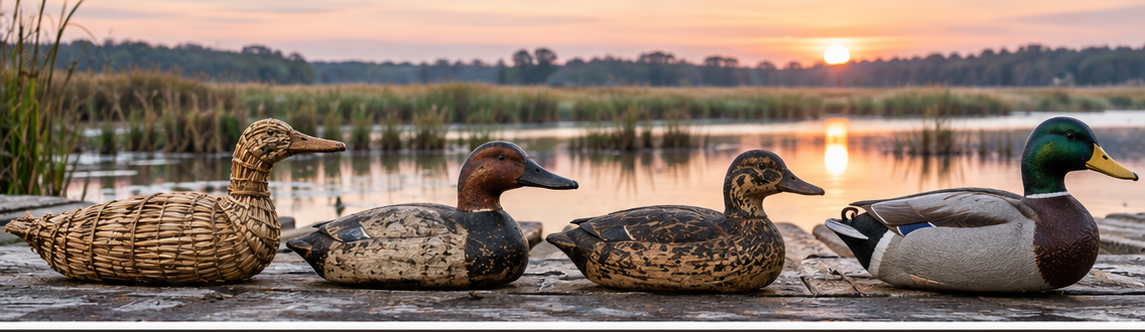

Wrap-Up-Functional Art on the Water

A good waterfowl decoy has always lived between two worlds.

It is an imitation of a bird, but it was never created simply to look like one. It had to work within wind, water, distance, light, and the behavior of living waterfowl. Its shape needed to be recognizable from above. The body had to sit naturally on the water. Its construction needed to survive transportation, cold mornings, wet boats, anchor lines, and repeated seasons of use.

That combination of appearance and purpose is what makes the decoy such an interesting object to collect.

Across this series, we have followed the waterfowl decoy from ancient woven hunting tools through nineteenth-century working birds, factory production, decorative carving, and modern collecting. What emerges is not simply a history of duck-shaped objects.

It is a history of people solving the same problem again and again with different materials, different tools, and different ideas about what a decoy could become.

Continue reading “Wrap-Up-Functional Art on the Water”
Collecting and Preservation

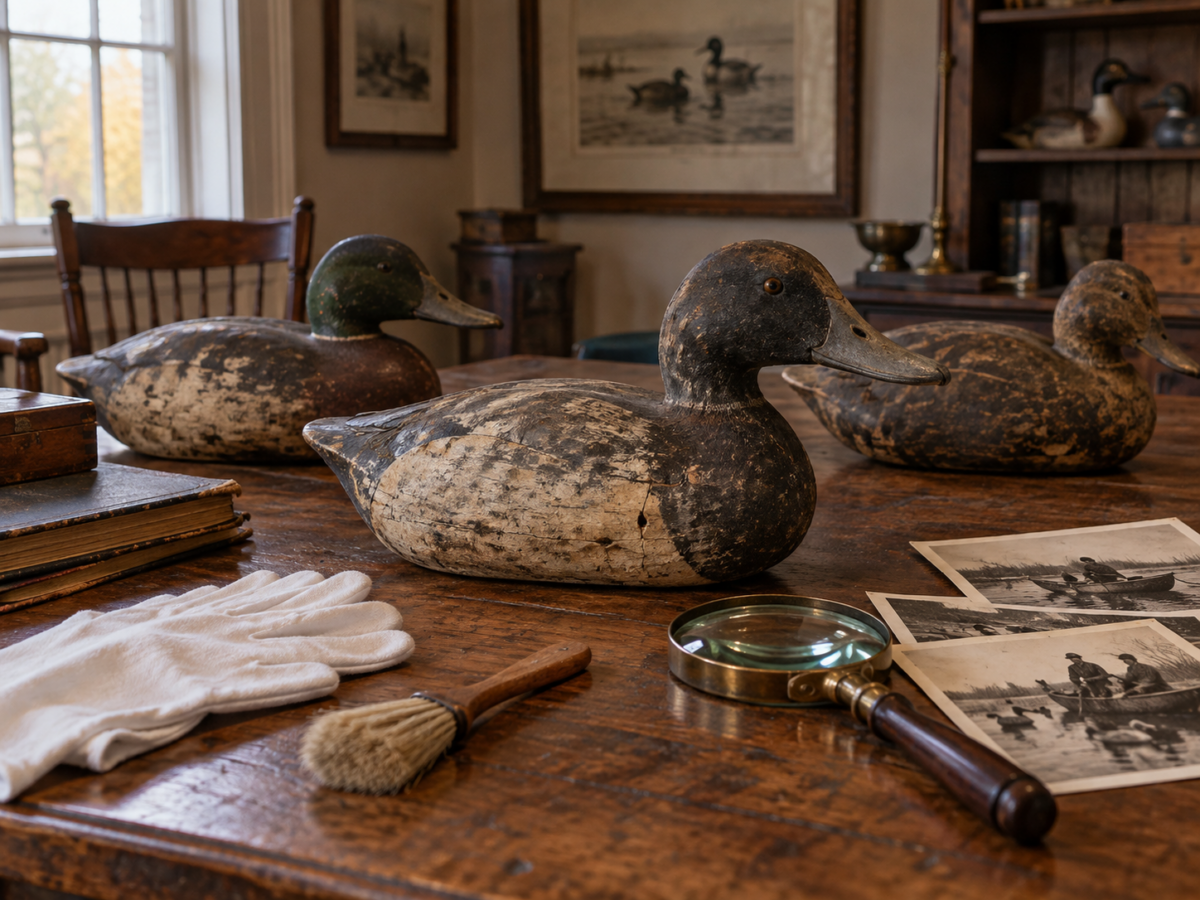
A waterfowl decoy can carry several histories at once.

There is the history of the bird it represents, the person or factory that made it, the region where it was used, and the hunting tradition to which it belonged. Then there is the history written directly onto the object: worn paint, repaired bills, anchor-line grooves, scratches from boats, replacement hardware, and perhaps a name or rig number added by a hunter generations ago.

For collectors, that history is often more important than perfection.

The challenge is learning to recognize what should be preserved, what may have been altered later, and when an attempt to “improve” an old decoy might actually erase some of the very evidence that makes it interesting.

Continue reading “Collecting and Preservation”

Decorative and Modern Decoys

For centuries, the waterfowl decoy existed because it had a job to do.

Whether woven from tule, carved individually by a hunter, or produced by a factory, the bird was ultimately judged by what happened when it was placed on the water. Did it float properly? Did its shape look convincing from above? Would real ducks or geese come closer?

During the twentieth century, that question began to change.

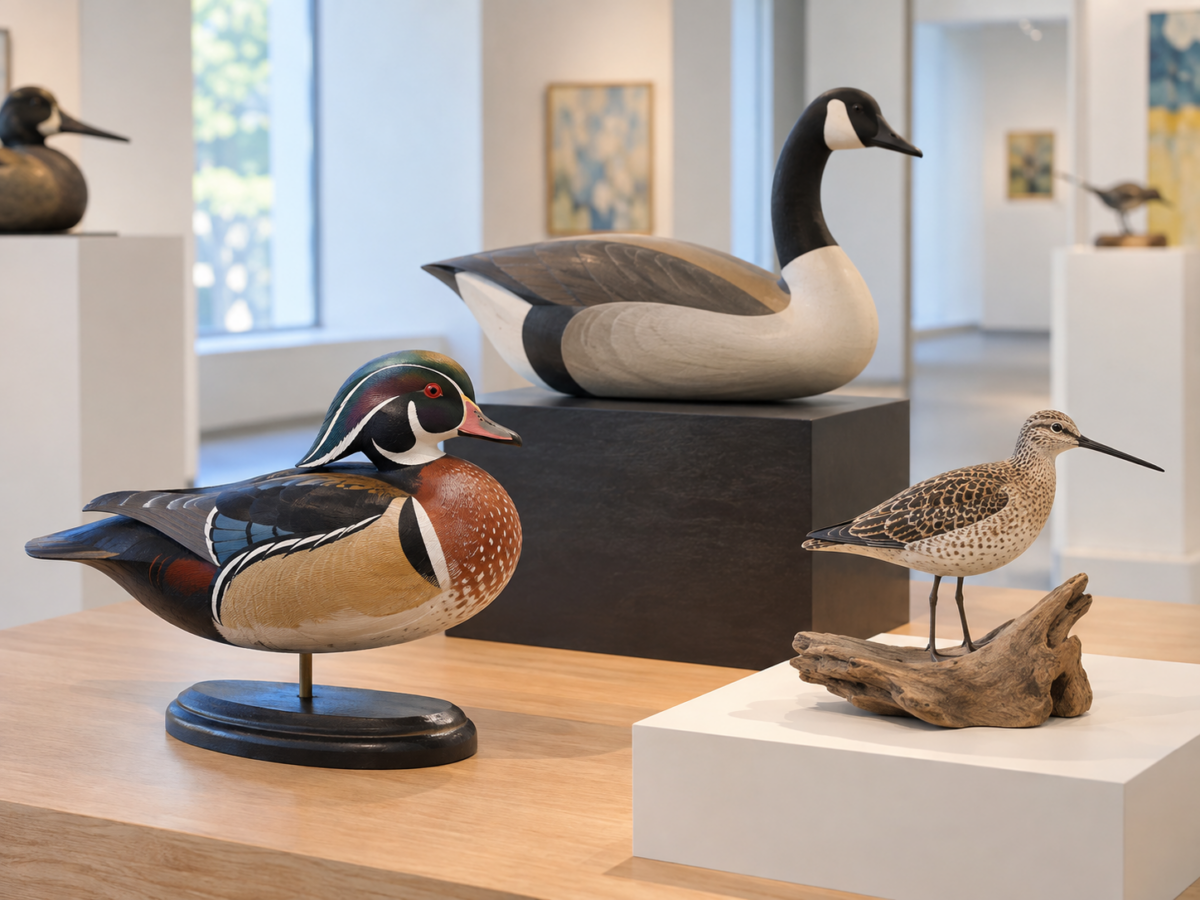
As hunting practices, conservation laws, manufacturing, and collecting evolved, decoy carving increasingly moved beyond the marsh. Some carvers continued making practical hunting rigs, but others pursued greater realism, elaborate feather detail, dramatic poses, and increasingly ambitious sculpture.

The working decoy had become the starting point for a new kind of American art.

Continue reading “Decorative and Modern Decoys”

Factory-Made Vs Hand-Carved

A weathered wooden duck sitting on an antiques table may look straightforward enough. It has a carved body, painted feathers, and the unmistakable shape of a working waterfowl decoy.

But how was it actually made?

By the late nineteenth and early twentieth centuries, American hunters could obtain decoys in two very different ways. Some birds were carved individually by hunters, guides, fishermen, craftsmen, or professional carvers. Others came from factories capable of producing dozens, hundreds, or eventually thousands of remarkably similar birds.

That distinction matters to collectors, but it is not as simple as “handmade is good, factory-made is ordinary.” Factory decoys have their own history, recognizable makers, construction techniques, grades, paint patterns, and collecting traditions. In fact, the line between factory production and hand craftsmanship can sometimes be surprisingly blurry.

Continue reading “Factory-Made Vs Hand-Carved”

19th-Century American Working Decoys

By the nineteenth century, the waterfowl decoy had become something both familiar and intensely practical along America’s rivers, bays, marshes, and coastlines.

The basic idea was ancient, as the previous post in this series explored. What changed during the nineteenth century was the scale of use, the growing importance of carved wooden decoys, and the emergence of regional traditions shaped by local birds, local waters, and the working habits of the people who hunted them.

These were not decorative carvings. They were equipment.

A good decoy had to float correctly, survive rough handling, resemble the right species from a distance, and remain useful after repeated exposure to cold water, mud, boats, and weather. Many of the objects now admired as American folk art began their lives being tossed into skiffs, rigged with weights, repainted when necessary, and put back to work season after season.

Continue reading “19th-Century American Working Decoys”

The Orgins of Waterfowl Decoys

Long before a carved wooden duck became something displayed on a mantel or admired at an antiques show, a decoy was a working tool.

Its purpose was practical: convince living waterfowl that a particular stretch of water was safe enough to approach. Doing that successfully required an understanding of birds, wetlands, available materials, and hunting behavior. Some of the oldest surviving North American waterfowl decoys show that this knowledge reaches back roughly two thousand years—and probably much farther.

They also challenge the image many collectors have of what a decoy is supposed to look like. The ancestors of the familiar painted wooden duck were not necessarily carved from wood at all. Some were woven from the plants growing in the same marshes where they were used.

Continue reading “The Orgins of Waterfowl Decoys”

©2025 Dear June Collectibles. All Rights Reserved.

Oh hi there 👋
It’s nice to meet you.

Sign up to receive awesome content in your inbox, every Friday morning.

(If you register as a user, you can comment on posts AND subscribe to the newsletter...two birds one stone)

We don’t spam! Read our Privacy Policy for more info.