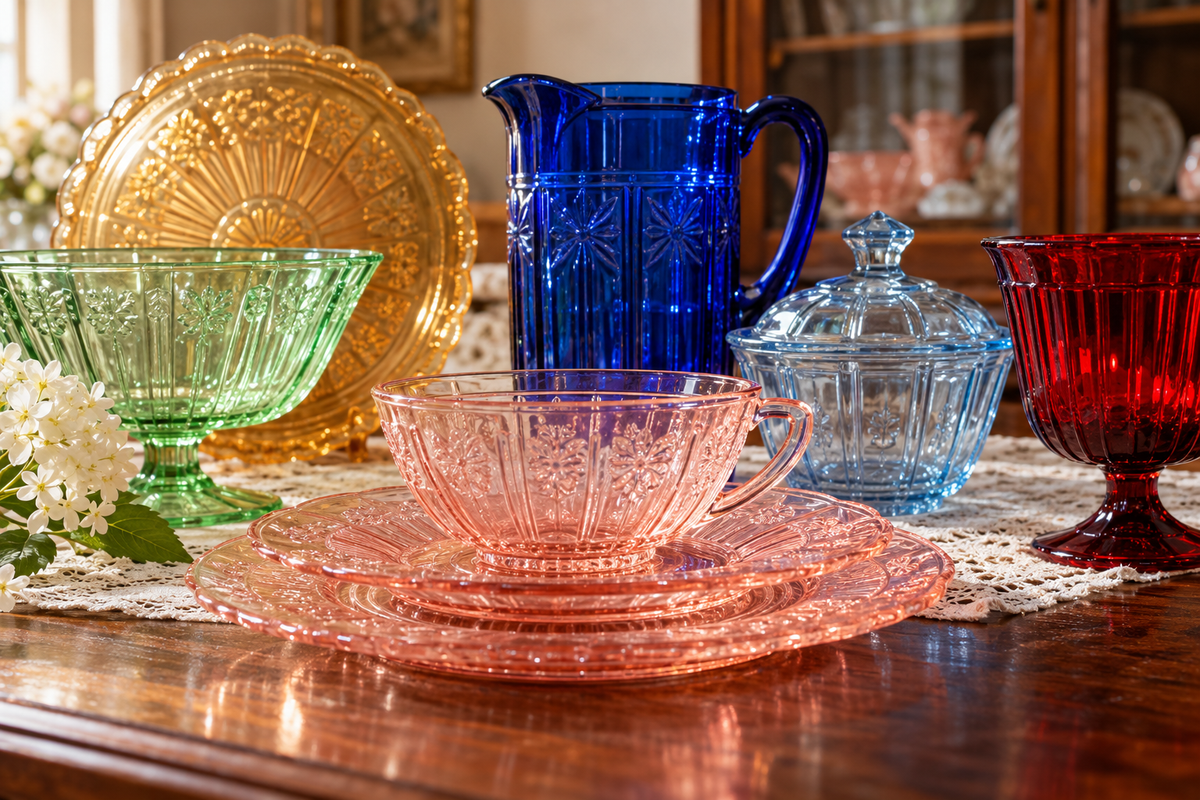
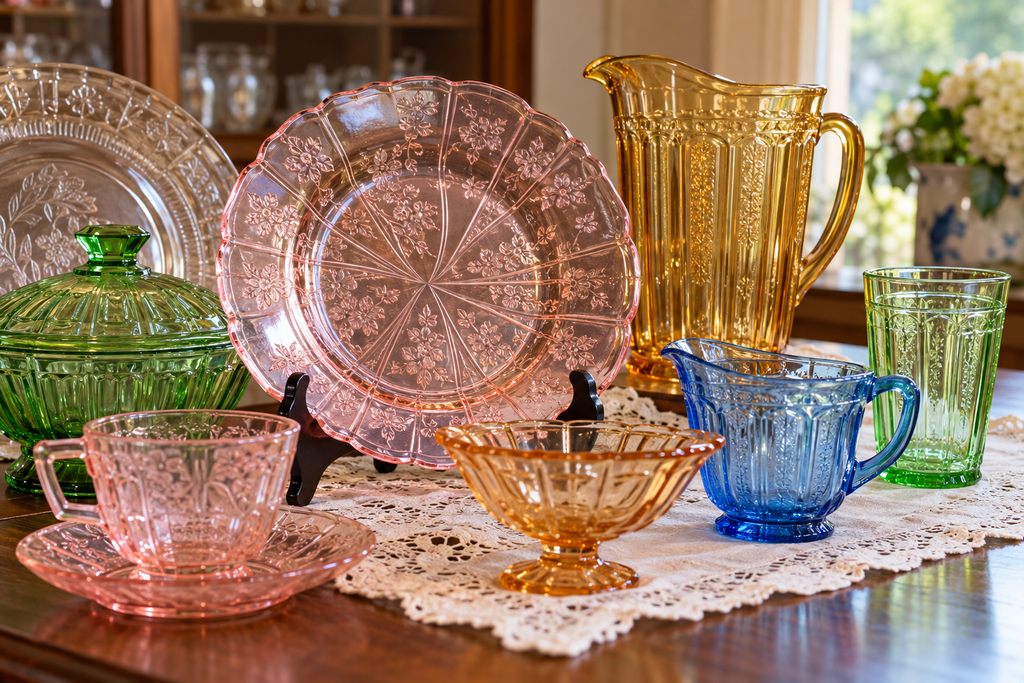
Depression glass colors are often the first thing collectors notice. A pale pink plate catches the light differently from a green tumbler. Amber can give an ordinary serving dish a warm, autumnal look, while cobalt blue or ruby red can stop someone in their tracks from across an antique shop.
Color is also one of the first things people use when trying to judge rarity. That is where collecting gets more complicated. A striking color is not automatically scarce, and a familiar color is not necessarily common in every pattern or piece. With Depression glass, scarcity usually comes from a combination of color, pattern, form, production history, survival, and condition rather than color alone.
Depression Glass Colors Were Part of the Appeal
Depression glass was machine-made tableware produced in enormous quantities during the late 1920s and 1930s, with some lines extending into the early 1940s and beyond. Its affordability was part of its success, but so was its appearance. Manufacturers offered household glassware in colors that could brighten a table without the expense of fine crystal.
Pink and green became particularly recognizable, but the palette was much broader. Period Depression glass appeared in crystal, amber, yellow, pale and darker blues, cobalt, ruby, amethyst, black, opaque white, jadeite, Delphite, and other shades. The National Depression Glass Association documents an extensive range of colors across dozens of major patterns produced during the Depression-glass era.
That variety was not random. Manufacturers could use color to differentiate patterns, refresh product lines, or appeal to changing tastes. The result is one reason Depression glass remains so visually interesting today: two pieces made for essentially the same purpose can feel completely different simply because of their color.
Collectors interested in exploring which colors were documented for particular patterns can consult the National Depression Glass Association’s major Depression glass pattern table.
Common Does Not Mean Uninteresting
Because Depression glass was made for the mass market, many surviving pieces are not rare.
That is not a flaw.
Pink, green, crystal, amber, and yellow appear repeatedly across Depression-era patterns. Hocking’s Mayfair, for example, was produced in several colors, while its Princess pattern also appeared in multiple shades. Jeannette, Federal, Hazel-Atlas, Indiana, and other manufacturers likewise produced patterns in different combinations of colors.
A common green plate may still be an attractive collectible. It might complete a dinner service, represent a favorite manufacturer, or simply look beautiful in a cabinet.
Collecting becomes much less satisfying when every object has to justify itself by being “rare.”
Some of the most appealing Depression glass collections are built around readily obtainable pieces because those pieces allow the collector to show an entire pattern, assemble place settings, or create a display based on color.
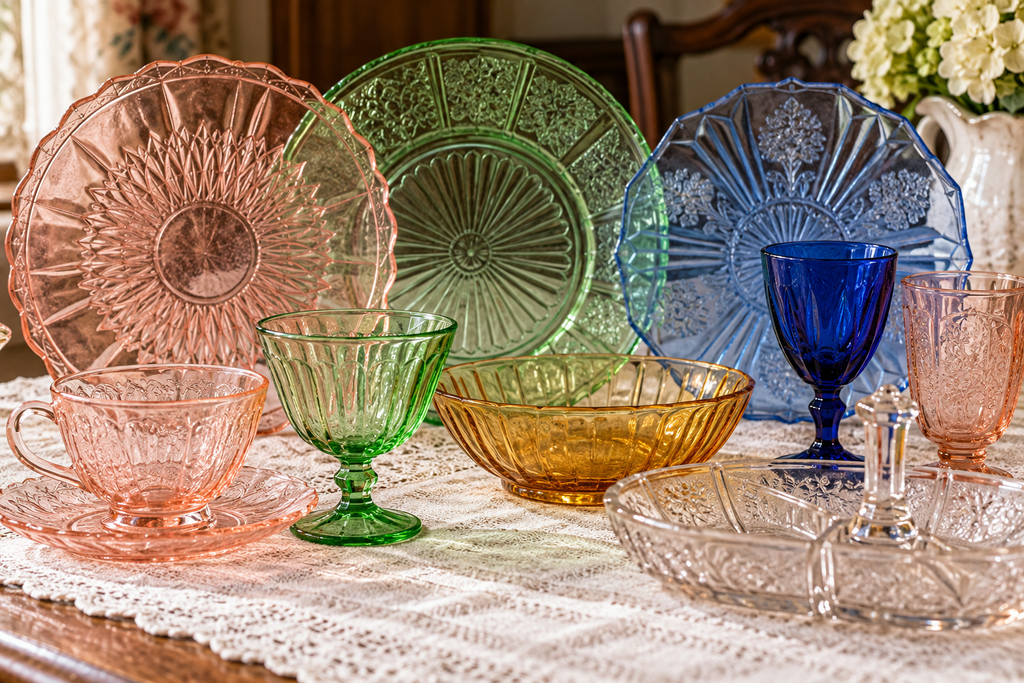
How Depression Glass Colors Affect Scarcity
Color matters most when it is considered within a specific pattern.
Take Cherry Blossom by Jeannette Glass Company. The National Depression Glass Association records the pattern as being produced from 1930 through 1939 in seven colors. Hocking’s Mayfair was made in five colors, while Princess was made in four. Hazel-Atlas Royal Lace was also produced in five documented colors.
Those records tell us something important, but they do not tell us everything.
Knowing that a pattern existed in several colors does not mean equal quantities were produced in every color. Nor does it mean that every piece in the pattern was made in every documented color.
That distinction creates many of the combinations collectors pursue.
A dinner plate may be easy to find in one color and frustratingly difficult in another. A cup might appear regularly while the matching pitcher seems almost nonexistent. A pattern that looks plentiful when viewed as a whole can contain individual pieces or color combinations that are surprisingly elusive.
That is why experienced collectors usually ask a more specific question than, “Is blue Depression glass rare?”
The better question is, “How difficult is this exact piece, in this exact pattern, in this exact color?”
Rare Color Is Not a Universal Label
Certain Depression glass colors attract attention because they appear less frequently across the collecting field.
Cobalt, ruby, amethyst, black, Delphite, jadeite, and some other colors can be much less familiar than the pink and green glass most people associate with the era.
But even here, the word rare needs caution.
Royal Ruby, for example, was an entire Hocking line produced in ruby-colored glass beginning in the late 1930s, with production continuing beyond the core Depression years. A piece being red therefore does not automatically make it scarce. Likewise, cobalt appears in several documented patterns from different manufacturers.
The same principle applies to opaque colors.
Jeannette produced some patterns in Delphite, an opaque blue, and jadeite, an opaque green. Those colors may stand out dramatically beside transparent pink or green glass, but their collectibility still depends on identifying the manufacturer, pattern, and exact piece.
Color can point you toward something unusual.
It cannot finish the identification for you.
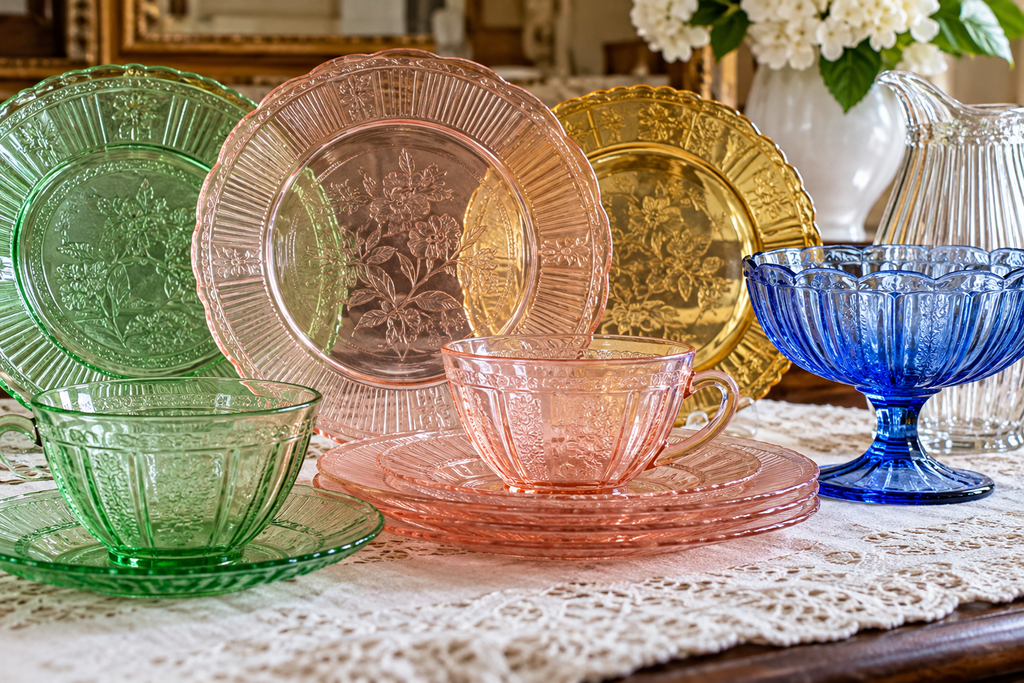
Piece Type Can Matter as Much as Color
Scarcity also depends on what the object actually is.
A pattern might have included dozens of forms: dinner plates, luncheon plates, cups, saucers, bowls, tumblers, pitchers, creamers, sugar bowls, serving platters, covered dishes, candlesticks, salt and pepper shakers, and specialty serving pieces.
They did not necessarily survive in equal numbers.
Some forms may have been produced in smaller quantities. Others were particularly vulnerable to damage. Lids became separated from bases. Handles broke. Large serving pieces were chipped. Small components disappeared into kitchen drawers or were discarded when their companions broke.
That means a relatively ordinary color can sometimes become desirable when paired with a difficult form.
For anyone assembling a complete pattern, the inexpensive plates may be the easy part.
The hunt often begins when the collector starts looking for the pieces that originally sat in the center of the table rather than at every place setting.
Condition Changes the Equation
Scarcity does not erase condition.
Depression glass was inexpensive machine-made glass, and manufacturing irregularities can be part of its character. The National Depression Glass Association notes that bubbles, inclusions, straw marks, slight irregularities, and variations in color can occur in authentic Depression glass and should not automatically be treated like later damage. Chips and cracks are another matter and can significantly reduce desirability.
Collectors therefore need to distinguish between manufacturing characteristics and damage acquired during decades of use.
A tiny bubble inside the glass may be completely normal.
A fresh chip on the rim is not.
Condition becomes especially important with scarce pieces because rarity can tempt buyers to overlook serious problems. Sometimes that makes sense. A collector may reasonably accept a minor flaw in something nearly impossible to replace.
But rarity should not make damage invisible.
Reproductions Complicate Scarcity
There is another reason color alone cannot establish rarity: some Depression glass patterns have been reproduced, while others were produced again after the Depression era by the original manufacturer or a successor company.
The National Depression Glass Association specifically flags patterns for which reproductions are known and distinguishes those from patterns that were produced again after 1940. Among the well-known names affected are Mayfair, Princess, Cherry Blossom, Royal Lace, and several others.
That does not mean every piece encountered in those patterns is suspect.
It means identification should consider more than pattern recognition.
Color, mold details, measurements, weight, finish, construction, and documented production history may all become important when distinguishing an original Depression-era example from later production.
A supposedly “rare color” becomes much less exciting if that particular version was made decades later.
How to Judge Scarcity Before You Buy
When an unusual piece of Depression glass turns up, a systematic approach is more useful than relying on color alone:
- Identify the pattern and manufacturer first. Similar colors were used by many companies.
- Confirm that the color is documented for that pattern. An unexpected color may be rare, later production, a reproduction, or simply a mistaken identification.
- Identify the exact form. Scarcity often belongs to a particular piece rather than the entire pattern.
- Check production history and known reproductions. Later issues can resemble Depression-era originals closely.
- Compare actual availability, not just asking prices. A seller can ask almost anything. Repeated appearances—or the lack of them—tell you more about practical scarcity.
This approach also helps sellers.
Calling every cobalt, red, or unusual-looking piece “rare” may attract attention, but accurate identification builds far more credibility. Sometimes the strongest description is simply what the evidence supports: a documented pattern, correct color, correct manufacturer, and honest condition.
Collect the Color, Learn the Story
Color remains one of the great pleasures of Depression glass.
A cabinet filled with pink glass can feel delicate and almost weightless. Green glass can evoke the optimistic color palettes of early twentieth-century kitchens. Amber feels warm and practical. Cobalt and ruby create dramatic contrast that seems surprisingly modern.
Those visual qualities are worth appreciating even when a piece is not scarce.
The deeper collecting story begins when color leads to questions.
Who made it?
Which pattern is it?
What other colors existed?
Was this form part of a large dinner service or a short-lived specialty line?
Why does one version appear everywhere while another almost never surfaces?
Those questions turn a colorful old dish into evidence of manufacturing, marketing, domestic life, and changing taste.
For a broader look at how Depression-era glass fits into the longer story of twentieth-century decorative glass, Dear June’s Mid-Century Marvels – Blenko, Fenton, and Scandinavian Designs follows the transition from Depression-era production into the bold glass designs of the postwar period.
The rarest piece on the shelf may deserve special attention.
But sometimes the common pink plate beside it tells just as much history.
Let’s Make History—one colorful piece at a time.
Discover more from Dear June Collectibles
Subscribe to get the latest posts sent to your email.