
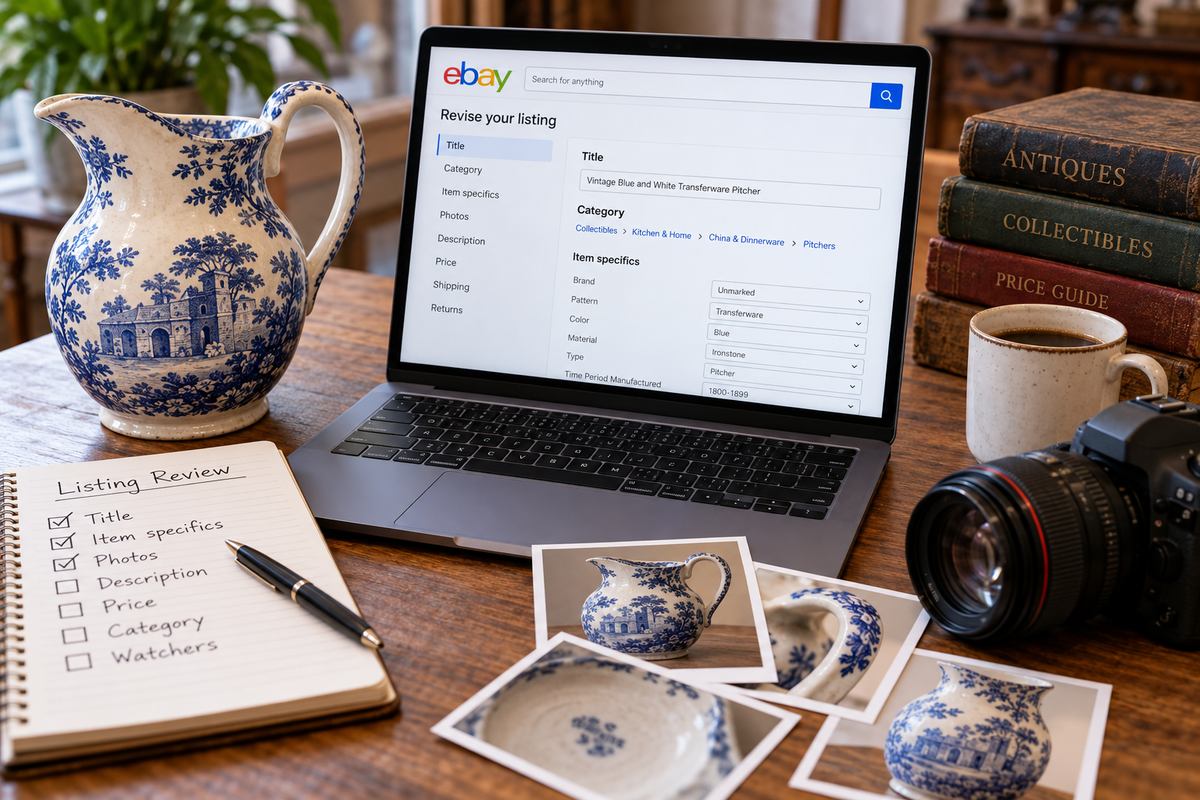
An old eBay listing can become strangely invisible to the seller.
You created it months or years ago. The item is still sitting safely in inventory. The listing renews automatically. Maybe it gets an occasional view or watcher, but nobody buys it. Eventually you realize you have been carrying the same merchandise—and the same listing—for far longer than you intended.
At that point, should you revise an old eBay listing, or should you end it and build a fresh listing?
There is no universal answer. Sometimes a few targeted changes are all a listing needs. Other times the original listing has accumulated so many problems that continuing to edit it is more work than starting over.
The important thing is to diagnose the problem before deciding what to do.
First, Separate an Old Listing From a Bad Listing
Age alone is not a reason to destroy a listing.
Some merchandise simply has a long selling cycle. Rare antiques, unusual replacement pieces, specialized books, obscure memorabilia, discontinued parts, and niche collectibles may need months or even years to meet the right buyer.
That is especially true when there are very few comparable examples available.
A listing that has been active for two years is therefore not automatically defective.
The better question is:
Has the listing remained competitive and accurate during those two years?
Markets move. Prices change. Buyers search differently. eBay adds or modifies item specifics. Better comparable sales become available. Sellers improve photography. What looked like a perfectly acceptable listing when it was created may no longer compete effectively.
As discussed in Dear June’s earlier look at the inventory trap created by thousands of unproductive listings, active inventory should not simply become forgotten inventory.
An old listing deserves periodic review.
That does not necessarily mean it deserves replacement.
Revise the Listing When the Foundation Is Still Good
Revising usually makes sense when the item itself is still appropriately positioned and the problems are limited.
Perhaps the price was reasonable when you originally listed the item but the market has softened. Maybe the title leaves out an important search term. The photographs are usable but the first image is not your strongest one. Several recommended item specifics are blank. The description could be clearer.
Those are repairable problems.
eBay allows sellers to revise most fixed-price listings, although specific restrictions can apply depending on the listing format and activity. According to eBay’s current seller guidance, sellers can generally change elements such as price and listing information without ending the fixed-price listing.
A revision is particularly attractive when you can identify a specific weakness.
For example:
- the price is 25 percent above recent comparable sales;
- an important maker or model number is absent from the title;
- the item is in the wrong category;
- recommended item specifics have never been completed;
- the description does not mention measurements buyers need;
- or stronger existing photographs can be reordered.
These are focused corrections.
They do not require rebuilding the entire listing.
Item Specifics Are Worth Revisiting
One of the easiest things to overlook in an older listing is structured information.
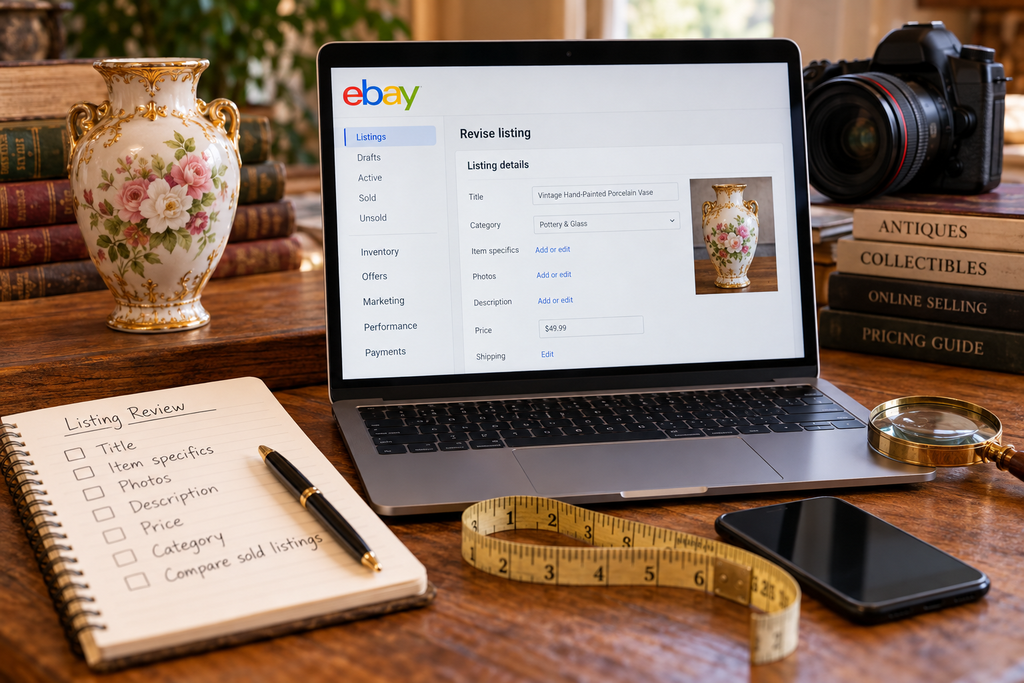
eBay emphasizes that item specifics help its system match merchandise with buyers and allow shoppers to narrow results using filters. A listing without the relevant brand, type, size, material, color, pattern, model, style, or other category-specific information may miss buyers who use those filters.
This matters particularly with listings created years ago.
The item-specific fields available today may not be identical to those available when you first listed the merchandise. Some fields may now be required, while others are recommended because buyers frequently search for them.
Before ending an old listing, check whether it simply needs better data.
The same applies to the title.
An old title may be technically accurate while wasting valuable space on words few buyers search for. A better title identifies the object clearly and includes useful attributes such as maker, pattern, material, model, era, size, or other distinguishing details when appropriate.
If those changes solve the real problem, revising is the efficient choice.
When Starting Over Makes More Sense
There comes a point when you are no longer revising a listing.
You are reconstructing it.
Suppose you open a five-year-old listing and discover all of the following:
The title is weak.
The price came from outdated research.
The category is questionable.
Most item specifics are missing.
The photographs are poorly lit.
There are only three photographs when the object really needs ten.
The description was written before you knew much about the item.
The dimensions are incomplete.
Condition problems are not shown clearly.
You have since identified the maker correctly.
At that point, preserving the old listing simply because it already exists may not save much time.
Starting over can force you to examine the merchandise as though it just entered inventory.
Take it back out.
Confirm the identification.
Check current sold-market evidence.
Measure it again.
Inspect the condition.
Photograph the important details.
Then build the listing around what you now know rather than continuing to patch decisions you made years earlier.
That process is more labor-intensive, but it can be worthwhile for merchandise valuable enough to justify the work.
New Photographs Can Be the Deciding Factor
Photos are one of the clearest reasons to reconsider an old listing.
Photography standards improve as a reseller gains experience. Equipment changes. Lighting improves. Backgrounds become cleaner. You learn which details buyers actually want to see.
eBay currently allows as many as 24 photographs in a listing and recommends making the first image a strong, clear view of the item. It also advises sellers to photograph wear, labels, marks, textures, and other relevant details.
If your original listing has one distant photograph, one dark photograph, and a blurry picture of the maker’s mark, adjusting the price may not address the real problem.
The merchandise itself may need to come back through the photography process.

Do Not End Listings Just to Chase a Supposed Algorithm Reset
There is a persistent reseller belief that an aging listing becomes permanently buried and must periodically be ended and recreated to make eBay treat it as fresh merchandise.
Be careful with that assumption.
Sellers certainly discuss strategies involving ending listings, relisting, or using Sell Similar, but eBay’s published explanation of Best Match does not say that simply destroying an old listing and recreating it guarantees improved placement.
Instead, eBay says Best Match considers multiple factors, including how closely the listing matches the buyer’s search, price, listing quality and completeness, service terms, item popularity, and seller performance.
That means starting over should have a purpose.
If you create a new listing with the same price, same photographs, same title, same missing item specifics, and same weak description, you have not actually solved anything.
You have simply recreated the problem.
A fresh listing is most useful when the fresh start accompanies meaningful improvements.
Watchers Complicate the Decision
Watchers are another reason not to end a listing reflexively.
A stale listing with no watchers, negligible traffic, weak presentation, and outdated pricing presents a fairly easy case for major intervention.
A listing with multiple watchers deserves more thought.
Those watchers represent some degree of buyer interest, although they do not guarantee that anyone intends to purchase. Ending the listing means you should not assume that interest automatically follows whatever replacement listing you create.
Before starting over, consider whether a price adjustment, offer, revised title, better specifics, or other targeted change might convert existing interest.
The presence of watchers should not trap you in a bad listing forever.
It should simply become one factor in the decision.
Use a Three-Level Review
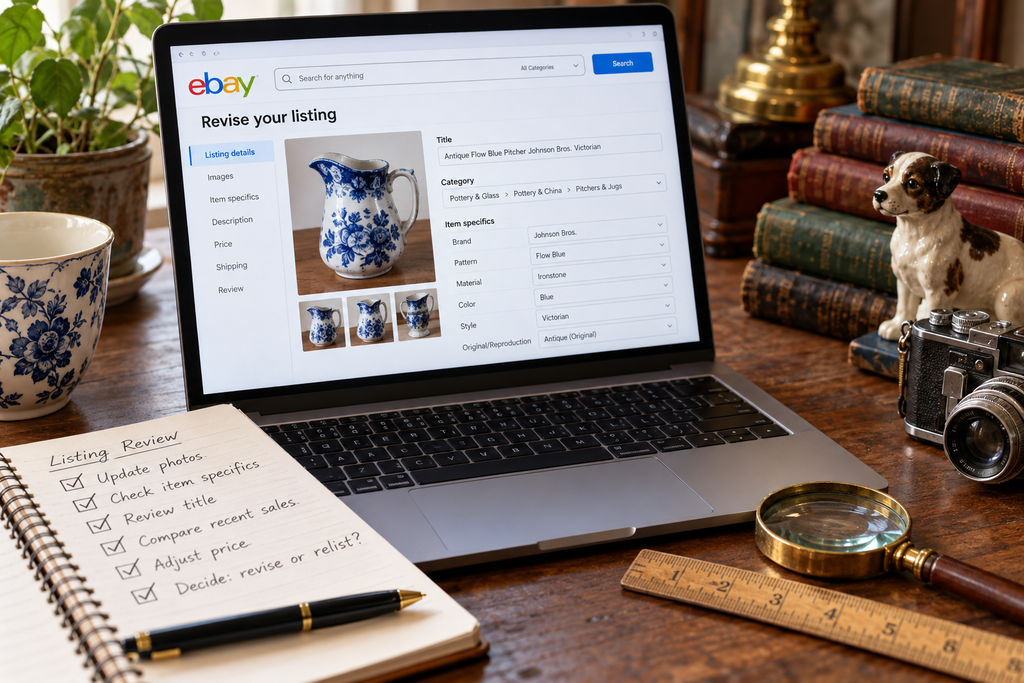
When I review older inventory, I find it helpful to divide stale listings into three groups.
Level One: Leave It Alone
The listing is accurate, competitive, complete, professionally photographed, and appropriately priced.
The merchandise simply has a limited audience.
This is often where genuinely uncommon collectibles and specialized long-tail inventory belong.
Patience may be the correct strategy.
Level Two: Revise It
The listing is basically sound, but current research identifies specific improvements.
Change the price.
Strengthen the title.
Complete item specifics.
Improve the description.
Reorder photographs.
Correct the category.
These are listings worth repairing.
Level Three: Rebuild It
The original listing no longer represents the quality of work you would create today.
Identification needs reconsideration, photos need replacing, pricing needs new research, condition needs rechecking, or multiple major fields are weak.
That item should return to the beginning of the listing process.
Your Time Still Has to Justify the Work
There is one final question that matters more than whether revising or starting over would technically produce the better listing:
Is the item worth the labor?
A $200 collectible may easily justify twenty minutes of additional research and a complete new set of photographs.
A common $12 household item may not.
This connects directly with the question explored in What Is Actually Worth Listing on eBay? A Reseller’s Guide to Time, Profit, and Sell-Through.
Sometimes the correct answer is neither “revise” nor “rebuild.”
It may be to lower the price and move it.
Lot it with related merchandise.
Transfer it to a local sales venue.
Donate it.
Or otherwise remove it from the online inventory system.
Resellers can spend enormous amounts of time perfecting low-value inventory simply because the listing already exists. That labor is not free.
Make the Listing Earn Its Place
The goal is not to keep every eBay listing alive indefinitely.
It is also not to continually end perfectly serviceable listings because they have reached an arbitrary age.
Review what the merchandise is doing.
Check current pricing.
Look at the photographs.
Read the title like a buyer.
Examine the item specifics.
Ask whether the description answers the questions a buyer would reasonably have.
Then decide how much intervention the listing actually deserves.
Some old listings need patience.
Some need maintenance.
Some need to be rebuilt from the ground up.
And some need to leave your inventory entirely.
Knowing the difference is part of managing an eBay store as a business rather than treating every active listing as permanent.
Let’s Make History—by giving old inventory a better chance to become a new sale.
Discover more from Dear June Collectibles
Subscribe to get the latest posts sent to your email.