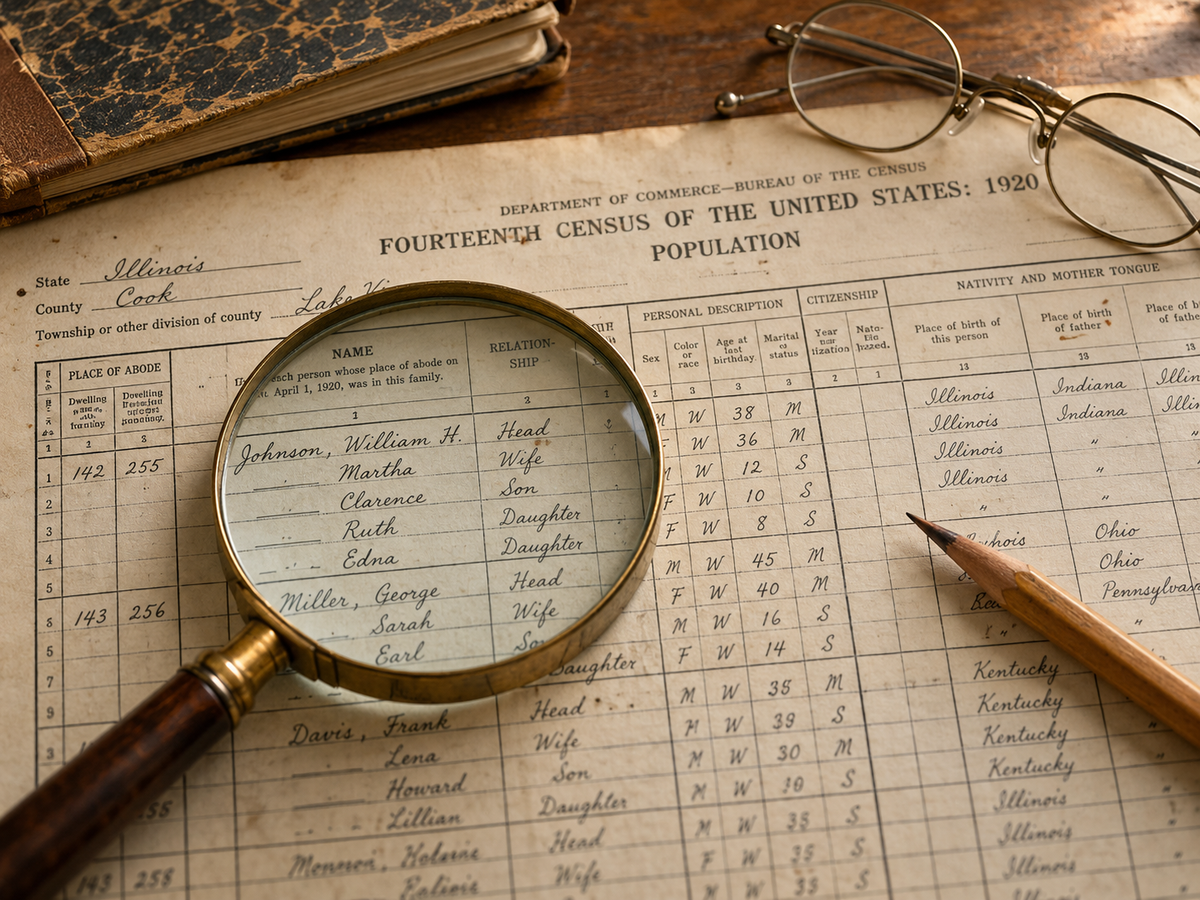
Few records are as useful to a family historian as a census. In a single page, you may find an entire household: names, ages, relationships, birthplaces, occupations, immigration information, property details, and even neighbors who later turn out to be relatives.
That makes census records extraordinarily powerful. It does not make them automatically correct.
One of the most important lessons when using census records for genealogy is to treat each entry as evidence to investigate rather than a finished biography. A census gives us a snapshot of a household at a particular moment. It can suggest where to look next, connect people across generations, and reveal changes in a family’s circumstances. But every fact still needs to be weighed against other records.
Why Census Records Are So Valuable to Genealogists
The United States has conducted a federal population census every ten years since 1790. The amount of information collected changed dramatically over time. Early censuses generally identified only the head of household by name and grouped other household members by categories. By 1850, the census recorded individual members of the free population by name, opening an entirely different level of genealogical research.
Later censuses added still more detail. The 1880 census recorded each person’s relationship to the head of the household. The 1900 census asked for month and year of birth, years married, children born and surviving, parents’ birthplaces, immigration information, occupation, and whether a home was owned or rented. Other census years asked somewhat different questions.
That means a census can provide far more than a name and approximate age.
It might suggest that an immigrant arrived around 1885, pointing you toward passenger lists and naturalization papers. An occupation could lead to city directories, labor records, newspapers, or company archives. A rented home in one census and an owned home in another might suggest that property records are worth investigating.
This is exactly how experienced researchers use census records: one clue leads to another record. The National Archives describes many of these possibilities in its guide to clues in census records from 1850–1950.
The mistake comes when we stop following those clues.
A Census Entry Can Be Wrong
It is tempting to look at a census sheet and think we are seeing facts recorded by the government.
What we are actually seeing is information collected from people.
The National Archives specifically cautions researchers that the accuracy of census information depends on the knowledge of the person who supplied it to the enumerator.
That distinction matters.
The person answering the enumerator’s questions may have been the person you are researching. It may have been a spouse, child, relative, landlord, or someone else who knew enough about the household to provide answers but did not necessarily know every detail accurately.
Then the enumerator had to hear the answer, interpret it, and write it down.
Later, someone may have indexed that handwritten entry so modern researchers could search for it online.
At every stage, another opportunity for error appeared.
A surname could be misspelled. An accent could be misunderstood. An age might be estimated. A birthplace could be simplified from a village or region into a country. A person answering for a parent might genuinely not know exactly when that parent was born.
Even perfectly legible census information may therefore conflict with another record.
That is not unusual. It is genealogy.
Read the Household, Not Just the Person
Finding your ancestor’s name should be the beginning of your census research, not the end.
Study everyone in the household.
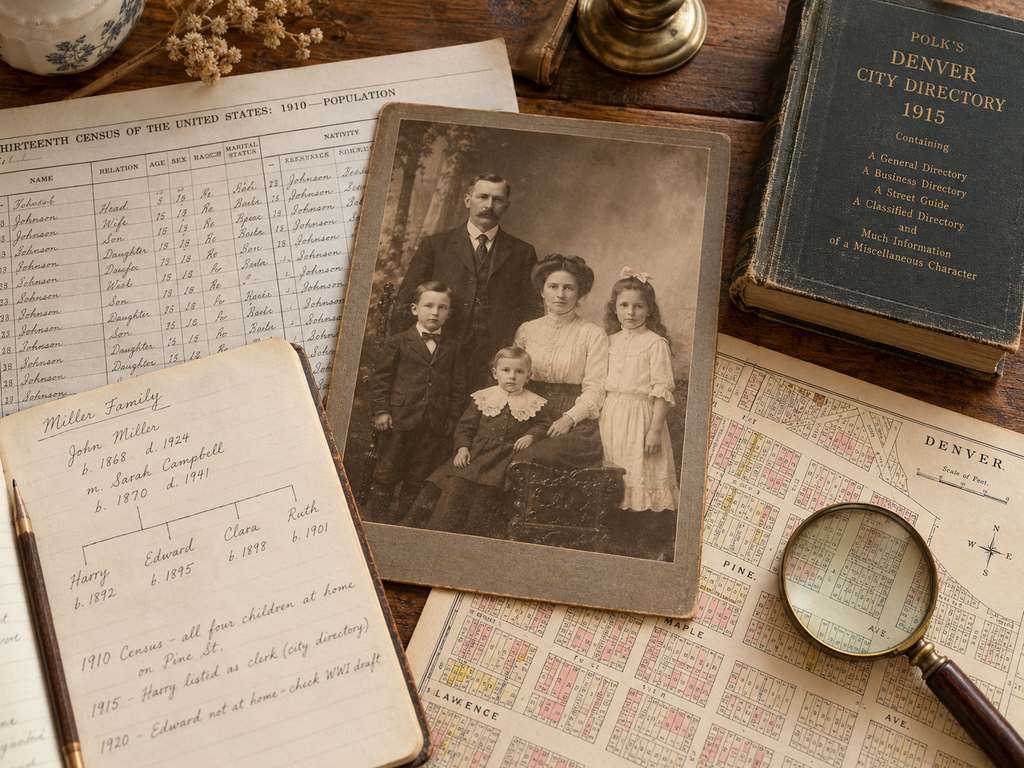
A widowed mother living with a married daughter can reveal the daughter’s maiden family. A nephew or cousin may provide the missing connection between two branches. Boarders with familiar surnames might be relatives rather than strangers. Children appearing for the first time help establish a family timeline.
Then look beyond the household.
Who lived next door?
Who lived several houses away?
Families frequently lived close to relatives, especially when they were farming, working in the same industry, newly arrived in a community, or moving together from one region to another. A mysterious neighbor can later become a brother, married sister, parent, in-law, or longtime family associate.
Addresses can matter, too. A street address may connect a family to city directories, maps, deeds, tax records, newspapers, or later census records.
Sometimes the most valuable information on the census is not the entry you originally searched for.
Using Census Records for Genealogy as a Roadmap
A productive way to work with census records is to separate what the document actually says from what you believe it means.
Suppose a census says a man is 37 years old.
That does not prove his birth date.
It gives you an approximate birth year based on the age reported for the official census date. The National Archives specifically recommends using census ages as clues for locating other records rather than treating them as exact birth information.
The same principle applies elsewhere.
Birthplace Is a Lead
If several censuses say an ancestor was born in Pennsylvania, that is meaningful evidence.
It still does not prove the exact town, county, or date of birth.
You may need birth or baptismal records, marriage records, military papers, obituaries, death certificates, probate files, or records belonging to siblings before you can identify the correct place.
Immigration Information Points Toward Other Records
The 1900 census, for example, asked foreign-born residents about the year they immigrated and their naturalization status.
Those answers can narrow a search tremendously.
But an immigration year written on a census should usually send you searching for passenger lists and naturalization records rather than become the final word on when the person arrived.
Relationships Need Context
A census relationship generally describes a person’s relationship to the head of the household.
That can create traps.
Someone listed as “mother” is the mother of the household head, not necessarily the mother of every person living there. A “daughter” may be the head’s daughter but the stepdaughter of the head’s spouse.
Always interpret the relationship column from the perspective the census intended.
What Happens When Two Censuses Disagree?
Sooner or later, they will.
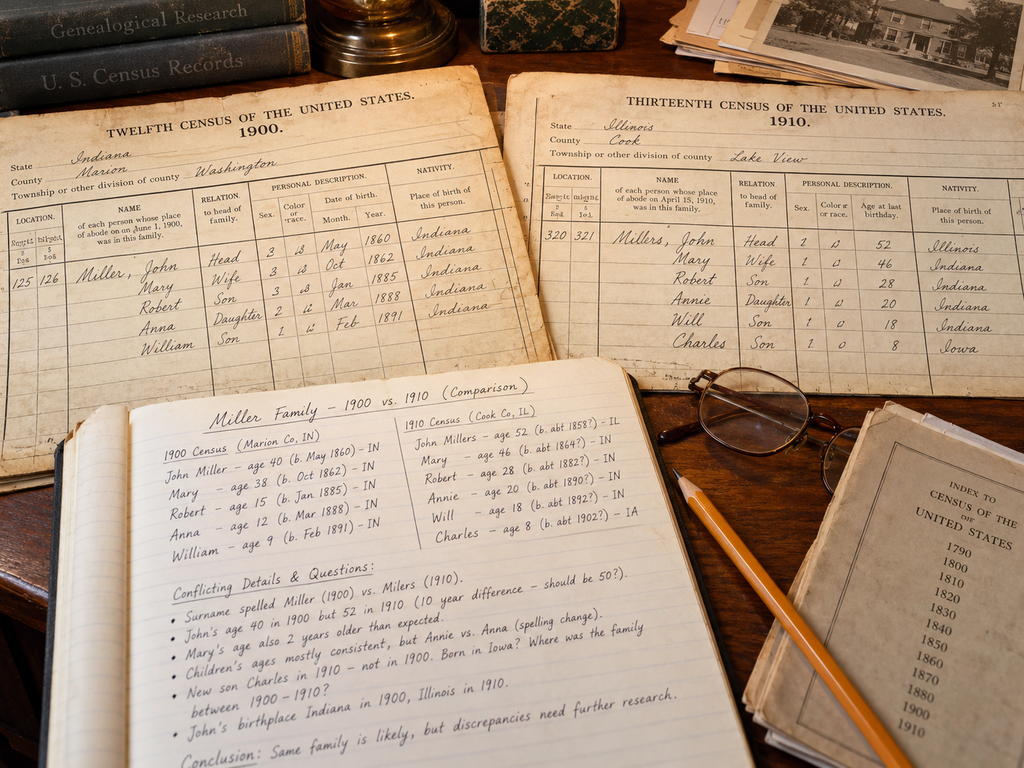
An ancestor might be 26 in one census and apparently 39 ten years later. A birthplace might change from New York to Pennsylvania. An immigration year may shift by five years. A surname may acquire an entirely different spelling.
Do not automatically choose the answer that appears most often.
Instead, ask why the information differs.
Compare the entire household. Look at spouses, children, occupations, addresses, neighbors, and other identifying details to make sure you are following the same person.
Then search for records closer to the event you are trying to establish.
If you need a birth date, a contemporary birth or baptismal record may carry more evidentiary weight than an age supplied decades later. If you need a marriage date, look for the marriage record rather than calculating it solely from the number of years married reported on a census.
Contradictions are not annoyances to be edited out of a family tree. They are research problems.
Sometimes resolving one of those problems is what proves you have found the right family.
Sometimes the Census Is Missing
There is another important danger: assuming that because you cannot find someone, the person was not there.
Names may have been badly indexed. Handwriting may be difficult to interpret. Families moved. People were temporarily absent. Enumerators could miss households.
And sometimes the records themselves did not survive.
The most famous example is the 1890 federal census. A 1921 fire and subsequent events resulted in the loss of most of the population schedules. Only fragments survive.
That missing twenty-year gap between the widely available 1880 and 1900 censuses can be frustrating, but it also demonstrates why genealogy cannot depend on one record type.
State censuses, city directories, tax lists, land records, newspapers, church registers, military records, probate files, school records, and other sources may help reconstruct what happened during the missing years. The Census Bureau notes that many states conducted their own censuses, sometimes between federal census years, and state or local archives may hold those records.
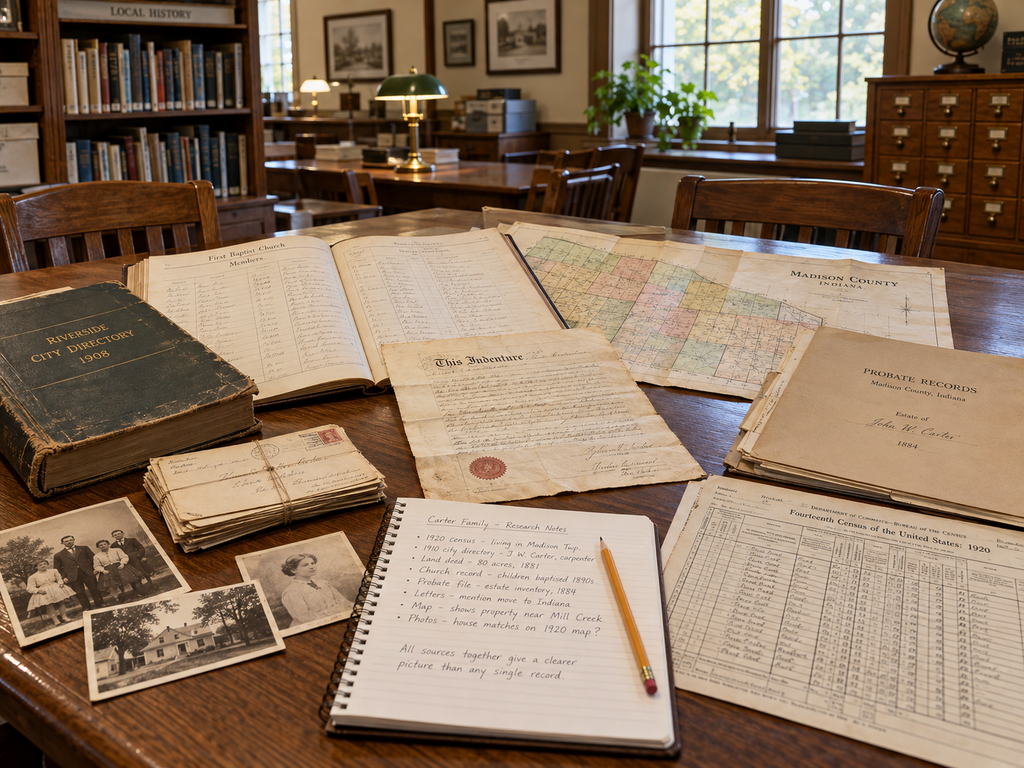
Build the Family From Evidence, Not From a Single Page
As of 2026, federal census schedules from 1790 through 1950 are publicly available for research. Individual census records remain confidential for 72 years, which means the 1960 census is scheduled for public release in April 2032.
Those surviving census pages represent one of the richest collections of family-history clues available to American researchers.
But that is what they are: clues.
A census can tell you where to search next. It can connect generations. It can reveal a previously unknown child, suggest an immigration period, identify an occupation, uncover a relative living nearby, or show that a family crossed three states in twenty years.
What it cannot do is replace the rest of the research.
That idea is central to the broader approach behind Dear June’s Family History Saturday: More Than Names and Dates. Family history becomes stronger when we move beyond collecting isolated names and dates and begin asking how the surviving records fit together.
So save the census record. Transcribe what it actually says. Compare it with earlier and later censuses. Follow the neighbors. Investigate the occupations, addresses, immigration information, and family relationships. Look for the records those clues suggest.
And when two sources disagree, resist the temptation to make the inconvenient one disappear.
That disagreement may be where the real research begins.
Let’s Make History—one census clue at a time, and one conclusion only after the evidence supports it.
Discover more from Dear June Collectibles
Subscribe to get the latest posts sent to your email.