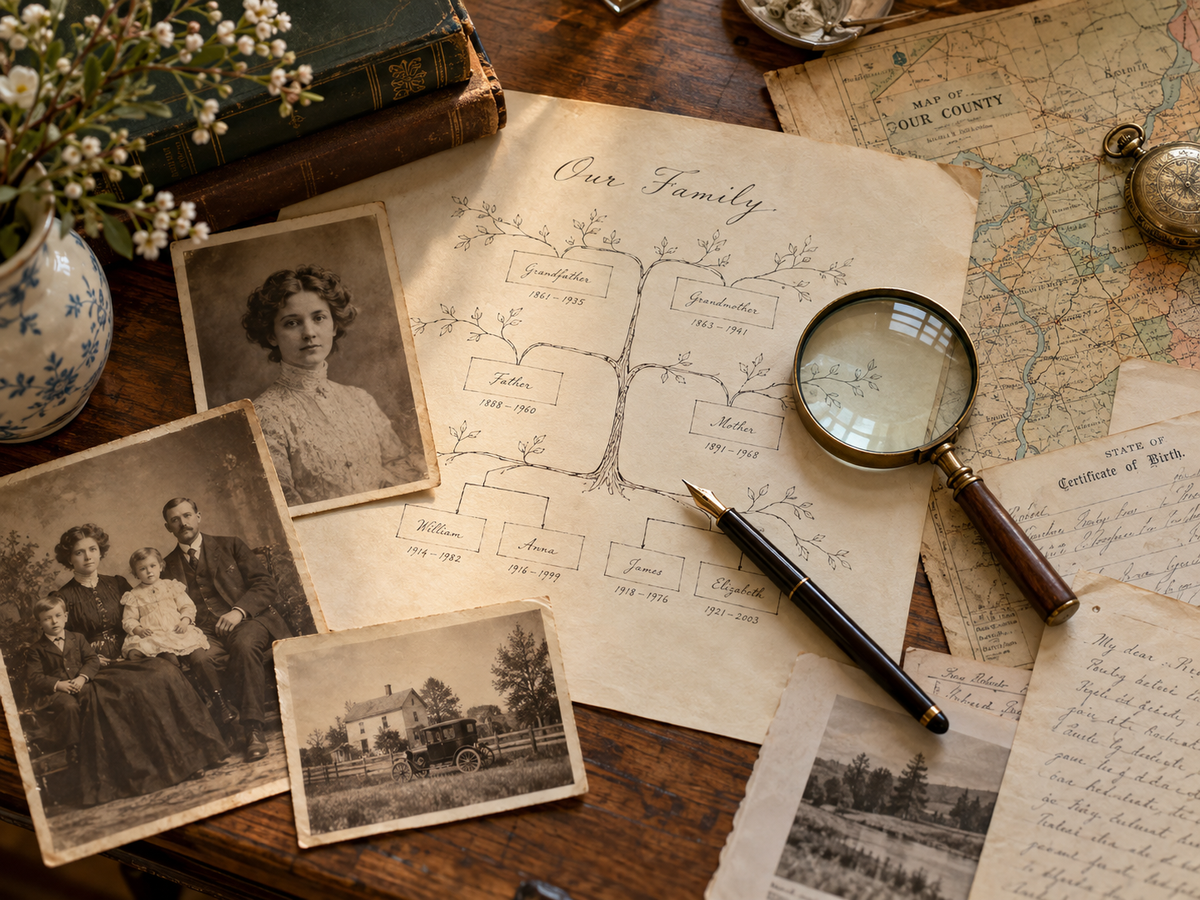
A family tree can begin with a remarkably simple framework: a name, a birth date, a marriage, a death, and a line connecting one generation to the next. Those facts matter. Without them, there is no structure.
But they are only the structure.
Family history becomes much more interesting when we begin asking what happened between those dates. Where did these people live? What work did they do? Why did a family leave one community for another? Who lived nearby? Which relatives remained close, and which disappeared from the record? What did military service, immigration, economic change, religion, property ownership, or a local event mean in the course of an ordinary life?
Those are the questions behind Family History Saturday, a new recurring Dear June Collectibles series devoted to genealogy, historical records, evidence, forgotten stories, and the work of reconstructing lives that survive only in scattered pieces of the historical record.
A Family Tree Is a Beginning, Not an Ending
Names and dates are essential to genealogy, but a chart alone can make a family seem much simpler than it really was.
An ancestor who appears on a family tree as “John Smith, 1848–1912” may have lived in three states, changed occupations twice, served in the military, lost a child, purchased a small piece of land, appeared in a local newspaper dispute, belonged to a church, and spent his final years living with an adult daughter.
None of those details necessarily changes the dates on the chart. All of them change how we understand the person.
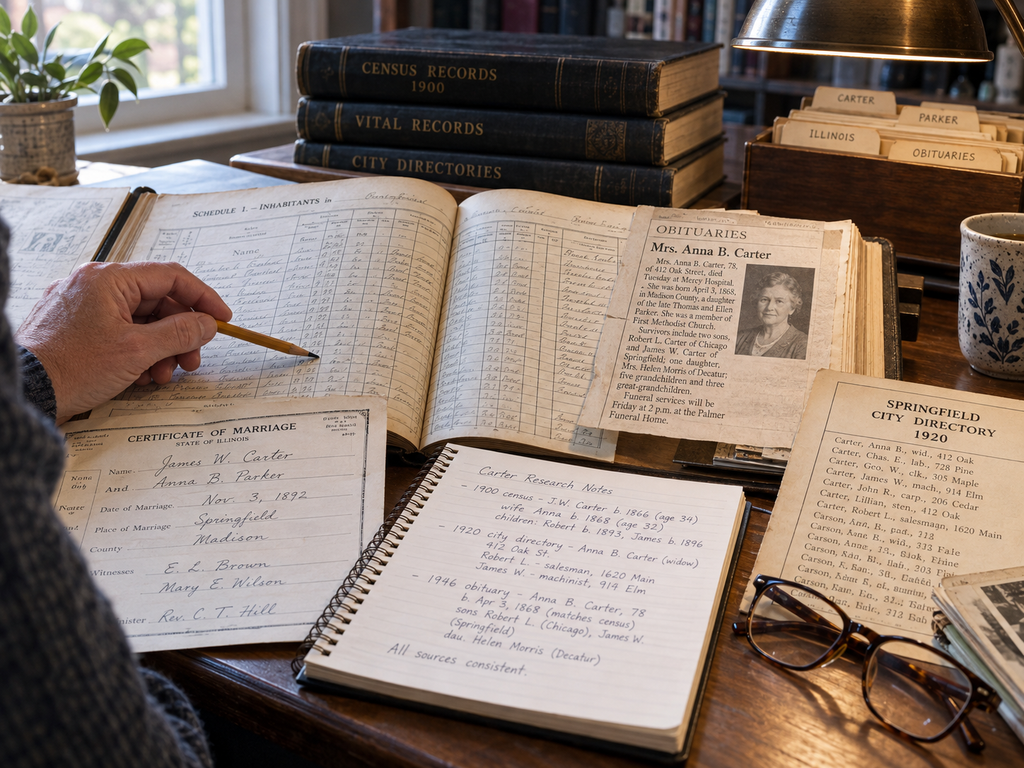
That is one reason good family-history research draws from many kinds of records rather than depending on a single database or online tree. Census schedules, birth and death records, marriage licenses, military files, land records, probate material, passenger lists, naturalization records, newspapers, directories, church records, cemetery information, court records, photographs, family papers, and local histories can each preserve a different part of the story.
Some records provide direct answers. Others provide clues.
And occasionally, the clue turns out to be more valuable than the answer we originally hoped to find.
Genealogy as Historical Detective Work
Genealogy frequently works like historical detective work because one discovery changes what we know to look for next.
An obituary may name a sister whose married surname was previously unknown.
A census may show that a family moved between two enumerations, narrowing the period in which that migration occurred.
A marriage record may identify parents and open an entirely new ancestral line.
A city directory may place someone at a particular address between census years.
A newspaper article may explain the circumstances surrounding an event that a death certificate can only date.
A military pension file may preserve family relationships or biographical information that never appeared in a simple service summary.
Even a discrepancy can become evidence.
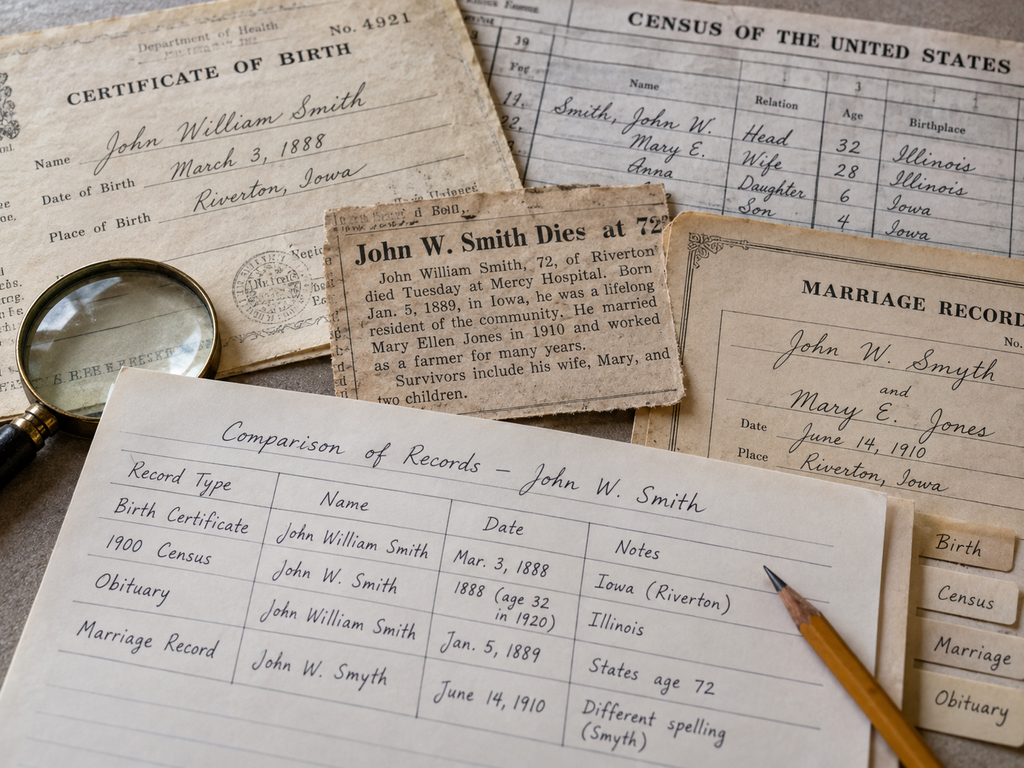
If three records give three different birth years, the goal is not simply to choose the date that appears most often. We have to ask when each record was created, who probably supplied the information, how close that person was to the event, and whether the records may actually refer to different people with similar names.
Sometimes the strange detail—the misspelled surname, unexpected birthplace, missing child, unfamiliar witness, or neighbor who keeps appearing nearby—is precisely what breaks open the research.
The World Around the Records Matters
Family history also benefits from looking beyond the individual.
People lived in communities. They worked within local economies, attended churches, bought property, served in wars, crossed borders, followed industries, joined relatives who had migrated before them, and responded to events happening around them.
Historical context can therefore help explain patterns that seem mysterious when viewed only on a pedigree chart.
A Pennsylvania family that suddenly appears in Ohio may have followed employment opportunities, transportation routes, relatives, or the availability of land. A household that repeatedly took in boarders may have been responding to economic necessity. A widow who moved into the home of an adult child may reflect family support arrangements that were entirely ordinary in her time and place.
Context does not allow us to invent motives that the records do not establish. It does, however, help us ask better questions.
That distinction will be important throughout Family History Saturday.
The goal is not to turn every ancestor into a dramatic character or to fill gaps with attractive stories. It is to recover as much of a life as the surviving evidence reasonably allows—and to be clear about where fact ends and interpretation begins.
What Does the Evidence Actually Prove?
The enormous growth of online genealogy has made family-history research easier in many ways. It has also made it extremely easy for an error to spread.
One unsupported relationship can be copied from tree to tree until hundreds of online profiles appear to agree with one another. But repetition is not independent evidence.
The more useful question is always: What source supports this claim?
A record may prove less than it first appears to prove.
A death certificate can contain excellent information about the death itself while providing incorrect information about the deceased person’s parents. A census can place a household in a location at a particular time without necessarily proving every relationship exactly as a modern researcher assumes it. An obituary may contain extraordinarily useful family information while still including mistakes.
This does not make those records useless. It means records must be evaluated.
Family-history research becomes stronger when we compare sources, identify contradictions, distinguish evidence from assumption, document where information came from, and state uncertainty when the evidence does not support a firm conclusion.
An unresolved question is not a failed research project. Sometimes the most accurate conclusion is that the available evidence points in one direction but does not yet prove the case.
What Family History Saturday Will Explore
This first article is an introduction rather than a lesson in one particular technique. Future installments will move through many parts of the research process.
We may look at researching a single ancestor, using censuses and vital records, finding relatives through newspapers and obituaries, tracing migration, understanding changing communities, evaluating conflicting evidence, working through genealogy brick walls, researching entire family lines, using local-history resources, placing ancestors in historical context, recognizing common errors in online trees, deciding what a record actually proves, preserving discoveries, and finding useful sources that are sometimes overlooked.
Some articles will be aimed squarely at beginners. Others will examine problems that experienced family historians know well.
The common thread will be evidence.
Family History Saturday will not be about collecting the greatest possible number of names. It will be about understanding the people represented by those names—and building family history carefully enough that someone else can see how we reached our conclusions.
From Personal Research to Dear June Family-History Services
My own genealogy research began approximately 17 years ago through extensive work on my extended family and research for people close to me. Over the years, that work developed into the same kind of historical investigation that appears throughout Dear June Collectibles: following records, comparing evidence, identifying people and places, reconstructing context, and trying to understand what survives from the past.
I am now offering documented family-history research professionally through Dear June Collectibles. That does not mean those 17 years were 17 years of paid client work. It means a long-standing research practice is now being developed into a professional service for people who want help answering defined family-history questions.
The available work ranges from focused Single Ancestor Genealogy Research and Historical Record Searches to Obituary & Newspaper Family Research, Family Line Research, and more difficult Brick-Wall Investigations. Additional family-history research options are also available depending on the question.
The service philosophy is deliberately straightforward: begin with a clearly defined research problem, work within an agreed scope, document the sources used, explain what the evidence supports, identify uncertainty rather than hiding it, and point out unresolved questions or sensible next steps when they may help.
These are remote, bounded research projects—not promises of unlimited searching or guaranteed discoveries.
Readers who would like professional help can find the current options at:
An Invitation to Keep Looking
Family History Saturday is intended for two kinds of readers, and there will probably be considerable overlap between them.
The first is anyone who simply enjoys genealogy, local history, old records, forgotten stories, and the puzzle of reconstructing the past. If that describes you, follow along. There is a great deal to explore.
The second is the person with a particular question sitting unresolved in a folder, family tree, shoebox, or browser tab: Who was this ancestor? Where did this branch come from? Can that family story be documented? Is there an obituary somewhere? Why do these two records disagree? What should I search next?
Sometimes that question can be answered, sometimes it leads to several better questions, and sometimes the surviving record refuses to give us certainty.
All three outcomes are part of serious family-history research.
What matters is approaching the evidence carefully, preserving what we find, and giving the people behind the records a chance to become visible again—not as names filling boxes on a chart, but as people who occupied real places, belonged to real communities, faced real circumstances, and left traces that can still be followed.
Let’s Make History—one carefully documented family story at a time, preserving the lives behind the records before their traces disappear.
Discover more from Dear June Collectibles
Subscribe to get the latest posts sent to your email.