World’s fairs were built around a paradox. They promised the future, yet most of what visitors saw was temporary.
Palaces rose for a single exposition. Experimental buildings stood for a season. Pavilions were dismantled, attractions closed, exhibits dispersed, and entire fairgrounds changed beyond recognition. Yet millions of visitors carried pieces of those temporary worlds home with them.
A souvenir spoon, admission ticket, postcard, guidebook, pinback button, architectural miniature, drinking glass, or commemorative plate may look modest beside the monumental architecture of a World’s Fair. But these small objects often outlasted the spectacles they represented.
That is why World’s Fair souvenirs are more than nostalgic keepsakes. Together, they preserve a material history of how different generations imagined progress.
From Industrial Progress to the World of Tomorrow
The modern World Expo tradition reaches back to London’s Great Exhibition of 1851, where nations displayed manufactured goods, machinery, art, and industrial achievement inside the Crystal Palace. Over time, international exhibitions evolved from showcases of industrial power into broader platforms for architecture, science, national identity, entertainment, technology, and ideas about the future.
The souvenirs evolved with them.
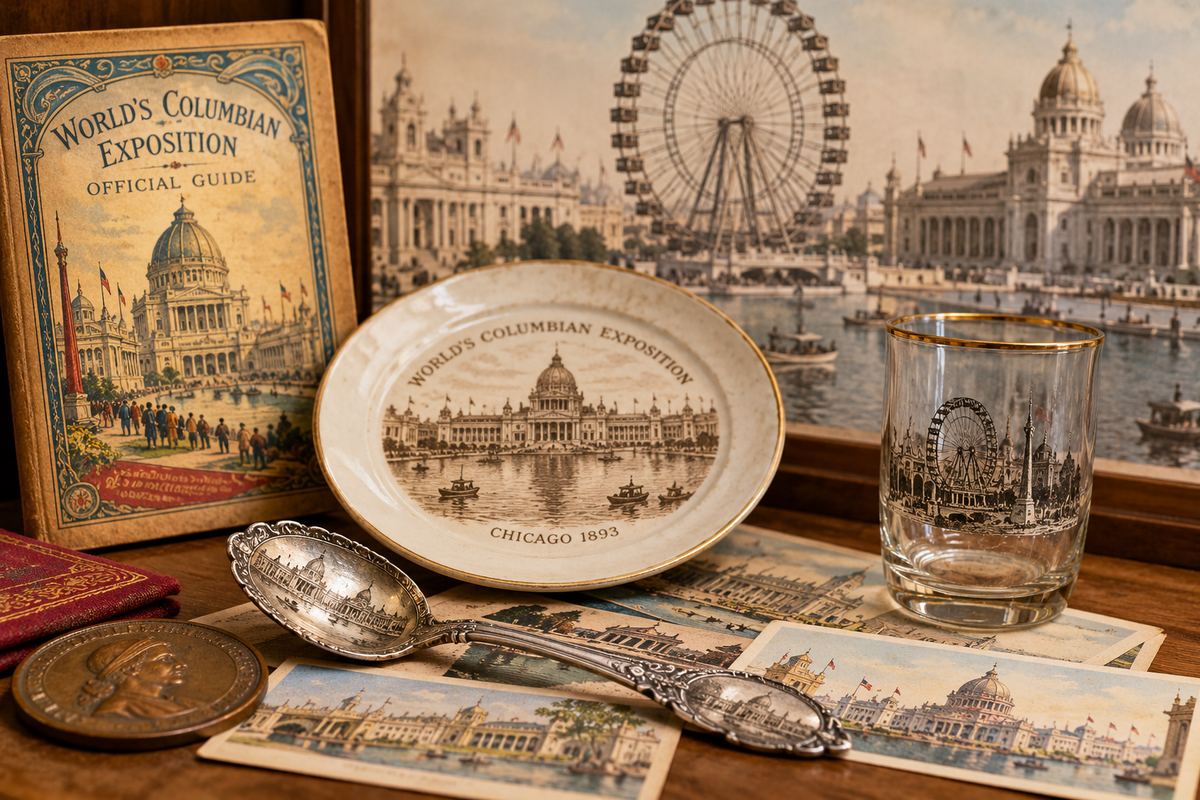
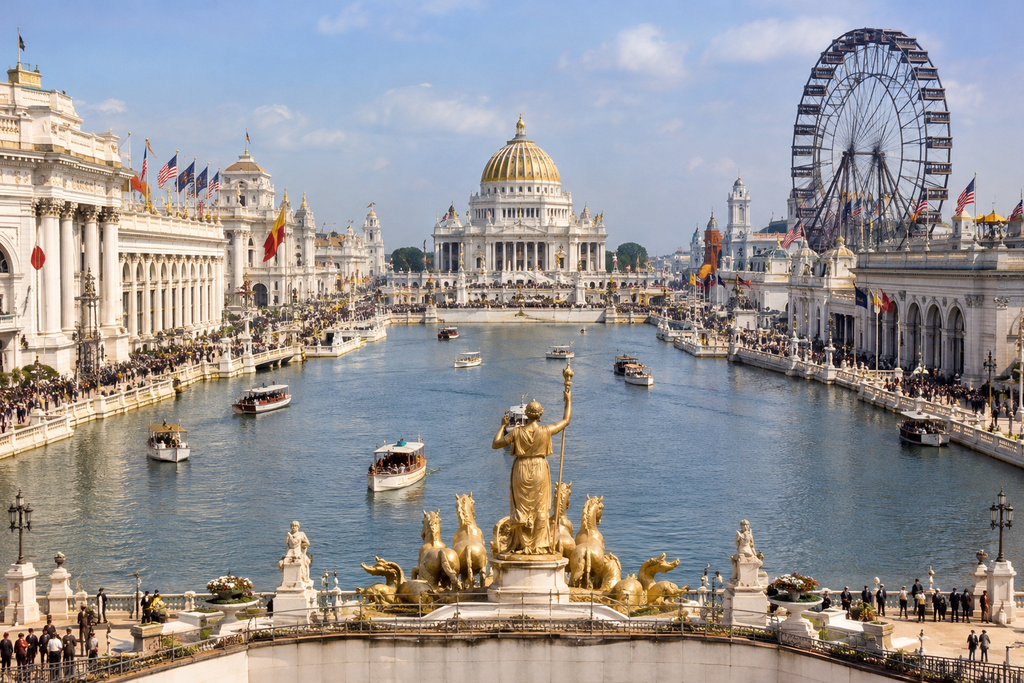
At Chicago’s World’s Columbian Exposition in 1893, visitors encountered an enormous neoclassical “White City,” the original Ferris Wheel, electrical illumination, international exhibits, and a Midway filled with concessions and entertainment. Manufacturers responded with an extraordinary range of souvenir objects.
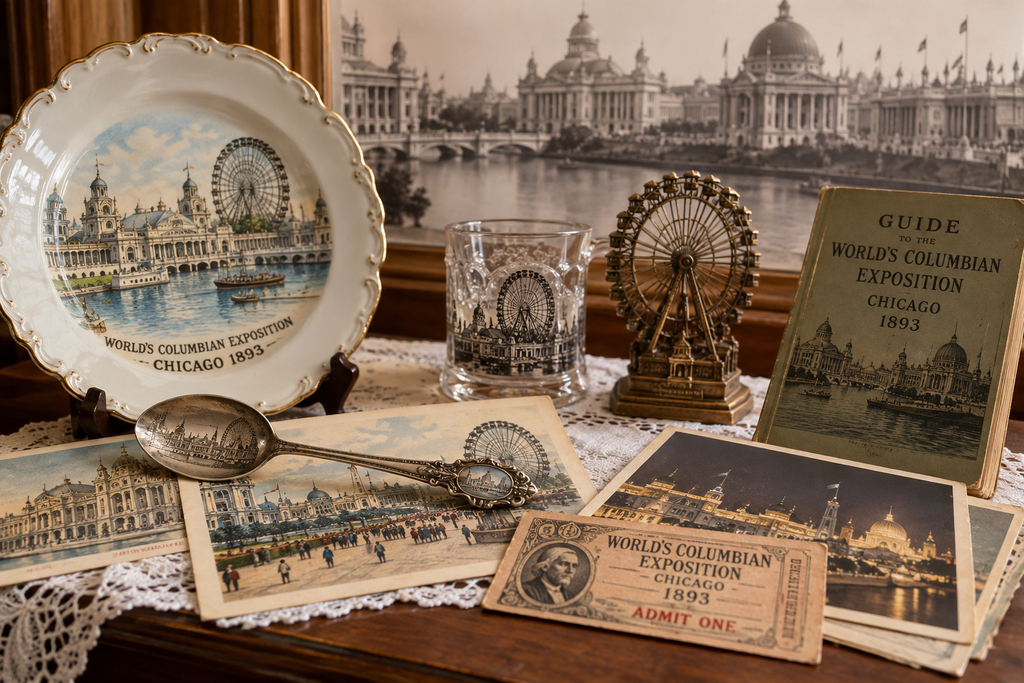
The Smithsonian preserves everything from Columbian Exposition stockings and fans to plates, boxes, and paperweights decorated with individual fair buildings.
Even the U.S. Post Office became part of the souvenir culture. The Columbian Exposition inspired the nation’s first commemorative postage stamps, while illustrated postal cards sold at the fair helped popularize picture postcards in the United States.
These were not simply products stamped with a date. They recorded what fair organizers and visitors considered worth remembering.
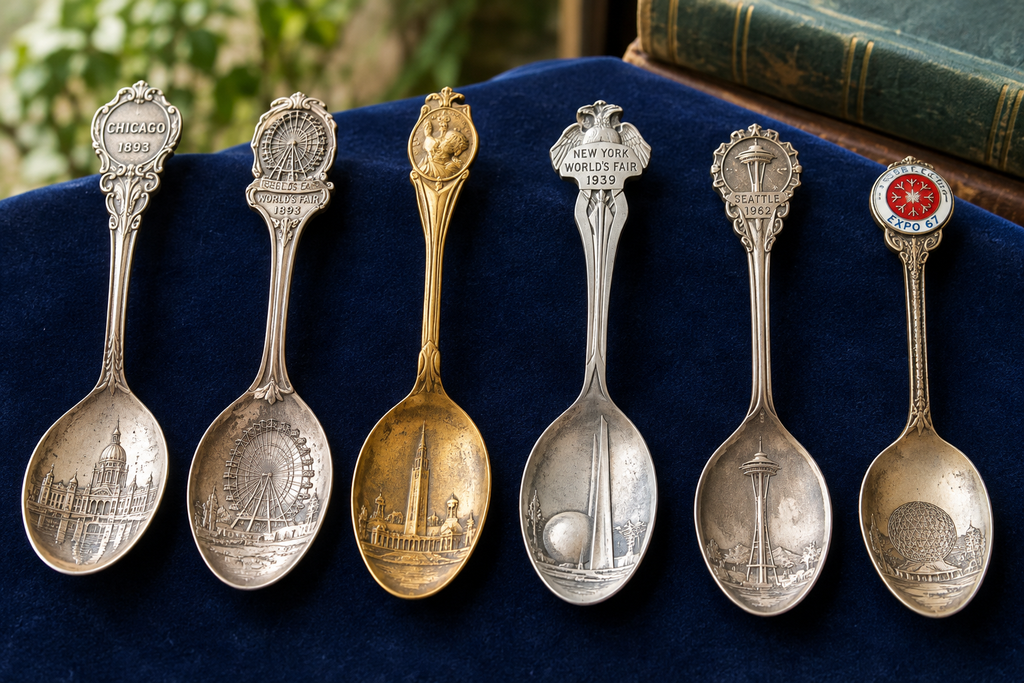
A plate might preserve the Administration Building. A spoon might depict the Ferris Wheel. A postcard might capture a pavilion that disappeared shortly after the gates closed.
The fair vanished. Its imagery remained.
When the Future Became a Souvenir
By the twentieth century, the language of World’s Fairs had shifted.
New York’s 1939–1940 fair did not merely celebrate industrial achievement. It promised a “World of Tomorrow.” Its signature Trylon and Perisphere became visual shorthand for modernity and appeared on an enormous variety of merchandise.
The Smithsonian preserves the pair on souvenir plates, compacts, pins, models, and other objects. One surviving plate produced by the Homer Laughlin China Company surrounds the Trylon and Perisphere with views of other fair buildings, effectively turning a piece of dinnerware into a miniature architectural record.
Then there were objects connected with individual attractions.
Visitors emerging from General Motors’ Futurama received buttons announcing “I Have Seen the Future.” That small giveaway summarized one of the fair’s most powerful ideas: attending a World’s Fair meant briefly stepping ahead of ordinary life.
Twenty-three years later, Seattle’s Century 21 Exposition presented another version of tomorrow.
The 1962 fair adopted the theme “Living in the Space Age.” The Space Needle and monorail became its defining landmarks, while nearly ten million visitors encountered an exposition shaped by aerospace, science, and Cold War-era optimism.
Again, the architecture became merchandise.
Collectors today can encounter Space Needle spoons, dishes, buttons, models, lighters, tokens, and countless other pieces. The Smithsonian even preserves a metal Space Needle souvenir model manufactured in Japan and retained in its original box.
Seen together, New York and Seattle souvenirs do something interesting. They preserve not the future as it actually happened, but the future as people hoped it might happen.
That distinction gives them much of their historical appeal.
Souvenirs as Personal Evidence
Official histories tell us what an exposition was intended to accomplish.
Souvenirs can tell us how visitors experienced it.
An admission ticket shows that someone entered. A heavily folded map suggests that it was carried through the grounds. A passport filled with pavilion stamps records an individual route through an international exposition. A worn spoon may have spent decades in a family silverware drawer rather than in a collector’s cabinet.
Even inexpensive objects can carry personal history.
Pinback buttons and badges are especially good examples. They could identify a pavilion, commemorate attendance, promote a corporation, or simply let the wearer announce participation in the event. Seattle’s surviving “I Was There” button combines the Space Needle, monorail, and U.S. Science Pavilion into a compact declaration of experience.
These pieces remind us that collecting is not only about rarity.
Sometimes the most interesting object is the one that still carries evidence of having been used.
A Collection Does Not Need Everything
World’s Fair collecting can easily become overwhelming because almost anything could become a souvenir.
That is why the strongest collections often develop around a particular idea.
One collector may concentrate on a single exposition. Another may follow commemorative spoons across decades. Someone else might pursue architectural models, corporate pavilion material, transportation souvenirs, photographs, postcards, admission tickets, or postal history.
Collecting by theme can reveal connections that are difficult to see when objects are considered separately.
A Ferris Wheel spoon from Chicago can sit beside a Trylon and Perisphere miniature from New York, a Space Needle model from Seattle, and an Expo 67 postcard from Montreal. Suddenly the collection becomes a small history of how exposition architecture changed from Victorian engineering spectacle to streamlined modernism and then to the Space Age.
The same principle works with paper.
World’s Fair postal material alone can span commemorative stamps, envelopes, postal cards, special cancellations, fairground post offices, and related ephemera across numerous expositions. The National Postal Museum’s World’s Fair holdings extend from Chicago in 1893 through a long sequence of later American fairs.
A focused collection does not need to be enormous to be meaningful.
It needs a reason for the objects to belong together.
Knowing What You Have
World’s Fair souvenirs also reward careful identification.
An exposition date printed on an object is useful, but it does not automatically establish when that particular piece was manufactured. Famous fair landmarks often remained tourist attractions long after their expositions ended, and anniversary merchandise, reproductions, fantasy pieces, and later souvenirs can all enter the market.
Materials and construction therefore matter.
Look for manufacturer marks, country-of-origin information, patent numbers, original boxes, period packaging, contemporary advertisements, and comparison examples in institutional collections. With paper, examine printing methods, paper quality, typography, postal markings, and evidence of genuine use.
A later souvenir is not necessarily undesirable.
It simply should not be represented as an original exposition-period object if the evidence does not support that conclusion.
The same restraint applies to value. Some World’s Fair material survives in large quantities, while other pieces appear much less often. Condition, subject, manufacturer, provenance, completeness, and current collector demand can all influence the market. Age alone is never a guarantee of rarity or high value.
Preserve Before You Improve
Collectors should also resist the temptation to make old souvenirs look new.
Heavy polishing can erase detail from metal. Cleaning can remove original surfaces. Adhesives used to repair paper may stain or permanently alter it. Repainting a model or touching up worn decoration may make an object appear brighter while reducing its historical integrity.
Whenever possible, preservation should begin with understanding the material.
Paper generally benefits from clean, stable storage away from excessive light, moisture, and damaging adhesives. Metals may require different handling depending on their composition and surface. Ceramics, glass, plastics, textiles, and early photographic materials all have their own vulnerabilities.
Original boxes and packaging deserve protection too.
They can provide manufacturing information and context that an object alone no longer carries.
The Future, Preserved in Small Things
The grandest World’s Fair structures were designed to make visitors stop and stare.
Yet the objects most likely to survive were often the ones small enough to slip into a pocket or suitcase.
That is the lasting charm of World’s Fair souvenirs.
Chicago’s White City survives on plates and stereoviews. New York’s World of Tomorrow remains visible on compacts, cameras, and buttons. Seattle’s Space Age optimism lives on in miniature Space Needles and souvenir spoons. Stamps, postcards, guidebooks, models, badges, photographs, tickets, and household objects continue to preserve places that were otherwise temporary.
The fairs themselves were demonstrations of change.
Their souvenirs became anchors.
They remind us that every generation has its own version of progress, its own confidence about tomorrow, and its own objects chosen to remember the experience.
For collectors, that creates something more interesting than a shelf full of old souvenirs. It creates a material record of the futures people once imagined.
Let’s Make History—one keepsake of progress at a time.
Discover more from Dear June Collectibles
Subscribe to get the latest posts sent to your email.