
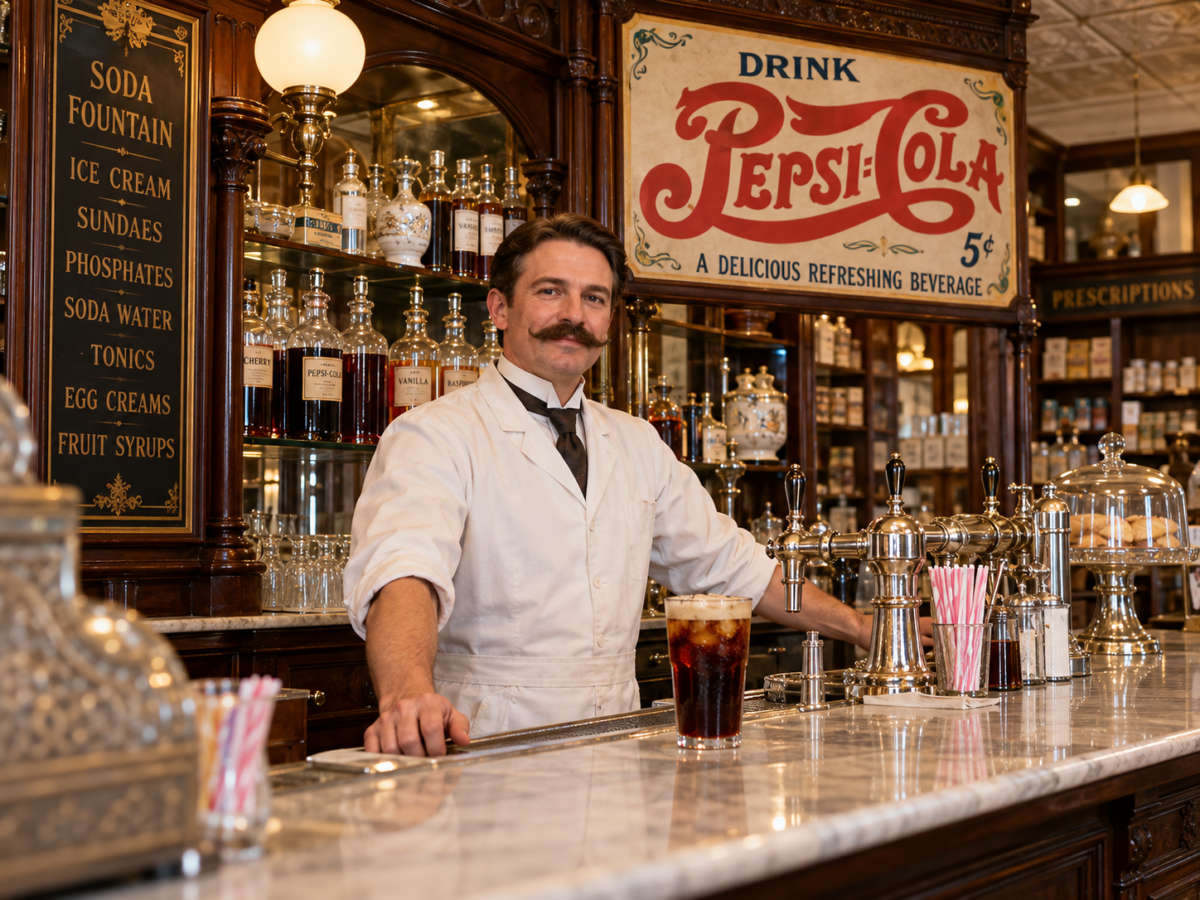
Long before Pepsi became a global brand associated with television commercials, pop stars, sports, and the famous Pepsi Challenge, it was a fountain drink mixed in a North Carolina drugstore.
The earliest decades of Pepsi-Cola are especially interesting for collectors because the company’s history can be followed through the objects it left behind: bottles, signs, trays, paper advertisements, crates, soda-fountain pieces, and other promotional material. Those pieces document more than changing logos. They show how a regional beverage repeatedly reinvented itself through packaging and advertising until it became a national competitor in the soft-drink business.
From Brad’s Drink to Pepsi-Cola
Pepsi’s story begins in New Bern, North Carolina, where pharmacist Caleb Davis Bradham operated a drugstore with a soda fountain. Like many pharmacists of the period, Bradham experimented with flavored carbonated beverages. In 1893, he began serving a concoction that became known locally as “Brad’s Drink.”
The name did not last. On August 28, 1898, Bradham renamed the beverage Pepsi-Cola. The precise reasoning behind the name has accumulated some folklore over the years, but claims that the original drink actually contained the digestive enzyme pepsin should be treated cautiously. What is certain is that Bradham was positioning his beverage in an era when soda-fountain drinks were frequently promoted as refreshing, invigorating, or beneficial to digestion.
Bradham soon moved beyond selling glasses across his own counter. He filed to register the Pepsi-Cola trademark in 1902, and the federal mark was registered in 1903. Production expanded from the drugstore into larger quarters, and Pepsi syrup began reaching independent bottlers. According to PepsiCo’s corporate history, 7,968 gallons of syrup were sold during the company’s first year of operation; by 1910, more than 250 bottling companies in 24 states were producing Pepsi.
That rapid growth created an equally important need: people had to recognize the name.
Advertising a New Kind of Refreshment
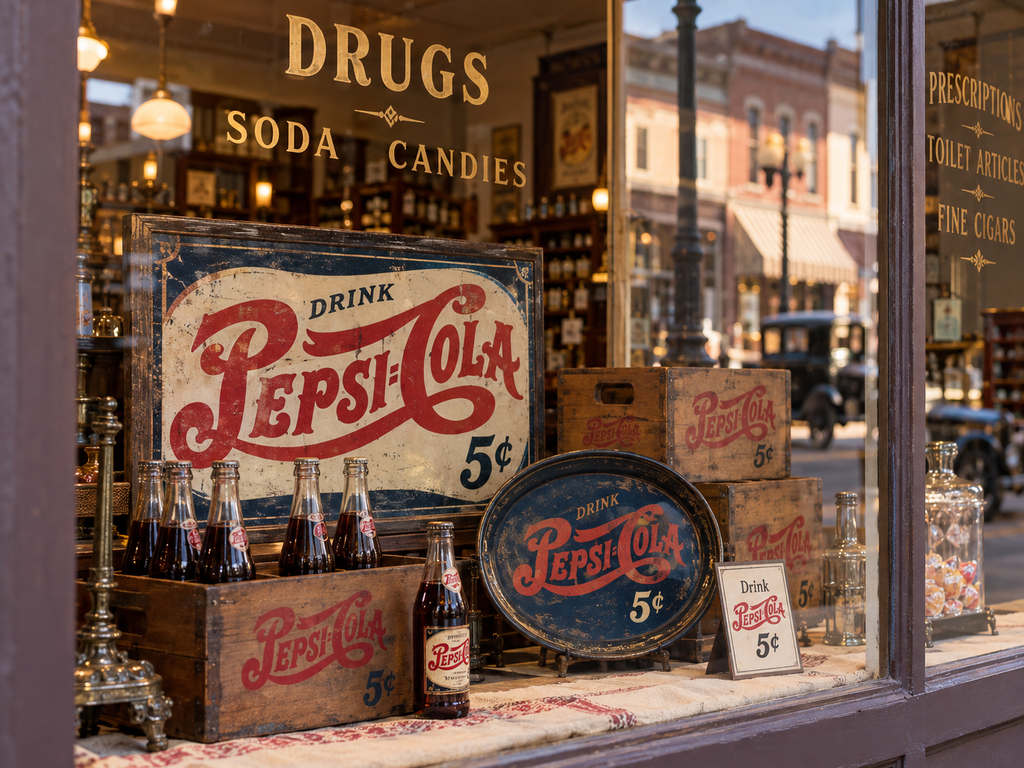
Early Pepsi advertising belongs to the colorful world of turn-of-the-century commercial graphics. Painted signs, newspaper advertisements, serving pieces, store displays, and branded bottles helped put a recognizable identity in front of consumers.
Much of this advertising emphasized refreshment, energy, purity, or wholesomeness—themes common throughout the emerging soft-drink industry. Soda fountains themselves were important advertising spaces. A customer entering a pharmacy might encounter a branded sign or mirror before ordering a glass at the counter, making advertising part of the experience of drinking the product.
Pepsi also embraced personality-based advertising surprisingly early. In 1909, automobile racing star Barney Oldfield appeared in Pepsi promotions. Linking a beverage to a nationally known figure associated with speed, daring, and modern technology was a distinctly forward-looking approach for the period.
For collectors, these early advertising materials can be especially evocative because they capture Pepsi before its later visual identity became standardized. Lettering, bottle forms, slogans, colors, and promotional formats changed over time, creating a trail that can sometimes help place an item within a broad period.
Expansion, Collapse, and a Second Beginning
Pepsi’s first period of growth did not continue smoothly.
World War I disrupted commodity markets, including sugar. Bradham made a costly commitment to sugar supplies during a period of extreme price volatility. When prices fell, the company was left in severe financial difficulty. Pepsi-Cola went bankrupt in 1923, ending Bradham’s ownership of the business he had created. The trademark and other assets changed hands during the years that followed.
That might easily have been the end of Pepsi-Cola.
Instead, the brand eventually came under the control of Charles Guth, president of the Loft candy and fountain business, in the early 1930s. Guth rebuilt Pepsi at a moment when the Great Depression had made price an increasingly important consideration for American consumers.
This period produced one of the most important advertising ideas in Pepsi history.
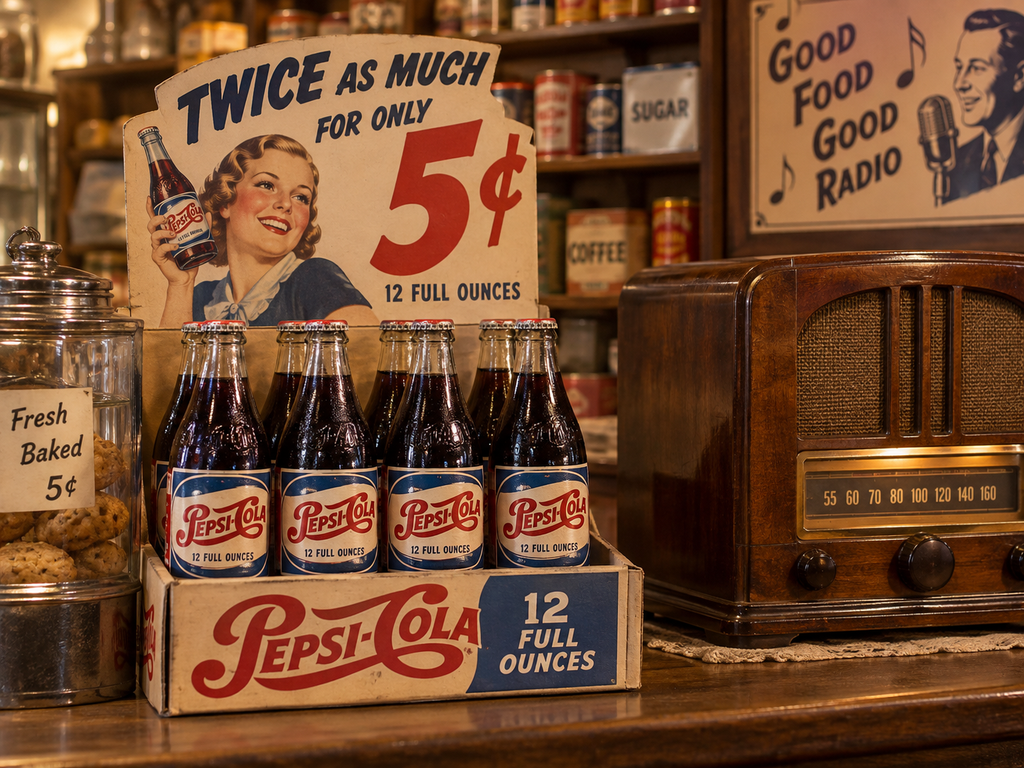
Rather than simply trying to make Pepsi look like another established cola, the company emphasized value. A larger bottle could give consumers more beverage for the same nickel they were accustomed to spending on a soft drink.
It was a message particularly suited to the Depression.
Twelve Ounces and a Nickel
Pepsi’s larger 12-ounce bottle became the center of an aggressive value proposition. Instead of relying on complicated claims about the drink itself, advertisements could communicate something almost instantly: more Pepsi for the consumer’s money.
The idea was simple enough to work on signs and printed advertising, but radio turned it into something far more memorable.
In 1939, the “Pepsi-Cola Hits the Spot” campaign brought the value message into American homes through a catchy musical advertisement built around the 12-ounce bottle and nickel price. The Library of American Broadcasting identifies it as the first advertising jingle to receive nationwide exposure over commercial radio stations.
That was a significant change in advertising. A sign disappeared when someone walked away from it. A newspaper might be discarded at the end of the day. A melody could remain in someone’s head.
By 1942, the Pepsi song had become popular enough that recordings were being distributed to jukebox operators. This took what began as advertising and placing it directly into popular entertainment.
Pepsi had begun learning a lesson that would influence its advertising for decades: a soft drink could be marketed not only through the qualities of the product, but through music, personality, repetition, and popular culture.
What Early Pepsi Advertising Tells Collectors
Today, the physical remains of these campaigns form a substantial collecting field.
Early embossed bottles can document local bottling operations as well as changes in packaging. Wooden crates, bottle carriers, and shipping material reveal the distribution side of the business. Soda-fountain signs and serving trays show how the company tried to attract customers at the point of sale. Magazine and newspaper advertisements preserve campaigns that may otherwise have vanished.
Even comparatively modest items can tell part of the story. Bottle caps, paper labels, calendars, matchbooks, thermometers, dealer displays, and other promotional pieces once functioned as everyday advertising rather than as collectibles.
That is part of their appeal.
A surviving sign was not originally made to explain the history of Pepsi to someone a century later. It was made to persuade someone to order a drink. When placed back into its historical context, it becomes evidence of how companies competed for attention in drugstores, groceries, restaurants, and public spaces.
Collectors should also resist dating an item solely by how “old” it looks. Pepsi’s script logo changed repeatedly, slogans were reused, and nostalgic reproductions can intentionally imitate early advertising. Materials, printing methods, construction, markings, bottle characteristics, documented advertising designs, and provenance can all be more useful than surface wear alone.
Reproduction advertising is not automatically undesirable. Some later Pepsi pieces have developed their own collector followings. An attractive reproduction should not be mistaken for an original early advertising piece.
Building a Brand Through Reinvention
One of the most striking things about early Pepsi history is how little of it was inevitable.
The company grew rapidly, collapsed, and passed through different owners. Then it returned with a marketing idea perfectly suited to the economic conditions of the 1930s. The brand that survived was not simply Caleb Bradham’s original soda-fountain creation preserved unchanged. It was repeatedly rebuilt.
Advertising helped make that reinvention possible.
Early promotions sold refreshment and modernity. Celebrity advertising connected the drink with recognizable personalities. Depression-era campaigns sold value. Radio transformed a pricing message into popular music.
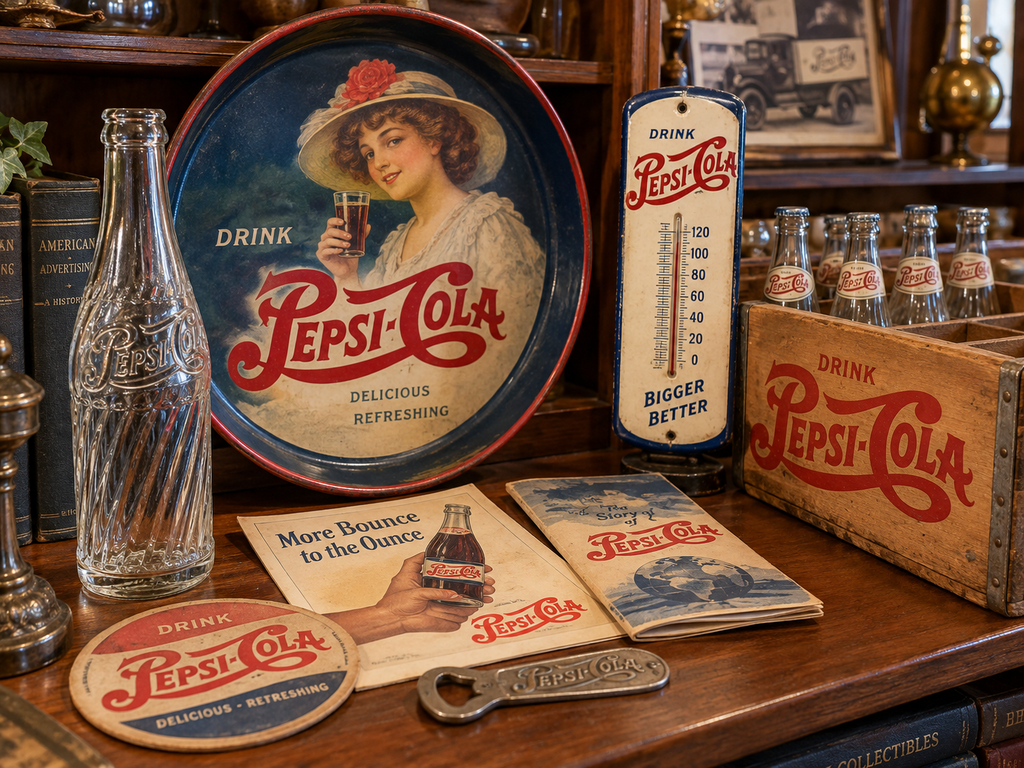
For collectors, that progression gives early Pepsi material more significance than the familiar logo alone might suggest. A bottle, sign, tray, or paper advertisement can represent a particular stage in the transformation of a local North Carolina fountain drink into a nationally recognized consumer brand.
The later decades would bring another dramatic evolution, as Pepsi increasingly connected itself with youth culture, changing graphic design, television, and the idea of a distinctly modern American lifestyle. But many of the tools behind those campaigns—recognizable personalities, memorable slogans, music, strong visual identity, and an ability to respond to the moment—were already being developed during Pepsi-Cola’s first half-century.
Let’s Make History one bottle, sign, and advertising slogan at a time.
Discover more from Dear June Collectibles
Subscribe to get the latest posts sent to your email.