

One of the easiest mistakes to make in reselling is confusing “I can sell this” with “I should list this.”
Those are not the same thing.
Spend enough time at estate sales, auctions, thrift stores, flea markets, and cleanouts and you will encounter an almost endless supply of merchandise that has some value. A $12 replacement saucer has value. So does a $20 hardcover book, a $25 vintage kitchen item, a $15 advertising piece, and a $30 decorative vase.
But an online resale business cannot run on value alone. Every item also consumes time, space, labor, packing materials, and eventually shipping effort. Some merchandise earns its place in an eBay store. Other merchandise may be perfectly sellable and still be a poor use of the seller’s resources.
That distinction becomes increasingly important as a resale operation grows.
Start With the Price It Will Probably Sell For
When deciding what to sell on e.Bay, asking prices are one of the least useful numbers available.
Search results may show five examples priced at $49.95, $59.95, or even $89.95. That does not mean buyers are actually paying those prices.
What matters is the likely selling price.
Completed and sold listings, when enough comparable examples exist, usually give a much better picture of demand. For unusual antiques and one-of-a-kind merchandise, there may not be an exact comparable sale, but the same principle applies: estimate what a real buyer is reasonably likely to pay rather than building the decision around the highest optimistic listing you can find.
A $40 item that reliably sells around $30 may still be worth handling. A supposedly $75 collectible that actually changes hands for $18 once every few months is a very different proposition.
The question is not:
“How much can I list this for?”
It is:
“What is this realistically likely to bring, and what will it take to get that money?”
The Sale Price Is Not the Profit
Once you have a realistic selling price, start subtracting.
eBay selling costs vary depending on such factors as category, store status, listing setup, and seller performance. Advertising can create additional costs depending on the promotional strategy being used.
Then there is the inventory itself.
If you paid $2 for an item that sells for $25, the economics are obviously different from paying $15 for the same item.
Shipping matters too, even when the buyer pays for it. Boxes, tape, bubble wrap, void fill, labels, and other materials cost money. Oversized or fragile merchandise may require substantially more packing supplies than a book or a postcard.
Most importantly, there is labor.
Your time has value even if you are working for yourself.
Count the Work Before You Count the Money
A reseller handles an item many more times than most buyers ever realize.
Depending on the merchandise, you may have to:
- clean it;
- identify it;
- research the maker, age, pattern, or model;
- test it;
- measure it;
- photograph it;
- edit or organize the photographs;
- write the listing;
- enter item specifics;
- calculate or verify shipping;
- assign and store inventory;
- retrieve it after it sells;
- pack it safely;
- print the label;
- and get it into the outgoing shipment.
That is why two items with the same selling price can have completely different profitability.
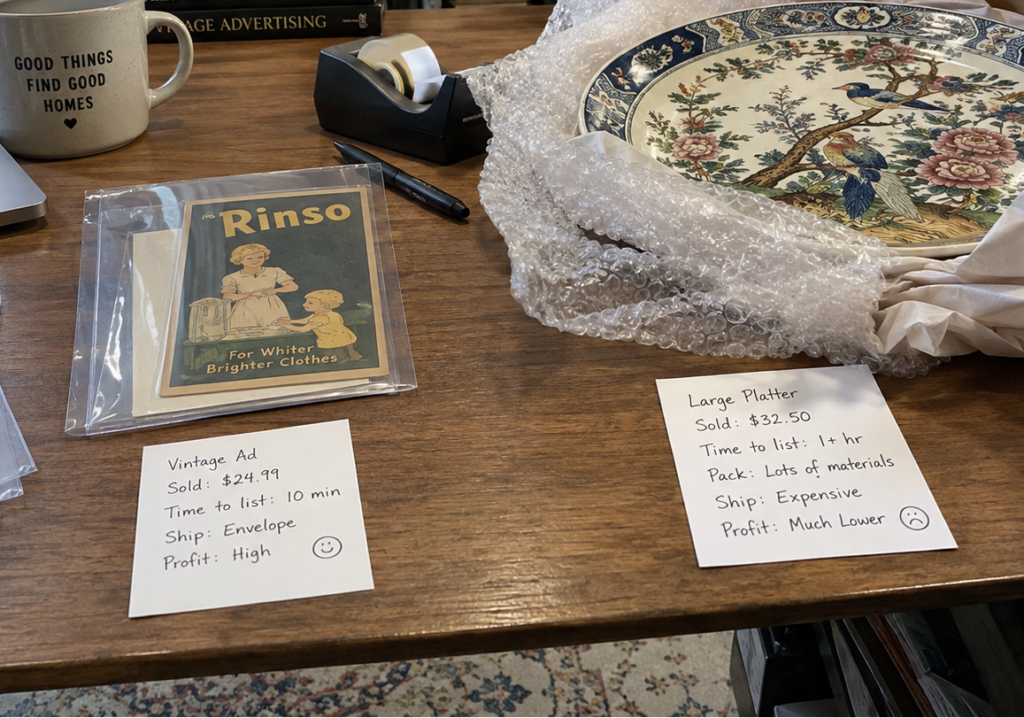
Suppose I have two items that are both likely to sell for about $25.
The first is a small vintage paper advertising piece. It is already clean. The maker is printed on the front. Research takes two minutes. I can photograph it quickly, store it in a sleeve inside a numbered bin, and ship it in a rigid mailer.
The second is a large unmarked decorative platter. It needs cleaning. I have to research the pattern. It requires photographs of the front, back, edge, marks, and several condition areas. It takes up a significant amount of shelf space, and when it sells I need a sturdy box, cushioning, and enough time to pack a large breakable object properly.
Both may produce a $25 sale.
They are not equally valuable to the business.
Sell-Through Is Part of the Price
There is another number that matters just as much as selling price: how likely the item is to sell.
Understanding eBay sell-through changes the way you look at inventory.
Imagine two items that will each probably bring $40.
One has steady demand and tends to sell within a few weeks when priced competitively.
The other has only a handful of interested collectors nationwide and might sit for two years waiting for the right person.
The slower item is not necessarily bad inventory. Rare antiques, specialized collectibles, unusual ephemera, and replacement pieces often require patience. A large diversified store can afford to carry some long-tail merchandise.
But you should know that is what you are doing.
Inventory sitting on a shelf for three years has a cost even when it was inexpensive to acquire. It occupies physical space, adds to the amount of merchandise you must manage, and represents money that has not yet returned to the business.
This is one reason supposedly profitable eBay items should never be judged entirely by gross margin.
Profitability also has a time component.
Storage Space Is a Business Resource
Small sellers can sometimes ignore storage efficiency for a while. Large sellers usually cannot.
Eventually every shelf, tote, cabinet, rack, closet, and warehouse section fills.
At that point, a bulky $20 item is competing for the same storage capacity that could hold several smaller items worth considerably more.
Consider another pair of $30 items.
One is a collectible pocketknife box, small book, photograph, compact kitchen utensil, or piece of ephemera that fits easily into existing inventory storage.
The other is a large decorative basket, inexpensive framed print, common lamp, or awkward household object that consumes several cubic feet.
Even before shipping enters the equation, these items are placing very different demands on the business.
Storage should therefore be part of your buying decision, particularly when dealing with estate merchandise where inexpensive goods can arrive by the carload.
Sometimes the Answer Is to Lot It
Low-value merchandise does not always need to be rejected. Sometimes it simply needs to be combined.
If six related items might sell individually for $8 to $12 each, creating six listings may make little sense.
A single $40 or $50 lot might be far more efficient.
Lots work especially well when the pieces appeal to the same buyer. Examples might include a group of vintage snapshots from one subject, several related advertising pieces, replacement flatware in the same pattern, a collection of small ornaments, related books, craft supplies, postcards from one location, or miscellaneous pieces from the same manufacturer.
You give up some potential gross revenue by lotting merchandise together, but you may save hours of listing and fulfillment work.
The highest possible revenue is not always the highest practical profit.
Cheap and Easy Can Beat Expensive and Difficult
There is no universal minimum dollar amount I would tell every reseller to use.
Someone listing from a spare bedroom has a different operation from someone maintaining thousands of active listings. A seller who acquires merchandise almost free has different economics from someone buying inventory at 40 percent of expected resale value. A seller specializing in small paper collectibles has different shipping requirements from someone dealing in glassware and ceramics.
That is why simplistic eBay reseller tips like “never list anything under $20” or “everything under $15 goes to the flea market” miss the point.
Sometimes an unusual $12 or $15 item is perfectly good reseller inventory.
If I can identify it instantly, photograph it in a minute, create the listing quickly, drop it into an existing inventory bin, and eventually ship it in a small envelope or box, I may be perfectly happy to sell it.
The processing cost is low.
On the other hand, I may pass on something worth $30 because it needs thirty minutes of research, cleaning, complicated testing, twelve photographs, and specialized packing.
Price matters.
So does friction.

Higher-Dollar Merchandise Deserves a Different Standard
Efficiency should not become an excuse to rush everything.
A $200 antique, rare photograph, unusual piece of ephemera, better collectible, scarce book, or unidentified piece of quality craftsmanship may deserve considerably more research.
An extra hour spent correctly identifying a $15 object is usually difficult to justify.
An extra hour that prevents a $300 object from being mistakenly listed for $50 is another matter entirely.
Better merchandise may also justify more detailed photography, careful measurements, condition reporting, provenance research, or consultation with specialized references.
The objective is not to make every listing as quickly as possible.
The objective is to spend your time where it has the greatest economic return.
Not Everything Belongs on eBay
One of the most useful skills in reselling is learning to route merchandise instead of trying to force everything through the same sales channel.
An item can be worth money without being worth shipping.
Large inexpensive household goods may do better at a flea market, yard sale, antique booth, or local marketplace. Fragile low-dollar items can sometimes be sold locally rather than spending more time packing them than the eventual profit justifies.
Other merchandise may be worth holding for a specialized venue.
An item that is mediocre general eBay inventory might make excellent merchandise for an antique show, holiday market, collector event, or themed sale.
And some items should simply be donated.
Donation is not necessarily failure. Neither is disposal.
A reseller who handles large quantities of estate and secondhand merchandise eventually encounters things that have technically measurable resale value but are too damaged, too common, too bulky, too difficult to process, or too slow-moving to justify keeping.
Holding everything because “somebody might buy it someday” is how inventory begins taking control of the business instead of serving it.
The Six-Way Reseller Decision
Before adding something to the online inventory pile, I find it useful to mentally run through six possible destinations:
List it.
The likely selling price, demand, processing time, shipping requirements, and storage needs make sense for online sale.
Lot it.
The individual pieces are too inexpensive or inefficient to process separately, but a related group could make a worthwhile listing.
Sell it locally.
The item has useful value, but shipping cost, size, fragility, or packing time makes local sale more attractive.
Hold it for a better venue.
The merchandise may fit an antique show, flea market, specialized collector event, seasonal sale, or another marketplace better than eBay.
Donate it.
The item remains usable, but the likely financial return does not justify the business resources required to sell it.
Discard it.
The object is damaged, incomplete, unsafe, unsanitary, or otherwise unsuitable for resale or donation.
That framework is more useful than a universal dollar threshold because it adapts to the actual item and the actual business.

The Inventory Trap
There is a dangerous stage in growing an eBay business where accumulating listings starts to feel like progress by itself.
It is easy to become proud of having hundreds, then thousands, of active listings.
A large inventory can be an enormous advantage. More merchandise creates more opportunities to sell, serves more niches, and allows a store to benefit from long-tail demand.
But listing count is not the same as productive inventory.
A store filled with thousands of items that each require substantial labor, produce little profit, sell extremely slowly, and occupy valuable storage space can become less efficient as it grows.
The seller remains busy. The shelves remain full. New inventory keeps arriving.
But the merchandise is not producing enough return for the resources invested in it.
That is the trap.
A strong online resale business is not built by listing everything that could theoretically sell. It is built by making repeated decisions about where time, space, money, and attention are most likely to pay off.
Sellability Is Only the Beginning
When you pick up an item and wonder whether it is worth listing on eBay, do not ask only what it is worth.
Ask what it will probably sell for.
Ask how often it sells.
Ask how much work it needs.
Ask where you will store it.
Ask what it will cost to pack and ship.
Ask whether it makes more sense combined with other merchandise.
Ask whether another sales venue would handle it more efficiently.
And occasionally ask whether the best business decision is simply to let it go.
The longer you resell, the more you realize that sourcing merchandise is rarely the hard part. There will always be another estate sale, another auction, another box of collectibles, another shelf of books, and another table full of things that appear to be worth something.
The real skill is deciding which of those things deserve your time.
That is what turns a collection of sellable objects into productive reseller inventory—and turns constant listing into an actual business.
Let’s Make History—one profitable decision at a time.