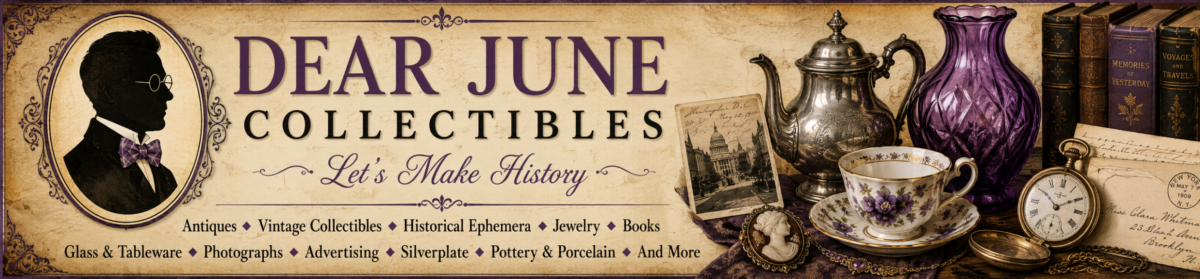
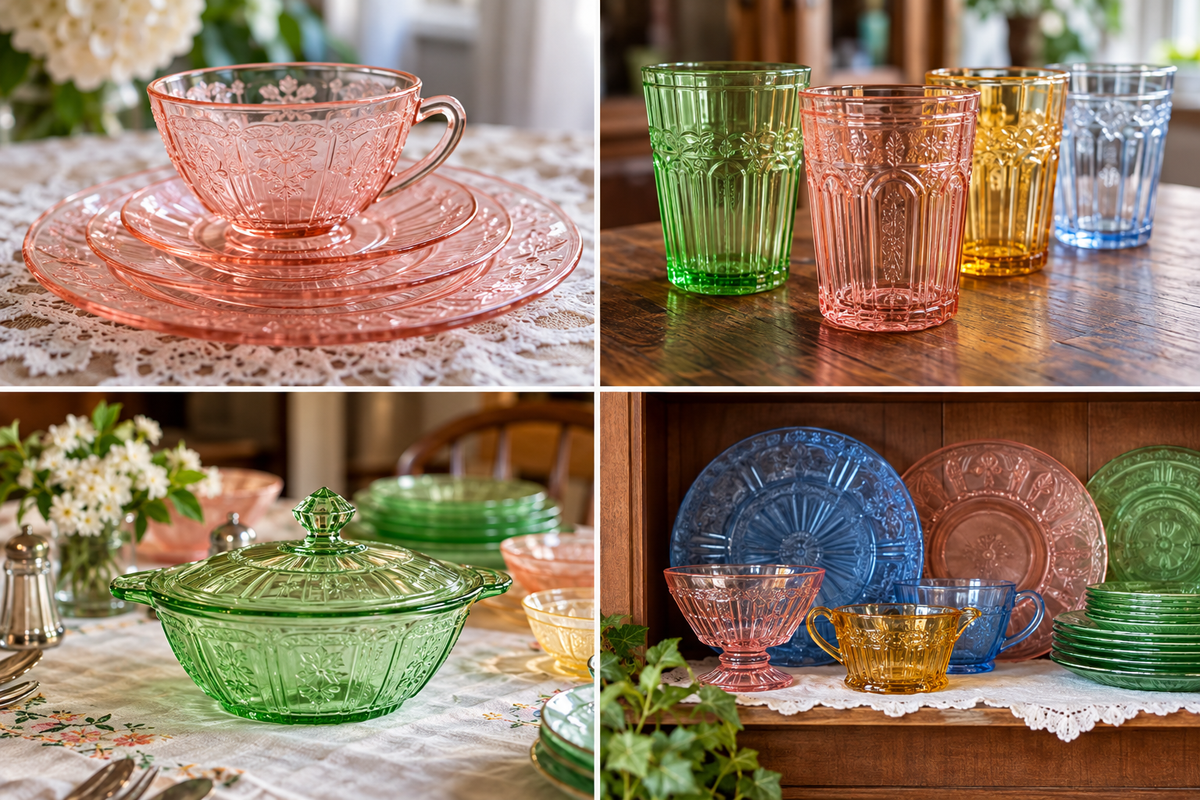
What is Depression glass? For many collectors, the answer begins with color: translucent pink plates, green tumblers, amber serving bowls, or pale blue cups glowing in the light. But Depression glass is more than a palette. It is a distinctly American chapter in the history of mass production, consumer culture, and the effort to bring attractive household goods within reach of ordinary families.
Produced primarily from the 1920s through about 1940, Depression glass was inexpensive, machine-made tableware manufactured in enormous quantities. Much of it was colorful, patterned, practical, and affordable. It appeared in stores, entered homes as promotional premiums, and sometimes arrived one piece at a time until a household had assembled much of a matching set.
Today, those once-common dishes have become collectibles—and surviving pieces offer a surprisingly vivid look at everyday American life between the world wars.
What Is Depression Glass, Exactly?
There is no perfectly rigid boundary around the term.
Collectors generally use Depression glass for inexpensive, mass-produced glass tableware associated with the late 1920s and 1930s, although some patterns appeared earlier and others continued into the 1940s or beyond.
The National Depression Glass Association identifies major patterns dating from the early 1920s through about 1940. The glass was typically produced by machine rather than individually formed and extensively hand-finished.
That distinction matters.
Glass pressing itself was not invented during the Great Depression. The Corning Museum of Glass traces mechanized glass pressing in the United States to the 1820s. The process placed molten glass into a mold and used a plunger to form the interior. Over the following century, increasingly efficient machinery made it possible to produce glassware at extraordinary speed.
By the 1920s, the technology was capable of turning out inexpensive household glass on a scale earlier glassmakers could hardly have imagined.
Depression glass was one result.
Beauty Through Mass Production
Earlier generations had certainly owned pressed glass, but improving machinery allowed manufacturers to combine speed, decorative molds, color, and low prices in new ways.
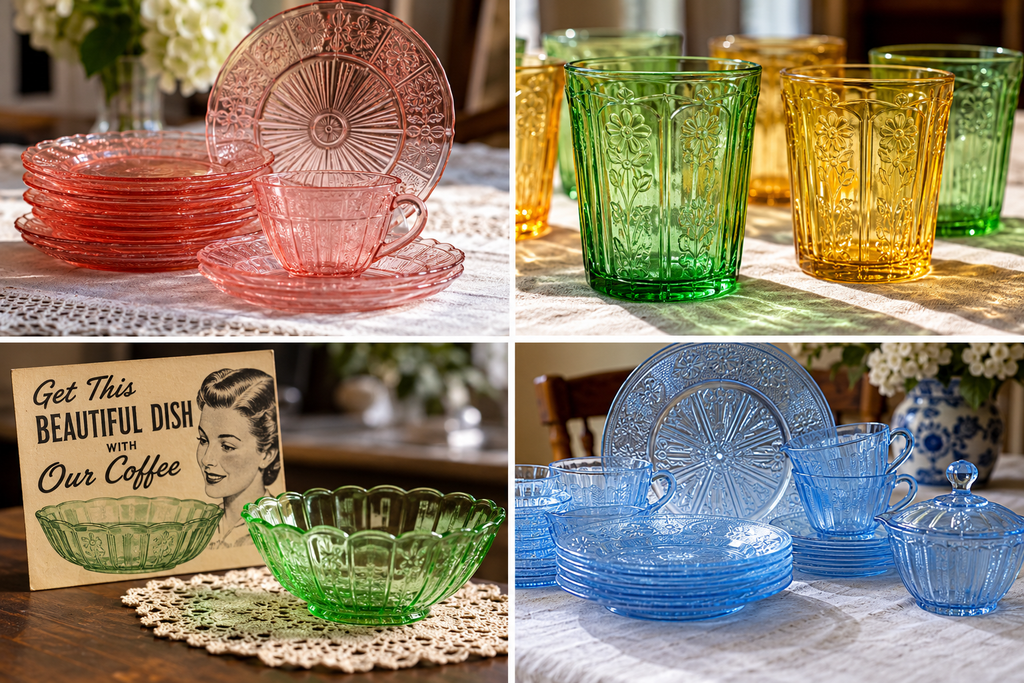
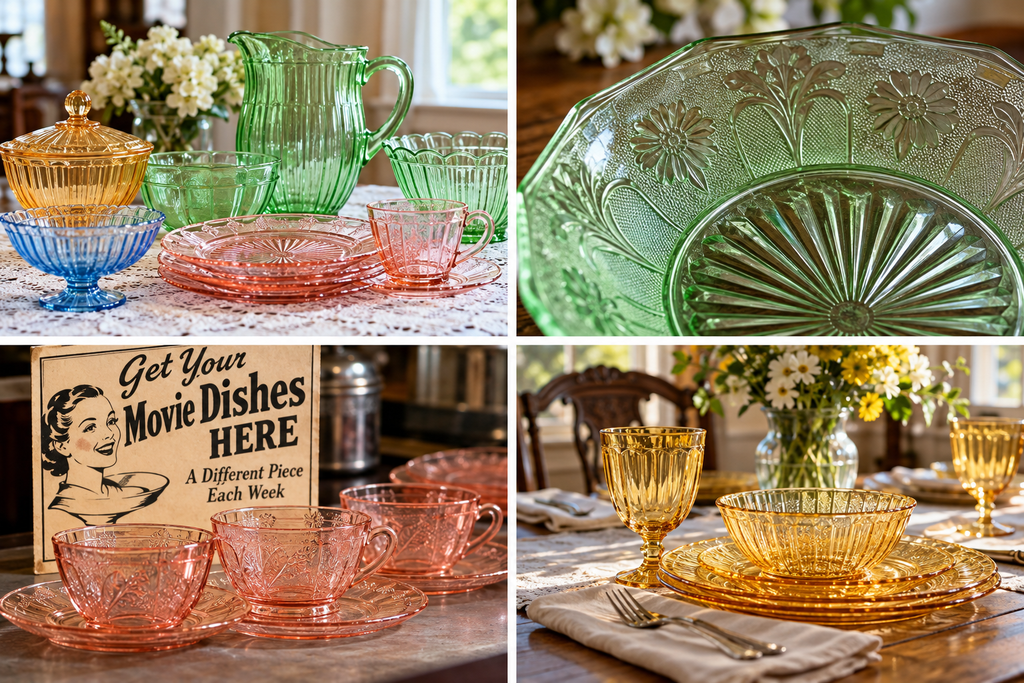
A company could produce thousands upon thousands of plates, cups, bowls, saucers, pitchers, serving dishes, and other pieces from standardized molds. Elaborate-looking flowers, geometric designs, scrolls, ribs, and other patterns could be formed directly into the glass rather than laboriously cut or engraved afterward.
That helped make decorative tableware available to families who could not afford expensive crystal or heavily hand-finished glass.
It also meant Depression glass was never intended to be flawless.
Collectors may encounter visible mold seams, small bubbles, slight irregularities in shape, variations in color, ripples, or marks created during manufacture. These characteristics do not automatically indicate damage or poor preservation. They can be normal evidence of rapid, economical production.
A chip along a rim or a crack across a plate is damage.
A small enclosed bubble from the factory is something quite different.
The Companies Behind the Glass
Several American manufacturers became closely associated with what collectors now call Depression glass.
Among the major names were:
- Hocking Glass Company
- Federal Glass Company
- Hazel-Atlas Glass Company
- Jeannette Glass Company
- Indiana Glass Company
- MacBeth-Evans Glass Company
- United States Glass Company
These companies did not all make the same types of glass or operate in exactly the same way. Their patterns, colors, production methods, and product lines varied considerably.
That diversity is part of what makes the category so collectible.
One manufacturer might offer a pattern dominated by flowing flowers. Another might favor strong Art Deco geometry. Some patterns included dozens of different forms, allowing buyers to build substantial table services. Others were comparatively limited.
Certain manufacturers also experimented heavily with color, shape, and specialized kitchen pieces.
The result was not one single “Depression glass look,” but an entire marketplace of affordable glassware.
How Families Acquired It
Price was one of Depression glass’s greatest advantages.
It could be purchased inexpensively in stores, but direct retail sale was only part of the story. Glassware also became useful as a promotional product. Manufacturers and other businesses could offer attractive dishes as premiums with consumer goods, encouraging customers to choose one brand repeatedly.
Food products and household goods were among the items associated with glassware promotions. Movie theaters also participated in dish giveaways, sometimes offering a different piece at regular intervals.
Imagine acquiring a plate this week, a cup another week, then returning later for a bowl.
Eventually, those individual pieces could become a recognizable table setting.
This method of distribution helps explain why Depression glass became woven so deeply into everyday household life. It was not restricted to formal dining rooms or wealthy homes. Maybe it appeared at breakfast, lunch, Sunday dinner, bridge parties, family gatherings, and ordinary weeknight meals.
It was useful first.
Collectible came later.
Color During Difficult Years
The contrast between the economic hardships of the 1930s and the cheerful appearance of Depression glass is difficult to miss.
Pink and green have become especially recognizable to collectors, but manufacturers produced glass in numerous colors. Amber, yellow, crystal, blue, red, and other shades also appeared, along with certain opaque colors.
Color gave inexpensive tableware visual impact.
A stack of translucent green plates could brighten a table. Pink glass could soften an otherwise practical kitchen setting. Sunlight passing through a colored pitcher or serving bowl turned an ordinary household object into something decorative.
Yet color alone does not identify Depression glass.
Later manufacturers produced similar shades, and many other kinds of vintage glass appeared in pink, green, amber, and blue. Identification requires considering pattern, shape, maker, construction, and production period together.
That is one reason learning Depression glass becomes more interesting the longer you collect it.
Depression Glass Versus Elegant Glass
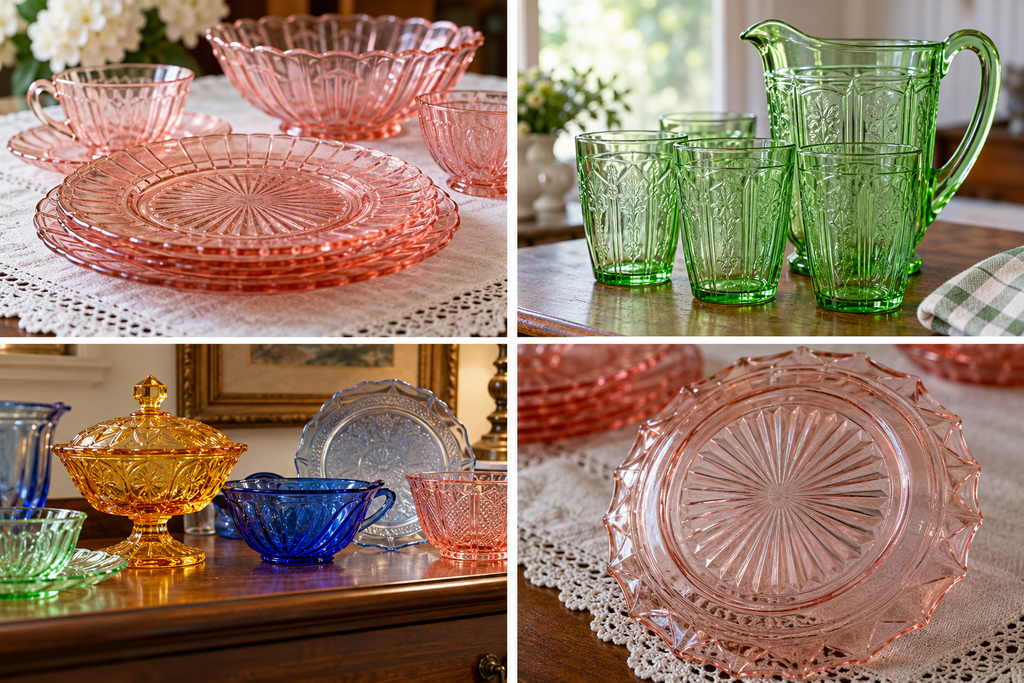
One of the most useful distinctions for beginning collectors is the difference between Depression glass and what collectors often call Elegant glass.
Both could be made during roughly the same period.
Elegant glass, however, was generally produced to a higher standard and often received additional finishing after it left the mold. Pieces might have polished edges, finer decoration, handwork, etching, cutting, or other finishing steps that added labor and cost.
Companies associated with Elegant glass include names such as Fostoria, Cambridge, Heisey, and others.
Depression glass generally depended more heavily on mechanized production and decorative molds to deliver attractive designs at a lower price.
Even here, the boundary is not absolute.
Some manufacturers and patterns occupy an uncomfortable middle ground, and collectors have debated classifications for decades. Glass history rarely arranges itself as neatly as modern collecting categories suggest.
That is worth remembering whenever a seller makes a confident identification based only on age or color.
Why Collectors Still Want It
Depression glass survived because people used it, saved it, inherited it, and eventually began deliberately collecting it.
Part of the appeal is visual. Colored glass displays beautifully, and matching pieces can transform a shelf or table.
Part of it is the challenge of identification. Once you begin recognizing patterns, shapes, and manufacturers, an anonymous pink plate at an estate sale becomes a small research problem waiting to be solved.
There is also the satisfaction of completing sets.
A collector may begin with one inherited bowl and spend years locating matching plates, cups, serving dishes, or less-common forms.
But Depression glass also has something that cannot be reduced to pattern names or price guides.
It has context.
These were dishes made for ordinary households during a period of enormous economic and social change. They represent industrial efficiency, changing consumer habits, national distribution networks, advertising promotions, modern design, and the democratization of decorative household goods.
They were inexpensive objects that helped make the table look a little more special.
That history matters.
Collect the Glass, but Learn the Story
For anyone beginning with Depression glass, identification should come before assumptions about value.
Learn the pattern.
Learn the manufacturer.
Determine which colors were actually produced during the original production period.
Look closely at the construction.
Study condition without confusing normal manufacturing irregularities with later damage.
And be cautious about assuming that every brightly colored piece of pressed glass from an estate sale belongs to this category.
Reproductions and later production complicate identification, while rarity varies dramatically from one pattern, color, or form to another. Those are subjects we will explore throughout this Depression Glass series.
For broader articles on antiques, identification, preservation, and the material culture behind collectible objects, visit Dear June’s Collecting & History archive.
Affordable Glass With an Enduring Legacy
Depression glass was not created to become precious.
That may be the most important thing to understand about it.
It was created to be made efficiently, sold cheaply, given away promotionally, carried home, stacked in cupboards, placed on tables, washed, reused, and enjoyed.
Its makers took industrial production and gave it flowers, geometry, color, and style.
Nearly a century later, collectors are still sorting through those surviving dishes—looking for patterns, completing sets, studying manufacturers, hunting unusual pieces, and remembering relatives who once used the same glass without thinking of it as antique at all.
That transformation from inexpensive household object to collectible is part of the larger story of material culture. What one generation considers ordinary may become evidence of everyday life for the next.
Depression glass reminds us that history does not survive only in museums, monuments, and expensive works of art.
Sometimes it survives in the kitchen cupboard.
Let’s Make History—one colorful piece of Depression glass at a time.
Discover more from Dear June Collectibles
Subscribe to get the latest posts sent to your email.