One of the most common pieces of genealogy advice is also one of the best: start with what you know and work backward.
That sounds simple. In practice, however, there is an important second half to the rule.
Start with what you know—but make sure you know why you believe it.
A family tree assembled from memory, handwritten notes, online trees, and stories passed down through several generations can give you an excellent starting point. It can also contain assumptions, merged identities, incorrect dates, and details that became more certain each time the story was repeated.
The beginning of good family-history research is therefore not filling as many boxes as possible. It is establishing a documented starting point, identifying what remains uncertain, and deciding which question you want the evidence to answer next.
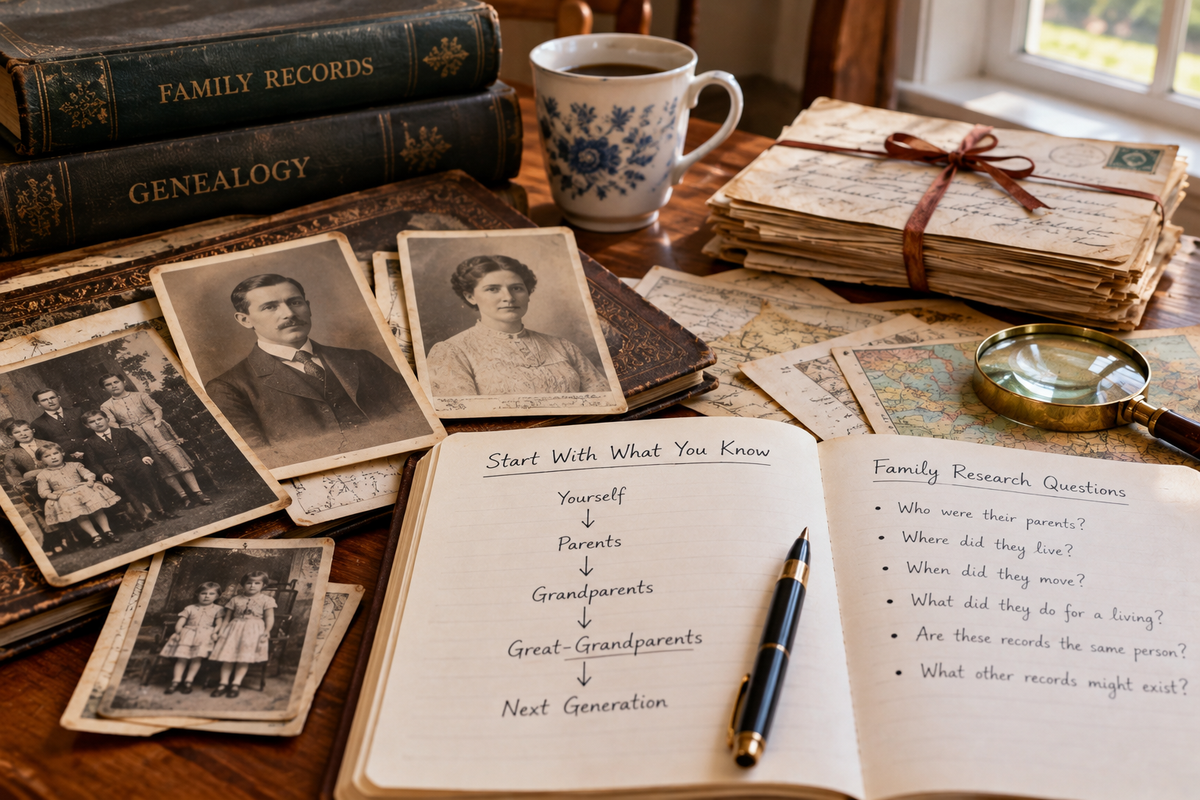
Begin With Yourself and Work Backward
The National Archives recommends beginning with yourself and moving from the known toward the unknown. That approach remains useful because genealogy is much easier to control when each generation connects to the next through identifiable evidence rather than a leap to an interesting person who happens to share a surname.
Begin with yourself, then your parents and grandparents, and continue backward toward deceased generations.
At this stage, record the basic information you already have:
- Full names, including maiden names and known alternate spellings
- Birth, marriage, and death dates
- Places connected with those events
- Family relationships
- Residences
- Occupations
- Military service
- Immigration or migration information
- Religious affiliations when relevant
- Other details that may help distinguish one person from another
Do not worry if some of the information is incomplete.
In fact, the blanks are useful. They show you where research is needed.
It is also worth recording variations rather than silently choosing one version. If your grandfather appears as William Joseph Murphy in one document, W. J. Murphy in another, and Joseph Murphy in family notes, preserve those variations. Names were recorded inconsistently, spellings changed, and people did not always use the same form of their name throughout life.
See What the Family Already Has
Before searching a database, look around.
Families often possess material that can save hours of research or point toward records you would not otherwise know to seek.
Birth, marriage, and death certificates are obvious examples, but useful family-history evidence may also be hiding in funeral cards, family Bibles, photographs, letters, diaries, military papers, immigration or naturalization documents, deeds, address books, newspaper clippings, cemetery information, handwritten family trees, and notes made by earlier relatives.
Even the back of an old photograph may matter.
A penciled name, town, studio mark, military unit, school, or approximate year can become the clue that identifies a person later.
These materials do not all carry the same evidentiary weight. A certified record created close to an event and a family tree written from memory decades later are different kinds of sources. Both can be useful, but they must be evaluated according to what they actually are.
That is one of the habits worth developing early: keep the information, but do not automatically promote every piece of information to fact.
Separate Knowledge From Memory and Assumption
Suppose a handwritten family tree says your great-grandfather was born in Pennsylvania in 1882.
What do you actually know?
Perhaps the person who created the tree had access to a family Bible that no longer survives, perhaps the date came from a death certificate, perhaps it was remembered by a granddaughter, and perhaps someone copied it from an online tree ten years ago.
Until you know the source, “born in Pennsylvania in 1882” is better treated as a lead than a conclusion.
A simple working system can help. As you organize what you have, mentally—or literally—separate information into categories such as:
Documented: supported by an identifiable source.
Reported: supplied by a relative or family tradition.
Copied: taken from another family tree, genealogy, or set of notes whose underlying evidence has not yet been checked.
Inferred: a conclusion suggested by available evidence but not directly stated.
Unknown: still unanswered.
Those labels can change as research progresses.
That is the point.
Family Stories Are Clues, Not Enemies
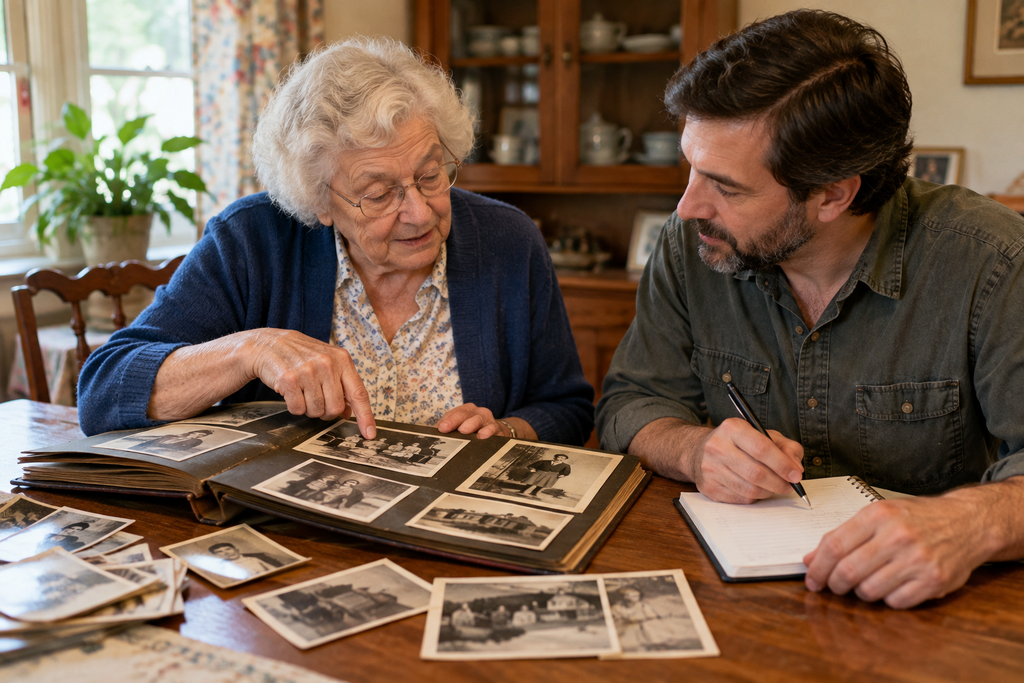
Family stories deserve respect.
Oral history may preserve details that never reached an official record: occupations, nicknames, family relationships, migrations, disagreements, unusual deaths, military experiences, lost property, religious changes, or the reason someone supposedly left a particular place.
A remembered story can tell you what to search for.
But memory is not a recording device.
Over time, two relatives can become one person. A town can become a nearby city that later generations recognize more easily. A Civil War story may migrate from one ancestor to his brother. An immigration date can drift by a decade. A story about a great-grandparent can gradually be attributed to a grandparent.
The goal of research is not to “disprove Grandma.”
The better question is: What parts of this story can surviving evidence support, refine, or contradict?
Sometimes the basic family story turns out to be remarkably accurate, sometimes the event happened, but to a different relative, and sometimes the story preserves an important truth even though the names or dates shifted.
And sometimes the evidence simply does not allow a firm conclusion.
All of those outcomes are useful.
An Online Tree Is Not the Same as Evidence
Online family trees can be enormously helpful. They can expose you to possible relatives, locations, records, photographs, and research done by people you may never have met.
They can also spread mistakes with astonishing efficiency.
One incorrect relationship can be copied into dozens or hundreds of trees. The number of trees repeating the claim does not turn one original assumption into independent evidence.
Common problems include people with similar names being merged into one identity, records attached to the wrong individual, impossible timelines, children appearing before their supposed parents were old enough to have them, and events assigned to a person who had already died.
Shared-tree systems themselves distinguish user-contributed family information from historical records, and good genealogy practice still requires examining whether the underlying source actually supports the conclusion being attached to it.
That does not mean ignoring online trees.
Use them as maps showing possible roads.
Then check whether those roads actually exist.
Turn What You Know Into a Research Question
One of the easiest ways to make genealogy unmanageable is to begin with:
“I want to research my family.”
That is a goal, but it is not yet a research question.
A useful question has boundaries.
For example:
Who were the parents of Margaret O’Brien, who was living in Pittsburgh in 1900?
Where was Samuel Carter living before he appeared in the 1880 census in Ohio?
When did the Reynolds family move from Virginia to Indiana?
Are the two men named Thomas Kelly appearing in these records actually the same person?
Can an obituary identify the married names of Sarah Miller’s daughters?
Each question suggests particular records, locations, and time periods.
That makes research more efficient.
If you want to determine when a family moved, you might compare census records, city directories, land transactions, tax records, newspapers, or children’s birthplaces.
If you want to identify parents, a different set of sources may become more important.
Research should follow the question rather than searching every database simply because it is available.
And genealogy rarely proceeds in a straight line.
One answered question usually creates another.
Record the Search, Not Just the Answer
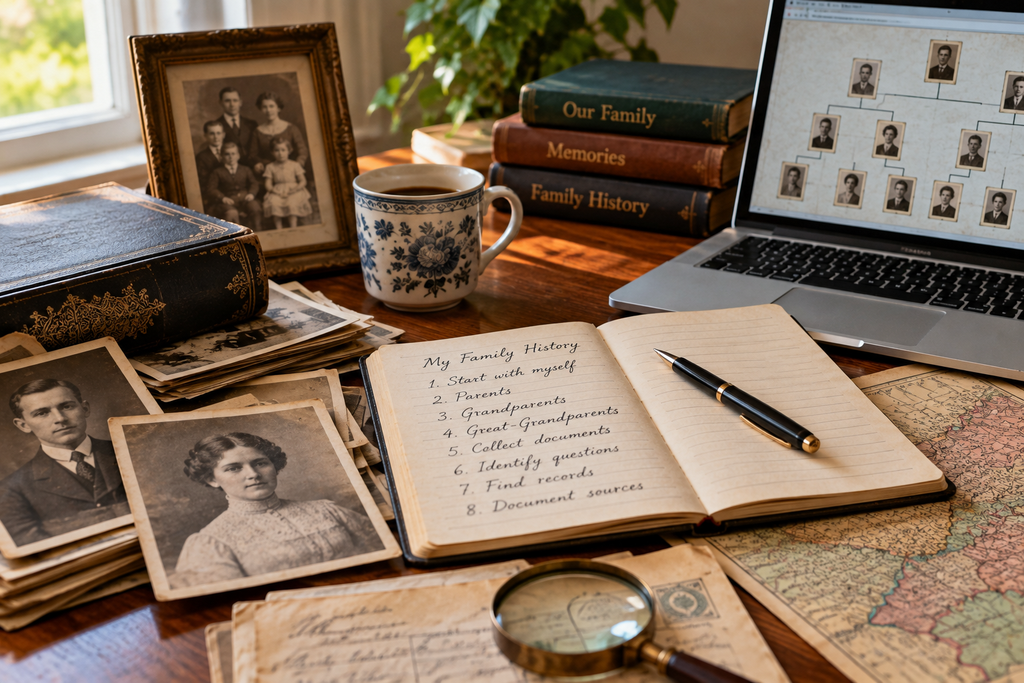
Documentation is easiest when it becomes part of the research process rather than something you intend to reconstruct later.
When you find a useful record, preserve enough information to answer several questions:
What did you find?
Where did you find it?
Which person does it appear to concern?
What does the record actually say?
What conclusion does it support?
Does anything conflict with information already collected?
What should be checked next?
A useful citation should contain enough information that you—or another researcher—can find the source again. FamilySearch similarly recommends providing enough identifying information for another person to locate and evaluate a source rather than merely attaching an unsupported statement to a tree.
This matters even when the answer seems obvious.
Six months later, “I found his marriage date somewhere” is considerably less useful than knowing exactly where that date came from.
Conflicting Evidence Is Part of the Research
Sooner or later, two records will disagree.
Perhaps a census suggests an 1867 birth while a death certificate gives 1869. One obituary names a mother as Catherine; a marriage record calls her Ellen. A gravestone disagrees with a military record. A person claims one birthplace in one census and another ten years later.
Do not quietly choose the answer you like best.
Record the conflict.
Then investigate it.
Ask who provided each piece of information, when the record was created, how close the informant was to the event, whether the record concerns the correct person, and whether other independent evidence supports either version.
Sources are especially valuable when information conflicts because they allow researchers to compare the evidence rather than simply selecting whichever fact has been repeated most often.
Sometimes the conflict can be resolved.
Sometimes one explanation becomes much more likely than the others.
And sometimes the responsible conclusion is:
The available evidence strongly suggests this answer, but does not yet prove it.
That is not a weakness.
It is better genealogy than certainty unsupported by evidence.
Know What You Are Trying to Find Next
The first stage of family-history research should leave you with more than a partially filled family tree.
You should have a working inventory of what is already known, what is merely remembered or copied, what sources support important facts, where conflicts exist, and which unanswered question deserves attention next.
That gives the research direction.
If organizing that starting point reveals a question you would rather have investigated professionally, Dear June Collectibles offers source-documented family-history research for defined projects. Depending on the problem, that might mean Single Ancestor Genealogy Research, a focused Historical Record Search, or a Genealogy Research Plan designed to identify the strongest next steps.
The broader genealogy and family-history research options are available at:
The same principle applies whether you are doing the work yourself or hiring someone to help.
Start with what you know.
Then ask where it came from.
Document it.
Question it.
Choose the next problem.
And follow the evidence wherever it actually leads.
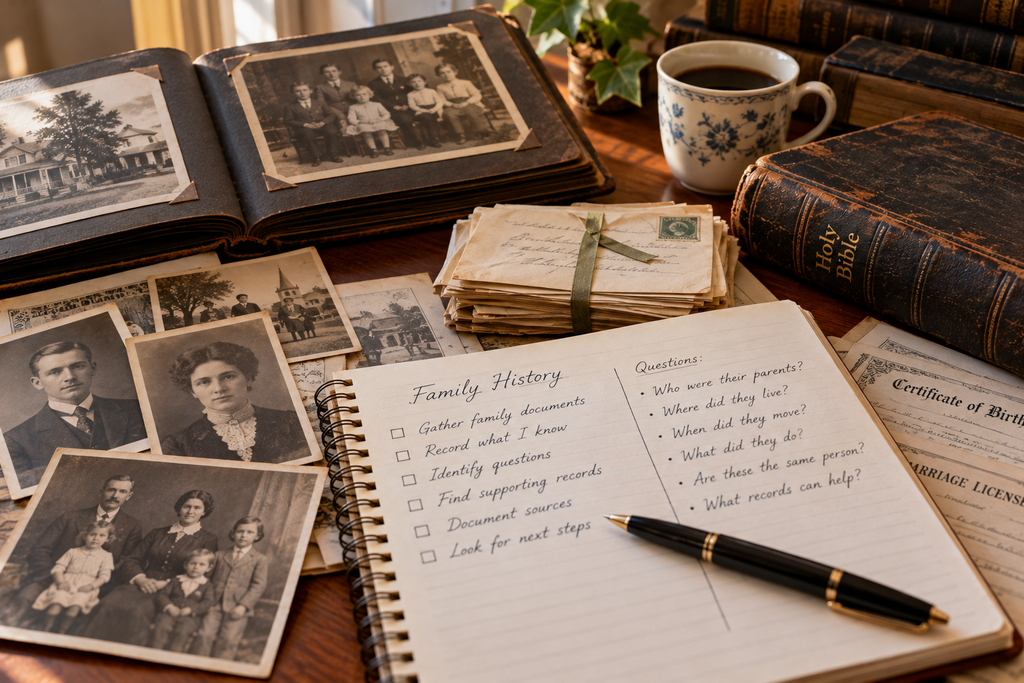
Family history does not become more reliable because we fill every blank. It becomes more reliable because we can explain why the information belongs there—and because we are willing to leave a blank when the evidence has not yet earned an answer.
Let’s Make History—by turning what our families remember into carefully documented stories the next generation can trust.
Discover more from Dear June Collectibles
Subscribe to get the latest posts sent to your email.