
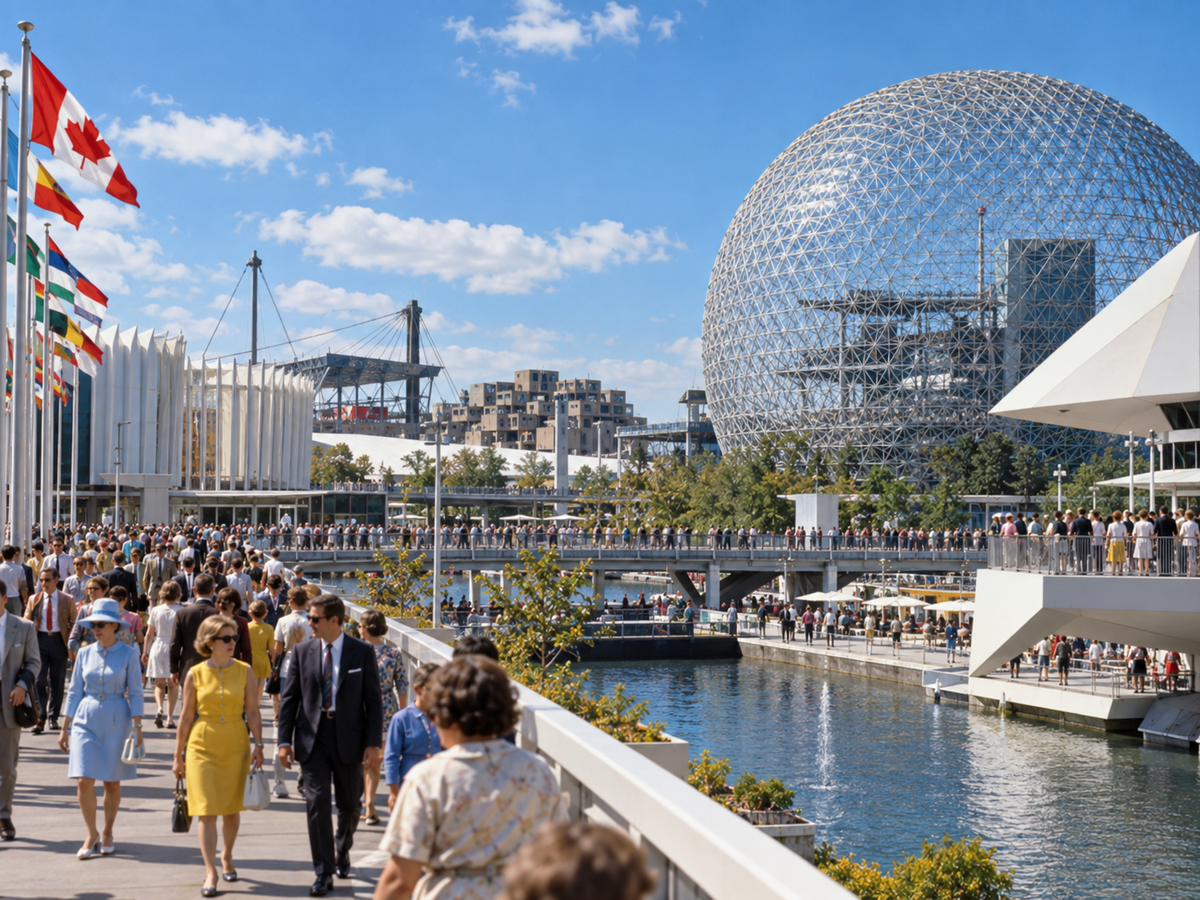
By the time Expo 67 opened in Montreal on April 28, 1967, the World’s Fair had become something larger than a showcase of industrial achievement. It was now a meeting place for architecture, national identity, mass tourism, design, entertainment, technology, and international culture.
Expo 67 embraced all of those ideas at once.
Held during Canada’s centennial year, the exhibition welcomed more than 50 million visits before closing on October 29. Sixty-two participants took part under the theme “Man and His World,” transforming islands in the St. Lawrence River into an extraordinary collection of experimental buildings, national pavilions, transportation systems, public art, restaurants, performances, and attractions.
For collectors, Expo 67 produced an equally international world in miniature. Passports, pavilion stamps, postcards, buttons, drinking glasses, ashtrays, spoons, pennants, records, guidebooks, tickets, and countless novelty souvenirs allowed visitors to carry pieces of the exposition home.
Montreal Invites the World
Expo 67 was closely tied to Canada’s 100th anniversary of Confederation, but its ambitions were unmistakably international.
The exposition was built partly on Île Sainte-Hélène and partly on Île Notre-Dame, an artificial island created in the St. Lawrence River. Montreal’s expanding Metro system connected visitors with a fairground designed largely around walking, bridges, canals, trains, and other forms of mass transportation rather than private automobiles.
More than 60 national pavilions presented countries through architecture, art, technology, food, design, and cultural displays. Corporate exhibits and theme pavilions expanded the experience further, while La Ronde supplied amusement rides and entertainment.
The structures themselves became souvenirs before visitors even entered a gift shop.
The United States pavilion, designed around Richard Buckminster Fuller’s enormous geodesic dome, was one of the most recognizable buildings on the site. Measuring about 76 metres in diameter and 61 metres high, the dome enclosed a multilevel exhibition devoted to “Creative America.” The structure survives today as Montreal’s Biosphere.
Nearby, Moshe Safdie’s Habitat 67 offered a radically different vision of urban housing, combining modular concrete units into an apartment complex that attempted to offer some of the advantages of individual homes within high-density city living. Habitat became another lasting visual symbol of the exposition.
Visitors could therefore return home with souvenirs depicting buildings that looked unlike almost anything in the earlier history of World’s Fairs.
The Expo Passport
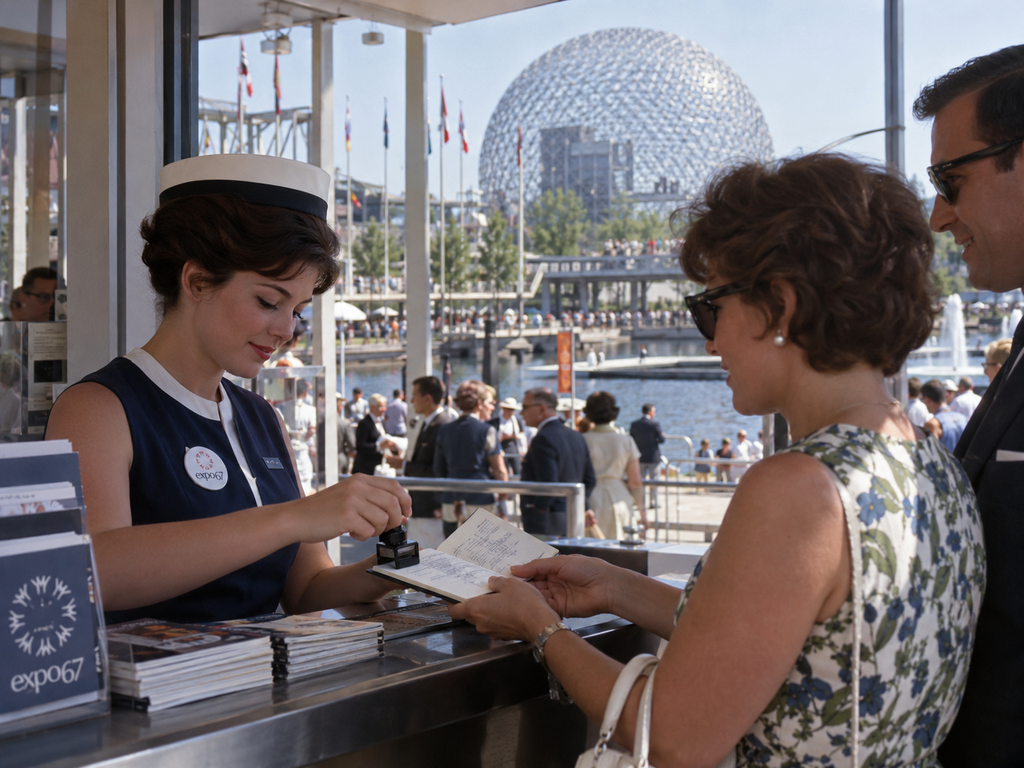
One of the most memorable Expo 67 collectibles began as something practical: a passport.
Visitors could purchase Expo passports and carry them from pavilion to pavilion, where they collected stamps or visas. The idea transformed touring the exhibition into a kind of international journey without leaving Montreal.
Today, those passports can be particularly appealing pieces of ephemera because no two necessarily tell exactly the same story.
McGill University’s Expo 67 collection includes multiple red season passports as well as later material from the continuing Man and His World exhibitions. The Canadian Museum of History also preserves an Expo 67 passport among its collections.
An unused passport is interesting as an artifact of the fair. A heavily stamped example can be even more personal.
The stamps reveal where an individual visitor went, which national pavilions they entered, and how they moved through the exhibition. Handwritten names, dates, notes, ticket stubs, or other material tucked inside can turn a mass-produced souvenir into a miniature travel record.
That makes the passport different from many conventional souvenirs. Rather than simply representing Expo 67, the visitor helped create the finished object.
An Explosion of Souvenirs
The enormous attendance created a vast market for merchandise.
McGill’s archival Expo collection illustrates just how broad the surviving material can be. It contains pavilion buttons, commemorative license plates, a recording titled The Sounds of Expo 67, drinking glasses decorated with pavilion scenes, ceramic plates, ashtrays, a pennant, postcards, tickets, souvenir spoons, and other objects.
Postcards were especially well suited to the fair.
Expo 67 offered architecture and color everywhere, from futuristic national pavilions to the Minirail, canals, bridges, Habitat 67, the geodesic dome, and the amusement areas of La Ronde. Postcards allowed visitors to send those sights around the world while also building inexpensive collections of their own.
McGill preserves individual postcards as well as accordion-style postcard books and miniature albums containing Expo views.
Other souvenirs brought Expo imagery into everyday life.
A family might use commemorative drinking glasses. A visitor could wear a pavilion button, display a pennant, keep a spoon in a souvenir collection, or play a record associated with the exhibition. Objects connected to corporate sponsors, individual countries, restaurants, transportation systems, and specific attractions broaden the field even further.
For collectors today, that variety makes Expo 67 unusually approachable. Someone can build a collection around architecture, paper, national pavilions, transportation, household objects, music, photography, or simply the Expo logo itself.
A Fair That Reflected a Changing World
Expo 67 also illustrates how international exhibitions were changing.
By the middle of the twentieth century, World’s Fairs were no longer simply competitions in machinery and industrial output. They increasingly presented technology as part of broader questions about humanity, cities, culture, cooperation, and everyday life.
The Bureau International des Expositions notes that this shift was visible in themes such as Brussels 1958’s “A World View: A New Humanism” and Montreal’s “Man and His World.” At the same time, decolonization increased the number of independent nations participating in international exhibitions, giving fairs a broader global character.
Expo 67 reflected both optimism and political change.
Parks Canada notes that the fair celebrated Canadian accomplishment while also raising questions concerning Indigenous identity and Quebec’s future within Canada. The Indians of Canada Pavilion was particularly important because Indigenous organizers used the space to address the history and treatment of Indigenous peoples rather than simply presenting a romanticized cultural display.
That context matters when collecting.
Souvenirs tell us what fairs promoted, but they may also reveal how participating countries wished to present themselves to an international audience at a particular moment in history.
Brussels, Osaka, and the Global Souvenir
Expo 67 belongs to a much larger international collecting field.
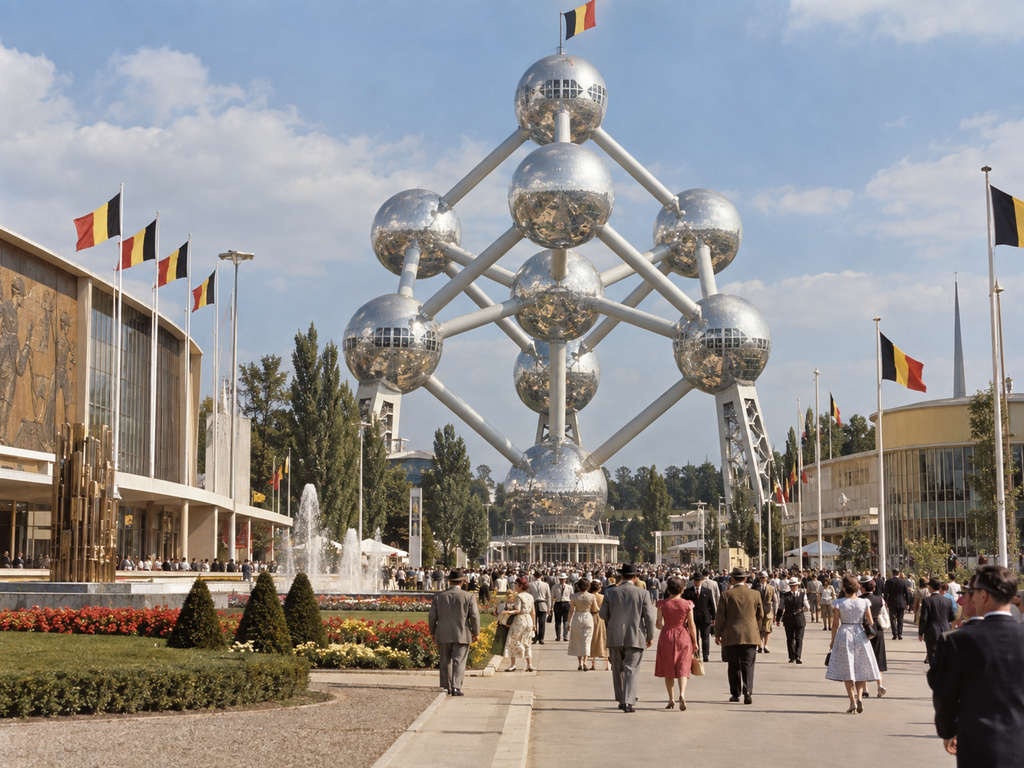
Nine years earlier, Expo 1958 in Brussels had introduced one of the most recognizable World’s Fair structures ever built: the Atomium. Designed as an enormous representation of an iron crystal magnified 165 billion times, the 102-metre structure embodied the era’s fascination with atomic science and technological progress. It became so closely associated with the exhibition that it ultimately survived and developed into a permanent symbol of Brussels and Belgium.
For collectors, the Atomium performs much the same function as the Trylon and Perisphere or Space Needle: its silhouette can immediately identify the fair behind a souvenir.
Then came Osaka.
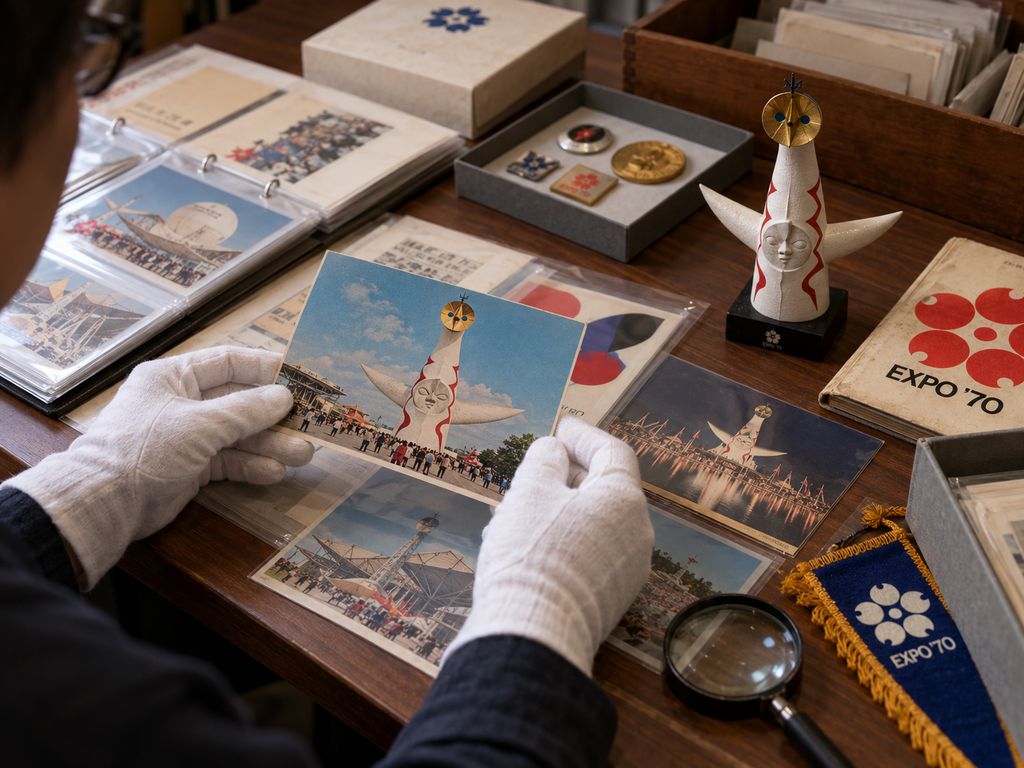
Expo 1970 was the first World Expo held in Japan and the first in Asia. More than 64 million visitors attended under the theme “Progress and Harmony for Mankind.” Its most famous symbol was Taro Okamoto’s 70-metre Tower of the Sun, a striking structure containing multiple symbolic faces and standing at the heart of the exposition’s Symbol Zone.
Just as earlier fairgoers carried home images of Chicago’s Ferris Wheel or Seattle’s Space Needle, visitors to Brussels and Osaka bought objects carrying these instantly recognizable landmarks.
That pattern appears repeatedly across international expositions.
Buildings become icons. Icons become graphics. Graphics become souvenirs.
A complex international event may ultimately survive in a collector’s cabinet as a spoon, pin, postcard, toy, ashtray, ceramic plate, ticket, pennant, or guidebook.
Identifying International World’s Fair Material
Global fair souvenirs can require a little more research than familiar American material.
Language is one obvious clue.
A souvenir may identify an exposition in French, Dutch, Japanese, Spanish, or another language rather than using the English phrase World’s Fair. Even Expo 67 regularly appears under both its English and French identities, including Man and His World and Terre des Hommes.
Logos and architecture are therefore especially useful.
The Atomium strongly suggests Brussels 1958. Fuller’s geodesic dome and Habitat 67 point toward Montreal. The Tower of the Sun identifies Osaka 1970. Other fairs developed their own equally distinctive buildings, mascots, emblems, typography, and visual styles.
Country names can also matter. A piece may have been produced for an individual pavilion rather than for the exposition generally.
Original packaging is especially useful when collecting international material because it may preserve manufacturer names, country of manufacture, fair licensing information, dates, or retail prices that the object itself lacks.
Collectors should also distinguish material sold during the original exposition from later tourist souvenirs.
Some famous World’s Fair structures survived and became permanent attractions. The Atomium, Habitat 67, Montreal’s Biosphere, and Osaka’s Tower of the Sun all continued beyond their original fairs. Their images therefore appear on later merchandise as well as original exposition souvenirs.
Collecting the World Through Its Fairs
Expo 67 demonstrates why World’s Fair collecting can expand almost indefinitely.
A collector might begin with Montreal postcards and discover pavilion material from France, Japan, the United States, or Czechoslovakia. That can lead to souvenirs from fairs held in those countries, followed by earlier exhibitions, later exhibitions, or specialized collections devoted to architecture, transportation, national identity, or graphic design.
The objects become connections between places and periods.
A Brussels Atomium souvenir reflects the atomic optimism of the 1950s. A Montreal passport captures the internationalism of the 1960s. An Osaka Tower of the Sun piece represents another interpretation of technological progress at the beginning of the 1970s.
Together, they show that there was never just one vision of the future.
Every host city interpreted progress through its own architecture, culture, politics, and design. Visitors then carried those interpretations around the world in suitcases and pockets.
That may be one of the most appealing things about global World’s Fair souvenirs. They are small objects created for temporary events, yet they preserve moments when entire countries gathered to explain who they were—and who they hoped to become.
Let’s Make History—one passport stamp and pavilion at a time.
Discover more from Dear June Collectibles
Subscribe to get the latest posts sent to your email.