A little more than two decades separated the New York World’s Fair of 1939 from Seattle’s Century 21 Exposition of 1962, but the future changed dramatically between them.
In New York, visitors were invited into a carefully designed “World of Tomorrow,” filled with streamlined buildings, new consumer products, television, highways, synthetic materials, and visions of technologically planned cities. By the time Seattle opened its gates in 1962, Americans were living with jet travel, satellites, nuclear power, computers, and an accelerating space race. Seattle’s fair looked upward, promising life in the Space Age.
The souvenirs from these fairs captured those changing ideas almost perfectly. The rounded Perisphere and soaring Trylon dominated New York memorabilia. Twenty-three years later, the Space Needle, monorail, and rocket-age graphics took their place.
For collectors, the two fairs offer an unusually clear opportunity to watch the American idea of the future evolve through ordinary objects.
New York Builds the World of Tomorrow
The 1939 New York World’s Fair opened on April 30 in Flushing Meadows, Queens, on the 150th anniversary of George Washington’s first presidential inauguration. It returned for a second season in 1940 and ultimately attracted nearly 45 million visitors. Its theme, the “World of Tomorrow,” promised an optimistic escape from the economic difficulties of the Great Depression and presented technology and consumer goods as tools for creating a better future.
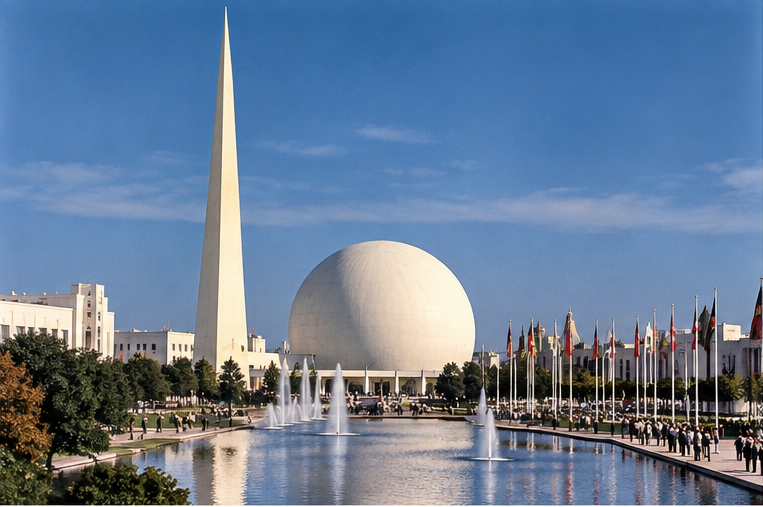
Nothing represented that vision more clearly than the fair’s Theme Center.
The Trylon was a towering triangular structure beside the enormous spherical Perisphere, connected by the curving Helicline ramp. Inside the Perisphere, visitors encountered Democracity, a model imagining an orderly future metropolis. The simple geometric forms of the Trylon and Perisphere became the fair’s unofficial logo and appeared on an enormous range of souvenirs.
That repetition is useful for collectors today.
A compact, pin, plate, camera, postcard, drinking glass, ashtray, or piece of jewelry showing a tall pointed tower beside a sphere can often be connected quickly with the 1939–1940 fair. Smithsonian collections demonstrate just how extensively the design was used, appearing on everything from inexpensive pins to decorative china and personal accessories.
The objects also reflect the period’s fascination with streamlined design. Even relatively inexpensive souvenirs could incorporate smooth curves, metallic finishes, plastics, bold graphics, and simplified geometric forms.
The future was not merely being exhibited. It was being packaged for visitors to take home.
A Fair Filled with Things to Buy—and Things to Photograph
The 1939 fair was closely connected with American consumer culture.
Major corporations created elaborate pavilions that introduced visitors to products, technologies, and ideas about modern living. General Motors presented its celebrated Futurama, designed by Norman Bel Geddes. Visitors rode above an enormous model landscape imagining an America of 1960 with controlled-access highways and efficiently organized cities.
Those leaving received small buttons announcing “I Have Seen the Future.” Examples survive in the Smithsonian today.
It is difficult to imagine a more concise World’s Fair souvenir. The object was inexpensive and small enough to wear home, yet it summarized the entire purpose of the attraction.
Kodak took a similarly clever approach. At the fair, visitors could purchase specially decorated cameras, including a Bullet camera featuring the Trylon and Perisphere. Kodak also operated a Photo Garden designed to provide attractive opportunities for visitors to take snapshots.
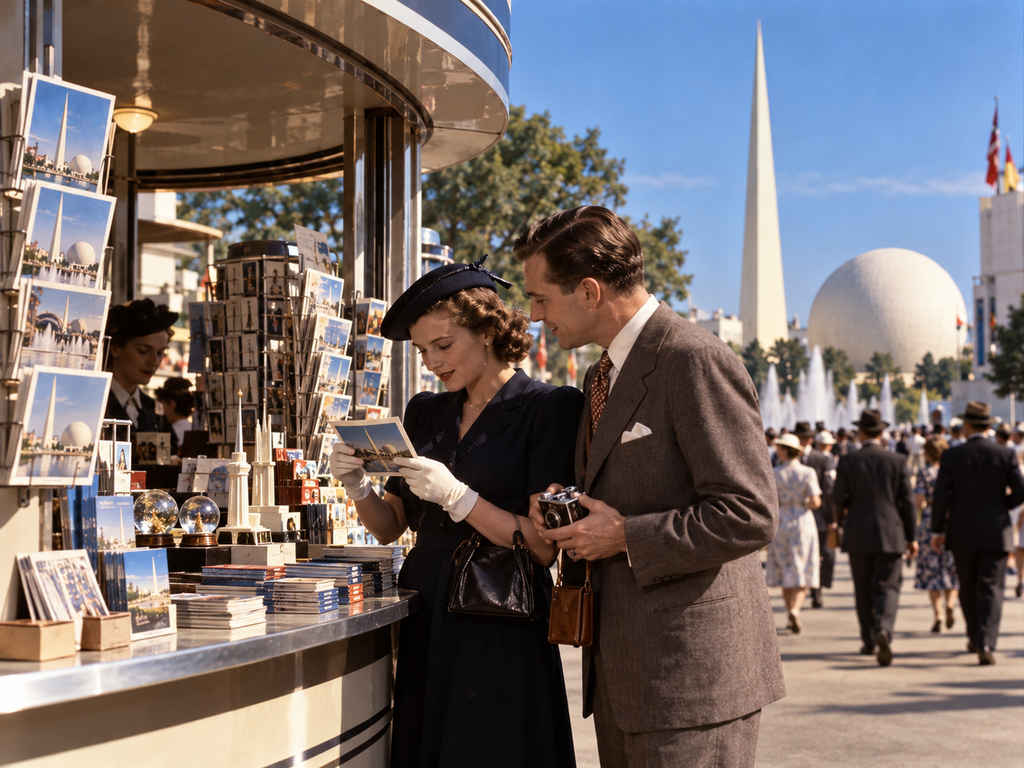
That connection between tourism, consumer products, and photography helped create an enormous visual record. Family albums filled with fair snapshots can now be collectibles alongside officially manufactured souvenirs.
Collectors may encounter souvenir plates, compacts, pins, textiles, photographs, film viewers, brochures, maps, tickets, advertising pieces, and countless other objects. One surviving Homer Laughlin souvenir plate surrounds the familiar Trylon and Perisphere with images of several exhibition buildings, essentially turning a piece of household ceramics into a miniature architectural tour of the fair.
Then history intervened.
The fair’s optimistic futurism existed against an increasingly ominous international backdrop. World War II began in Europe during the fair’s first season. By the time the exposition closed in 1940, its vision of an orderly technological future existed beside a very different global reality.
Seattle Looks Toward Space
When another major American World’s Fair opened in Seattle on April 21, 1962, technology no longer meant quite the same thing.
The Soviet launch of Sputnik in 1957 had intensified competition in science and space exploration. Seattle also had close ties to the aerospace industry. What had originally been conceived partly as a commemoration of Seattle’s earlier 1909 Alaska-Yukon-Pacific Exposition evolved into something much more forward-looking: the Century 21 Exposition.
Its theme was “Living in the Space Age.”
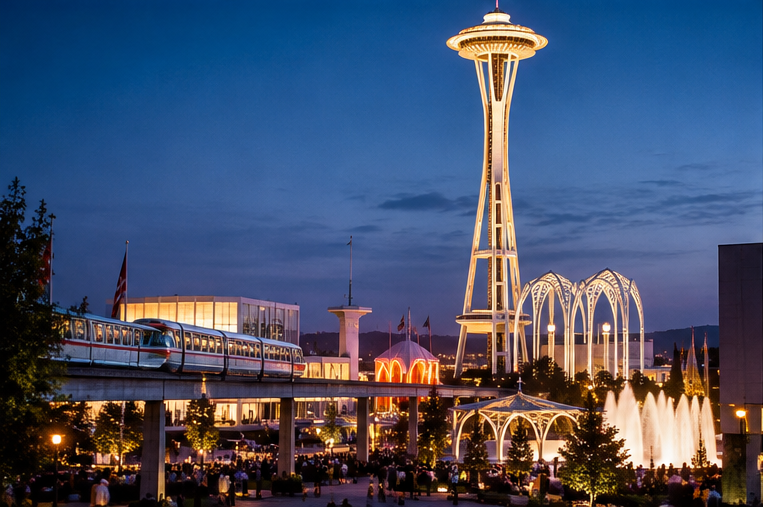
The fair ran through October 21, 1962 and attracted nearly 10 million visitors. Several structures created for it became permanent Seattle landmarks, including the Space Needle, Seattle Center Monorail, and the United States Science Pavilion, which became the Pacific Science Center.
The difference from 1939 is immediately apparent in the souvenirs.
New York’s dominant symbols were abstract geometric architecture: sphere and spire. Seattle offered a structure that looked almost ready for launch.
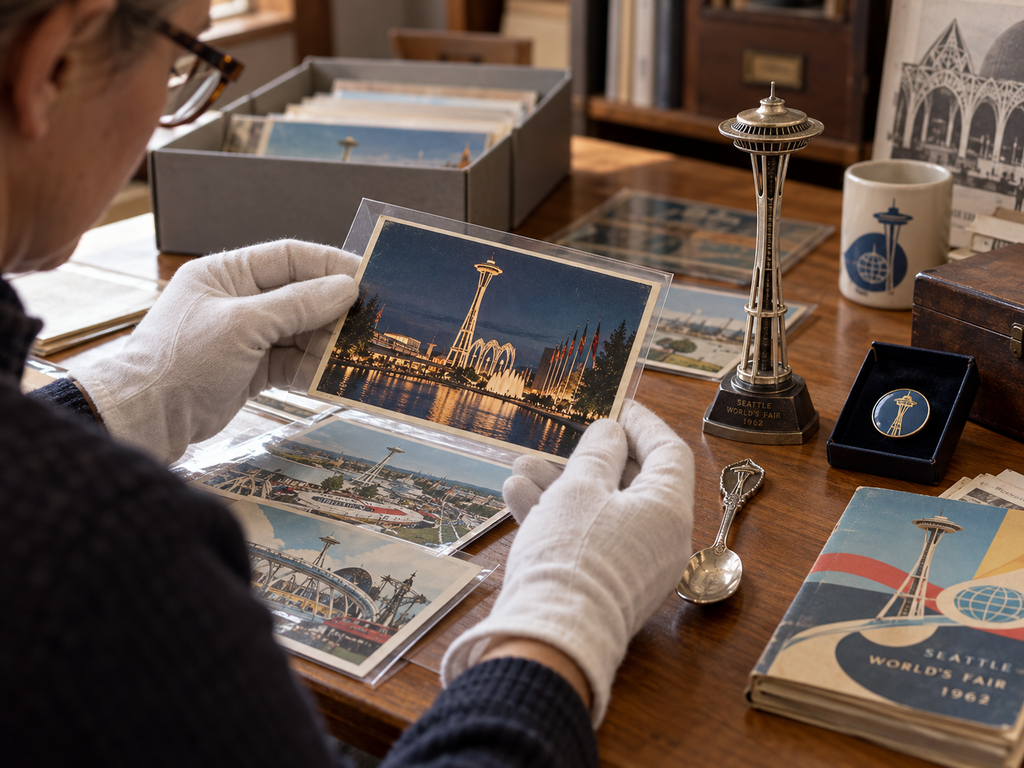
The Space Needle became irresistible souvenir material.
Its narrow tower and flying-saucer-like observation level translated easily onto postcards, drinking glasses, plates, spoons, pins, jewelry, toys, ashtrays, and household objects. Some manufacturers went further and turned the building itself into three-dimensional merchandise.
The Smithsonian preserves, among other pieces, a ceramic souvenir dish showing the Space Needle, a spoon decorated with it, and a miniature metal Space Needle model manufactured in Japan in its original box.
The Souvenirs Become More Modern
Placing souvenirs from 1939 beside those from 1962 reveals more than different landmarks.
They also show changes in manufacturing and consumer taste.
The New York fair still produced plenty of traditional souvenir forms: commemorative china, metal compacts, decorative pins, textiles, and household objects. But plastics and modern industrial materials had become increasingly visible.
By 1962, inexpensive molded goods, colorful printed materials, novelty objects, and unmistakably mid-century graphics were everywhere. The visual vocabulary of the Space Age—stars, rockets, atoms, satellites, sweeping curves, and futuristic typography—made ordinary souvenirs feel modern.
Even traditional souvenir categories received a space-age treatment.
A spoon was still a spoon, but now it might carry a tiny Space Needle. A commemorative dish could feature the futuristic tower rather than a neoclassical exposition hall. A pinback button could combine the Space Needle, monorail, and U.S. Science Pavilion into a tiny wearable summary of the fair.
One surviving Seattle button simply announced “I Was There.” Its design includes three of the exposition’s most recognizable features: the Space Needle, monorail, and Science Pavilion.
That phrase gets directly to the purpose of so much World’s Fair memorabilia.
The souvenir was evidence of participation.
Collecting Two Different Futures
For collectors, New York 1939–1940 and Seattle 1962 can be approached separately, but comparing them makes both more interesting.
New York material often rewards an eye for Art Deco and streamlined design. The Trylon and Perisphere are obvious identifiers, but collectors can also pursue corporate pavilion material, Futurama pieces, cameras and photographic memorabilia, transportation items, architectural souvenirs, advertising, textiles, guidebooks, and paper ephemera.
Seattle offers another enormous range. Space Needle material alone could form a substantial collection, but there are also monorail souvenirs, Century 21 logos, Science Pavilion items, postcards, programs, maps, tokens, badges, toys, and promotional material.
Some objects crossed the boundary between souvenir and functioning currency. Century 21 even produced tokens redeemable for one dollar in trade at the exposition grounds or participating Washington businesses. Surviving examples combine the Space Needle, monorail, and U.S. Pavilion with unmistakably promotional wording.
As with older World’s Fair material, collectors should be cautious about assuming that anything showing a famous landmark dates from the original exposition.
The Space Needle never disappeared, and it remains an internationally recognized Seattle symbol. Thousands of later souvenirs have been manufactured using its image. Determining whether a piece actually dates to 1962 can require attention to packaging, manufacturer information, inscriptions, materials, construction, and comparison with documented examples.
New York material presents its own complications. The fair operated during both 1939 and 1940, and souvenirs may bear either year, both years, or simply fair imagery without a prominent date.
What Happened to Tomorrow?
Perhaps the most fascinating thing about these two fairs is that we can now judge their visions of the future from the future they were trying to imagine.
Some predictions look naïve. Others seem surprisingly familiar.
The automobile-centered America imagined at New York’s Futurama resembles parts of the suburban highway landscape that emerged after World War II. Television and synthetic materials became ordinary. Seattle’s fascination with aerospace anticipated an era in which satellites, space exploration, and advanced electronics became part of everyday life.
Yet neither fair could truly predict how society would change.
That makes their souvenirs more interesting, not less.
They preserve moments when tomorrow still seemed like a destination people might visit for an afternoon. Buy a ticket, ride the monorail, enter a pavilion, look at a model city, purchase a postcard, and glimpse a world that had not arrived yet.
New York gave visitors the World of Tomorrow.
Seattle invited them into the Space Age.
What those visitors carried home—buttons, dishes, cameras, models, postcards, spoons, tokens, photographs, and countless other keepsakes—allows collectors today to hold two very different versions of the future in their hands.
Let’s Make History—from the World of Tomorrow to the Space Age.
Discover more from Dear June Collectibles
Subscribe to get the latest posts sent to your email.