World’s Fair collecting can become enormous very quickly.
A single exposition might produce postcards, tickets, guidebooks, photographs, glassware, ceramics, jewelry, toys, advertising, pennants, medals, buttons, spoons, architectural miniatures, and dozens of other kinds of souvenirs. Add more than a century of international fairs, and attempting to collect “World’s Fair memorabilia” without some kind of focus can seem almost impossible.
One solution is to collect by theme rather than by fair.
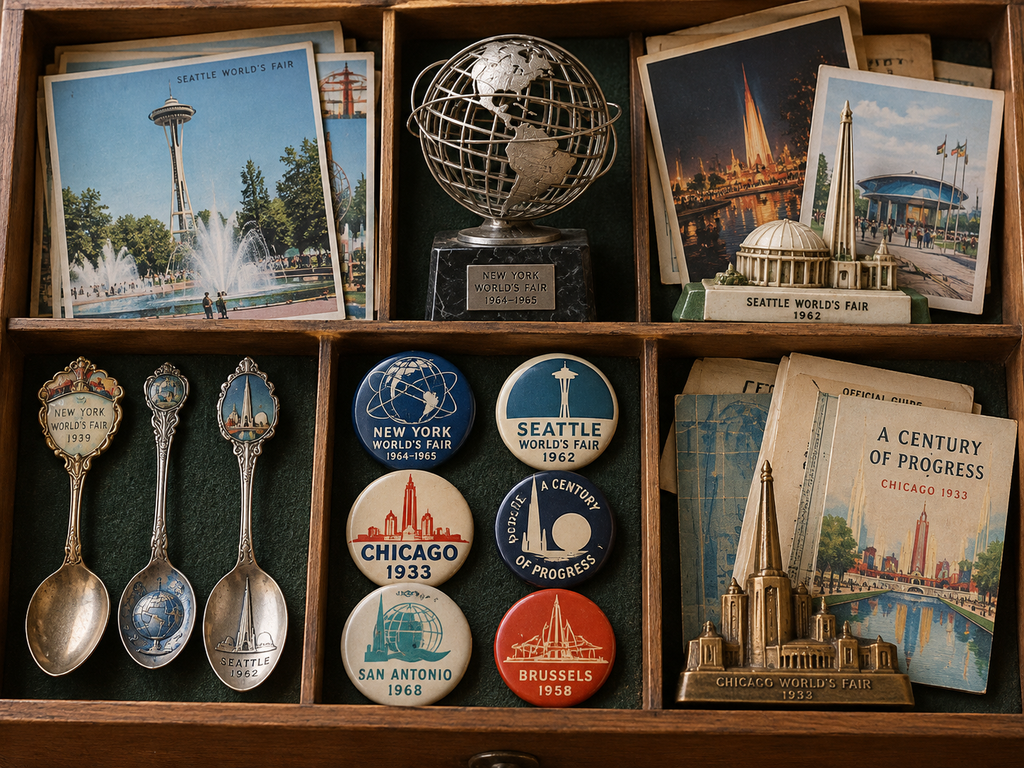
Instead of trying to acquire everything from Chicago 1893 or New York 1939, a collector might follow souvenir spoons through several decades, assemble badges and buttons from different expositions, or build a miniature skyline from architectural models. The resulting collection tells a different story: not simply how one fair marketed itself, but how souvenir design changed as manufacturing, tourism, architecture, and popular taste evolved.
Three categories—spoons, badges, and models—show particularly well how that approach can work.
Souvenir Spoons: A Fair in the Palm of Your Hand
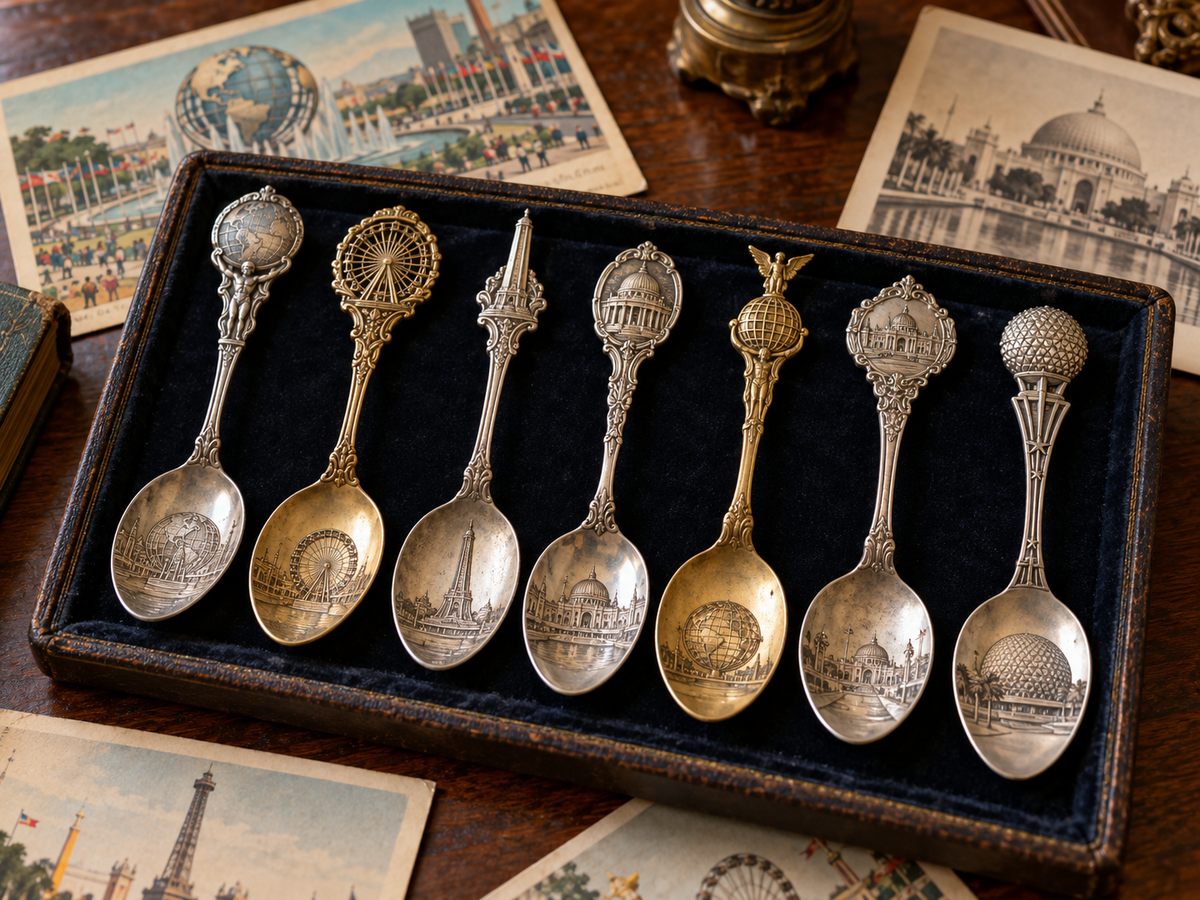
Few souvenir forms pack as much imagery into such a small object as the commemorative spoon.
The 1893 World’s Columbian Exposition provides an excellent example. The Smithsonian’s National Museum of American History preserves numerous spoons from the Chicago fair, and the variety is remarkable. Individual examples depict the Ferris Wheel, Administration Building, Transportation Building, Woman’s Building, Agricultural Building, Christopher Columbus, Queen Isabella, and other exposition subjects. One Tiffany & Company example is made of gold-plated silver and carries a depiction of Columbus.
That variety makes spoons especially suitable for thematic collecting.
A collector could pursue several spoons from one exposition and use them almost like a miniature illustrated catalog of its attractions. Another collection might trace fair architecture through spoons from Chicago, St. Louis, New York, Seattle, Montreal, and later expositions. Still another might concentrate on makers, materials, unusual bowl designs, or spoons depicting transportation and technological themes.
Details matter.
Look beyond the decoration on the front. The reverse of the handle may carry a maker’s mark, silver designation, patent information, or other clue to origin. Materials vary considerably. Some examples are sterling silver; others are plated, base metal, or made from less expensive alloys. A silver-colored spoon should therefore never be assumed to be sterling without examining its marks.
Condition should also be judged realistically. Light surface wear is understandable on an object more than a century old. More serious concerns include badly bent handles, heavy corrosion, missing enamel, aggressive polishing that has softened the design, or repairs.
And sometimes what appears to be damage is simply evidence that the souvenir was used rather than displayed.
That is part of the appeal. These were objects small enough to carry home and familiar enough to become part of domestic life.
Badges, Buttons, and the Souvenir You Could Wear
If spoons brought the fair into the home, badges and buttons allowed visitors to carry the fair on themselves.
The category can include pinback buttons, stickpins, identification badges, promotional giveaways, pavilion pins, commemorative medals fitted for wear, and inexpensive novelty pieces. Their materials range from metal and celluloid to early plastics and later synthetic materials.
Because badges were worn in public, they were also effective advertising.
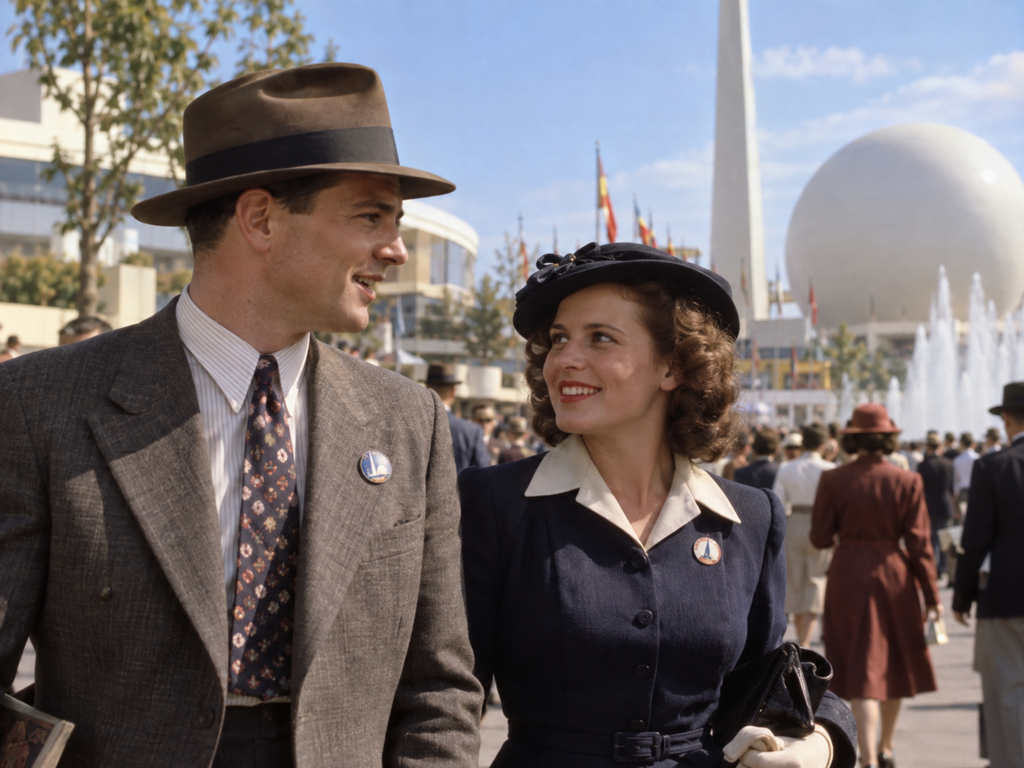
One of the best-known examples comes from the 1939–1940 New York World’s Fair. Visitors leaving General Motors’ enormously popular Futurama attraction received buttons reading “I Have Seen the Future.” The Smithsonian preserves surviving examples and identifies them as giveaways associated with General Motors’ “Highways and Horizons” pavilion.
In only a few words, the button captured the entire promise of the fair.
Other badges worked differently. Some identified the wearer as a visitor to a particular pavilion. Others celebrated the exposition as a whole. At Seattle’s 1962 Century 21 Exposition, an “I Was There” souvenir button combined three signature attractions—the Space Needle, Monorail, and U.S. Science Pavilion—into a wearable record of attendance.
For collectors, badges offer several advantages. They are generally compact, easy to display, and capable of preserving striking period graphics. A group from different fairs can show dramatic changes in typography and design, from ornate late-Victorian imagery to Art Deco geometry, mid-century modern graphics, and Space Age styling.
They can also lead into unexpected corners of exposition history.
A button might relate to a corporate pavilion rather than the fair itself. Another might advertise a concession, political organization, participating state, national pavilion, retailer, or special event. The Smithsonian’s 1939 New York holdings, for example, include not only general fair buttons but pieces associated with specific commercial and pavilion experiences.
When evaluating badges, examine the front and back.
The fastening mechanism can sometimes help establish age, but pin construction by itself is rarely enough to authenticate a piece. Look at printing quality, materials, manufacturer information, oxidation, wear around the pin, and whether the imagery corresponds to the fair being claimed.
Condition can be particularly important with celluloid buttons. Moisture can cause staining or deterioration, while metal backs may rust. Keeping them dry and away from excessive sunlight is generally wiser than trying to make an old badge look new.
Models: Taking the Architecture Home
World’s Fairs repeatedly created buildings that visitors had never seen anything like before.
That made architecture a natural subject for souvenirs.
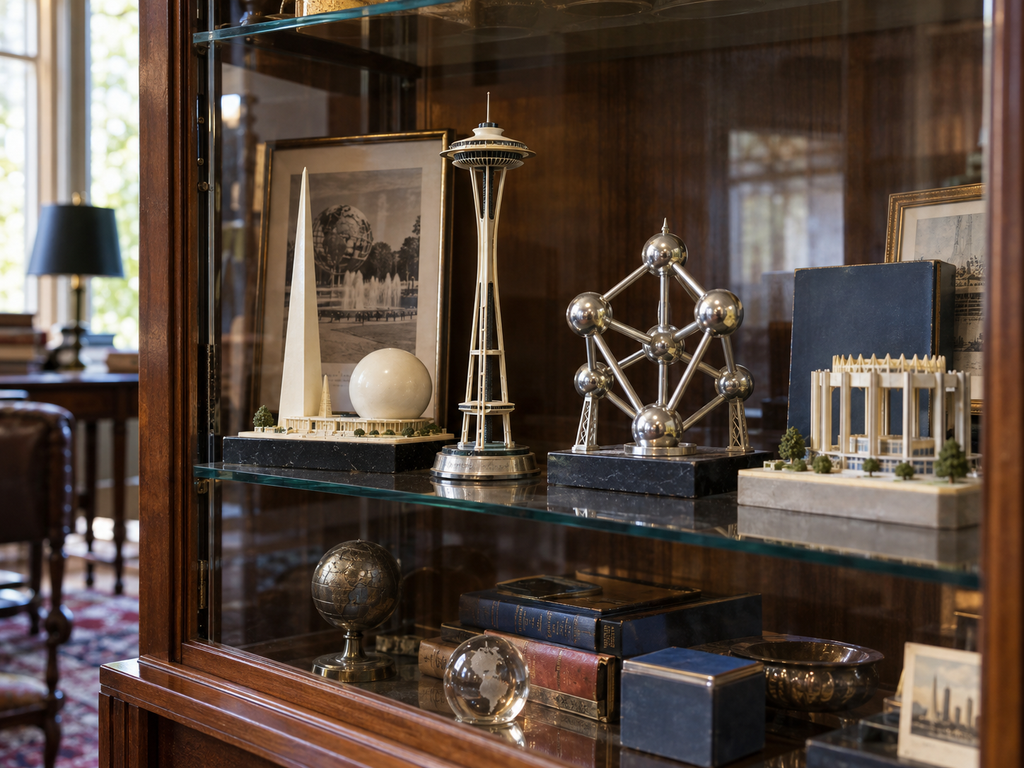
Miniature models reduced temporary monuments to something that could fit on a desk or mantel. A visitor might not be able to take home the Trylon and Perisphere, Space Needle, Atomium, or another celebrated structure—but a few inches of metal, plastic, ceramic, or wood could preserve its shape.
The 1939–1940 New York World’s Fair generated multiple miniature representations of its Trylon and Perisphere. The Smithsonian holds several period models in different sizes, demonstrating that the fair’s Theme Center was reproduced repeatedly as a three-dimensional souvenir rather than only appearing on postcards and dishes.
Seattle followed the same pattern in 1962.
The Space Needle was almost perfectly suited to miniaturization. One surviving Smithsonian example is a metal souvenir model made in Japan and retained with its original box.
That original packaging is worth noticing.
For models, boxes can be particularly useful because they may identify the manufacturer, importer, place of production, official fair licensing, or retail presentation. Packaging can also help distinguish an original exposition-period souvenir from one made decades later for ordinary tourists.
Architectural souvenirs become more complicated when the landmark survives after the exposition.
Seattle’s Space Needle, Montreal’s Habitat 67 and former U.S. pavilion dome, Brussels’ Atomium, and Osaka’s Tower of the Sun all remained recognizable after their fairs ended. Their continued fame created markets for later souvenirs.
A miniature Space Needle is therefore not automatically a 1962 souvenir simply because it depicts the correct building.
Collectors need to look at construction, markings, packaging, design style, manufacturing origin, and comparison with documented examples. Sometimes an object can be confidently placed in the fair period. Sometimes the best description is simply “vintage.” In other cases, it may be a much later tourist piece.
Uncertainty is preferable to inventing precision that the object cannot support.
Building a Collection Across Fairs
Collecting by object type changes how a World’s Fair collection develops.
Imagine three shelves.
One contains spoons beginning with elaborate nineteenth-century designs and moving toward simpler twentieth-century examples. Another contains buttons and badges whose graphics move from engraved or pictorial imagery toward Art Deco, mid-century, and Space Age design. A third holds architectural miniatures tracing changing ideas about what the future should look like.
The objects begin talking to one another across time.
Chicago’s Ferris Wheel can sit beside New York’s Trylon and Perisphere. New York can lead to Seattle’s Space Needle. Seattle can be compared with Montreal’s geodesic dome or Brussels’ Atomium.
This approach also allows collectors to be selective.
You do not need every World’s Fair spoon ever made to have an interesting spoon collection. Ten carefully chosen examples representing different fairs, materials, buildings, or design periods may tell a better story than a drawer full of nearly identical pieces.
The same is true of badges and models.
A collection gains coherence when there is a reason one object sits beside another.
Identification Before Price
World’s Fair material ranges from common souvenirs to pieces that appear far less often, but rarity and value should not be assumed simply because an object is old.
Start with identification.
Determine which exposition the piece represents. Confirm the date of the fair. Look for makers, inscriptions, pavilion names, recognizable buildings, trademarks, and country-of-origin marks. Compare questionable pieces with documented museum examples, period catalogs, advertisements, photographs, and established reference material.
Then examine condition and completeness.
A miniature with its original box may be more desirable than the model alone. A badge with severe rust may appeal differently from one retaining a clean original surface. A spoon with a documented maker can offer more information than an unmarked example, although that does not automatically mean it is more valuable.
Most importantly, avoid polishing, refinishing, repainting, or “improving” something before understanding what it is.
Collectors generally have far more options for preserving an original surface than for restoring one that someone has already polished away.
A Different Way to Tell the World’s Fair Story
Previous generations of fairgoers selected souvenirs because they wanted something tangible from an experience designed to disappear.
Collectors can reverse that process.
By gathering the same kind of object from several different expositions, we can compare the fairs themselves. A spoon reveals what architects and landmarks organizers wanted remembered. A button preserves slogans, logos, commercial promotion, and the identity of the wearer. A miniature model turns temporary architecture into a permanent object.
Each category captures the fair differently.
That is why collecting by theme can be so satisfying. Instead of trying to recreate an entire exposition, the collector follows one thread through many of them.
A small spoon, a one-inch button, or a tabletop model may not seem capable of holding much history.
Put enough of them together, though, and an entire century of imagined futures begins to take shape.
Let’s Make History—one spoon, badge, and miniature landmark at a time.
Discover more from Dear June Collectibles
Subscribe to get the latest posts sent to your email.