
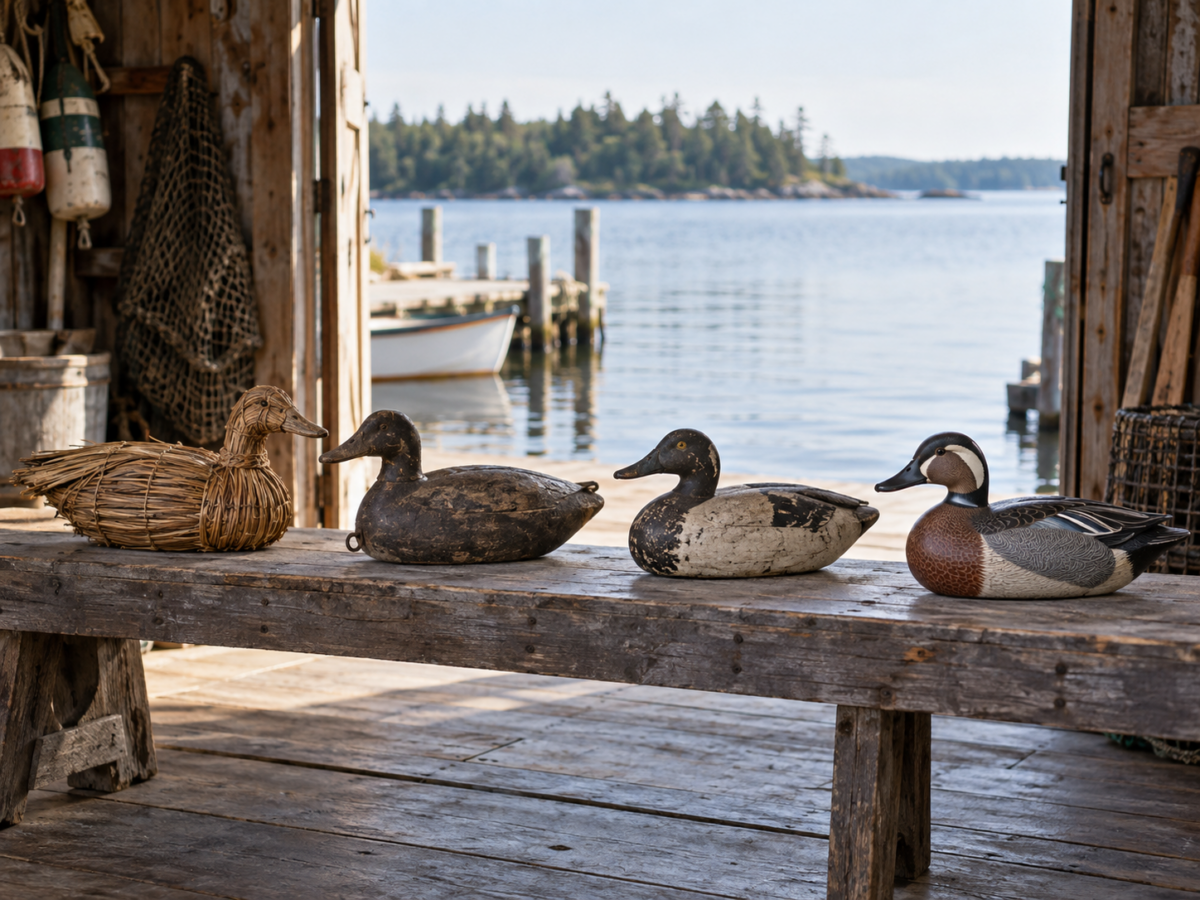
A good waterfowl decoy has always lived between two worlds.
It is an imitation of a bird, but it was never created simply to look like one. It had to work within wind, water, distance, light, and the behavior of living waterfowl. Its shape needed to be recognizable from above. The body had to sit naturally on the water. Its construction needed to survive transportation, cold mornings, wet boats, anchor lines, and repeated seasons of use.
That combination of appearance and purpose is what makes the decoy such an interesting object to collect.
Across this series, we have followed the waterfowl decoy from ancient woven hunting tools through nineteenth-century working birds, factory production, decorative carving, and modern collecting. What emerges is not simply a history of duck-shaped objects.
It is a history of people solving the same problem again and again with different materials, different tools, and different ideas about what a decoy could become.
Function Came First
Some of the oldest surviving North American waterfowl decoys make the functional origins of the form especially clear.
Examples recovered from Lovelock Cave in Nevada and preserved by the Smithsonian’s National Museum of the American Indian were constructed from tule rushes, feathers, cordage, paint, and grass. Several date to roughly 400 BC through the beginning of the Common Era. Their makers used materials gathered directly from the wetland environment to produce recognizable waterfowl forms capable of helping bring birds closer to hunters.
That basic principle survived even as the materials changed.
European settlers adopted established Native decoy techniques, and by the early nineteenth century both commercial and sport hunters were using carved wooden birds. The Smithsonian American Art Museum describes these carved and painted objects as tools intended either to imitate prey or convince passing birds that a landing area was safe.
From that point forward, the history of the decoy became increasingly diverse.
There was never one perfect duck decoy.
There were only solutions appropriate to particular places and particular hunters.
The Landscape Helped Shape the Bird
Regional decoy traditions are among the clearest examples of form following function.
A carver working on Chesapeake Bay faced different water, weather, species, and hunting practices from someone carving along New Jersey’s Barnegat Bay or Long Island’s Great South Bay.
Those differences eventually became visible in the birds themselves.
Smithsonian documentation of Mid-Atlantic carving traditions notes that head position, feather painting, and tail shape can help distinguish regional traditions such as Core Sound, Chesapeake Bay, Barnegat Bay, and Great South Bay.
Collectors now study those differences as artistic signatures of place.
Originally, however, they were often practical choices.
A particular body shape might ride rough water more effectively. A strongly defined head could remain recognizable at a distance. Simplified paint might be perfectly adequate for a bird seen from the sky rather than from across a gallery.
Regional style developed because people repeatedly made what worked.
That may be one of the most important ideas in understanding traditional decoys: their artistic qualities were not necessarily added on top of their usefulness.
Very often, the beauty came directly from solving the practical problem well.

Working Birds Were Never Precious Objects
It is difficult to reconcile the prices and careful handling of some antique decoys today with the way they were originally treated.
Working birds were equipment.
They were carried in boats, stacked with other decoys, dropped into water, dragged by rigging, stored in sheds, repainted, repaired, and used until something made continued use impractical.
During the nineteenth century, commercial waterfowl hunting increased as improved transportation allowed hunters in previously remote areas to send birds to growing urban markets. Smithsonian Folklife research notes that railroad transportation helped connect Mid-Atlantic waterfowling communities with city markets by the middle of the century.
A decoy in that environment had to earn its place in the rig.
That explains many of the features collectors now examine carefully: nail repairs, replaced heads, paint layers, weights, anchor attachments, cracked bodies, and worn bottoms.
An untouched-looking bird is not automatically more historically interesting than a scarred one.
Sometimes the scars tell the story.
Factories Changed the Scale, Not the Purpose
As demand increased, decoy production moved beyond individual workshops.
Manufacturers such as the Mason Decoy Factory produced standardized wooden birds in quantity, using machinery to make bodies more consistent while still relying on hand-finishing and painting. The National Gallery of Art’s research on American material culture notes that Mason offered several grades of decoys with different levels of detail and hand finishing.
Factory production changed who could obtain decoys and how easily hunters could assemble large matching rigs.
It did not change the basic requirement.
A factory bird still had to work.
It needed to resemble the right species, float properly, withstand use, and help create a convincing scene on the water.
This is why dividing decoys into “factory” and “handmade” categories does not automatically separate ordinary objects from artistic ones.
Both can reveal excellent design.
They simply represent different production systems.
The handmade bird can preserve the decisions of one carver.
The factory bird can preserve the growth of American sporting-goods manufacturing.
Both belong to the same history.
When Collectors Began Seeing Art
Something interesting happened when working decoys began leaving the marsh.
People started looking at them differently.
Instead of asking only whether a bird would fool a duck, collectors began noticing silhouette, paint, regional character, carving technique, and individual makers.
By the early twentieth century, decoys were beginning to appear in exhibitions and collections as examples of American folk art. National Gallery research points to decoy exhibitions held in the 1920s and 1930s as evidence of that changing status.
That shift fundamentally changed the future of decoy carving.
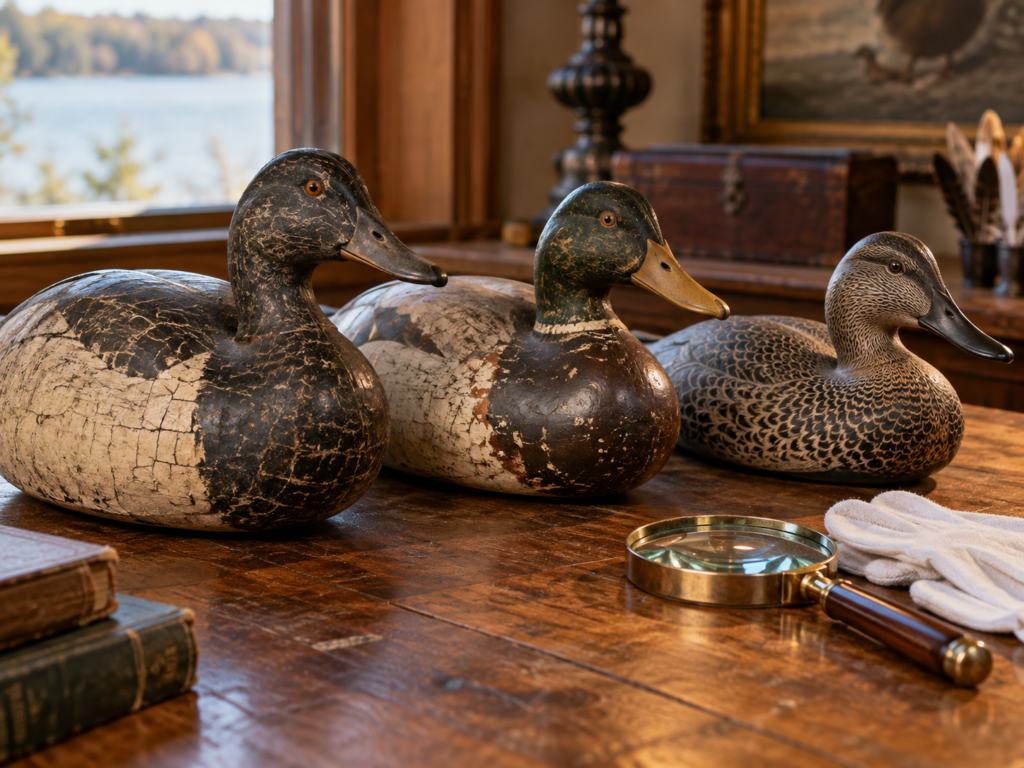
Carvers no longer had to think only about field performance. Decorative carving allowed far greater realism, delicate feather work, complex poses, carved habitat, and increasingly ambitious painting.
The Ward brothers of Crisfield, Maryland, became especially important to that transition. Salisbury University describes Lem and Steve Ward’s decorative work as helping elevate decoy carving into an art form, bridging practical waterfowling traditions and expressive sculpture.
Yet traditional working forms did not disappear.
Contemporary carvers still produce functional birds, regional interpretations, decorative sculpture, and pieces that deliberately preserve older hand-tool traditions. Smithsonian Folklife programs have documented living carvers maintaining traditions associated with Core Sound, Chesapeake Bay, New Jersey, Long Island, and other waterfowling regions.
The decoy did not stop being functional art.
Its definition simply became broader.
What Collectors Are Really Preserving
A decoy collection can easily become a collection of attractive birds.
It becomes more interesting when it becomes a collection of stories.
One bird might illustrate a particular regional tradition.
Another might show factory production.
A third may retain multiple layers of working repaint.
A modern decorative carving might demonstrate how far wildlife carving moved beyond the requirements of hunting.
A contemporary working bird can show that the tradition is still alive.
The strongest collections often preserve those relationships rather than concentrating exclusively on names or market value.
Documentation helps enormously.
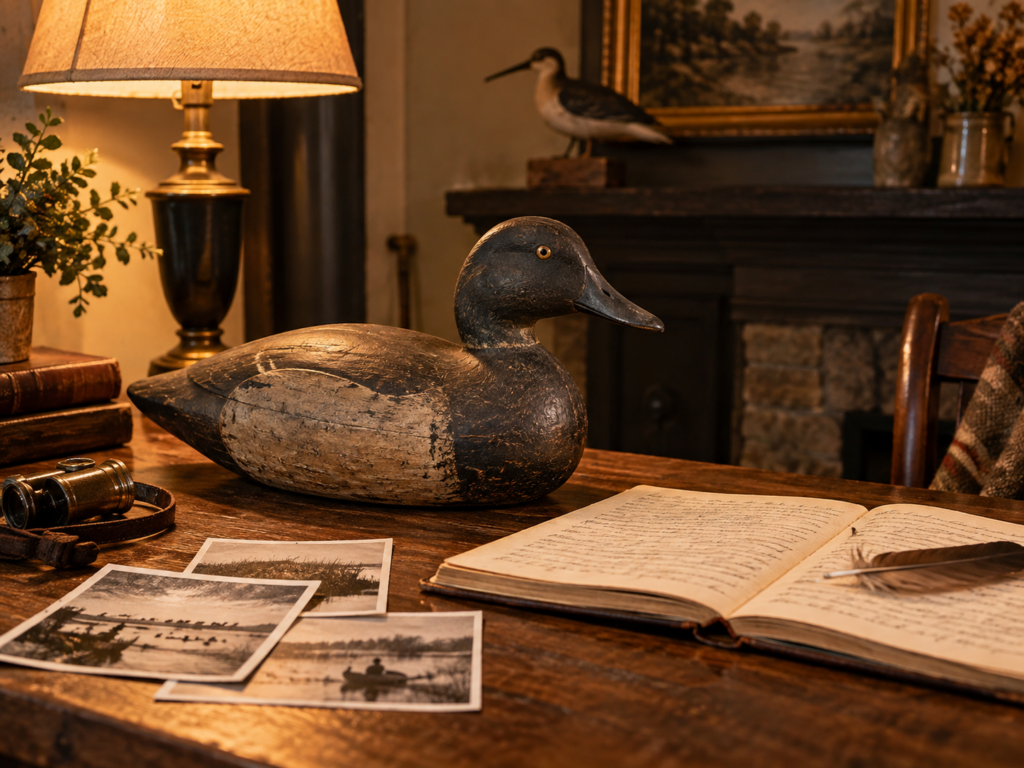
A photograph showing a decoy in its original rig, a family note identifying the hunter who owned it, an old sales receipt, a maker’s signature, competition paperwork, or information about where the bird was found can transform an object from an attractive carving into a documented piece of material culture.
Preserving the surface matters too.
Collectors sometimes inherit the assumption that restoration means making something look new again. With decoys, that can erase the very qualities worth preserving.
Old paint, honest wear, repairs made during working life, and even imperfections can provide information.
The goal should not always be to return the bird to an imaginary perfect condition.
Sometimes the best preservation decision is simply to stabilize it and allow the evidence of its life to remain visible.
More Than a Wooden Duck
The remarkable thing about waterfowl decoys is how much history can be contained within such a simple shape.
They connect Indigenous hunting knowledge with European settlement and marshes with city markets.
They connect individual craftspeople with factories and hunting equipment with folk art.
And they connect twentieth-century conservation with modern sporting traditions.
And they connect anonymous working objects with museums and serious collections.
The Smithsonian today classifies historic decoys not merely as sporting equipment but also as sculpture and folk art, reflecting how completely their meaning has expanded beyond their original use.
Yet the functional origin remains essential.
Remove the water, the hunter, the migrating birds, and the need to create a convincing illusion, and much of what shaped the traditional decoy disappears.
The broad breast, simplified head, worn underside, chipped paint, anchor attachment, and strong silhouette were not arbitrary artistic choices.
They came from use.
Functional Art on the Water
That may be the best way to understand the decoy after following its history from beginning to end.
It is functional art on the water.
Some examples are rough, some are elegant, and some were made by unidentified hunters who never imagined anyone would collect their work.
Others were created by famous carvers whose names now appear in museums and auction catalogs.
Some were turned out by factories.
Others required hundreds of hours of individual craftsmanship.
But all of them belong to a tradition that began with a simple act of observation.
People watched waterfowl.
They learned how birds gathered, fed, rested, and responded to the presence of others.
Then they created an object designed to become part of that scene.
The most successful decoys made artificial birds appear natural.
Generations later, collectors reversed the process.
We removed those birds from the water and began looking at them as objects in their own right.
And once we did, we discovered that a working tool could also preserve craftsmanship, regional identity, innovation, and beauty.
That is why the waterfowl decoy remains so compelling.
It wasn’t merely art.
It was never merely equipment.
It’s always been a little of both.
Let’s Make History—one decoy at a time.