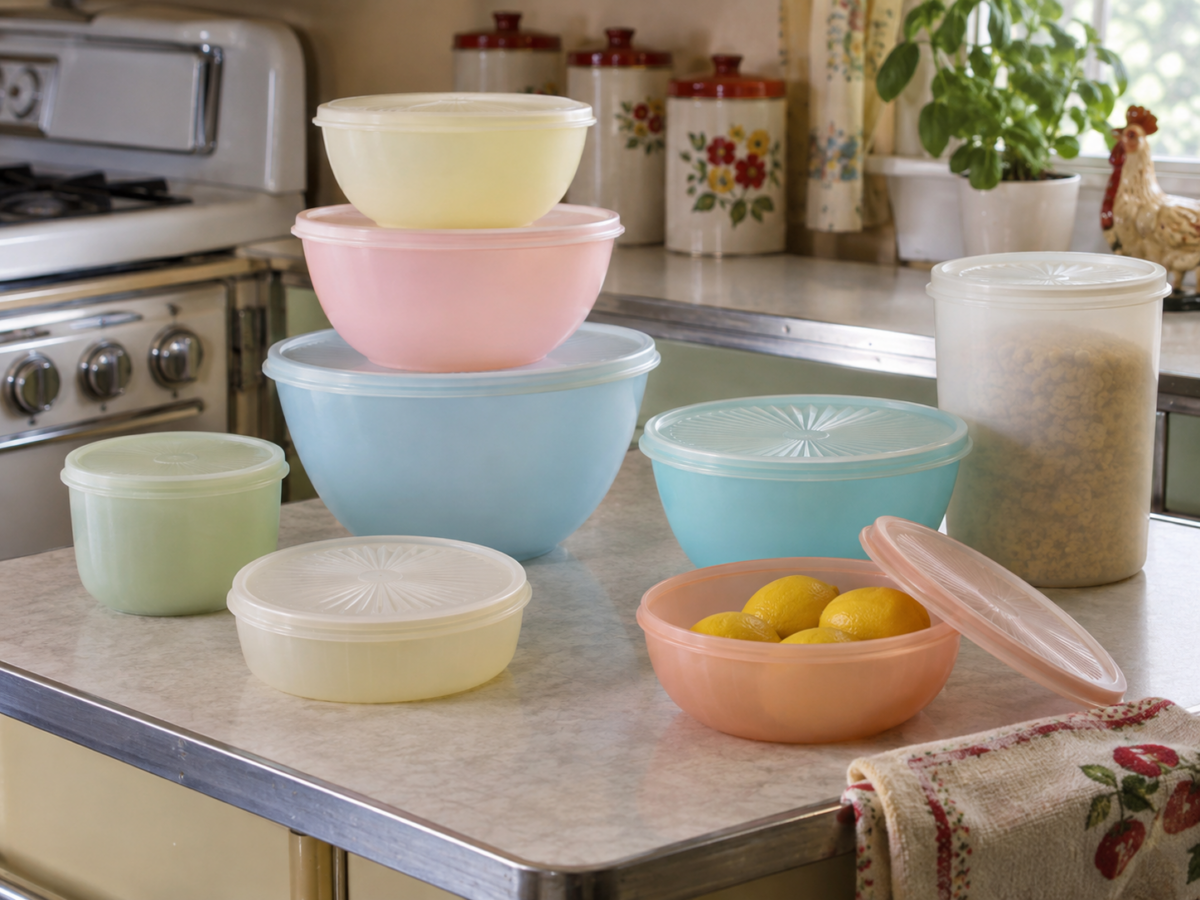
Today, plastic food containers are so ordinary that it is easy to forget how revolutionary they once seemed. Open almost any kitchen cupboard and you will find containers designed to stack, seal, travel, and keep leftovers fresh. In the years immediately following World War II, however, the idea of storing food in a lightweight plastic bowl with an airtight lid represented something genuinely new.
Tupperware emerged at exactly the right moment. New plastics developed and expanded during the war were entering civilian life, refrigerators were becoming increasingly common, supermarkets were changing shopping habits, and manufacturers were looking for ways to transform wartime materials into useful household goods.
Into that changing world came inventor Earl S. Tupper and a remarkably simple idea: make plastic attractive, practical, reusable, and capable of sealing food tightly.
From Industrial Plastic to the Kitchen
Earl Silas Tupper was already interested in invention long before his name became synonymous with food storage. During the 1930s, he experimented with products and materials while pursuing several business ventures. In 1937, he went to work for DuPont as a sample maker, gaining experience during an important period in the development of synthetic materials. He established the Tupper Plastics Corporation in 1939.
One material that caught his attention was polyethylene. Early plastics often carried drawbacks that made them less appealing for domestic use: they could be brittle, unpleasantly colored, or associated more with industrial applications than with a fashionable modern kitchen.
Tupper experimented with polyethylene waste material and developed ways of producing cleaner, smoother plastic suitable for consumer goods. The Smithsonian notes that he produced translucent and opaque colored containers and marketed an early line under the name “Welcome Ware” beginning in the 1940s.
The material itself offered several advantages. Polyethylene was lightweight, relatively durable, washable, and capable of being molded into smooth shapes. Unlike ceramic bowls or glass refrigerator dishes, plastic containers were far less likely to break when dropped.
But attractive plastic bowls alone were not enough to create a household revolution.
Tupper needed a lid.
The Seal That Changed Everything
The defining feature of early Tupperware was not simply the plastic. It was the seal.
Tupper developed a flexible lid modeled in part on the way a paint-can lid created a tight closure. His container-and-seal design was filed for patent protection in 1947, with the patent granted in 1949.
Closing the container properly required pressing the lid while releasing excess air. The familiar procedure became known as “burping” the container. Once sealed, the combination could help prevent spills while slowing the exposure of stored food to outside air.
For families adapting to larger refrigerators and less frequent grocery shopping, that was an important improvement. The Smithsonian notes that Tupperware appeared as American households were increasingly using modern refrigerators and supermarkets, creating demand for better ways to preserve and organize food between shopping trips.
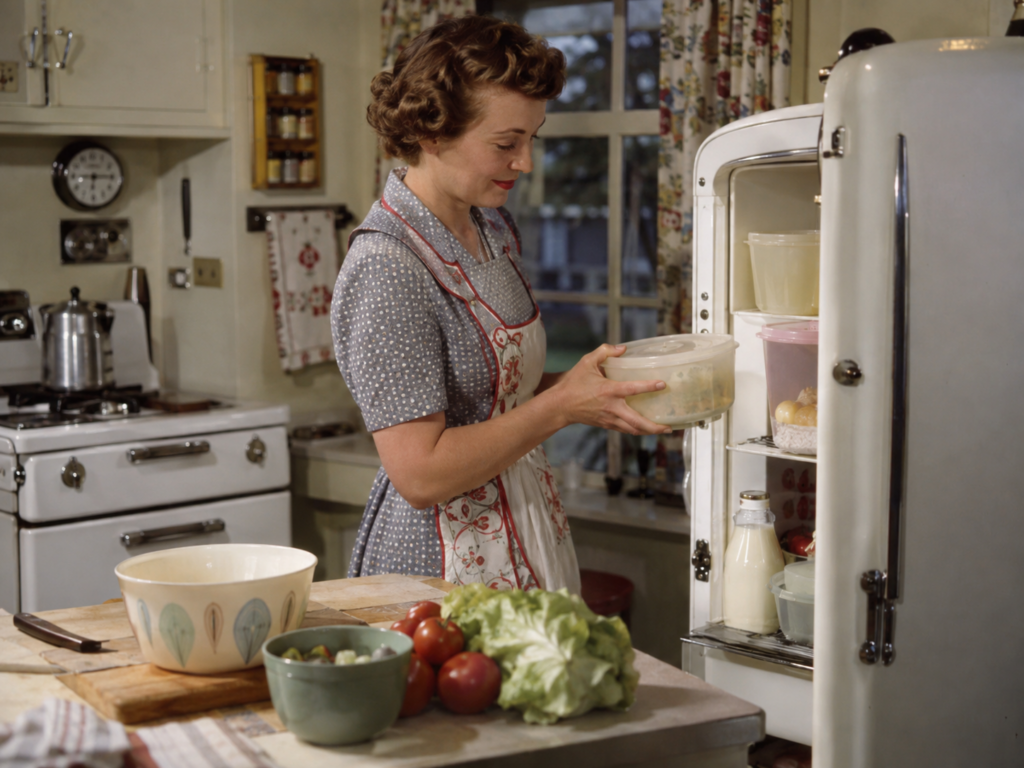
Early products such as the Wonderlier Bowl combined that practical seal with a distinctly modern appearance. Instead of attempting to imitate ceramic or glass, Tupper embraced what plastic could do. The containers were lightweight, gently curved, and frequently translucent enough that their contents could be partly seen through the walls.
They looked like products of the future because, in many ways, they were.
A Postwar Material Becomes Respectable
Plastic did not always enjoy the everyday familiarity it has today. During the first half of the 20th century, consumers encountered a rapidly expanding variety of synthetic materials, from Bakelite and celluloid to wartime plastics used for military and industrial purposes.
After World War II, manufacturers faced a new opportunity: materials and manufacturing knowledge developed or expanded during wartime could be redirected toward civilian consumption.
Tupperware became one of the best-known examples of that transition.
Its smooth forms and practical construction fit comfortably into the streamlined aesthetics of the period. The National Museum of American History describes Tupper’s bowls as both a technological improvement and an expression of modern design.
There was also something optimistic about the product. Postwar advertising frequently portrayed the modern household as cleaner, more efficient, and better organized than the one that came before it. New appliances promised less work, new kitchens promised convenience. and new materials promised improvements over traditional ones.
Tupperware belonged naturally in that world.
There was only one problem.
Consumers did not immediately understand it.
A Great Product That Needed Explaining
A shopper looking at an unfamiliar plastic bowl on a department-store shelf could easily miss what made it special. The airtight seal was not obvious simply by looking at the product, and using that seal correctly required a small demonstration.
Consequently, Tupperware initially struggled in conventional retail stores.
That weakness eventually helped create one of the most famous marketing systems of the 20th century.
Saleswoman Brownie Wise discovered that Tupperware made far more sense when someone demonstrated it. Customers could touch the containers, see how the lids worked, watch the seal being formed, and understand why these bowls differed from other plastic household goods.
Wise had experience with home demonstrations through Stanley Home Products. By the late 1940s, she was successfully selling Tupperware through gatherings where products could be demonstrated directly to potential customers. Earl Tupper recognized the effectiveness of the approach, and in 1951 Wise joined the company as vice president of marketing. Tupperware increasingly moved away from ordinary store shelves and toward the home-party sales system that would become inseparable from the brand.
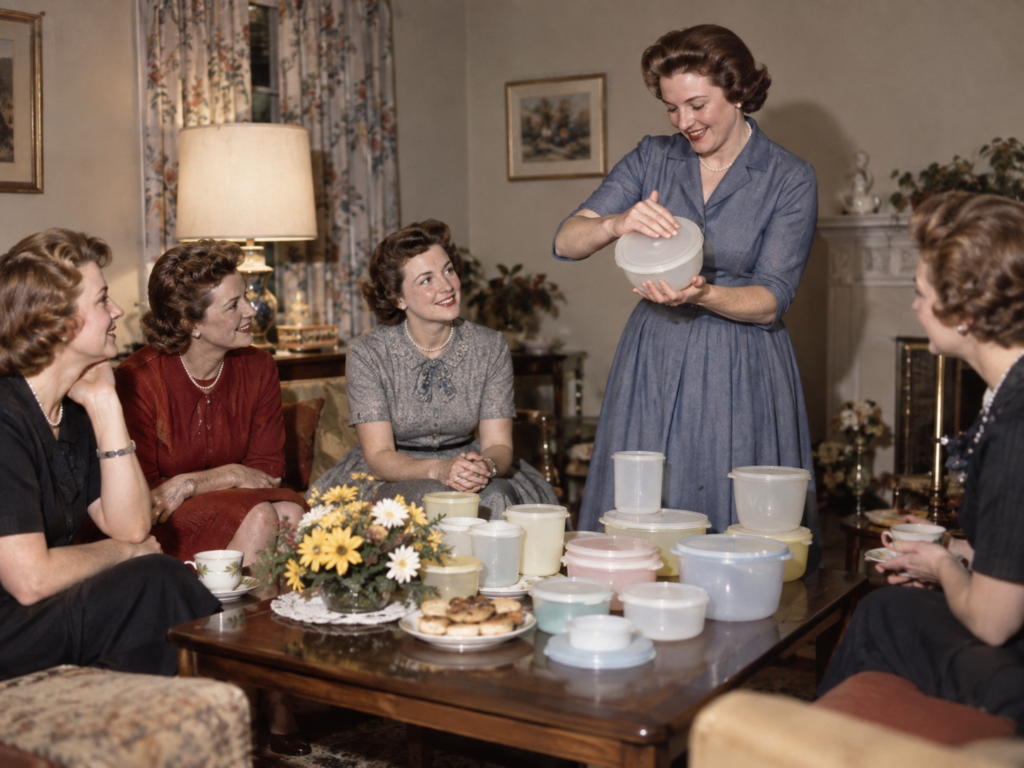
The famous Tupperware party deserves its own story, but its success began with something fundamental about the product itself: this was an object that benefited from being handled.
That physical experience transformed an unfamiliar plastic container into a surprisingly convincing piece of household technology.
What Early Tupperware Meant
It would be easy to dismiss a plastic bowl as insignificant beside more traditional antiques made of silver, porcelain, wood, or glass. Material culture, however, is not defined by luxurious materials.
Sometimes the most important objects are those that quietly change everyday behavior.
Tupperware helped normalize plastic as a material worthy of the American kitchen. It demonstrated that plastic did not have to mean a cheap disposable substitute. It could instead be designed for repeated use and associated with efficiency, cleanliness, organization, and modern living.
The containers also reflected broader changes taking place within postwar households. Refrigeration was transforming food storage. Supermarkets encouraged families to purchase more food at once. Suburban kitchens offered increased cabinet and refrigerator space. Manufacturers supplied a growing assortment of specialized household products intended to make those spaces more efficient.
A stackable plastic bowl with a tight-fitting lid fit perfectly into that new domestic landscape.
Early Tupperware as a Collectible
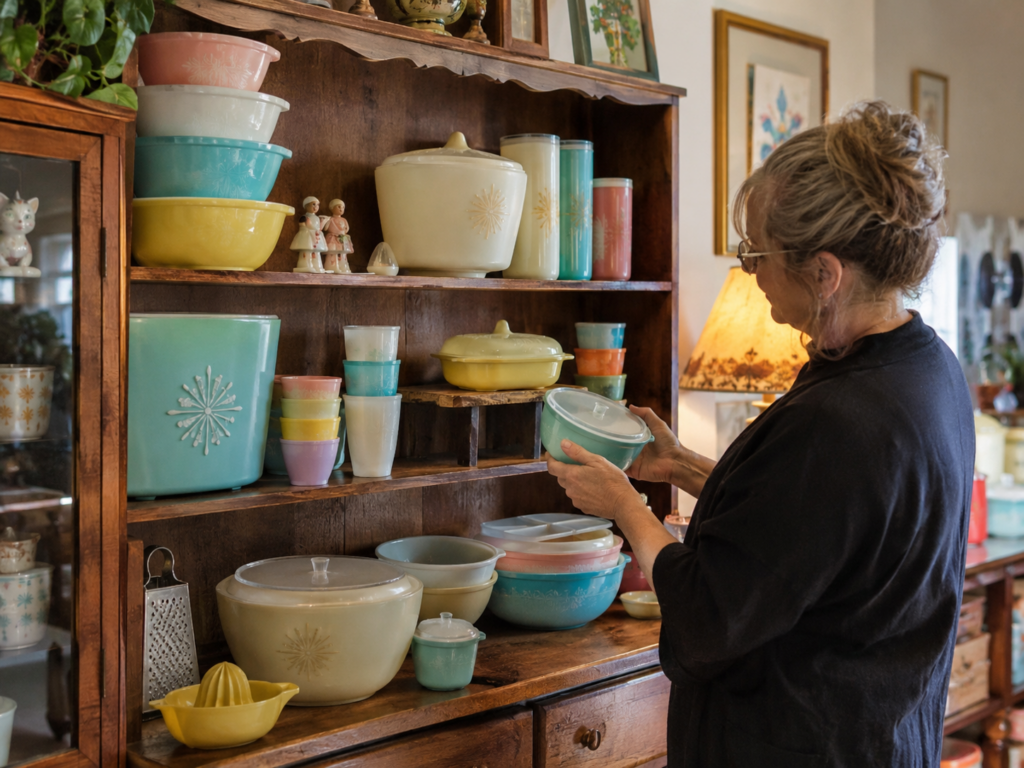
For collectors, early Tupperware occupies an interesting position between industrial design, kitchenware, advertising history, and postwar Americana.
Surviving pieces can reveal how quickly both plastic technology and consumer taste evolved. Early examples may have softer, more subdued appearances than the bright colors many people associate with later Tupperware. Shapes, markings, seals, and product lines also changed as the company expanded.
Condition matters, but age should be kept in perspective. Plastic can discolor, warp, scratch, absorb odors, or become brittle after decades of use and storage. Lids and containers were also easily separated over the years, meaning complete matching pieces can be more appealing than miscellaneous components.
Collectors should be cautious about identifying age by color alone. Tupperware designs sometimes remained in production for extended periods, while colors and related forms could reappear or evolve. Molded manufacturer markings, product numbers, construction details, catalogs, and dated advertising can provide stronger evidence when trying to identify an early piece.
Just as importantly, vintage Tupperware survives because people actually used it. A bowl with modest wear may have spent decades storing leftovers, carrying picnic food, holding ingredients, or sitting inside the refrigerator of an American household.
That history of ordinary use is part of its appeal.
A Revolution Hidden in the Cupboard
Earl Tupper did not invent plastic, food storage, or the refrigerator. His achievement was bringing several developments together in an object that solved an everyday problem remarkably well.
He took an emerging material, refined it for household use, paired it with an innovative sealing system, and created containers suited to the changing rhythms of postwar American life. Brownie Wise and the sales organization that followed would transform those containers into a cultural phenomenon, but the foundation remained Tupper’s deceptively simple combination of bowl, lid, and flexible polyethylene.
Within a few years, Tupperware would move far beyond its uncertain beginnings on retail shelves. It would acquire distinctive colors, become the centerpiece of countless living-room sales parties, provide earning opportunities for thousands of people, and establish itself as one of the most recognizable names in American housewares.
Before all of that, however, there was a new material, an inventor experimenting with possibilities, and a plastic bowl that could “burp.”
That was enough to start a revolution.
Let’s Make History—one airtight seal at a time.