

Long before a carved wooden duck became something displayed on a mantel or admired at an antiques show, a decoy was a working tool.
Its purpose was practical: convince living waterfowl that a particular stretch of water was safe enough to approach. Doing that successfully required an understanding of birds, wetlands, available materials, and hunting behavior. Some of the oldest surviving North American waterfowl decoys show that this knowledge reaches back roughly two thousand years—and probably much farther.
They also challenge the image many collectors have of what a decoy is supposed to look like. The ancestors of the familiar painted wooden duck were not necessarily carved from wood at all. Some were woven from the plants growing in the same marshes where they were used.
A Hunting Tool with Ancient Roots
Waterfowl have long provided food and useful materials to people living around North America’s lakes, rivers, marshes, and coastal environments. Hunters learned that ducks and geese are social birds. A group already resting on the water can signal to birds overhead that a place may be safe for feeding or landing.
A convincing imitation could therefore bring a passing flock within useful range.
The principle is remarkably durable. Modern hunters may deploy carefully painted spreads containing dozens of wooden, cork, foam, or plastic birds, but the underlying idea is ancient: create the appearance of waterfowl already resting comfortably below.
Some of the most remarkable surviving evidence comes from Lovelock Cave in Nevada.
The Tule Decoys of Lovelock Cave
In 1924, archaeologist Mark Raymond Harrington excavated a cache of waterfowl decoys from Lovelock Cave in western Nevada. Several surviving examples are now preserved by the Smithsonian’s National Museum of the American Indian.
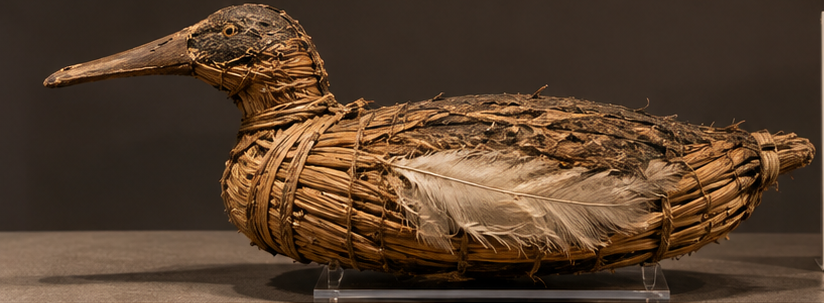
These decoys are generally dated to approximately 400 BC through the beginning of the Common Era. Rather than being carved, they were constructed from tule rushes and other plant material, with cordage, paint, and, in some examples, feathers used to strengthen the resemblance to living birds.
Smithsonian research describes a cache of eleven decoys modeled after canvasbacks. Ten were painted, and nine retained white feathers attached along the sides of their bodies. Their chests, necks, and bills were carefully treated with pigments to reproduce recognizable markings.
These were not crude approximations.
They were carefully engineered hunting equipment.
Built from the Marsh Itself
Tule was an especially sensible material for a wetland hunting tool.
Long stems could be gathered locally, bundled, folded, tied, wrapped, and shaped into a lightweight body. Cattail and cordage could help secure the form, while feathers and skins from previously taken birds made the finished decoy more lifelike.
Later documentation of western Nevada tule-decoy making describes makers selecting long, sound bulrush stems, allowing them to dry properly, and binding them carefully so the finished form would remain tight. The construction method was based on generations of practical knowledge about both the plant material and the birds being imitated.
A successful decoy had to do more than resemble a duck when examined from a few feet away.
It needed a convincing silhouette from above. It had to sit properly near the water. Its markings needed to suggest the correct species. It had to be light enough to carry and sturdy enough to survive repeated hunting trips.
The Lovelock Cave cache appears to have been stored between hunting expeditions, suggesting that the decoys were valued reusable equipment rather than temporary objects made for a single outing.
The tradition also did not disappear with the archaeological examples. Native knowledge keepers from western Nevada have documented tule decoys continuing to be made and used in the region, particularly around Stillwater Marsh.
That continuity matters. These objects are not simply curiosities from a vanished culture. They belong to a much longer history of Indigenous knowledge, craftsmanship, hunting, and adaptation to the wetlands of the Great Basin.
There Was Never Just One Type of Early Decoy
It would be convenient to imagine decoy history as a simple progression: woven birds came first, wooden birds followed, and modern manufactured decoys came afterward.
Actual history is rarely that tidy.
Native communities across North America lived in very different environments and worked with whatever materials made sense locally. Plant fibers, bird skins, feathers, reeds, clay, and other resources could all be adapted for hunting.
The important idea was not any one material.
It was deception.
A hunter needed to create something recognizable enough to influence the behavior of a wild bird. How that was accomplished depended upon the landscape, available resources, hunting methods, and species being pursued.
That makes the earliest history of waterfowl decoys less the story of a single invention than a story of repeated observation and problem-solving.
When Form Followed Function
Collectors today often admire decoys for the things that make them visually distinctive: graceful carving, expressive heads, unusual paint patterns, regional styles, or the recognizable hand of a particular maker.
Those qualities are important, but they can obscure the reason decoys existed in the first place.
A working decoy was not originally intended to be sculpture.
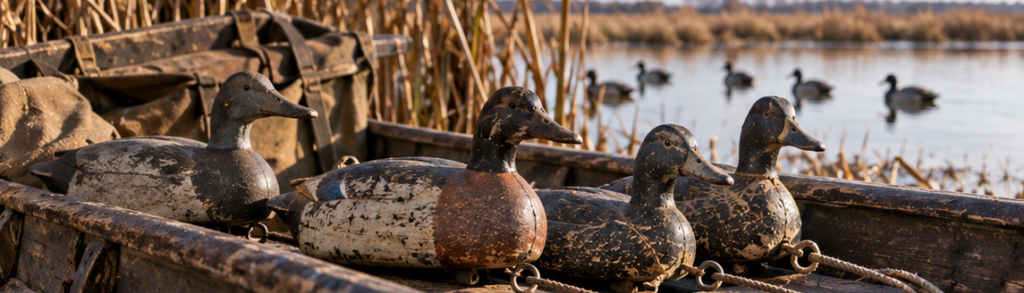
Its body needed to present the correct shape from a distance. Its head and neck could suggest resting, feeding, alertness, or another natural posture. Color mattered because pattern and contrast helped a bird overhead recognize what appeared to be another member of its species.
Even small practical choices mattered.
A decoy that floated incorrectly could look unnatural. One that was too heavy would be difficult to carry. A fragile design might not survive repeated trips through boats, marshes, mud, ice, and storage sheds.
The most successful designs balanced illusion with durability.
That connection between usefulness and appearance remained important when wooden decoys became widespread. Many working decoys that collectors now consider American folk art were originally shaped by cold water, wind, boats, birds, and hard use rather than by any expectation that they would someday be placed on display.
Their beauty often came from how efficiently their makers solved a practical problem.
The Move Toward Carved Wood
As European settlers established communities around North American waterways, waterfowl hunting became increasingly important for both food and commerce. Native hunting knowledge influenced newcomers, and carved wooden decoys eventually became a major part of the waterfowling tradition.
Wood offered obvious advantages.
A buoyant wooden body could withstand years of use. Cedar and other workable woods could be shaped with hand tools, weighted when necessary, repaired, repainted, and rigged for use in groups. A hunter or local craftsman could also modify a design to match the species and conditions common to a particular area.
By the nineteenth century, distinctive regional traditions were developing around major waterfowling areas. Body shape, head position, paint, construction methods, and rigging could all reflect local conditions.
These differences would eventually give collectors the regional schools, makers, and styles that form such an important part of decoy collecting today.
But those carved birds were part of an older tradition rather than the beginning of it.
Market Hunting and the Working Decoy
During the nineteenth century, growing cities created an enormous market for wild ducks and geese.
Improved transportation made it possible for hunters in productive waterfowl regions to send birds to distant restaurants, markets, and urban consumers. For professional market hunters, decoys were not decorations. They were equipment used to help produce income.
A large rig might be subjected to hard use season after season.
That history helps explain why genuine working decoys often show substantial wear. Paint was refreshed. Cracks were repaired. Heads were replaced. Weights and rigging were altered. Shot occasionally struck the decoy rather than the bird.
To a modern collector, those changes can look like imperfections.
Historically, they may be evidence that the object actually did the job it was made to do.
What the Earliest Decoys Mean for Collectors
Most collectors will never encounter a genuine archaeological decoy, and ancient cultural material should not be approached like ordinary antique merchandise.
Objects removed from archaeological contexts can involve serious questions of ownership, provenance, cultural patrimony, and applicable law. Claims that an undocumented object is an “ancient Native American decoy” should therefore be treated with considerable skepticism.
Museum collections are a far better place to study the earliest surviving examples.
The Smithsonian’s documented Lovelock Cave material allows collectors to examine construction, materials, form, and historical context without separating those objects from the records that make them meaningful.
Modern tule decoys made within continuing traditions can also help demonstrate technique while respecting the difference between contemporary craft and archaeological material.
Learning this earlier history changes the way later decoys look.
A nineteenth- or twentieth-century wooden duck is no longer simply an old sporting collectible. It becomes one expression of a much older idea: observe the bird, understand the landscape, work with available materials, and create a convincing enough imitation to change the behavior of something alive.
Before Folk Art, There Was a Tool
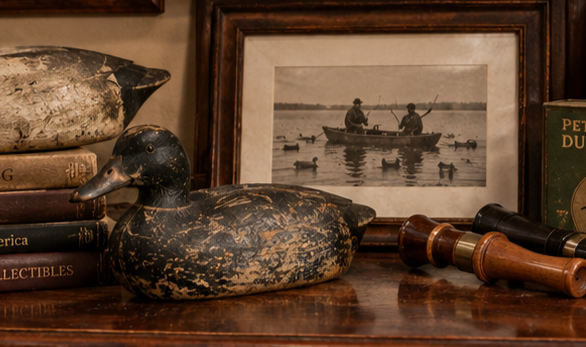
Today, waterfowl decoys are collected as folk art, sporting memorabilia, regional history, and examples of individual craftsmanship.
Their beginnings were far more practical.
The ancient hunter setting a tule bird among the reeds was not thinking about auction estimates, famous makers, or display shelves.
The important questions were simpler.
Would it look convincing?
Would it sit properly?
Would passing birds trust what they saw?
Those questions helped shape an object that eventually became one of the most recognizable forms in American sporting culture.
Materials changed. Tule and feathers were joined by carved wood, cork, molded fiber, plastic, foam, and modern composites. Hunting practices changed as well. Commercial market hunting disappeared, conservation laws reshaped waterfowling, and recreational hunters increasingly became partners in managing the resource they pursued.
Yet the fundamental idea survived.
Place something on the water that looks enough like a bird, and perhaps another bird will believe it.
That is where the long history of the waterfowl decoy begins.
Let’s Make History—one decoy at a time.