
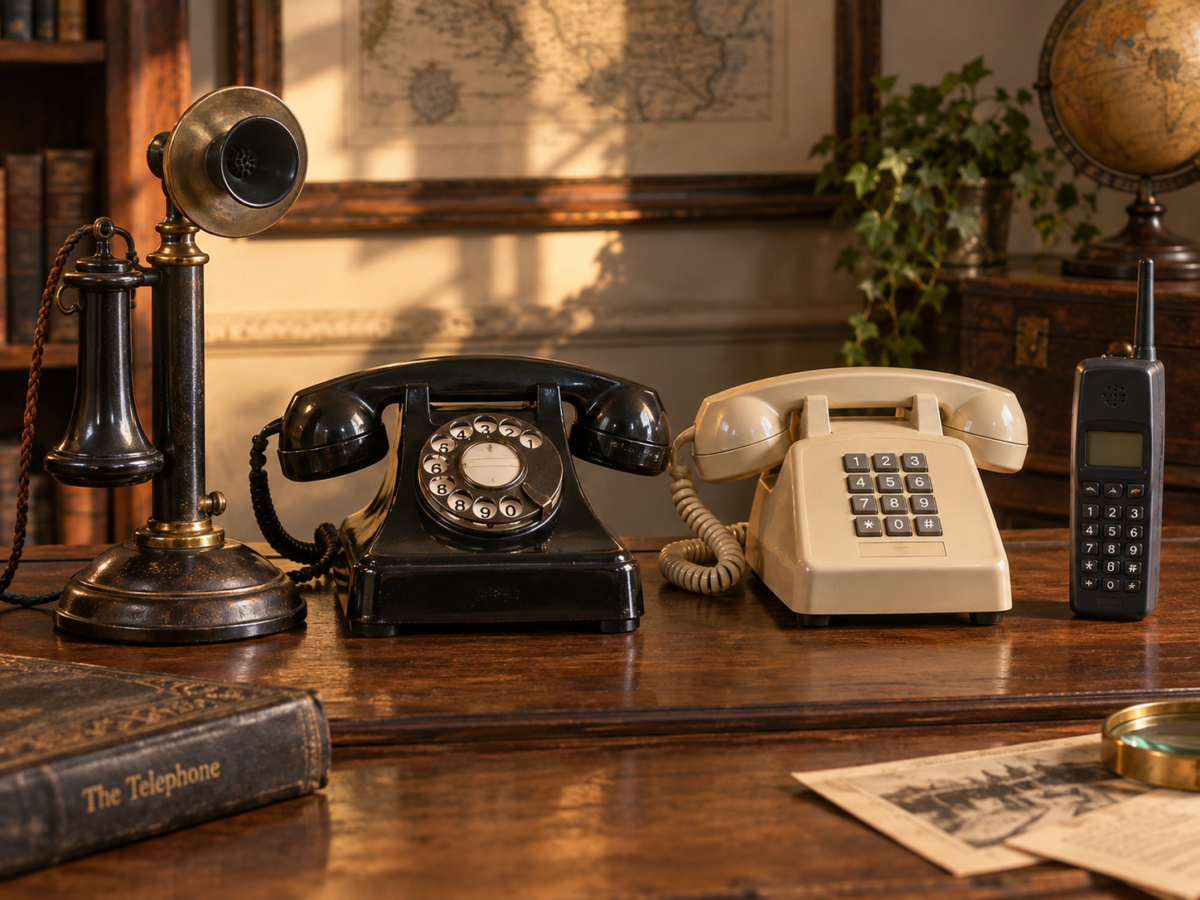
The word dial has outlived the object that gave it meaning.
For much of the twentieth century, dialing a telephone meant exactly that: placing a finger into a circular wheel, turning it to a stop, and letting a spring-driven mechanism click back into place. Today we still “dial” a number even when we tap a glass screen, choose a saved contact, or simply tell a digital assistant whom we want to call.
That lingering word is a small reminder of how deeply telephone technology became woven into everyday life.
Across roughly a century and a half, the act of reaching another person has moved from asking an operator for assistance to turning a rotary dial, pressing a keypad, selecting a name from a digital address book, and touching an icon on a smartphone. Each stage left behind its own objects, sounds, habits, and collectibles.
Before Anyone Dialed
The earliest telephone user did not dial anything.
Once telephone exchanges began connecting multiple subscribers, the caller generally contacted an operator and requested the person or business they wanted. The first commercial telephone exchange began operating in New Haven, Connecticut, on January 28, 1878. George W. Coy designed its switchboard, creating a central point through which subscribers could be connected rather than requiring a separate dedicated line between every pair of telephones.
For the caller, the process was conversational. Lift the receiver, signal the exchange, speak with the operator, and ask for the desired connection.
That arrangement made the operator an essential part of the telephone itself. The network could not function without someone physically creating the path between callers.
As telephone systems expanded, however, the enormous number of possible connections made automation increasingly attractive. The next major change would give part of the operator’s work directly to the subscriber.
The Caller Takes Control
Automatic switching is closely associated with Almon B. Strowger and the systems developed from his work in the 1890s. Early automatic exchanges used electromechanical equipment to select a route through the network without requiring an operator to make every connection manually.
With automatic service, turning the dial sent a series of electrical pulses to the exchange. Those pulses told the switching equipment which path to select.
The result was an important cultural shift. The caller was no longer simply requesting a connection. The caller was operating part of the network.
Rotary dialing eventually became one of the defining rituals of telephone use. It required patience, particularly with longer numbers. Dial a wrong digit near the end and the safest solution was often to hang up and begin again.
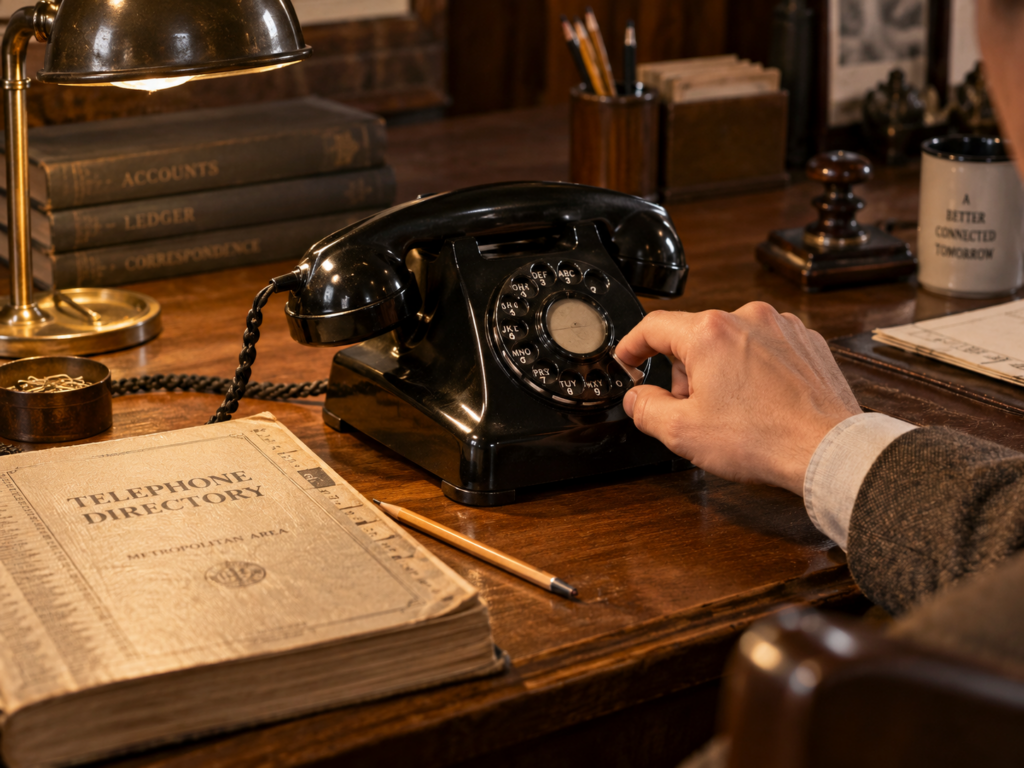
Even the arrangement of the dial received careful attention. By the mid-twentieth century, telephone designers were studying how quickly and comfortably people could use the finger wheel, read the numbers, and hold the handset.
The telephone was no longer simply a machine that worked. It was becoming a carefully designed part of everyday life.
A Telephone Number Became Part of Everyday Identity
As automatic dialing expanded, telephone numbers became an increasingly important part of personal and business identity.
Numbers appeared on business cards, advertisements, matchbooks, calendars, storefront signs, stationery, delivery trucks, and countless promotional objects. Telephone directories became household reference books, while the small number cards fitted into telephone dials could connect an otherwise ordinary instrument to a specific company, exchange, household, or community.
For collectors, these seemingly minor pieces can matter enormously.
A telephone with an original dial card, property tag, or service label may retain information that disappears when the set is heavily restored. A directory found with a telephone can help establish where it was used. A repair tag or company plate may show that an instrument spent years in a hotel, school, factory, railroad office, or public building.
Telephone history therefore survives not only in the machine but in the information attached to it.
That makes ephemera particularly valuable to anyone interested in material culture rather than simply decorative display.
From Turning a Dial to Pressing a Button
Eventually, even the rotary mechanism began to seem unnecessarily slow.
Touch-Tone service replaced electrical pulses with combinations of audible tones generated by a push-button keypad. Commercial Touch-Tone service appeared in the United States in 1963, beginning another major change in how subscribers controlled the telephone network.
The difference was immediately physical.
Instead of turning and waiting for a dial to return, callers pressed buttons. Each digit could be entered almost instantly.
The familiar rectangular keypad eventually became so standard that its layout migrated far beyond telephones to security systems, automated equipment, banking machines, and computer interfaces.
Push-button dialing also helped prepare telephone users for increasingly automated interactions. Banking systems, voicemail, business menus, information services, and other networks could ask callers to make selections directly from the keypad.
The telephone was becoming an interface with machines as well as with other people.
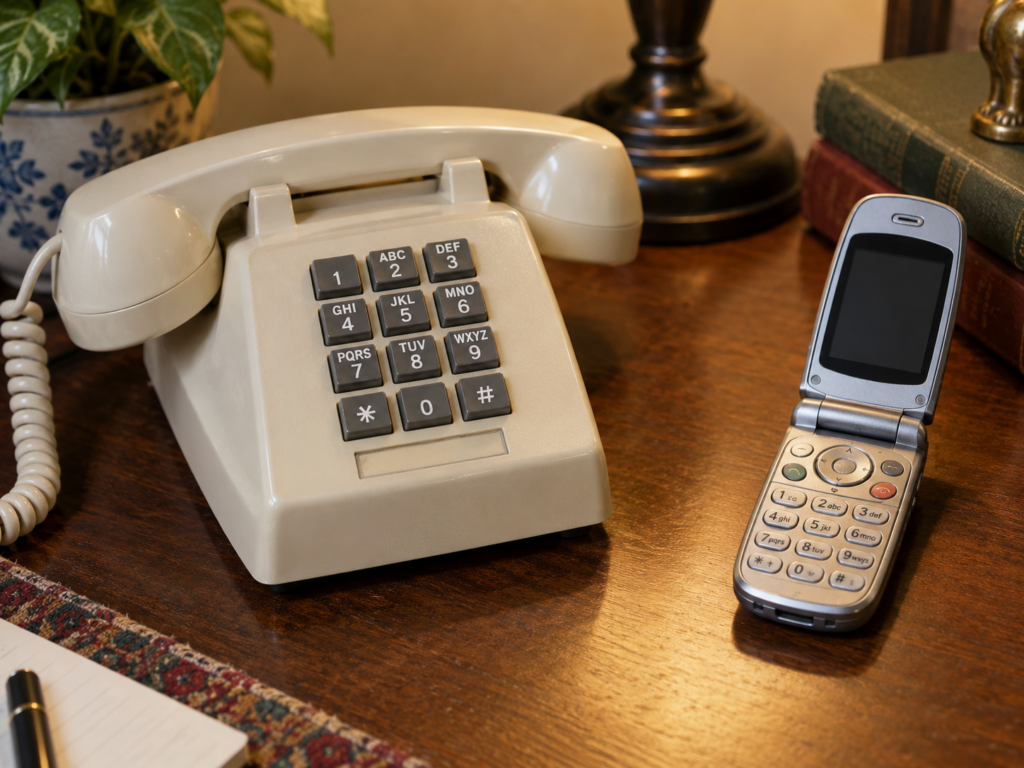
When “Dialing” Stopped Meaning Dialing
Mobile phones eventually removed the physical dial entirely, but the language remained.
Early cellular phones still used physical keypads. Later flip phones, candy-bar phones, and other digital handsets continued the button-based tradition even as the underlying networks became increasingly sophisticated.
Then touchscreens began replacing much of the physical interface.
Today, a caller may never enter a number at all. A saved contact, recent-call list, web link, voice command, or messaging application can establish the connection.
Yet people continue to say they are dialing someone.
That is how thoroughly the old technology shaped the language.
The same thing happened with other communication terms. Phones still “ring” even when they produce a downloaded song. We “hang up” even though nothing is placed on a hook. A smartphone may show an image of an old handset to represent calling even though many younger users have never regularly operated a telephone shaped like one.
Obsolete objects continue to influence the way newer technologies explain themselves.
Collecting the Act of Making a Call
For collectors, telephone history becomes especially interesting when different generations are viewed together.
An early transmitter and receiver demonstrate the period when speech transmission itself was astonishing. A switchboard plug represents the era when a person completed the connection. A rotary dial preserves automatic pulse switching. A Touch-Tone keypad represents electronic signaling. A flip phone or early smartphone shows the transition toward mobile digital communication.
Together, these objects tell a story that no single telephone can.
Collectors do not necessarily need the rarest or most expensive examples. Ordinary household phones often illustrate technological change exceptionally well because they show what people actually used.
A black rotary desk phone, a brightly colored mid-century telephone, a beige push-button kitchen phone, and an early cellular handset can create a surprisingly effective timeline of twentieth-century communication.
Preserve the Clues Before Making It Pretty
Telephone restoration deserves some restraint.
Collectors naturally want dirty or damaged equipment to look presentable, but an old telephone contains historical information that can be removed surprisingly easily.
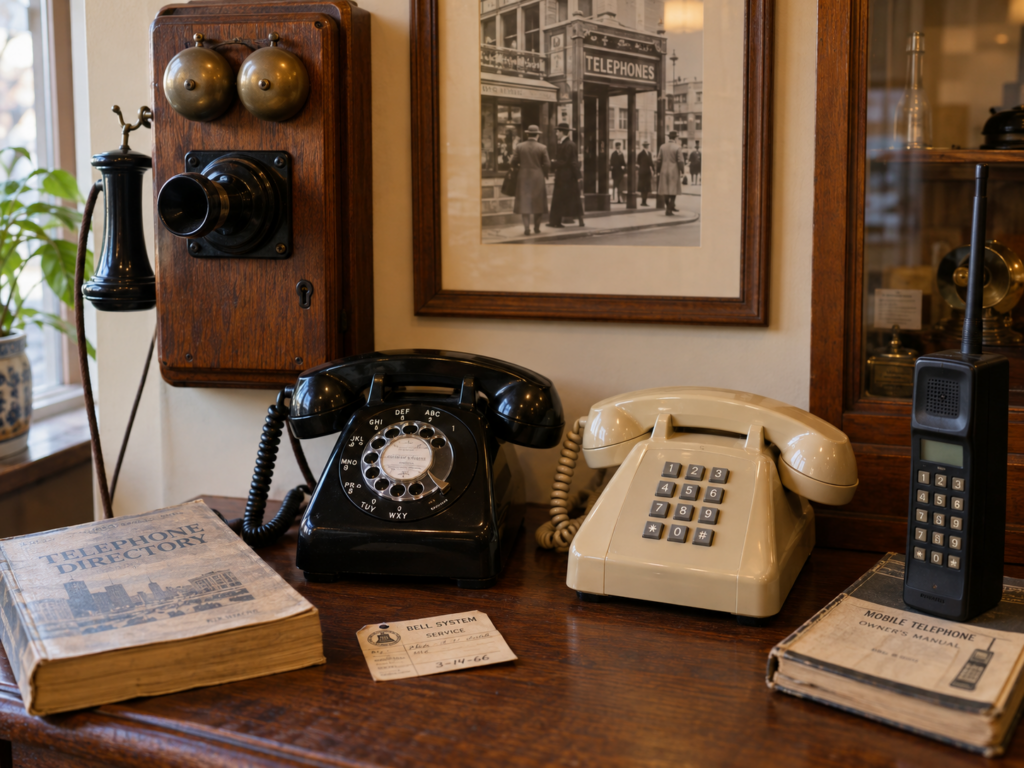
Original dial cards, number plates, cloth cords, mounting hardware, service stamps, handwritten labels, wiring diagrams, and company markings can all provide evidence about an instrument’s working life.
Even mismatched components deserve consideration before replacement. Telephone companies repaired equipment constantly. A handset or cord installed during decades of legitimate service may be part of the object’s history rather than an unfortunate defect.
Cleaning is often sensible. Erasing history is not.
Photograph markings before disassembly. Save removed parts. Record where an object came from. Keep related directories, manuals, bills, photographs, and advertising together when possible.
Provenance can transform an ordinary telephone into something far more interesting.
A common wall phone with documentation showing that it hung in a particular neighborhood store for forty years tells a richer story than an immaculate but anonymous example.
The History Hidden in an Everyday Object
Telephones are easy to overlook precisely because they became so ordinary.
For generations, nearly every home and business had one. People complained about them, waited beside them, stretched their cords into another room, memorized numbers, received important news through them, and eventually carried them everywhere.
That familiarity makes them unusually useful historical objects.
A telephone can reveal changing materials, industrial design, electrical engineering, labor history, consumer culture, advertising, domestic life, and the development of enormous communications networks.
It can also preserve something more personal: the changing physical act of reaching another human being.
First we asked an operator.
Then we turned a dial.
Then we pushed buttons.
Then we tapped a screen.
The technology became faster and increasingly invisible, but the purpose remained remarkably consistent.
Someone is somewhere else.
We want to reach them.
And for more than a century, the telephone has been changing the way we do it.
Let’s Make History—one number at a time.