

By the nineteenth century, the waterfowl decoy had become something both familiar and intensely practical along America’s rivers, bays, marshes, and coastlines.
The basic idea was ancient, as the previous post in this series explored. What changed during the nineteenth century was the scale of use, the growing importance of carved wooden decoys, and the emergence of regional traditions shaped by local birds, local waters, and the working habits of the people who hunted them.
These were not decorative carvings. They were equipment.
A good decoy had to float correctly, survive rough handling, resemble the right species from a distance, and remain useful after repeated exposure to cold water, mud, boats, and weather. Many of the objects now admired as American folk art began their lives being tossed into skiffs, rigged with weights, repainted when necessary, and put back to work season after season.
From Hunting Tradition to Working Tool
By the early nineteenth century, both commercial and recreational hunters in North America were using carved wooden waterfowl decoys. The Smithsonian American Art Museum notes that European settlers adopted established Native decoy techniques and that carved wooden examples were in use by commercial and sport hunters by this period.
Wood offered obvious advantages.
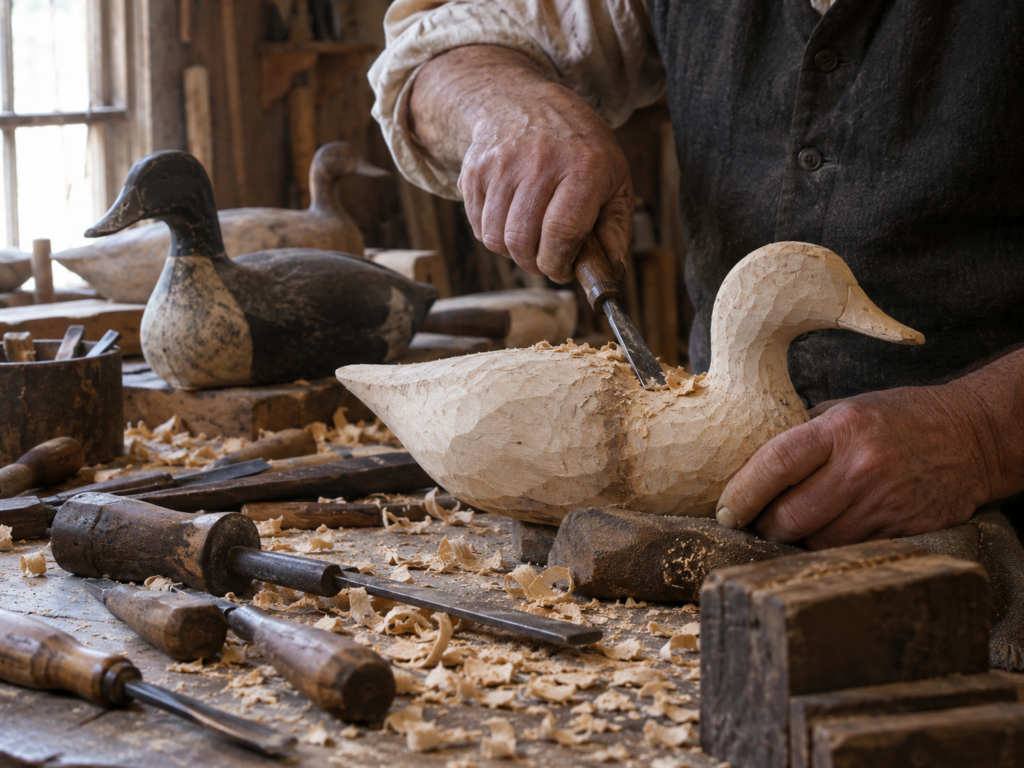
It could be shaped with ordinary hand tools. Buoyant species could be made to ride naturally on the water. Broken heads and bills could be repaired. Paint could be refreshed. Weights, anchors, and line attachments could be changed as hunting conditions demanded.
The result was not one standardized American decoy but thousands of local variations.
A hunter working Chesapeake Bay did not necessarily need the same bird as someone hunting New Jersey’s coastal marshes, Long Island’s bays, or an inland lake. Water depth, wind, current, target species, boat design, and hunting method all influenced what worked best.
Over time, those practical differences helped produce recognizable regional carving traditions.
The Market-Hunting Era
The nineteenth century also brought a dramatic expansion in commercial waterfowl hunting.
Migrating ducks and geese had long been an important food source, but improved transportation connected productive hunting regions with growing urban markets. Smithsonian Folklife research notes that by the middle of the nineteenth century, rail transportation allowed hunters in formerly remote communities to ship large quantities of waterfowl to Mid-Atlantic cities.
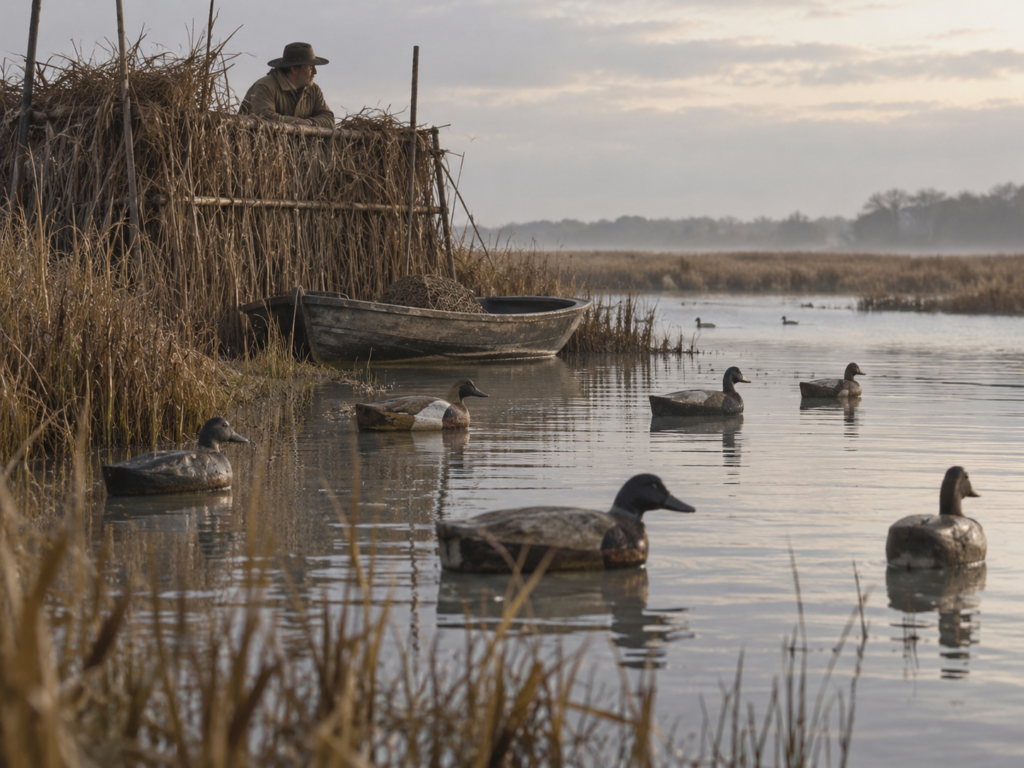
The Chesapeake Bay became one of the best-known centers of this activity. Its enormous seasonal bird migrations supported a culture that included market gunners, guides, boatbuilders, decoy carvers, and later sporting hunters and collectors. The Chesapeake Bay Maritime Museum notes that in the nineteenth and early twentieth centuries, waterfowl from the region was served in elite hotels and clubs along the eastern seaboard.
For a market hunter, decoys were part of the business.
A rig might include many birds, and appearance mattered primarily because effectiveness mattered. Rough-hewn construction was not necessarily a flaw. If a decoy worked, floated properly, and helped draw birds within range, it had fulfilled its purpose.
This is one reason nineteenth-century working decoys can look very different from later decorative carvings made expressly for collectors.
Built to Survive Work
Working decoys were repeatedly exposed to conditions that would be considered abusive treatment for most collectibles today.
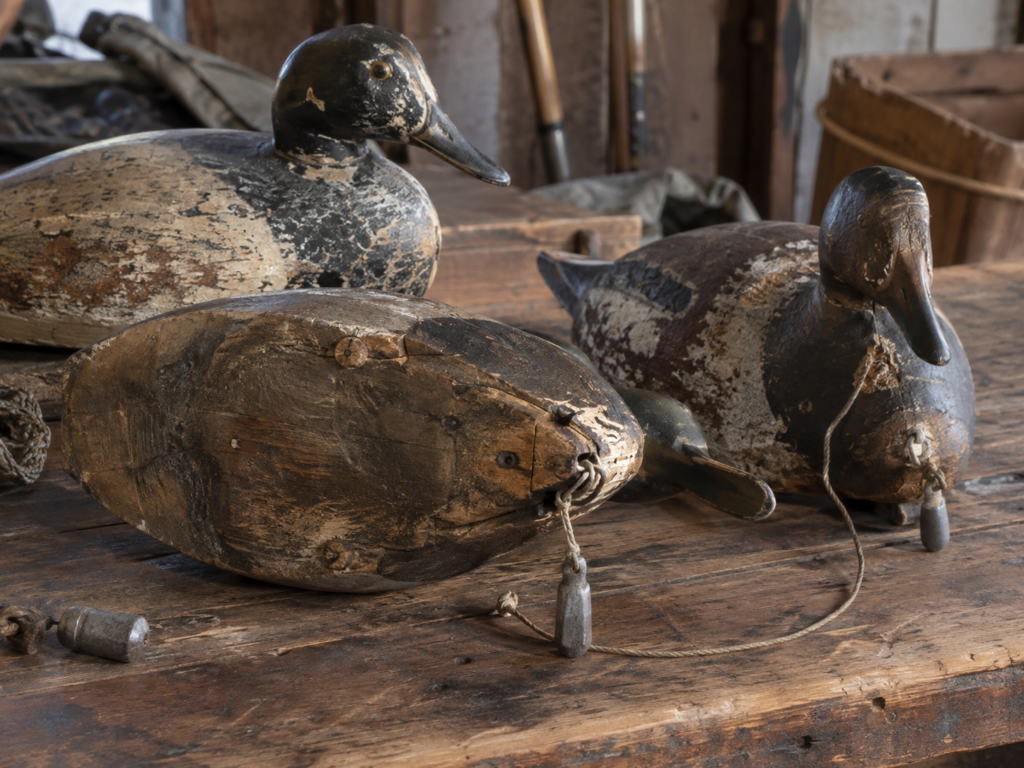
They were hauled in boats, stacked in sheds, dragged by anchor lines, scraped against hulls, soaked in salt or fresh water, and knocked together during transportation. Paint wore away. Bills broke. Heads loosened. Bodies cracked. Hunters repaired them because replacing useful equipment cost time and money.
That history survives in the object.
Old nail holes may show where a head was reset. Repaint can represent decades of field maintenance rather than modern restoration. Shot scars may indicate that a decoy was accidentally struck while in use. Line attachments and weights can reveal how it was rigged.
For collectors, this creates an important distinction between working alteration and later restoration.
A repaint applied by a hunter during the decoy’s active life may be historically significant even if it covers earlier paint. A modern repaint intended to make the bird look cleaner or more valuable is something entirely different.
The difficult part is determining which is which.
Carving for Water, Not for the Shelf
A nineteenth-century carver did not need to reproduce every feather.
From a distance, broad form and contrast were often more important than minute detail. A recognizable head shape, the correct body profile, and effective blocks of color could be enough to suggest a canvasback, black duck, mallard, or other target species.
That does not mean these decoys lacked craftsmanship.
Quite the opposite.
A skilled maker understood how little carving was necessary to create the right impression. The best working decoys often achieve remarkable character with restrained shapes and simple paint.
The body also had to function as a floating object. Balance mattered. Some traditions favored solid bodies; others used hollow construction to reduce weight and improve buoyancy. Later documented working examples show how makers selected buoyant woods and sometimes hollowed bodies specifically so the finished decoy would ride correctly on the water.
Utility shaped style.
The sweep of a back, angle of a neck, width of a breast, and placement of weight beneath the body were not merely aesthetic choices. They affected how the bird appeared when viewed across moving water.
Regional Style Begins to Matter
As decoy making became established in major waterfowling regions, local styles became increasingly distinctive.
Smithsonian Folklife documentation points to regional traditions associated with places such as Chesapeake Bay, Barnegat Bay, Core Sound, and Great South Bay, noting that details like head pose, tail shape, and paint can distinguish one regional tradition from another.
Those distinctions are central to collecting today.
A decoy can sometimes reveal where it was made even when the maker is unknown. Body construction, wood choice, head attachment, keel design, paint pattern, and overall silhouette may provide clues.
That does not mean attribution is easy.
Working decoys were copied, repaired, traded, and moved from one area to another. Some makers followed local conventions closely, while others developed individual habits. Many nineteenth-century carvers remain unidentified.
For that reason, responsible identification often uses cautious language such as “attributed to,” “school of,” or “possibly from” rather than treating every stylistic resemblance as proof.
Ordinary Makers, Extraordinary Survival
One of the appealing things about early working decoys is how often their makers were not professional artists.
They could be hunters, boatbuilders, fishermen, farmers, craftsmen, or people simply making what they needed.
That is part of what places decoys within the broader tradition of American folk art.
Their makers solved practical problems with the tools and materials available to them. The surviving object carries evidence of handwork: uneven knife marks, asymmetry, simple joinery, brushstrokes, and repairs.
What collectors now admire as individuality may have begun as efficiency.
A carver might repeat a body pattern because it was fast and proven. A head might be exaggerated because that profile read better from the air. Paint might be simplified because fine detail was pointless after a season in the marsh.
The artistry was inseparable from use.
What Collectors Should Examine
When evaluating an early working decoy, condition alone should not determine interest.
Original paint is important, but heavily worn original surfaces can still be more desirable than bright later repaint. Repairs may add character when they clearly belong to the decoy’s working history. Old rigging holes, weights, line ties, and underside wear can help establish that an object actually saw use.
Construction deserves close attention.
Look at how the head joins the body, whether the body is solid or hollow, the shape of the bottom, the placement of weights, and the type of hardware. Tool marks can be informative. So can differences between exposed and protected paint.
Provenance is especially valuable.
A decoy with a reliable history connecting it to a particular family, hunting club, region, or rig can be far more informative than an anonymous bird purchased solely for appearance.
Collectors should also be cautious about claims of great age. An object described as “nineteenth century” should have construction, materials, surface, and provenance consistent with that date. Artificially aged paint and manufactured wear can imitate the appearance of use surprisingly well.
When Working Decoys Became Historical Objects
The nineteenth-century system of commercial waterfowl hunting did not continue indefinitely.
By the end of the century, growing concern over wildlife depletion was producing stronger conservation measures. The federal Lacey Act of 1900 restricted interstate commerce in illegally taken wildlife, and later federal measures increasingly curtailed market hunting. The Migratory Bird Treaty Act of 1918 ultimately created the framework that still governs the taking and protection of migratory birds in the United States.
As commercial hunting declined, waterfowling changed.
Former market hunters could continue as sport hunters or guides. Decoy carving continued, but changing hunting practices encouraged different levels of realism and craftsmanship. Smithsonian Folklife research notes that as market hunting faded, more lifelike decoys became increasingly important for a less purely utilitarian form of hunting.
Eventually, the same battered wooden birds once treated as ordinary gear began attracting collectors.
That transformation is one of the most interesting parts of decoy history.
An object created to spend winter mornings floating in dark water became an object studied for regional style, maker attribution, paint history, and artistic merit.
Folk Art That Earned Its Wear
Nineteenth-century working decoys occupy an unusual place between tool and sculpture.
They were shaped by function, yet function produced form. They were meant to fool birds, yet generations later they can reveal a remarkable amount about the people who carved and used them.
Their chipped paint, worn bottoms, repaired necks, and battered bills are not simply damage.
They can be records of work.
That makes a true working decoy different from an object designed from the beginning to sit safely on a shelf. Its appearance developed not only in the carver’s hands but through seasons of use.
The nineteenth-century hunter needed a bird that floated properly, survived the marsh, and brought real waterfowl closer.
The collector sees something else as well: regional history, craftsmanship, folk art, and evidence of a vanished working world.
Both views belong to the same object.
Let’s Make History—one working decoy at a time.