
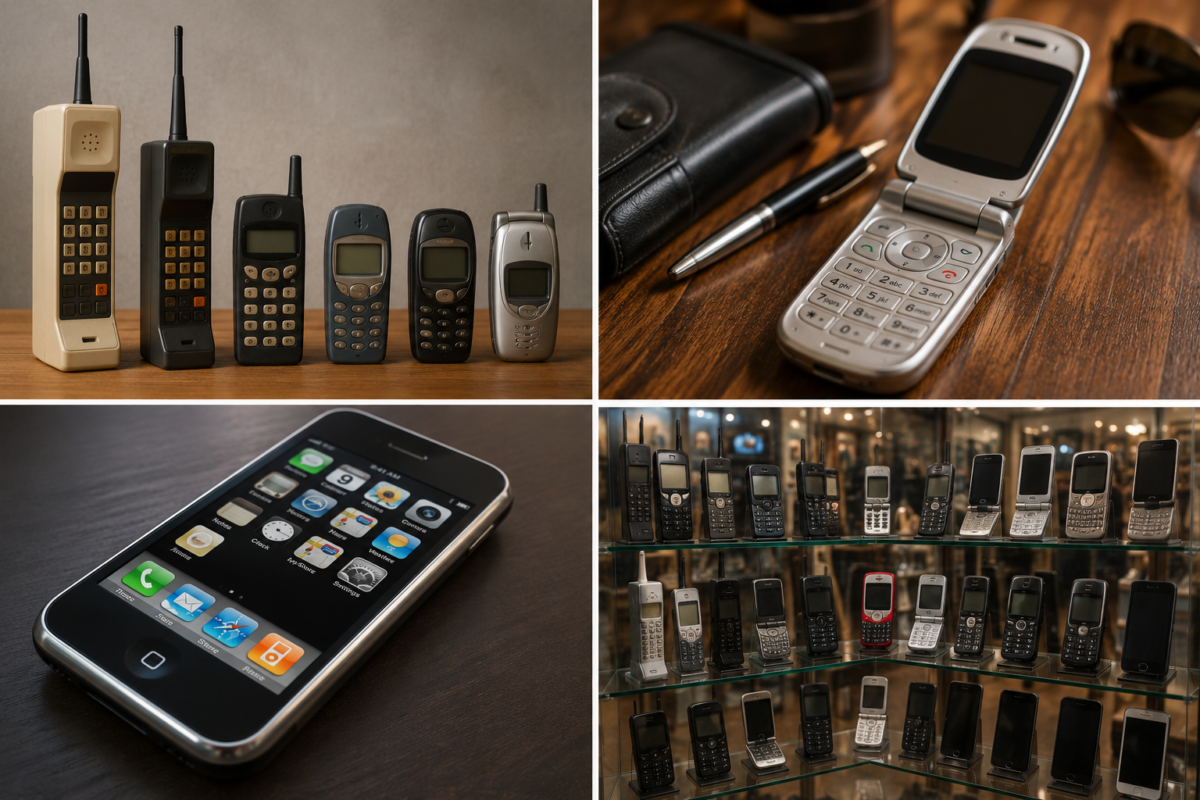
For most of telephone history, the telephone belonged to a place. It sat on a desk, hung on a kitchen wall, waited beside a bed, or stood inside a booth on a street corner. Even when long-distance service allowed voices to travel hundreds or thousands of miles, the instrument itself remained attached to a building by a wire.
The mobile phone changed that relationship completely.
In only a few decades, a telephone that began as expensive, specialized radio equipment became an ordinary personal possession. Along the way, mobile phones shrank from hefty handsets into pocket-sized devices, changed from analog to digital communication, learned to send text messages, absorbed the functions of organizers and cameras, and eventually became handheld computers that also happened to make telephone calls.
Before the Telephone Fit in a Pocket
Mobile telephone service existed well before the familiar handheld cell phone. Radio-based car telephone systems allowed some motorists to place calls while traveling, but the equipment was bulky, channels were limited, and service was expensive. The telephone could move with the automobile, but it was hardly something a person could casually carry around.
Cellular technology approached the problem differently. Rather than relying on a single powerful transmitter to serve a huge region, a network could divide an area into smaller geographic cells. As a caller moved, the network could transfer the connection from one cell to another.
The most famous early demonstration of a truly handheld cellular telephone occurred on April 3, 1973. Motorola engineer Martin Cooper made a public call in New York City using a prototype portable cellular phone. The Smithsonian identifies Cooper’s demonstration as the public introduction of the first true handheld cell phone, while Motorola records the same event as its first working portable cellular system and handset demonstration.
Commercial cellular networks followed. Japan opened commercial cellular service in 1979, with Nordic countries following in 1981. These early networks used analog technology—the first generation of cellular service later known as 1G.
The idea of carrying a telephone was no longer simply experimental. It was becoming an industry.
The Age of the “Brick”
Early handheld cellular phones did not disappear discreetly into a pocket.
Motorola’s DynaTAC 8000X received U.S. regulatory approval in September 1983 and became available to consumers in 1984. It weighed about 28 ounces, and its substantial rectangular body, long antenna, physical keypad, and limited battery capacity made it very different from anything people now associate with a mobile phone.
The nickname “brick phone” was understandable.
The size was only one barrier. Early cellular phones and the service required to use them were expensive, making mobile communication a status symbol as much as a convenience. The sight of an executive carrying a large cellular handset became one of the visual shorthand images of 1980s business culture.
That cultural role gives early mobile phones much of their collecting interest today. They document a moment when simply being able to carry a telephone was remarkable.
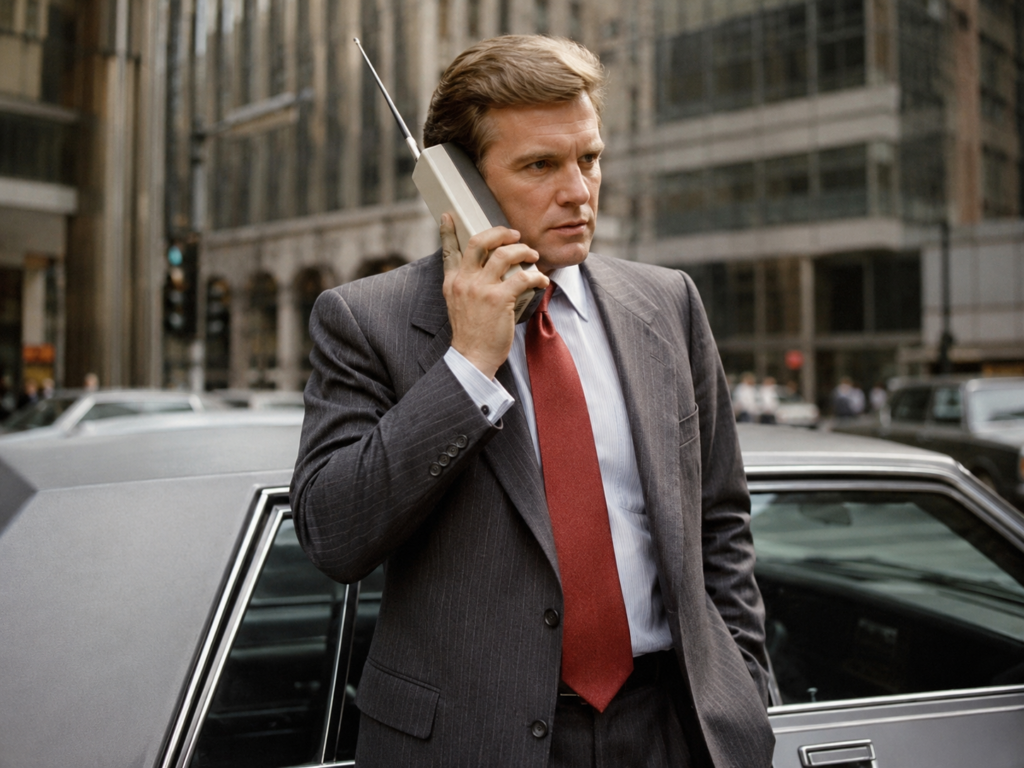
Designers and engineers quickly concentrated on making the technology smaller. Batteries improved, electronic components became more compact, and manufacturers experimented with folding, sliding, and increasingly portable designs.
The objective was straightforward: turn a piece of communications equipment into something a person could realistically take everywhere.
From Analog to Digital
Making phones smaller was only part of the transformation.
First-generation cellular networks transmitted voice primarily through analog radio signals. During the 1990s, second-generation systems increasingly shifted mobile communications into the digital world.
One major milestone came in 1991, when the first GSM call was made on Finland’s Radiolinja network. The first SMS text message followed in 1992.
Those developments changed what a mobile phone could be.
Digital networks made more efficient use of available radio spectrum and supported services beyond ordinary voice conversations. Text messaging, in particular, created an entirely new form of everyday communication. A telephone no longer needed to ring before two people could exchange information.
The phones themselves reflected the change.
Large analog handsets gave way to compact candy-bar phones, folding clamshells, and other designs intended for pockets and handbags. External antennas grew shorter and eventually disappeared into the housing. Screens became larger and more informative. Electronic address books reduced the need to memorize telephone numbers.
Then came alarms, calculators, calendars, games, customizable ringtones, and interchangeable covers.
The mobile phone was becoming personal in a way the household telephone rarely had been.
A kitchen telephone belonged to everyone in the house. A mobile phone increasingly belonged to you.
The Flip Phone Era
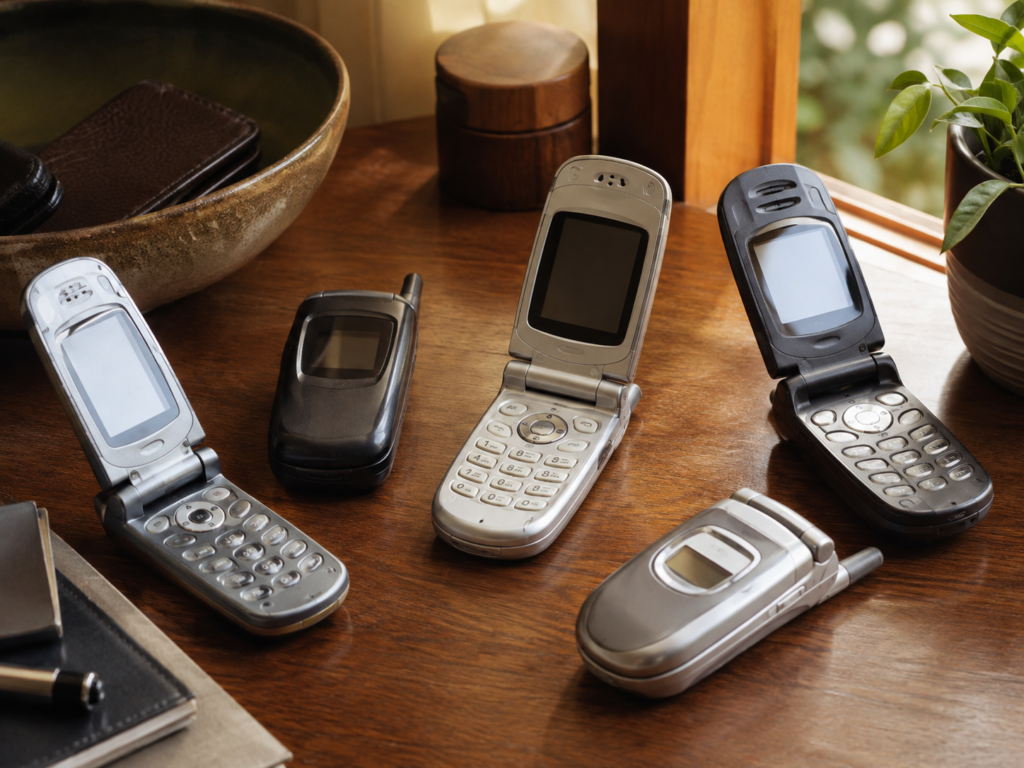
Few mobile-phone forms evoke the late 1990s and early 2000s as strongly as the flip phone.
Opening a clamshell handset to answer a call and snapping it shut afterward added a physical gesture to mobile communication, much as spinning a rotary dial had done generations earlier. Folding designs also protected the keypad while allowing manufacturers to make phones more compact.
Phones became fashion objects as well as technology.
Manufacturers competed over size, shape, color, displays, buttons, and increasingly distinctive designs. Some buyers wanted the smallest possible phone. Others wanted large screens, business features, cameras, or a handset that simply looked different from everyone else’s.
For collectors, this era provides enormous variety. A basic mass-market flip phone, an unusually small handset, an early camera phone, or a distinctive luxury model can each represent a different part of the mobile revolution.
What once seemed disposable is beginning to look increasingly like material culture.
When the Telephone Became a Computer
The smartphone did not suddenly appear in 2007.
Manufacturers had been experimenting with combinations of cellular telephones and handheld computers for years. One especially important example was the IBM/BellSouth Simon Personal Communicator, introduced in the early 1990s. It combined mobile calling with a personal organizer, pager, fax capability, and touchscreen. The Computer History Museum describes Simon as the first smartphone, although its high price, bulk, and short battery life kept it from becoming a mass-market success.
Other devices continued blurring the boundaries between telephones, personal digital assistants, pagers, and computers. Phones acquired email, web access, full keyboards, color screens, downloadable software, and cameras.
Then the pace accelerated.
Apple introduced the iPhone in January 2007 as a combination mobile phone, widescreen media player, and internet communications device built around a large multi-touch display. It reached the U.S. market that June.
The importance of that change went beyond eliminating most physical buttons.
The telephone was becoming a software platform.
Applications could perform tasks that once required separate objects. Maps replaced road atlases. Digital cameras replaced film cameras for everyday snapshots. Music players moved into phones. Calendars, address books, calculators, alarm clocks, flashlights, games, newspapers, and eventually payment cards all began disappearing into the same device.
Voice communication remained important, but it was no longer the only feature defining the telephone.
What Mobile Phones Offer Collectors
Mobile phones are young compared with most traditional antiques, but age alone does not determine historical significance.
In fact, the rapid pace of technological change creates an unusual collecting situation. Enormous numbers of mobile phones were manufactured, yet consumers were encouraged to replace them frequently. Trade-in programs, recycling, damaged batteries, obsolete networks, and simple disposal have removed countless examples from circulation.
Collectors can approach the field in several ways.
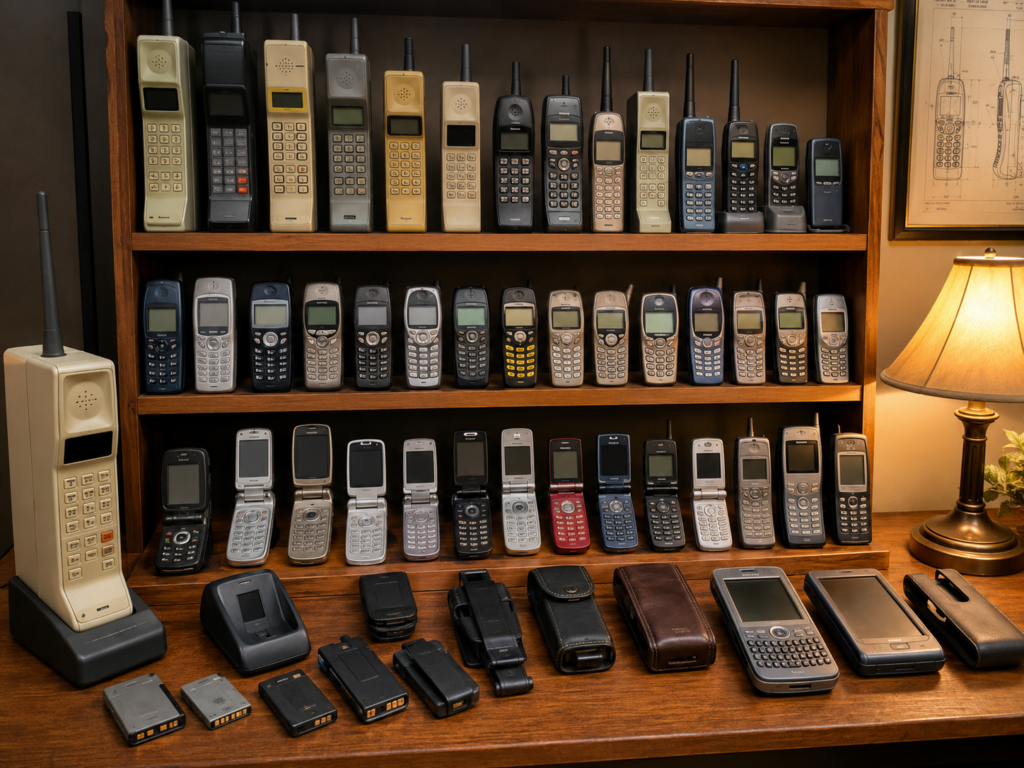
Some concentrate on early brick phones and the beginnings of handheld cellular service. Others collect flip phones, unusually small handsets, early camera phones, first-generation smartphones, particular manufacturers, unusual colors, or devices connected with important technological transitions.
Original accessories can make a substantial difference to a surviving example. Chargers, charging cradles, batteries, belt clips, leather cases, manuals, boxes, car adapters, earbuds, and other accessories help recreate how a phone was actually sold and used.
Condition needs to be considered differently from that of older mechanical telephones.
Plastic may yellow or become brittle. Rubberized coatings can deteriorate into a sticky surface. Hinges loosen. Keypad markings wear away. LCD screens can fail or bleed. Charging ports and proprietary cables become difficult to replace.
Batteries require particular caution. Aging rechargeable batteries may swell, leak, or become unsafe to charge. A historically interesting phone does not need to work in order to remain collectible, and attempting to revive a questionable battery can damage both the object and its surroundings.
When the Artifact Contains an Archive
Digital devices present collectors with a problem that did not exist with most earlier telephones: an old mobile phone may contain someone’s personal life.
Stored contacts, photographs, text messages, emails, calendars, notes, account information, and other data can remain inside devices long after they have been discarded or sold.
That means a collector encountering an old phone should think about privacy as well as preservation.
A phone intended for anonymous resale or display may appropriately be erased when that can be done safely. A device with documented historical provenance presents a more complicated situation because its data may form part of its history. Either way, casually exploring another person’s private information simply because the technology makes it possible is difficult to justify.
This is one of the major differences between collecting traditional telephone equipment and collecting digital communications technology.
An antique telephone records its history through scratches, repairs, fading, and wear.
A modern telephone may literally contain the history of the person who owned it.
Yesterday’s Technology Becomes Tomorrow’s Collectible
The mobile revolution happened so quickly that many of its early artifacts still feel too recent to be historic.
That perception will not last forever.
The oversized handheld cellular phone of the 1980s already belongs unmistakably to another era. Flip phones that once seemed modern now trigger nostalgia. Early smartphones can appear surprisingly primitive beside current devices despite being only a few decades old.
That rapid obsolescence is precisely what makes them worth preserving.
The history of the telephone began with the challenge of carrying a human voice through a wire. A century later, engineers removed the wire. Then they digitized the voice, added text, connected the telephone to the internet, inserted a camera, and transformed the entire instrument into a portable computer.
Yet underneath all that technological change remains essentially the same desire that drove the telephone from the beginning.
Someone is somewhere else, and we want to reach them.
The machinery has changed dramatically. The reason for using it has not.
Let’s Make History—one signal at a time.
Looking for something related?
Dear June Collectibles carries thousands of antiques, vintage pieces, collectibles, ephemera, books, housewares, jewelry, memorabilia, and unusual finds. Inventory changes constantly.
Found something like this while clearing a home or collection?
Before assuming it should be thrown away, tell us what you found. Dear June Collectibles helps families, collectors, executors, and homeowners sort household contents, collections, and estates and identify realistic resale possibilities.