
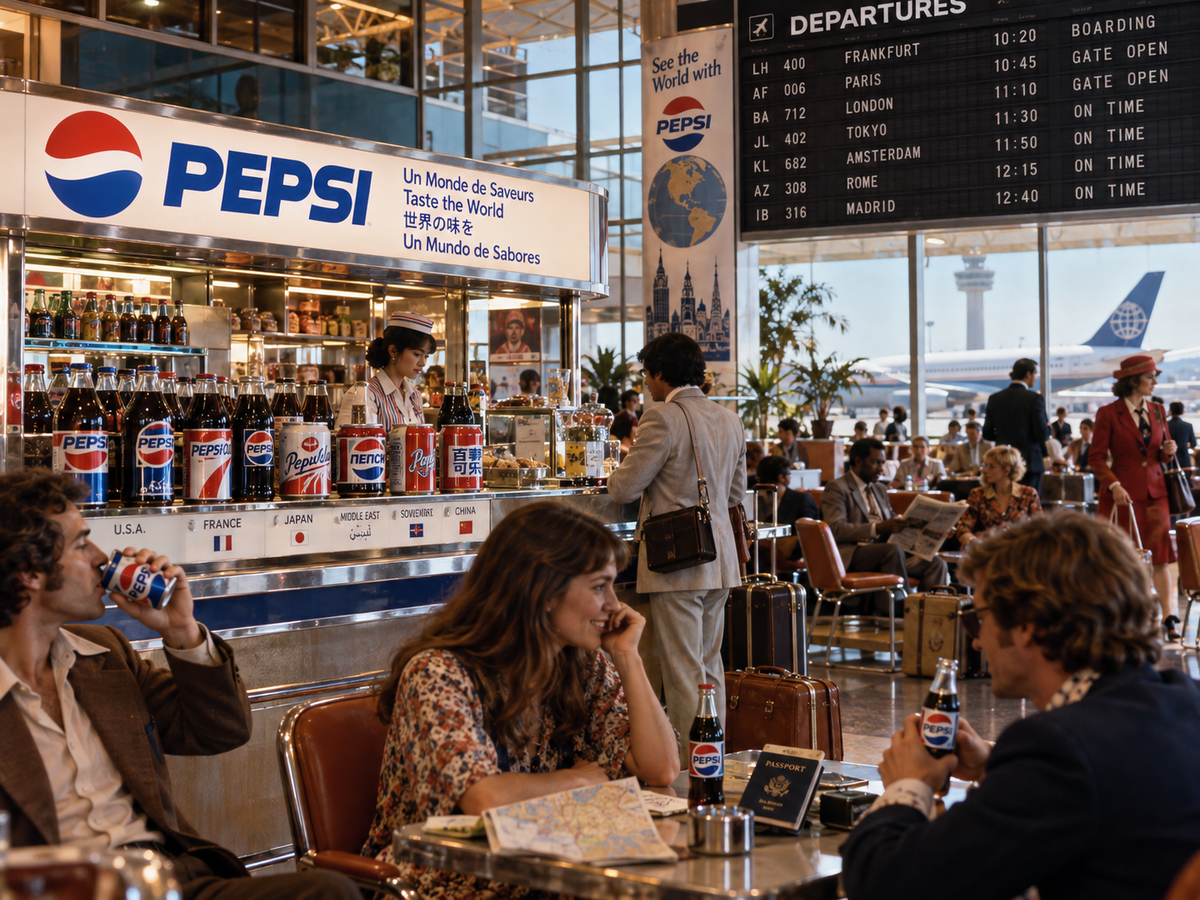
A Pepsi collectible does not always belong neatly in a collection of soda advertising.
It might also be music memorabilia, sports merchandise, movie promotion, fashion, foreign advertising, restaurant material, or packaging from a country thousands of miles from the place where Pepsi-Cola began. As Pepsi expanded internationally and increasingly attached its name to entertainment and popular culture, the range of objects carrying its familiar red, white, and blue identity expanded with it.
For collectors, those crossovers create some of the most interesting corners of Pepsi collecting. They also make identification more complicated. A foreign Pepsi sign may look unfamiliar while being entirely authentic, and a promotional can may be sought as enthusiastically by fans of the celebrity pictured on it as by soda collectors.
When Pepsi Became an International Brand
Pepsi began as an American product, but international growth gradually changed what Pepsi advertising and packaging could look like.
That change is visible in surviving material from the mid-20th century. The Smithsonian’s Pepsi-Cola Advertising Collection includes international signs and promotional objects primarily dating from the late 1960s and 1970s. Among the documented material are German signs, a decal from Yugoslavia, international cardboard cartons, and photographs of Pepsi cups used in Japan.
Those objects demonstrate an important point for collectors: there was never just one universal form of Pepsi memorabilia.
A basic corporate identity might be shared across countries, but local bottlers, languages, package sizes, regulations, manufacturing methods, and advertising needs could produce meaningful differences. A sign intended for a German shop was not necessarily identical to one supplied to an American grocery store. Bottles could carry different measurements or bottling information. Paper advertising might use translated slogans, market-specific imagery, or locally familiar settings.
That variation is one reason international Pepsi pieces can be so interesting. They combine a recognizable global brand with the material culture of a particular place.
Pepsi Behind the Iron Curtain
Few episodes illustrate Pepsi’s international ambitions better than its unusual history in the Soviet Union.
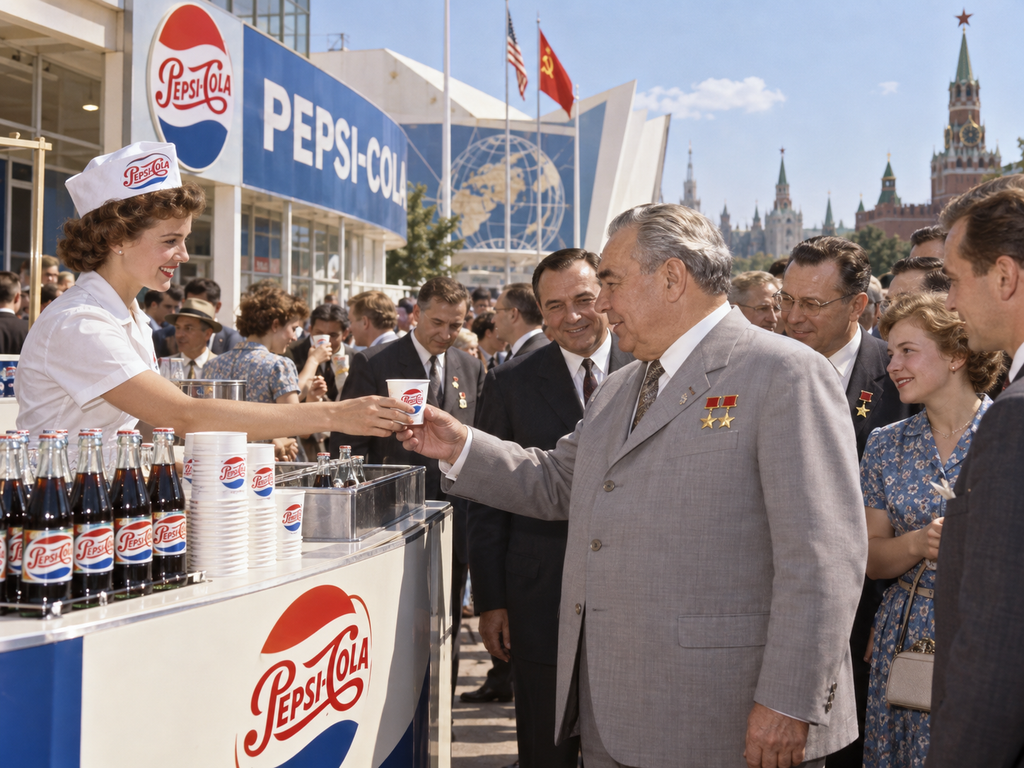
At the 1959 American National Exhibition in Moscow, Pepsi-Cola International executive Donald Kendall arranged for Soviet leader Nikita Khrushchev to sample Pepsi. Approximately three million cups of Pepsi were served to visitors during the six-week exhibition. After years of negotiation, Pepsi reached a barter arrangement with the Soviet government, and in 1974 a franchise bottling plant opened at Novorossiysk. PepsiCo describes Pepsi as the first Western consumer product to be made and sold in the Soviet Union.
For a collector, that history changes the meaning of an otherwise ordinary-looking bottle, label, advertising sign, or serving piece.
Soviet-era Pepsi material can appeal simultaneously to collectors of soda advertising, Cold War history, Soviet ephemera, packaging, and international consumer culture. That is a perfect example of a collectible crossover: the object belongs to several historical stories at once.
It also illustrates why unfamiliar lettering should not automatically be treated as evidence that an item is wrong. Cyrillic text, metric measurements, local manufacturer information, or a logo presented differently from its American counterpart may be exactly what makes an international piece historically significant.
When Pepsi Crossed Into Music, Sports, and Entertainment
International expansion was only part of the story. Pepsi also became increasingly willing to place its brand inside other areas of popular culture.
Music is perhaps the most obvious example.
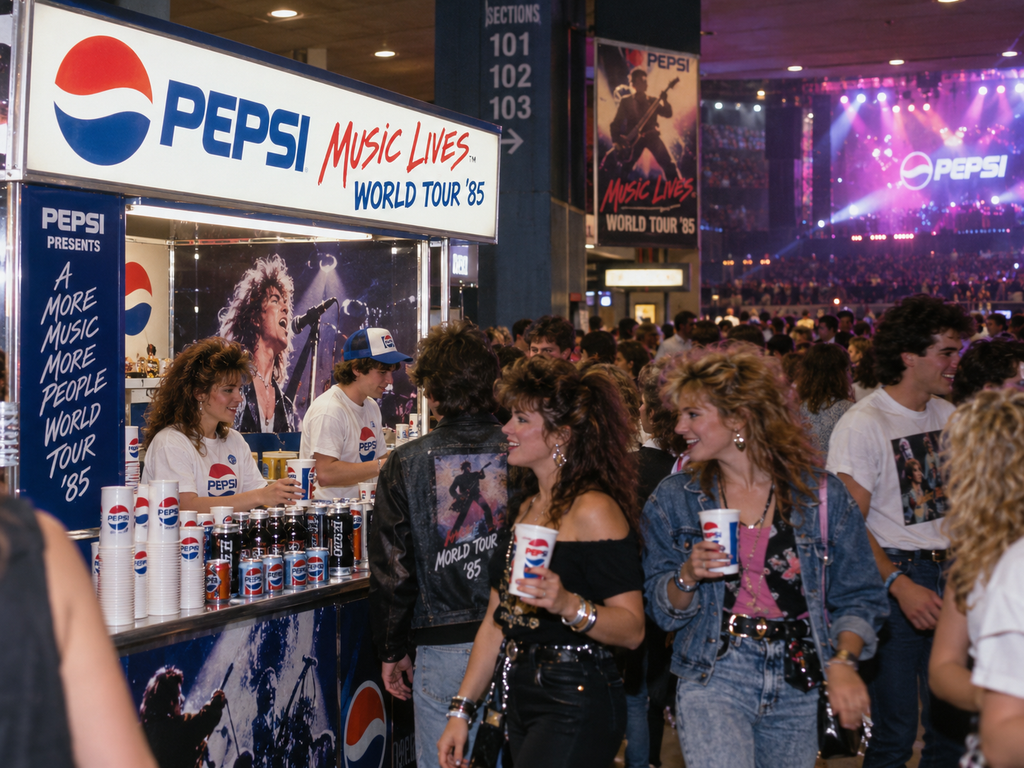
Michael Jackson first appeared in a Pepsi campaign with his brothers in 1983 during the company’s “New Generation” era. Pepsi later sponsored Jackson’s Bad tour, and the relationship became one of the most recognizable connections between a soft-drink company and a major recording artist. Decades later, Pepsi revisited that history with a 2012 global promotion that placed Michael Jackson imagery on limited-edition cans distributed across numerous international markets.
Pepsi repeated the collectible-packaging idea in 2018. Its Pepsi Generations campaign used special cans featuring Michael Jackson, Ray Charles, and Britney Spears along with Pepsi logos associated with their respective eras. The same campaign revived Pepsi Stuff merchandise and other promotional products.
Those cans occupy more than one collecting category. A Britney Spears collector may want one without otherwise caring about beverage advertising. A music memorabilia collector might pursue the entire set. Pepsi enthusiasts may approach the same cans as part of the history of changing package graphics.
Sports created similar opportunities. Pepsi has attached its name to major football, soccer, and other sporting events, producing everything from cups and stadium advertising to clothing and limited packaging. More recently, PepsiCo’s UEFA partnerships have deliberately combined football with entertainment, music, and global promotion.
The result is an enormous family of objects whose appeal extends well beyond traditional soda collecting.
The Package Becomes the Collectible
Ordinary packaging normally has a short life. A bottle is returned, a can is recycled, and a carton is discarded.
Cross-promotional campaigns can reverse that expectation.
Once a celebrity, film, sporting event, anniversary, or special design appears on the package, consumers have a reason to save something that would otherwise disappear. Manufacturers understand this, which is why limited-edition cans and bottles are frequently issued in series.
That distinction matters when discussing rarity.
A limited design is not automatically rare. A promotion distributed nationally—or internationally—may have involved millions of packages. Pepsi’s 2012 Michael Jackson campaign, for example, was planned around imagery appearing on approximately one billion cans worldwide.
Survival and demand matter more than the words “limited edition.”
Some packages were saved extensively because consumers immediately recognized them as collectible. Others disappeared because nobody considered them worth keeping. Regional promotions may be much harder to encounter than highly publicized national campaigns even when the national item looks more impressive.
Pepsi Outside the Beverage Aisle
The logo has also migrated onto objects that have little practical connection with serving cola.
Shirts, jackets, hats, beach equipment, watches, radios, bags, glasses, coolers, toys, and countless promotional premiums have carried Pepsi branding. Some were inexpensive giveaways. Others resulted from deliberate collaborations with established designers or manufacturers.
In 2014, for example, Pepsi launched a global fashion capsule collection tied to its football campaign, working with international designers and retailers on clothing, accessories, and electronics. A later 2018 project brought the Pepsi identity into clothing and accessories through collaborations with brands including Umbro and New Era.
Objects like these demonstrate how far a corporate trademark can travel from its original product.
A Pepsi-branded jacket might be collected as advertising, fashion, sports memorabilia, or corporate promotional material. A stadium cup can interest both Pepsi collectors and fans of the team or event. A celebrity can brings together packaging and entertainment memorabilia.
These overlaps can also influence value. Demand may come from several groups rather than from Pepsi collectors alone.
What to Look for in International and Crossover Pieces
Foreign and crossover items deserve the same careful examination as older American Pepsi advertising, but collectors often need to look for different clues.
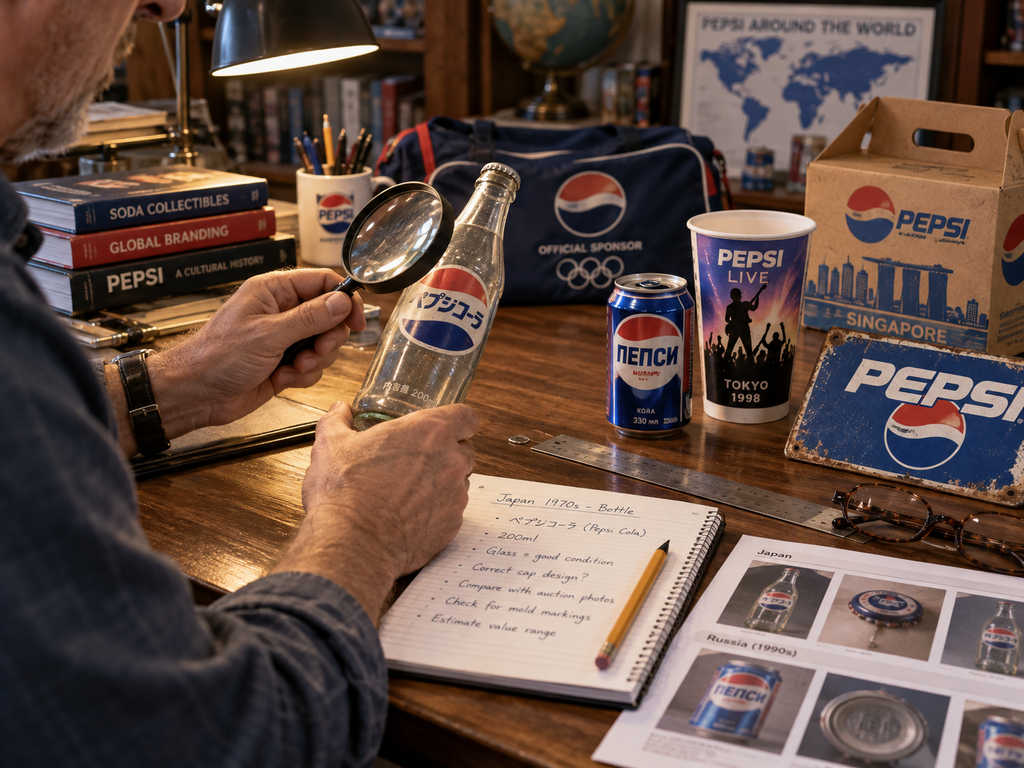
Start with the object itself rather than assuming its date from the logo. Look for manufacturer names, country-of-origin markings, metric volume statements, bottling information, copyright dates, licensing language, promotional partners, printers, or event names.
On entertainment-related material, licensing information can be particularly helpful. A genuine promotional item involving a performer, sports league, movie property, or fashion company may carry several corporate marks rather than Pepsi branding alone.
International objects can require more research because familiar American dating guides may not apply cleanly. Logos and packages were not necessarily changed everywhere at the same moment. Old equipment could remain in service, local bottlers could use approved regional variations, and campaigns could reach different markets on different schedules.
Condition should also be judged according to the type of item.
An unopened promotional can can develop leakage or corrosion over time. Paper cups and cartons were inherently disposable and may be difficult to find clean. Outdoor signs naturally suffer weathering. Clothing needs to be examined for fading, cracking graphics, stains, and alterations.
Most importantly, unusual should not be confused with rare. A piece may simply be unfamiliar because it came from another market.
One Brand, Many Visual Languages
Pepsi’s success as a global collectible subject comes from a useful contradiction: the brand has remained recognizable while constantly changing.
The red, white, and blue identity became strong enough to travel across languages and national borders, yet the company repeatedly redesigned packaging and advertising to keep the brand contemporary. That process continues today. Pepsi’s 2023 visual redesign was introduced in North America before expanding globally in 2024, with the refreshed identity rolling into more than 120 markets.
For future collectors, those changes will create another generation of variations.
For collectors today, the attraction of crossover and international Pepsi material is the opportunity to follow a familiar symbol into unexpected places. A Japanese cup, Soviet bottle, German sign, concert promotion, football shirt, celebrity can, or fashion collaboration may look completely different from a 1950s American soda-fountain sign, yet each belongs to the same long advertising history.
That breadth is what makes Pepsi collecting difficult to exhaust. The deeper the brand moved into the world, the more kinds of objects it left behind—and the more histories those objects began to share.
Let’s Make History across borders, brands, and the many worlds Pepsi collecting brings together.
Discover more from Dear June Collectibles
Subscribe to get the latest posts sent to your email.