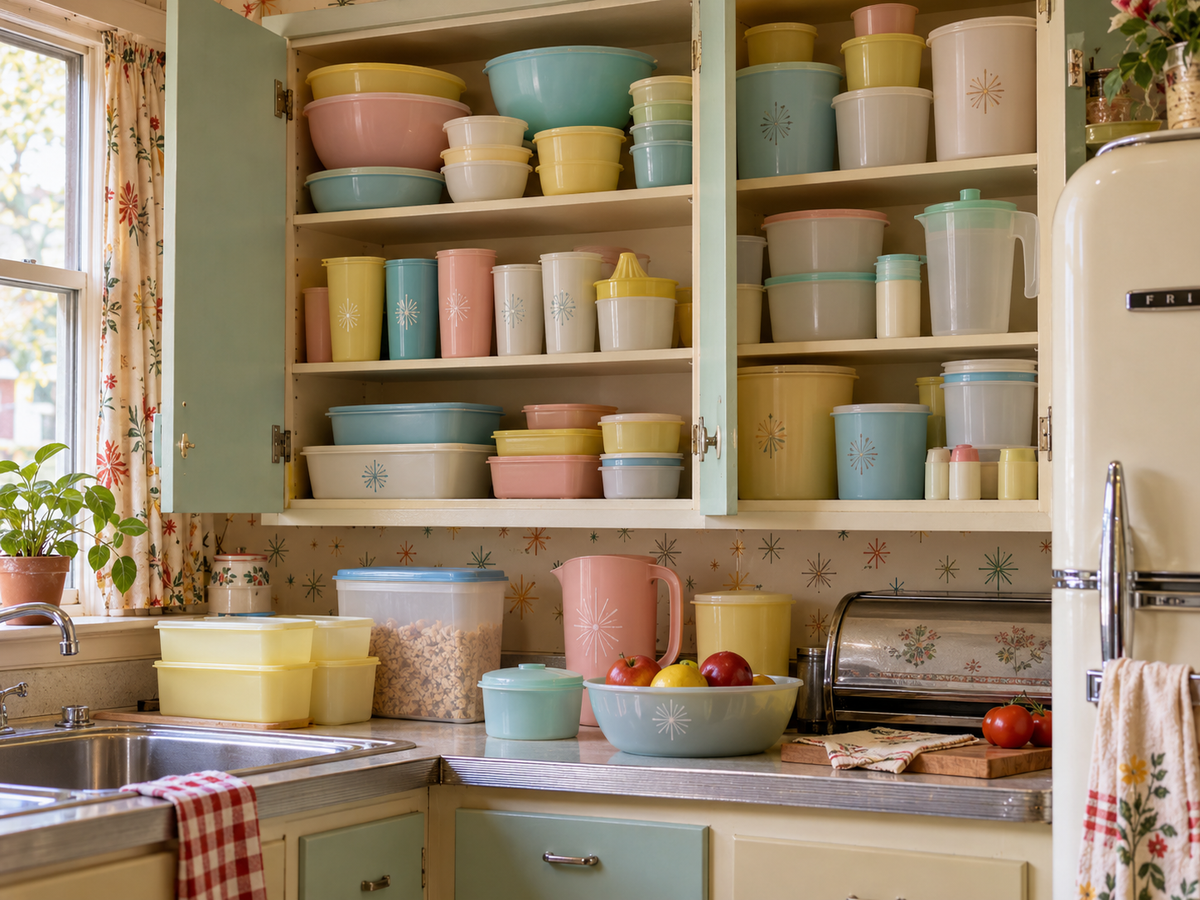
Few household objects capture mid-century America as completely as a piece of vintage Tupperware.
The story begins with a new material. It continues through an ingenious airtight seal, carefully chosen colors, suburban kitchens, living-room sales parties, and a generation of women who turned household demonstrations into business opportunities. By the 1950s, what had begun as an experiment in molded polyethylene had become something far more significant than a collection of food-storage containers.
Tupperware had become part of American life.
That is why these objects deserve attention from collectors today. A vintage bowl or pitcher can tell us about changing technology, industrial design, consumer culture, domestic routines, entrepreneurship, and even the way Americans imagined the modern home.
Taken together, the pieces form a colorful record of an era that believed the future might arrive in the kitchen cupboard.
Plastic Becomes Modern
Plastic was not new when Earl Tupper began experimenting with polyethylene, but Tupperware helped change how consumers experienced it.
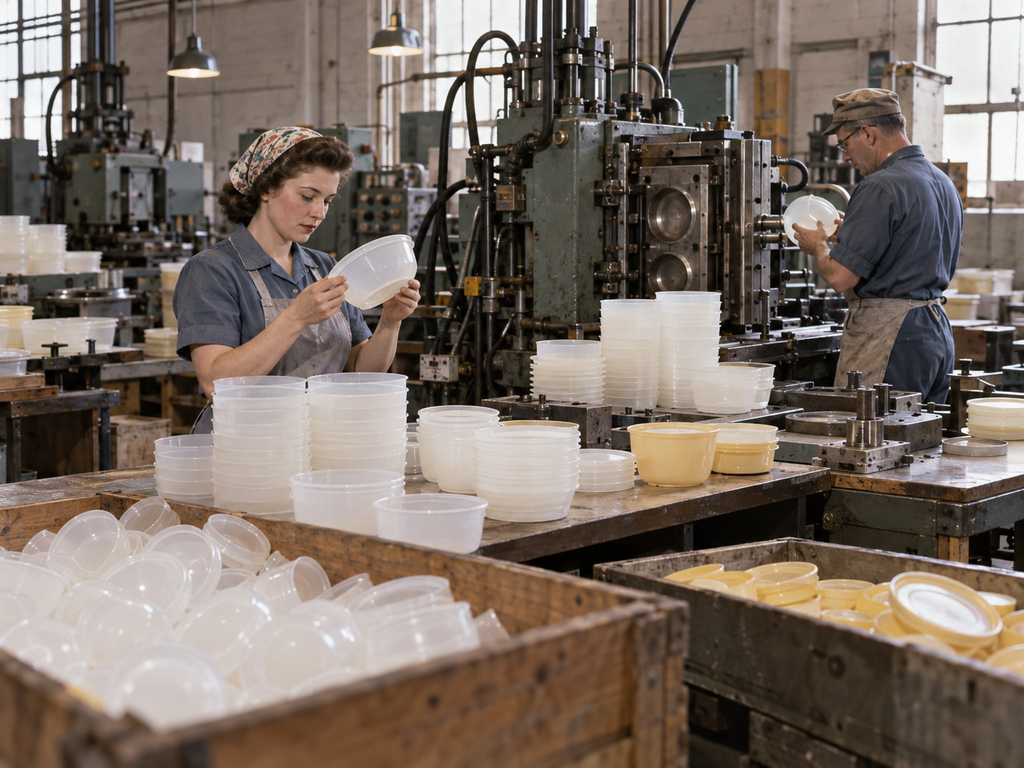
Earlier plastics had already found places in telephones, jewelry, radios, electrical components, and countless industrial products. What Tupper accomplished was different. He developed a smooth, flexible polyethylene suitable for household use and paired it with an airtight, watertight seal inspired by paint-can lids. The combination formed the technological foundation of Tupperware.
That seal mattered because the product arrived during a broader transformation of American domestic life.
Refrigerators were becoming standard household equipment. Supermarkets encouraged families to purchase larger quantities of food. Postwar homes increasingly emphasized convenience, efficiency, and organization.
Tupperware fit directly into that world.
Its lightweight containers could replace breakable refrigerator dishes and miscellaneous covered bowls. They stacked easily, came in useful shapes and sizes, and looked distinctly different from the kitchenware of previous generations.
Instead of pretending to be ceramic or glass, Tupperware looked like plastic—and made that seem desirable.
That may be one of its most important design achievements.
Color Gave the Future a Personality
Technology alone does not explain why vintage Tupperware remains so recognizable.
Color helped turn functional containers into objects people remembered.
Soft pastels, translucent finishes, brighter hues, and later earth tones allowed Tupperware to follow changing decorating fashions across decades. A kitchen cupboard could contain practical storage while still reflecting the colors of the rest of the room.
That makes vintage Tupperware particularly useful for understanding design history.
Put examples from different periods together and they begin to resemble a timeline. The subdued optimism of early postwar colors gives way to changing tastes in the 1960s and the stronger greens, yellows, oranges, and browns associated with many 1970s interiors.
For collectors, color is part of the attraction—but it should never be the only method of identification. Designs often remained in production, similar shades could return, and decades of sunlight, washing, food staining, and storage can alter the appearance of plastic.
The most reliable identification comes from considering color alongside shape, molded markings, product numbers, construction, and period catalogs.
The Product That Had to Be Demonstrated
Tupperware also proved that a well-designed product could fail if customers did not understand it.
Traditional retail stores initially struggled to sell the containers. Shoppers could see a plastic bowl on a shelf, but they could not necessarily understand why its unusual lid mattered.
The seal had to be shown.
That problem helped create one of the most famous sales systems of the 20th century.
Brownie Wise had already been selling household products through home demonstrations when she discovered how effectively Tupperware could be sold in that setting. Customers could handle the containers, watch the seals being closed, and see firsthand what differentiated them from ordinary kitchen bowls.
Her success attracted Earl Tupper’s attention. In 1951, Wise became vice president of Tupperware Home Parties and took a leading role in developing the company’s large-scale party-plan sales organization. Smithsonian records credit her with developing the party system and sales organization as well as helping create the company’s annual Jubilee gatherings.
The result transformed the brand.
Tupperware was no longer simply sold.
It was demonstrated, discussed, passed around, ordered among friends, and woven into social gatherings.
When the Living Room Became a Store
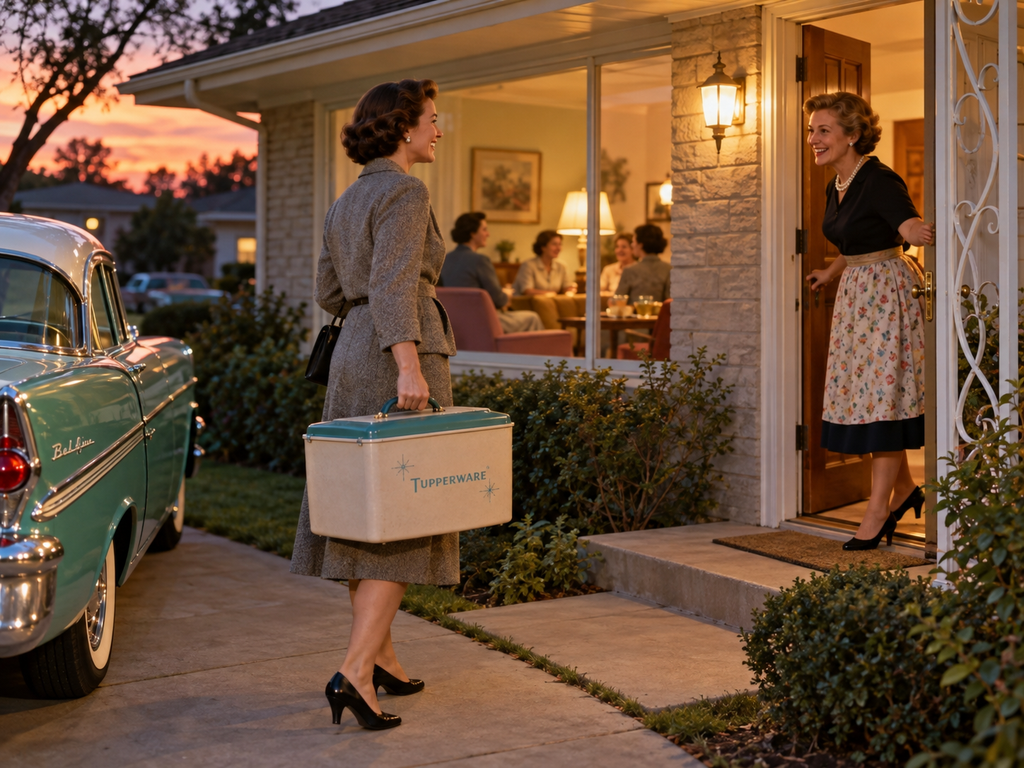
The Tupperware party now occupies a distinctive place in mid-century cultural history because it existed at the intersection of domestic life and commerce.
The hostess provided the home. Friends and neighbors formed the audience. A dealer brought the merchandise, demonstrations, sales materials, and enthusiasm.
The familiar living room became a temporary marketplace.
For women especially, that arrangement could provide opportunities unavailable through conventional employment. The Smithsonian notes that the home-party system allowed participants to build businesses from domestic spaces, an important option during a period when many married women faced considerable limitations in the traditional workplace.
Brownie Wise herself became a highly visible business executive at a time when women rarely occupied comparable corporate positions. The Smithsonian’s collection of her papers specifically identifies her career as important to understanding gender, consumerism, technology, and postwar American culture.
Her tenure at Tupperware ended in 1958 after conflicts with Earl Tupper and the company’s board, but the sales structure she helped build continued long after her departure.
The larger idea proved remarkably durable: people often buy differently when products are introduced through personal relationships.
Long before livestream shopping, influencers, social-media demonstrations, and online selling groups, Tupperware had already shown the commercial power of social networks.
Everyday Objects Become Collectibles
None of this meant that families buying Tupperware in the 1950s or 1960s expected to preserve it for future collectors.
Quite the opposite.
These were working household goods.
They stored leftovers, carried salads to picnics, held cookies, organized refrigerators, served drinks, traveled to church suppers, and returned from family gatherings with mismatched lids—or sometimes never returned at all.
That ordinary use is precisely what makes surviving pieces interesting.
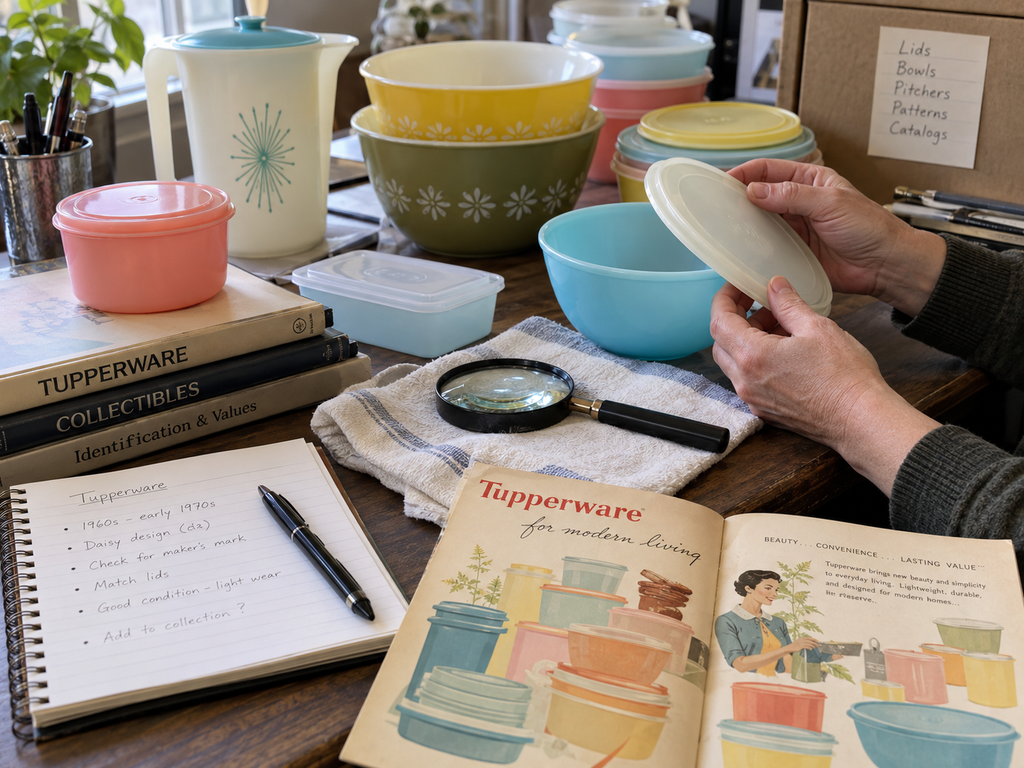
Vintage Tupperware occupies an unusual collecting category because it is simultaneously industrial design, kitchenware, advertising history, plastic technology, and social history.
Collectors can approach it from almost any direction.
Some seek early bowls and containers. Others concentrate on favorite colors, specific decades, unusual product lines, complete sets, pitchers, canisters, serving pieces, or promotional objects.
Paper ephemera adds another dimension. Catalogs, party invitations, dealer literature, order forms, training materials, sales publications, and Jubilee souvenirs document the business surrounding the objects themselves. The Smithsonian’s Brownie Wise archive includes company publications, recruitment literature, catalogs, correspondence, speeches, photographs, and other records associated with the Tupperware party system.
Those materials can sometimes make an ordinary plastic container far easier to understand.
A catalog can identify its original name.
An advertisement can reveal how it was intended to be used.
A party brochure can show how it was sold.
Together, object and ephemera provide something closer to the full historical picture.
Condition Tells Its Own Story
Collectors accustomed to glass, ceramics, or metal quickly discover that vintage plastic has its own condition vocabulary.
Rather than chips, crazing, or tarnish, Tupperware may show scratching, fading, staining, warping, surface dullness, brittle areas, hardened lids, or lingering odors.
Matching lids can be particularly challenging.
Because these pieces were used so heavily, containers and seals often became separated. Families replaced missing parts, mixed pieces from different sets, or continued using a bowl long after its original lid disappeared.
A complete matching example can therefore be especially satisfying to find.
Yet pristine condition is not the only thing that gives an object historical interest.
A lightly worn bowl still represents what Tupperware actually was: a household tool meant to be used repeatedly rather than admired from across a room.
There is room in a collection for both exceptional survivors and pieces carrying decades of ordinary kitchen history.
Why Tupperware Matters
It is easy to look at antique furniture, hand-painted porcelain, silver, or finely made glass and immediately recognize craftsmanship and history.
Plastic asks us to look differently.
Tupperware was manufactured by machine. It was produced in enormous quantities. Much of it was inexpensive enough for ordinary households to own.
None of those things make it historically insignificant.
In fact, they are exactly why it matters.
Mass-produced objects often tell us more about everyday life than luxury objects ever can. They show what ordinary people bought, used, stored, washed, replaced, shared, and remembered.
Tupperware reveals a society becoming increasingly comfortable with synthetic materials. It reflects changing attitudes toward food storage and household efficiency. Its colors document shifting design fashions. Its sales system provides insight into women’s work, direct marketing, suburban social networks, and postwar consumer culture.
Few collectible objects connect so many different stories while remaining so immediately familiar.
Plastic Icons of Mid-Century Life
Perhaps the best measure of Tupperware’s cultural impact is how little explanation the objects often require.
A particular bowl appears at an estate sale and someone remembers their grandmother owning it.
A pitcher brings back childhood summers.
A stack of brightly colored containers resembles something that once occupied every shelf of a family refrigerator.
That recognition is history working through objects.
Earl Tupper supplied the inventive material and seal. Brownie Wise helped create the selling system that placed the products inside millions of domestic conversations. Dealers and hostesses carried them into living rooms. Families put them to work.
Decades later, collectors preserve what remains.
Vintage Tupperware may never possess the rarity of an 18th-century porcelain vase or the craftsmanship of hand-carved furniture, but that is not the point.
Its importance comes from being ordinary.
These were objects designed for modern life, embraced by millions of households, and shaped by the optimism, consumer culture, technology, colors, and social changes of the mid-20th century.
The future they once represented has become our past.
And now those plastic bowls, pitchers, seals, catalogs, and party souvenirs have stories worth preserving.
Let’s Make History—one plastic icon at a time.
Discover more from Dear June Collectibles
Subscribe to get the latest posts sent to your email.