
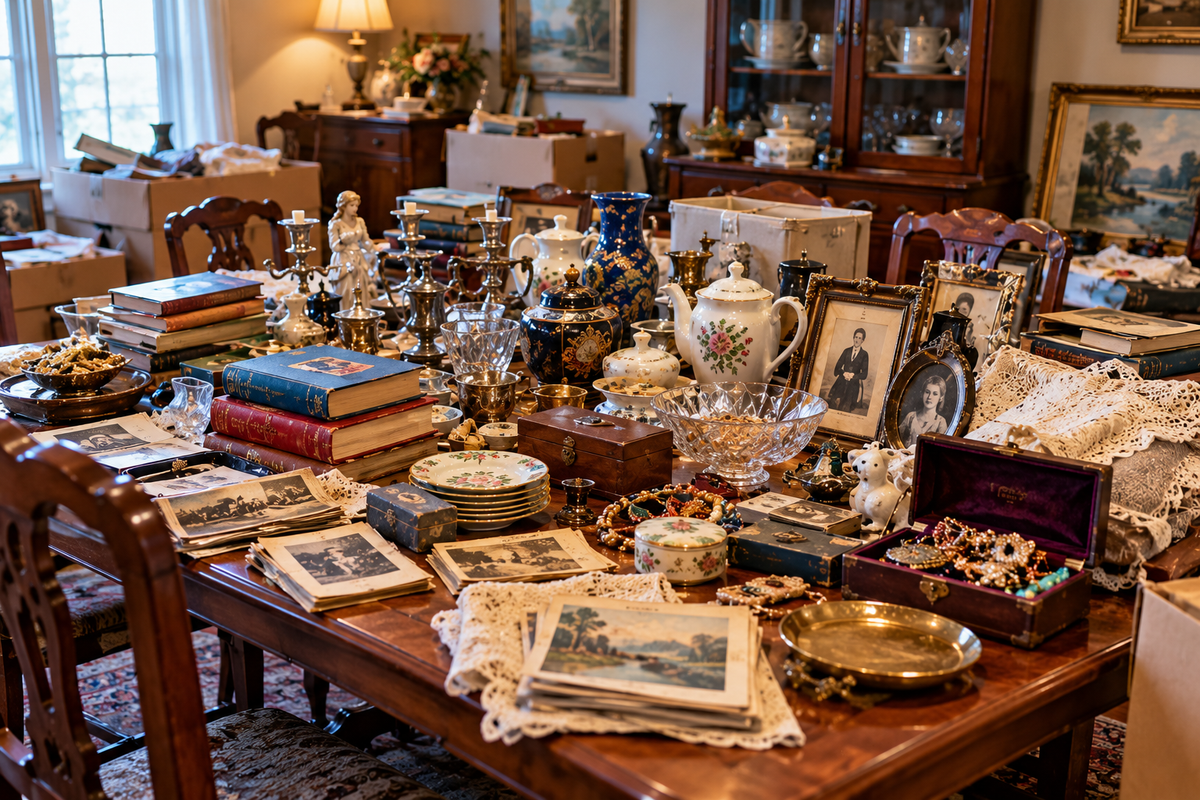
There is a massive transfer happening in American households that receives far less attention than the transfer of money.
Financial planners call it the Great Wealth Transfer. Cerulli Associates currently estimates that roughly $124 trillion in wealth will transfer through 2048, much of it from Baby Boomers and older generations to spouses, heirs, and charities. That is a financial-assets estimate—not an estimate of antiques, furniture, boxes of photographs, jewelry, books, dishes, tools, collectibles, or everything else accumulated inside people’s homes.
But alongside that financial transfer is what I think of as the Great Stuff Transfer.
Decades of possessions are also changing hands as people downsize, move, enter assisted living, combine households, or die. The U.S. Census Bureau reported that the population age 65 and older had reached 61.2 million in 2024, accounting for 18 percent of the population. AARP’s 2024 Home and Community Preferences Survey also found that 75 percent of adults age 50 and older wanted to remain in their current homes as they age.
That means many families eventually face not a carefully edited collection, but an entire household assembled over thirty, forty, fifty, or more years.
And that creates a problem much more complicated than asking:
“Is any of this valuable?”
Estates Are Rarely Divided Into “Valuable” and “Junk”
One of the biggest mistakes people make when dealing with an inherited estate is assuming everything falls into two piles:
valuable antiques and junk.
Actual estates rarely work that way.
A typical household may contain several different layers at once:
- obviously valuable objects;
- moderately valuable merchandise worth selling;
- niche collectibles whose value is difficult to recognize without research;
- inexpensive pieces that make sense only when grouped together;
- ordinary but useful household goods;
- sentimental possessions with little commercial value;
- material suitable for donation;
- and things that are genuinely damaged, obsolete, unsafe, or unsaleable.
The difficulty is identifying which is which without spending more time on the process than the property can reasonably return.
That is the central problem with selling inherited items.
Potential value and labor arrive together.
The Things That Look Valuable Are Not Always the Things That Sell
People naturally notice certain objects first.
A large china cabinet full of porcelain looks important. A heavy piece of furniture looks expensive. An elaborate crystal set feels valuable. Something purchased for hundreds of dollars thirty years ago may still be remembered as an expensive possession.
Meanwhile, a box of paper in the attic may be ignored.
But resale markets do not assign value according to visual importance, original purchase price, size, or family memory.
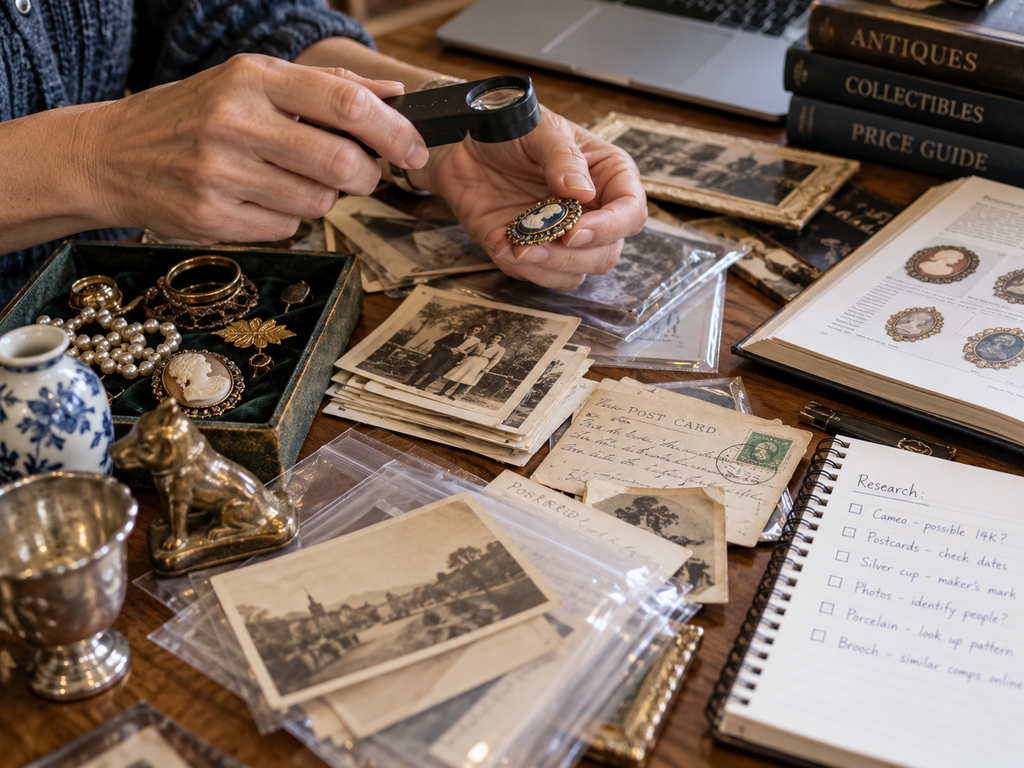
A small advertising item may have stronger collector demand than an enormous dining-room set. An old railroad timetable, obscure local photograph, discontinued replacement part, small piece of costume jewelry, specialty book, vintage Christmas ornament, instruction manual, postcard, or unusual household object can sometimes have a real market precisely because someone is looking for that specific thing.
That does not mean every box of old paper contains treasure.
It means unfamiliar is not the same as worthless.
Research matters most when there is enough evidence to justify doing it.
Every Item Carries a Labor Bill
Anyone who has operated an eBay store at scale learns this quickly.
An object does not become income simply because it has resale value.
Before the money arrives, someone may have to:
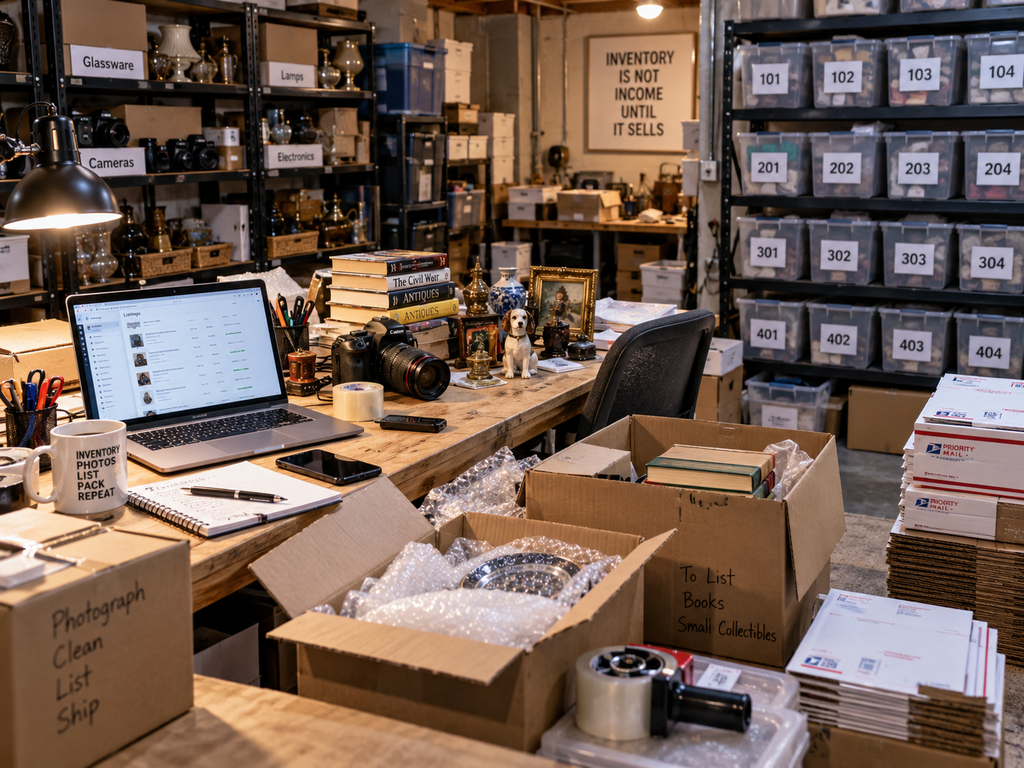
research it, clean it, measure it, test it, photograph it, identify flaws, write the listing, determine shipping, answer questions, store it, locate it again months later, pack it, and ship it.
Fees and promotional costs reduce the final return further.
This is why a $30 item can be excellent inventory—or terrible inventory.
Consider two estate items that might each sell for about $30.
One is a small piece of identifiable ephemera. It needs five photographs, slips into a numbered inventory bin, and eventually ships in a rigid mailer.
The other is an unmarked decorative object that needs cleaning, forty minutes of research, measurements, extensive condition photographs, several cubic feet of storage, and a carefully packed oversized box.
The sale prices may be similar.
The economics are not.
That is true whether the seller is an experienced eBay reseller or a family attempting its first estate resale.
Demand Matters as Much as Value
Another common mistake is finding one high asking price online and treating it as market value.
Asking prices tell you what sellers hope to receive.
They do not necessarily tell you what buyers pay.
When researching estate collectibles, sold results and other credible market comparables are usually far more useful than the highest active listing.
And even a legitimate $100 value does not answer the entire question.
How many actually sell?
A $100 object with consistent demand can be very good inventory.
A $100 object with fifteen active examples and one sale every six months may require patience, aggressive pricing, or a different venue.
Inventory is not income until it sells.
That principle matters especially when a family needs a house emptied within weeks rather than operating a storage business for the next three years.
The Reseller Opportunity—and the Reseller Trap
The transfer of household possessions does create opportunities for resellers.
Estates and downsizing households can produce books, jewelry, advertising, ephemera, memorabilia, vintage household goods, tools, collections, decorative objects, and obscure specialty items that fit well into online resale.
There is also strong evidence that consumers remain interested in secondhand merchandise. In eBay’s 2025 Recommerce Report—an eBay-sponsored survey rather than an independent census of the resale economy—89 percent of surveyed consumers expected to maintain or increase their spending on pre-owned goods, and 36 percent cited finding unique or collectible merchandise as a reason for buying secondhand. eBay also reported that 86 percent of the sellers it surveyed source inventory from their own belongings.
But access to more merchandise does not automatically create a better business.
One of the fastest ways to bury an online resale operation is to keep acquiring things merely because they are cheap.
The reseller version of the estate problem looks like this:
A garage fills.
Then a spare room.
Then a basement.
Then storage units.
There may be thousands of dollars in theoretical resale value sitting there, yet the owner cannot photograph and list it fast enough to convert that value into cash.
The business has not acquired an asset so much as a backlog.
This is where the familiar reseller death pile becomes a genuine operational problem.
Merchandise awaiting processing still requires space and organization. Merchandise already listed still requires storage. Low-dollar items still consume labor when they sell.
Buying inventory is usually easier than processing it.
The discipline is deciding how much merchandise the business can realistically absorb.
Cheap Inventory Can Be Very Expensive
Imagine buying an entire household accumulation for a low price.
At first glance, that sounds ideal.
There may be hundreds of sellable objects.
But suppose most will bring between $10 and $25 each and require individual research, photography, listings, storage, and shipping.
You have not simply purchased merchandise.
You have purchased hundreds of future tasks.
That may still make sense for a reseller with an extremely efficient workflow, cheap storage, low acquisition cost, and the ability to process large volume.
For someone already six months behind on inventory, it may be disastrous.
The purchase price is only one inventory cost.
Labor and storage count too.
Sometimes the Correct Answer Is a Lot
Estate resale becomes far more efficient when you stop assuming everything deserves an individual listing.
Ten common postcards might not justify ten separate listings.
A group from one town, subject, family, manufacturer, or era might justify one.
The same can apply to books, costume jewelry, flatware, photographs, sewing supplies, advertising, ornaments, small collectibles, replacement parts, kitchenware, and dozens of other categories.
You may sacrifice some theoretical maximum revenue by selling items together.
But maximum gross revenue is not always maximum practical profit.
Saving two hours of work can be worth considerably more than squeezing another twelve dollars out of an estate.
Families Do Not Need to Become Resellers
This is equally important on the estate side.
A family dealing with an inherited collection does not automatically need to open an eBay account, learn shipping, buy a thermal printer, create inventory numbers, and spend the next eighteen months selling Uncle George’s possessions one item at a time.
Sometimes direct online selling makes sense.
Sometimes it absolutely does not.
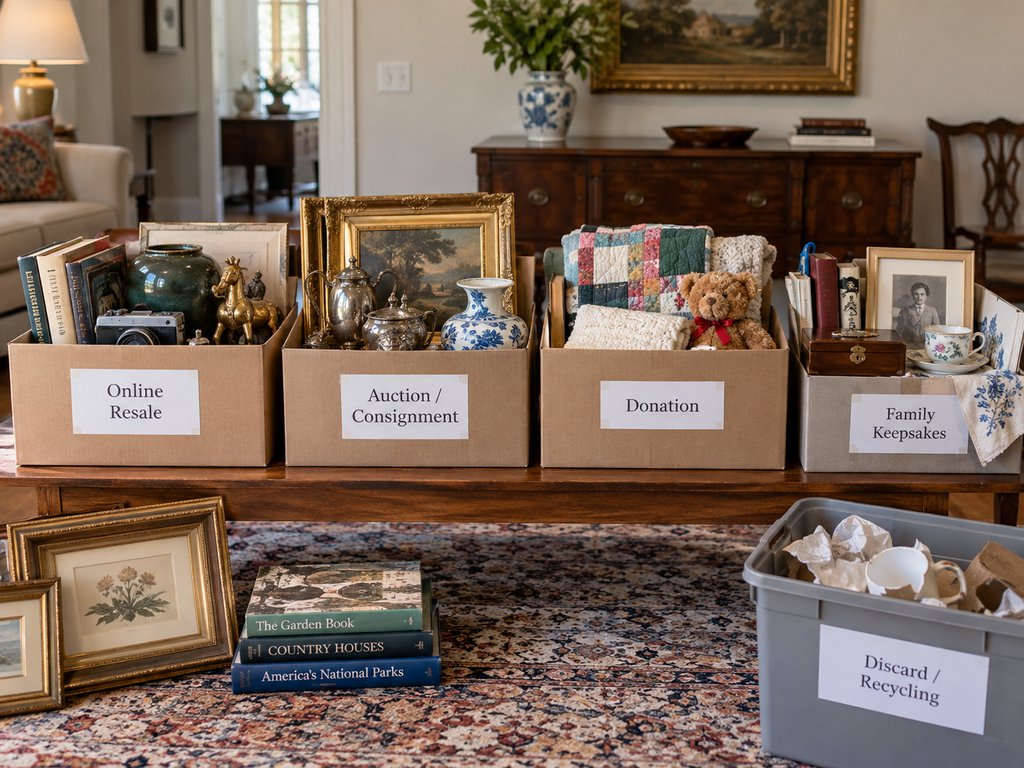
Different parts of the same estate may belong in completely different channels.
Selling Online
Online marketplaces can work particularly well for items that are relatively easy to ship and have searchable national or international demand.
Specialty collectibles, ephemera, books, small antiques, replacement pieces, memorabilia, jewelry, and unusual one-off objects can fit this model.
The tradeoff is labor.
Auction
Auction may be appropriate for certain higher-value, specialized, or concentrated collections where knowledgeable bidders and professional marketing matter.
The auctioneer’s specialty matters too. A firm strong in fine art may not be the best outlet for a large toy collection, and vice versa.
Estate Sale
An estate sale can make sense when a property contains enough locally saleable merchandise to justify opening the home and moving a significant quantity within a limited period.
Its strength is volume.
Its weakness is that not every specialized item finds its best buyer locally during a short sale window.
Consignment
Consignment can be useful when merchandise fits a dealer, shop, gallery, marketplace seller, or specialist who already reaches the appropriate customer.
But not every item justifies the administrative effort of consignment.
Cataloging or Evaluation
Sometimes the immediate question is not “Where do we sell it?”
It is:
“What do we actually have?”
A collection may need to be organized, photographed, identified, and researched before anyone can make an intelligent disposition decision.
Cleanout or Disposition Service
Sometimes the priority is clearing the property.
That does not mean everything should automatically go into a dumpster.
A paid estate cleanout or disposition service can be appropriate when a family needs help separating resale material, personal property, donations, recycling, and disposal while moving the project toward completion.
Donation and Disposal
These are legitimate parts of the process.
Useful merchandise with insufficient resale value may make excellent donation material.
Broken, contaminated, incomplete, unsafe, or genuinely unwanted material eventually needs disposal.
A successful estate project is not one in which every object gets sold.
It is one in which appropriate effort is spent where it produces an appropriate result.
Before You Throw It Away—or Spend Six Months Trying to Sell It
This is the balance that matters most.
At one extreme, people sometimes clear properties too quickly.
Boxes are donated or discarded because nobody recognizes the contents. Small collectibles disappear. Photographs, documents, jewelry, advertising, books, old correspondence, local memorabilia, and specialty material are treated as clutter because they do not resemble conventional antiques.
Real value can be lost that way.
At the other extreme, families can become paralyzed because they are afraid to dispose of anything.
Every teacup gets researched.
Every book gets searched online.
Every piece of costume jewelry receives its own plastic bag.
Six months later, the garage is still full.
Neither approach is efficient.
Before spending substantial time on an item, ask:
What is the likely selling price?
Is there real demand?
What condition is it in?
How much research will identification require?
Can it be shipped easily?
How much storage will it consume?
What selling fees or commissions apply?
How long might it reasonably take to sell?
Would several similar pieces work better as a lot?
Would a different venue be more efficient?
And perhaps most importantly:
Does this item deserve the amount of effort we are about to give it?
That question can save both money and months of unnecessary work.
Where Dear June Fits
These same decisions are part of the everyday work at Dear June Collectibles.
For resellers who already have inventory but are struggling with pricing, stale merchandise, listings, promotions, traffic, conversion, or sell-through, Dear June offers written reseller consulting and eBay Store Growth Audits based on actual online-resale operations.
For families or collectors who first need to understand what they have, remote collection or estate evaluation and cataloging guidance can help identify what deserves deeper research and what disposition routes may make sense.
For appropriate local projects, Dear June also provides paid household and estate cleanout and disposition assistance throughout South and Central New Jersey and the Greater Philadelphia region, generally focusing on non-furniture contents rather than operating as a traditional furniture-removal service.
Selective resale or consignment arrangements may also make sense in some circumstances, but Dear June does not approach estates with the assumption that it should simply purchase the entire contents.
Sometimes eBay is the answer.
Sometimes auction is.
Sometimes donation is.
Sometimes the answer is simply getting the house cleared.
The correct solution depends on the property.
The Real Value Is Knowing What Deserves the Work
The Great Stuff Transfer is not a promise that every inherited household contains valuable antiques.
It is something more practical.
Millions of households contain decades of accumulated possessions, and those possessions eventually have to go somewhere.
Some will become family heirlooms.
Some will become reseller inventory.
Some will move through auctions, estate sales, antique shops, flea markets, and online marketplaces.
Some will be donated.
Some will finally be discarded.
The important part is making those decisions intentionally.
For resellers, that means resisting the temptation to turn every inexpensive estate opportunity into another mountain of inventory.
For families, it means neither throwing everything away blindly nor assuming they must personally extract the last possible dollar from every object.
The objective is the same on both sides:
identify what deserves the effort.
If you are dealing with an inherited collection you do not understand, reseller inventory that has grown faster than your ability to sell it, or a household that needs a practical disposition plan, Dear June Collectibles can help you determine the next step without assuming there is only one correct way to handle it.
Let’s Make History—one profitable decision at a time.
Discover more from Dear June Collectibles
Subscribe to get the latest posts sent to your email.