
For most of human history, a voice traveled only as far as a person could shout. By the middle of the nineteenth century, the electric telegraph had changed long-distance communication, but it still translated information into coded signals that had to be sent, received, and interpreted. The telephone promised something more startling: the ability to send the human voice itself through a wire.
That breakthrough is most closely associated with Alexander Graham Bell and the year 1876, but the telephone did not appear from a single flash of inspiration. It grew from decades of experiments in electricity, acoustics, telegraphy, and speech. Bell’s success was decisive, yet it emerged from a crowded field of inventors trying to solve variations of the same problem.
From Telegraph Clicks to the Human Voice
The telegraph had already proved that electrical signals could travel quickly over long distances. Samuel Morse’s system, demonstrated publicly in the United States in 1844, sent information as patterns of electrical pulses. By the 1870s, inventors were searching for ways to make telegraph lines carry more information at once. One approach was the “harmonic telegraph,” which attempted to transmit several signals simultaneously by using different tones.
Bell initially worked within that problem. His background, however, was unusual for an electrical inventor. He came from a family deeply involved in speech and elocution, taught deaf students, and studied how sound was produced and perceived. Smithsonian and Library of Congress records show that his acoustic experiments helped shape his thinking about converting sound vibrations into electrical changes that could be transmitted over a wire.
The essential challenge was to create an electrical current that varied continuously with the vibrations of speech. A simple telegraph circuit switched between on and off. Speech required something far more subtle: countless rapid changes in intensity and frequency had to be represented electrically and then reproduced as sound at the other end.
Bell Was Not Working Alone
The familiar schoolbook version of telephone history can make the invention seem like a one-man race. It was not.
German teacher Johann Philipp Reis had demonstrated a device he called a “telefon” in the early 1860s. It could transmit some sounds and imperfect speech but did not develop into a practical system. Italian immigrant Antonio Meucci experimented with electrical voice communication and filed a caveat for a “talking telegraph” in 1871. In 2002, the U.S. House of Representatives formally recognized Meucci’s work and contributions to the development of the telephone.
Elisha Gray became Bell’s most famous rival. On February 14, 1876, Bell’s patent application reached the U.S. Patent Office; Gray’s attorney filed a caveat describing a similar voice-transmission invention later that same day. The timing became part of a long and contentious dispute. Bell’s patent was ultimately upheld, but the episode remains one reason historians describe the telephone as an invention that emerged from overlapping experiments rather than from an isolated idea.
Three Days That Changed Communication
Bell received U.S. Patent No. 174,465, titled “Improvement in Telegraphy,” on March 7, 1876. The patent described a method of transmitting vocal or other sounds by producing electrical undulations corresponding to the vibrations of sound.
Three days later came the experiment that entered popular history.
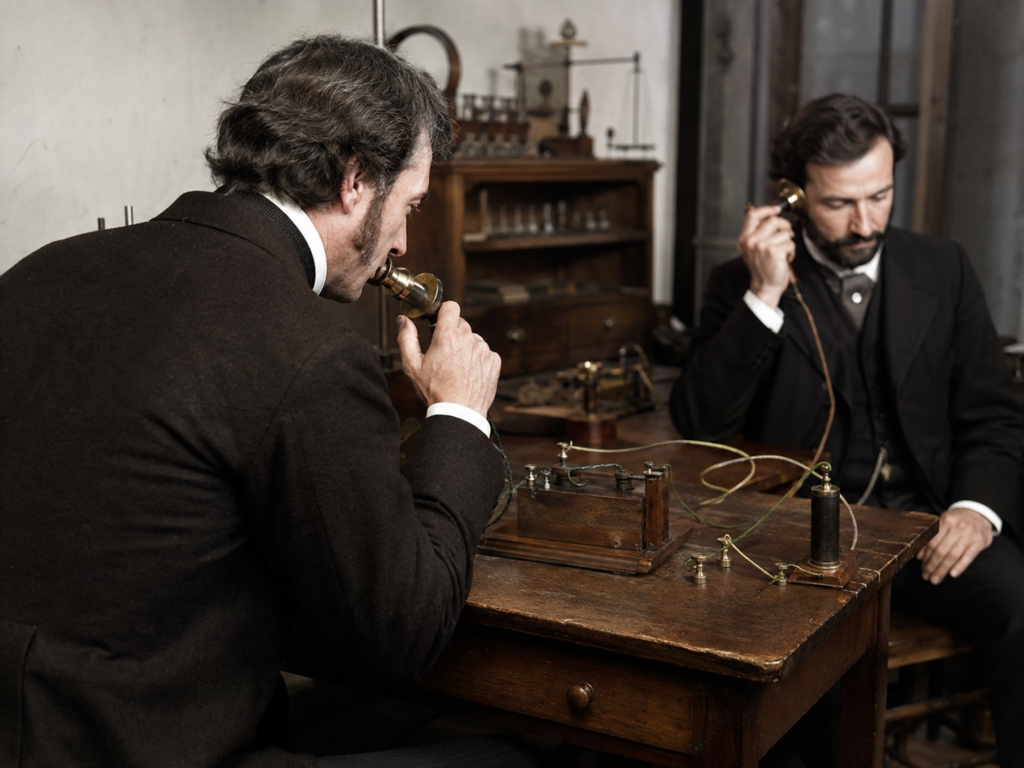
On March 10, Bell and his assistant Thomas A. Watson were working in separate rooms in Boston. Bell spoke into an experimental transmitter, and Watson heard intelligible speech through the receiver. Bell’s laboratory notebook recorded the now-famous request: “Mr. Watson — come here — I want to see you.” The importance was not the sentence itself. It was that Watson could understand it through an electrical apparatus.
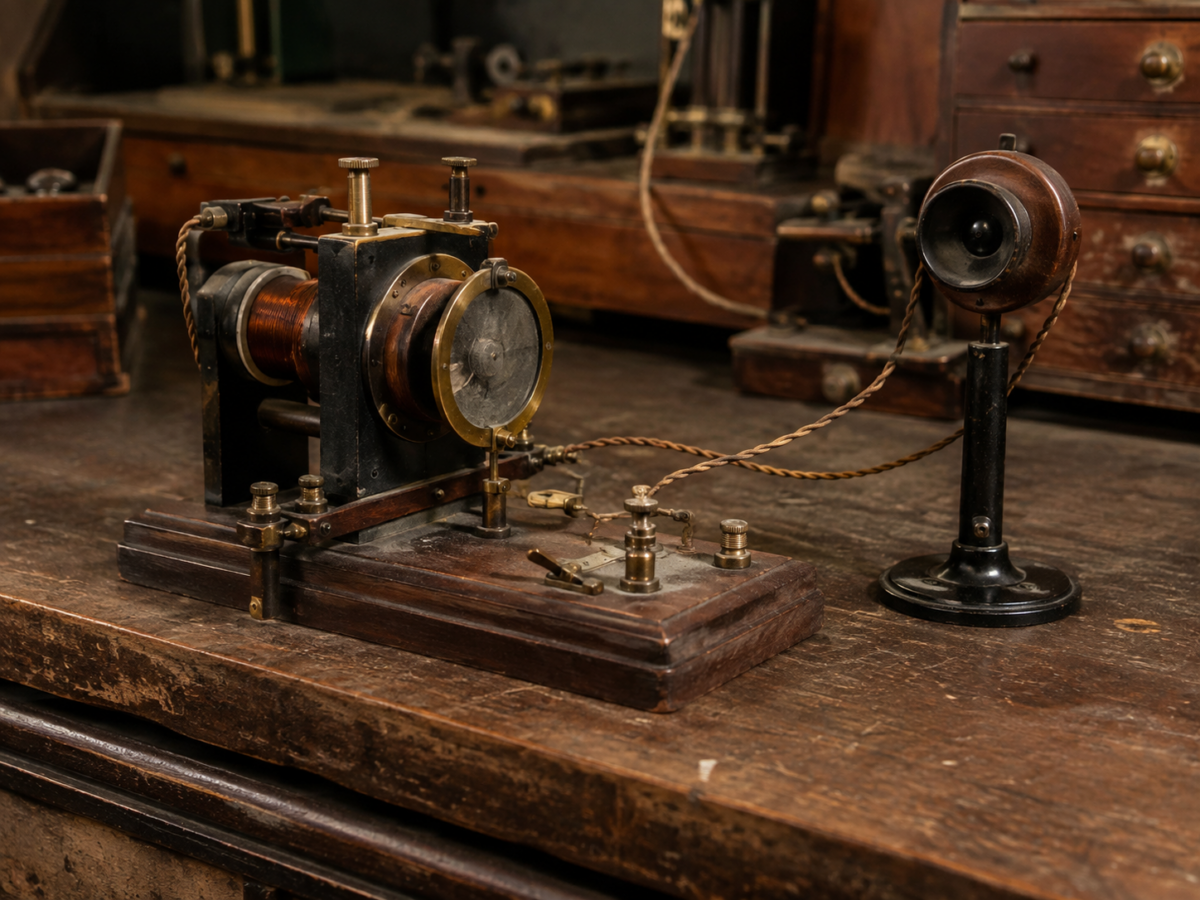
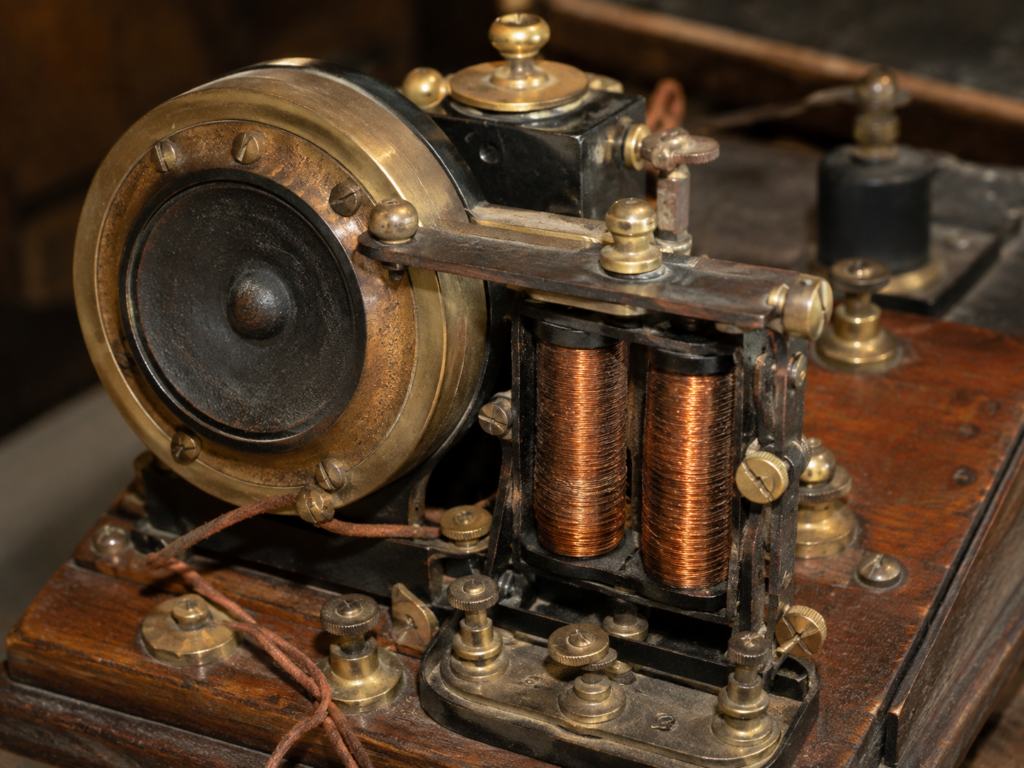
The earliest telephone did not resemble the polished desk and wall sets that collectors encounter from later decades. Experimental instruments could look almost improvised: wood bases, brass fittings, electromagnets, membranes, wires, and horn-shaped or cylindrical components assembled in workshops. Some designs used the same basic instrument for transmitting and receiving. Surviving experimental Bell instruments in the Smithsonian demonstrate just how close the birth of modern telecommunications was to the world of handmade scientific apparatus.
From Experiment to Public Sensation
A successful laboratory demonstration was only the beginning. People had to be convinced that a talking wire was useful rather than merely curious.
In June 1876, Bell demonstrated his telephone at the Centennial Exhibition in Philadelphia, an international showcase of industry, technology, and culture held during the United States’ centennial year. Among those who encountered the invention were prominent visitors and scientific judges, including British physicist William Thomson, later Lord Kelvin, and Emperor Pedro II of Brazil. The exhibition helped move the telephone from private experiment into public awareness.
Bell and his financial backers continued developing the technology. In July 1877, Bell, Watson, Gardiner Greene Hubbard, and Thomas Sanders formed the Bell Telephone Company. The challenge was now larger than inventing a device. A useful telephone required wires, instruments, maintenance, standardized equipment, and eventually an entire network connecting one subscriber to another.
That network would transform business and domestic life over the following decades. Instead of sending a messenger or telegram and waiting for a response, people could increasingly conduct a conversation across town and, eventually, across the country. The telephone compressed distance in a deeply personal way because it transmitted not simply information but voice, tone, hesitation, urgency, and emotion.
What Early Telephone Objects Tell Collectors
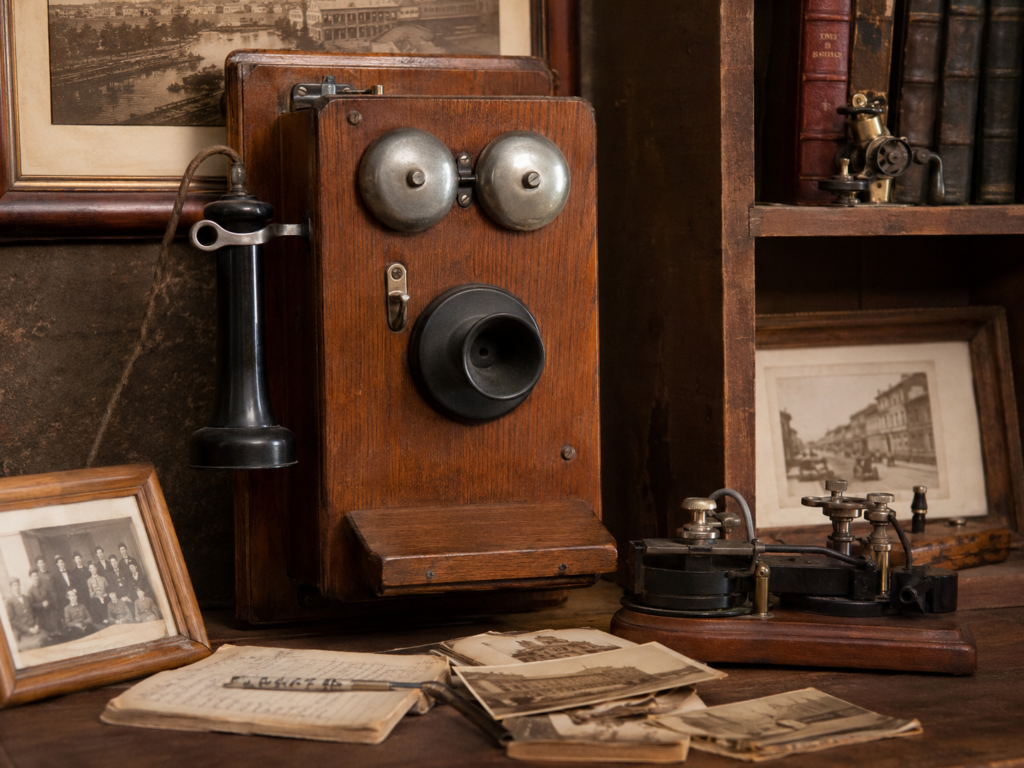
For collectors, the telephone’s beginnings are visible not only in rare experimental apparatus but in the material culture that followed the invention. Nineteenth-century telephone collecting can include early receivers and transmitters, wooden wall sets, magneto components, bells, instruction sheets, patents and patent-related material, advertising, company documents, trade literature, photographs, and other ephemera associated with the rapidly expanding industry.
Dating early telephone equipment requires care. Components were repaired, upgraded, reused, and combined, and a wooden wall telephone can contain parts from more than one period. Maker plates, patent dates, transmitter markings, receiver forms, wiring arrangements, bells, generators, and cabinet construction can all help establish when an instrument was made or modified. Patent dates are especially easy to misread: a date stamped on a component usually identifies intellectual-property history, not necessarily the exact manufacturing date of the complete telephone.
Condition also needs to be judged differently from that of purely decorative antiques. Old telephone equipment was working technology. Worn cords, replacement wiring, repaired terminals, changed receivers, extra mounting holes, and modifications may be part of an object’s service history. Heavy restoration can make an instrument more visually appealing, but it may also erase evidence of how the telephone was actually used.
Collectors should also be cautious around grand claims. A telephone advertised as “1876,” “Bell’s first model,” or “the first telephone” demands substantial documentation. Genuine experimental instruments connected directly with the invention of the telephone are major institutional objects, not ordinary antiques appearing casually in the marketplace. More commonly encountered early pieces belong to the commercial generations that followed Bell’s experiments, and they are historically interesting in their own right.
A New Kind of Connection
The birth of the telephone was not one clean moment with a single uncontested inventor. It was the result of multiple experimenters, competing designs, legal disputes, scientific curiosity, and the growing nineteenth-century belief that electricity could conquer distance.
Bell’s 1876 patent and successful transmission with Watson gave the new technology a practical and legal foundation, while public demonstrations showed what the device could do. From there, the telephone quickly stopped being a laboratory novelty and became an infrastructure project—one that would create new companies, new occupations, new social customs, and an enormous range of objects that collectors still study today.
The earliest telephones can look primitive beside the devices that followed, but that is part of their appeal. In wood, brass, wire, magnets, and thin vibrating membranes, they preserve the moment when conversation first learned how to travel by electricity.
Let’s Make History—one ring at a time.
Looking for something related?
Dear June Collectibles carries thousands of antiques, vintage pieces, collectibles, ephemera, books, housewares, jewelry, memorabilia, and unusual finds. Inventory changes constantly.
Found something like this while clearing a home or collection?
Before assuming it should be thrown away, tell us what you found. Dear June Collectibles helps families, collectors, executors, and homeowners sort household contents, collections, and estates and identify realistic resale possibilities.