
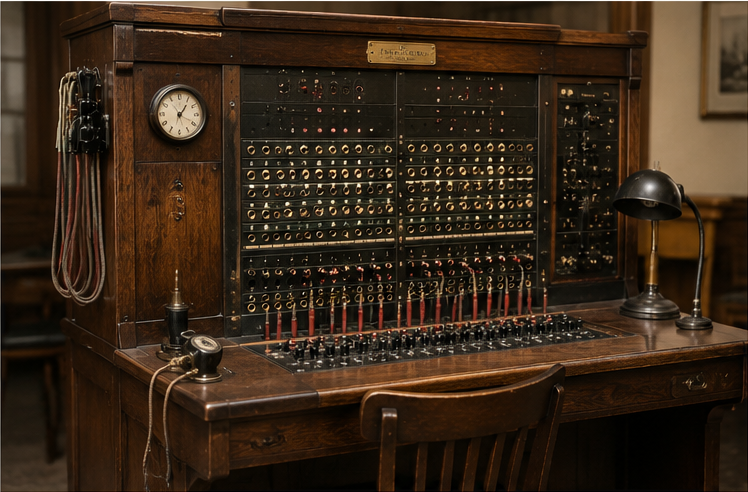
The invention of the telephone solved one extraordinary problem: it allowed the human voice to travel over a wire. Almost immediately, however, another problem appeared. If hundreds or thousands of people owned telephones, how could any one of them reach any of the others?
Before automatic dialing, the solution was decidedly human. A caller contacted a central telephone exchange, where an operator physically connected one line to another using a switchboard.
For decades, these operators formed the living center of the telephone network. Their work connected homes with businesses, doctors with patients, travelers with hotels, and eventually cities with one another. The switchboard also created an entirely new category of material culture, leaving collectors with everything from enormous wooden exchanges to plugs, headsets, employee badges, photographs, manuals, directories, and other pieces of operator history.
Building the First Telephone Networks
The earliest telephones were frequently installed as direct connections between two locations. A business might have a telephone linking its office with a warehouse, for example. It worked, but connecting every telephone directly to every other telephone was obviously impractical as the number of users increased.
The commercial telephone exchange provided the answer.
George W. Coy saw Alexander Graham Bell demonstrate the telephone in New Haven, Connecticut, in April 1877. Later that year, Coy secured a Bell franchise for New Haven and Middlesex Counties and joined Herrick Frost and Walter Lewis in establishing the District Telephone Company of New Haven. On January 28, 1878, their exchange opened with just 21 subscribers.
Coy’s early switchboard was remarkably humble compared with the massive exchanges that followed. According to National Park Service records, its construction included carriage bolts, handles adapted from teapot lids, and wire associated with women’s bustles. The entire office furnishings, including the switchboard, were valued at less than $40. Although the board could accommodate numerous subscribers, only two conversations could be handled simultaneously.
The principle established in New Haven was transformative. Instead of requiring a dedicated wire between every possible pair of telephones, each subscriber needed a connection to a central exchange. An operator could then create the necessary temporary circuit.
The telephone was becoming a network.
The Rise of the Telephone Operator
Early exchanges initially followed practices familiar from telegraph offices and employed boys and young men. That changed quickly.
In late 1878, sisters Emma and Stella Nutt became pioneering female telephone operators. Women soon became the dominant switchboard workforce, a pattern that continued internationally for roughly a century. Employers promoted women as patient and courteous voices for the new industry, while the lower wages commonly paid to female employees also made the arrangement economically attractive to telephone companies.
The work itself was anything but simple.
Operators needed to listen closely, speak clearly, remember procedures, manipulate cords and plugs rapidly, watch multiple indicators, and keep track of several conversations at once. Large exchanges required concentration and physical coordination for hours at a time.
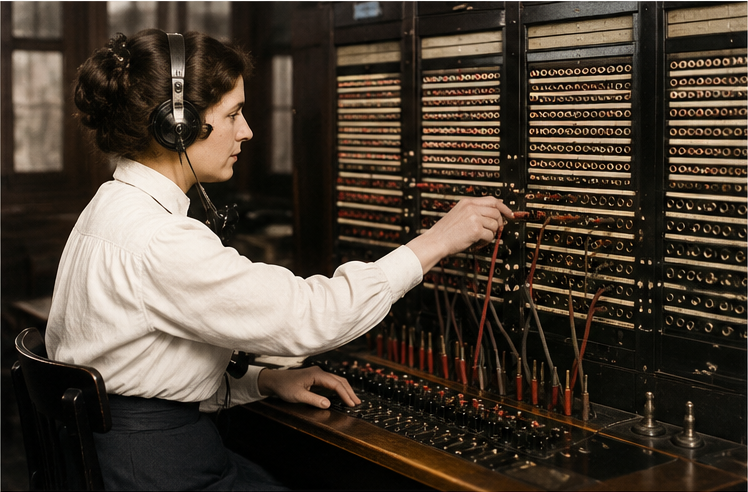
When a subscriber needed service, a signal appeared at the switchboard. Depending upon the equipment and period, this might involve a mechanical indicator or an electric lamp. The operator connected her headset to the subscriber’s line, learned whom the caller wished to reach, and inserted plugs into the appropriate jacks to establish the circuit.
When the conversation ended, another signal indicated that the cords could be removed and returned to their resting positions.
Multiply that process by hundreds—or eventually thousands—of calls, and the operator’s importance becomes obvious.
In small communities especially, operators could become remarkably knowledgeable about the people using their exchange. They might recognize subscribers by voice and know which doctor was available, whether a store had closed, or where someone might be reached. This gave operators an unusual place at the intersection of technology and community life.
From Local Calls to Long Distance
As telephone service expanded, operating became increasingly specialized. Some employees handled local traffic, while others worked long-distance desks, information services, hotel exchanges, businesses, government buildings, hospitals, and private branch exchanges.
Even prominent institutions needed people to manage their telephone systems. The Smithsonian installed telephones throughout its Castle in June 1878, when Washington, D.C., still had only a small number of telephone lines. Its system connected offices and workrooms so employees could communicate without walking from one part of the building to another.
Large central offices eventually contained imposing walls of jacks, indicators, cords, plugs, and lamps. Rows of operators worked shoulder to shoulder before them, creating the familiar image preserved in countless early twentieth-century photographs.
The operator was not merely answering a telephone. She was physically constructing the route that allowed the conversation to happen.
The “Hello Girls”
One particularly important chapter in operator history came during World War I.
The U.S. Army Signal Corps recruited bilingual women to provide telephone service overseas. Approximately 7,000 women applied, but only 223 were selected for overseas duty. Known popularly as the “Hello Girls,” these operators worked in military communications, sometimes close to the front lines, connecting calls much faster than less-experienced personnel could manage.
Their story also reflects the complicated status of women in military service. Despite taking military oaths and working for the Army Signal Corps, they were denied veteran status after the war. Recognition did not come until decades later, when surviving members were finally granted the status and benefits they had long sought.
Their surviving uniforms, photographs, documents, badges, correspondence, and related material are therefore part of both telecommunications history and women’s military history.
The Switchboard as a Collectible
Complete antique switchboards can be spectacular objects, but they present obvious challenges for collectors. Commercial boards can be enormous, extraordinarily heavy, and filled with fragile electrical components.
Smaller private switchboards are more manageable. Hotels, apartment buildings, factories, hospitals, railroad facilities, department stores, and offices often maintained their own internal systems. These boards occasionally appear outside institutional collections and can provide an impressive centerpiece for a telecommunications collection.
Their history may matter as much as their age.
A switchboard documented as coming from a particular hotel, factory, railroad station, or local business can offer considerably more historical interest than an unidentified example. Photographs, inventory records, labels, handwritten markings, and accompanying paperwork may help preserve that connection.
Collectors should remember that switchboards were working machines. Components were routinely serviced, replaced, modified, and upgraded. A board that remained in use for decades may contain equipment from several periods.
Originality therefore needs to be evaluated with some flexibility. A replacement cord installed during the board’s working life is different from a modern reproduction added solely to make an incomplete board look finished.
The Smaller Pieces Operators Left Behind
Fortunately, preserving operator history does not require room for an entire switchboard.
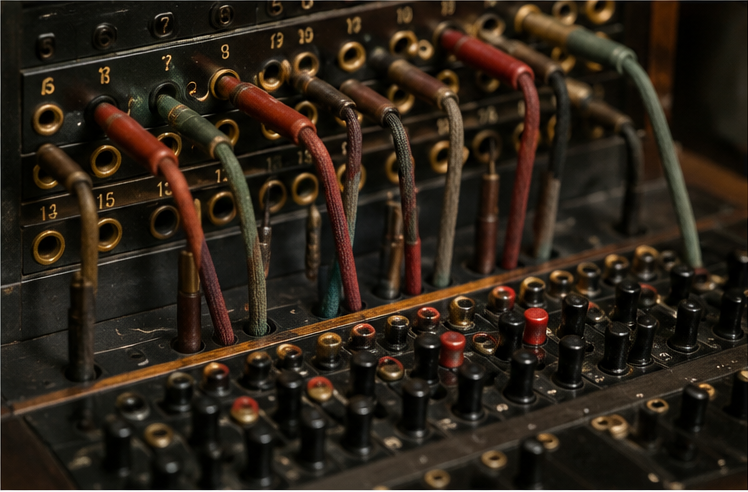
Plugs and cord assemblies are among the most direct reminders of manual telephone service. Every one represents the physical act that once connected two callers. Individual jacks, indicators, keys, lamps, bells, and other switchboard components can also appeal to collectors interested in early technology.
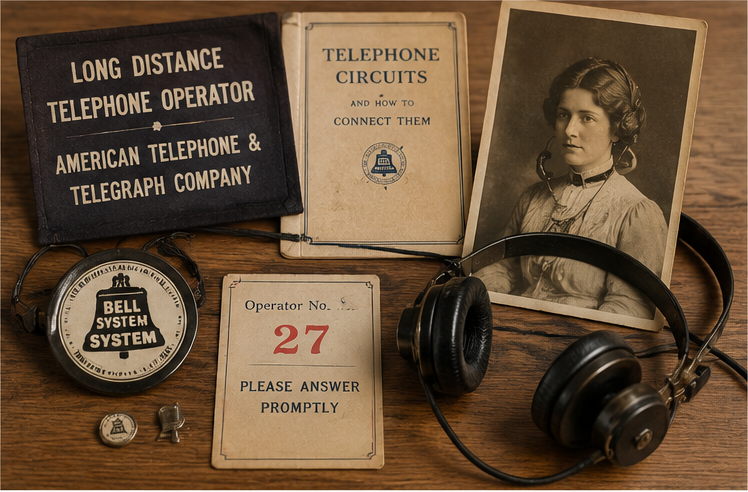
Operator headsets are particularly recognizable. Designs changed considerably over time, from relatively substantial early apparatus to lighter equipment that allowed operators to keep both hands free while manipulating the board.
Paper and employee memorabilia can be equally fascinating.
Operator collections may include training manuals, instruction cards, employee newsletters, telephone-company publications, identification badges, service pins, photographs, postcards, directories, time records, advertising, and correspondence.
Unlike a telephone sitting alone on a shelf, these artifacts bring the people who operated the system back into the story.
Collecting With Context in Mind
When examining operator material, identification should begin with whatever information remains attached to the object.
Manufacturer names can help. Companies including Western Electric, Kellogg, Stromberg-Carlson, and Automatic Electric supplied equipment during different periods, although a maker’s name alone does not automatically date an entire assembly.
Construction is another clue. Wooden cases, cloth-covered wiring, Bakelite or hard-rubber components, plug shapes, indicator mechanisms, and lamp designs changed as telephone technology evolved.
Photographs deserve particular attention. A seemingly ordinary image of several operators can become much more significant if the reverse identifies the exchange, company, town, employees, or photographer. Manuals and employee publications may also preserve terminology, workplace rules, training procedures, uniforms, and expectations that are otherwise difficult to reconstruct.
Condition varies considerably. Cloth cords fray, rubber insulation hardens, metal oxidizes, wood accumulates scratches, and headsets lose pads or wiring. These signs of use are not automatically defects to eliminate. They can be evidence that the equipment spent years doing exactly what it was designed to do.
Aggressive restoration can actually remove some of that history. Completely rewiring a board, refinishing its cabinet, polishing every metal surface, or replacing worn components for appearance alone may make an object prettier while making it less informative.
When a Person Completed Every Call
Automatic telephone exchanges gradually removed operators from routine local connections, but the change did not happen overnight. Manual service continued in many communities and institutions long after automatic switching became available, while operators remained important for long-distance, information, directory assistance, hotel, business, and specialized calls.
For much of telephone history, lifting the receiver did not immediately connect a caller with a machine.
It connected the caller with another person.
Telephone operators turned Bell’s invention into a practical network one cord at a time. Every jack represented a destination, every glowing indicator represented someone waiting, and every pair of plugs created a temporary pathway through which two voices could meet.
The surviving switchboards, headsets, plugs, photographs, badges, manuals, and other operator memorabilia preserve that human infrastructure. They remind us that long before computers began routing communications invisibly, telephone networks depended upon thousands of people sitting before walls of wire and patiently asking where we wanted our call to go.
Let’s Make History—one connection at a time.
Looking for something related?
Dear June Collectibles carries thousands of antiques, vintage pieces, collectibles, ephemera, books, housewares, jewelry, memorabilia, and unusual finds. Inventory changes constantly.
Found something like this while clearing a home or collection?
Before assuming it should be thrown away, tell us what you found. Dear June Collectibles helps families, collectors, executors, and homeowners sort household contents, collections, and estates and identify realistic resale possibilities.