

Chinese export porcelain has a particular charm in American collecting because it tells two stories at once. One story belongs to China: skilled potters, painters, kilns, trade networks, and generations of ceramic knowledge. The other belongs to America: port cities, tea tables, merchant families, shipping fortunes, household display, and the desire to own something refined from half a world away.
For American buyers, Chinese porcelain was never just a dish. It could signal taste, prosperity, global awareness, and participation in a growing consumer world. A tea bowl, punch bowl, platter, or dinner plate might have crossed oceans before arriving in a parlor, dining room, tavern, or merchant home. Today, those same pieces help collectors trace how global trade entered everyday American life—one table setting at a time.
Before Direct American Trade
Chinese porcelain reached North America before the United States existed as a nation. In the colonial period, imported goods moved through European trade systems, especially British and Dutch networks. Porcelain arrived alongside tea, silk, spices, lacquerware, and other luxury goods that helped shape elite and aspiring household culture.
Not every household owned fine Chinese porcelain, of course. It was a desirable imported product, and price, access, and status all mattered. But by the 18th century, Chinese ceramics were familiar enough in colonial America to influence taste. They appeared in homes, estate inventories, archaeological sites, and surviving family collections.
For collectors, this early presence matters because it reminds us that Chinese export porcelain was part of American material life before the country had its own direct China trade.
After Independence: American Merchants Look to China
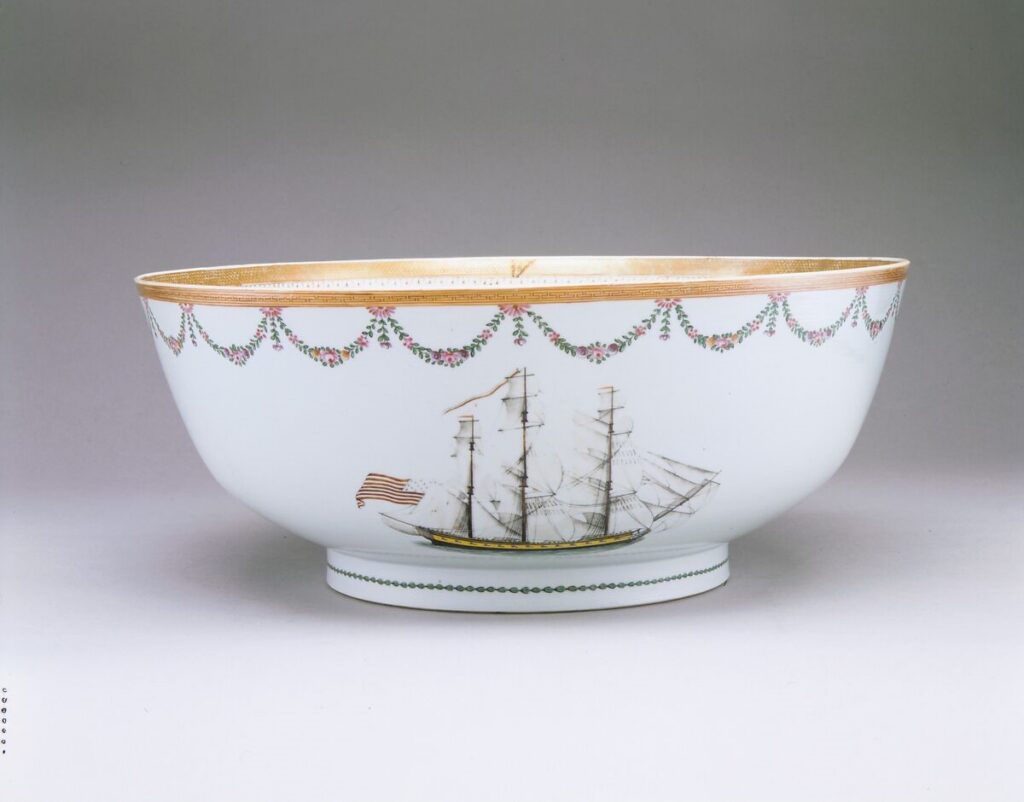
After the American Revolution, American merchants pursued direct trade with China more aggressively. Ships from port cities such as New York, Philadelphia, Boston, and Salem sailed to Canton, the major Chinese port through which Western trade was conducted for much of this period.
This trade was not simple. Voyages were long, expensive, and risky. Merchants had to assemble cargoes that could be sold or exchanged, navigate foreign trade rules, and wait through lengthy buying and shipping processes. But the potential rewards were great. Tea was especially important, but porcelain remained one of the goods that connected American consumers to the China trade.
Porcelain came home in many forms: small tea wares, large serving pieces, punch bowls, dinner services, and decorative objects. Some pieces were ordered intentionally. Others came as part of mixed cargoes selected for resale.
Port Cities and the Rise of China Trade Taste
The American market for Chinese export porcelain was strongest where trade wealth and consumer culture overlapped. Port cities played an especially important role.
In cities such as Boston, Salem, New York, Philadelphia, and Charleston, imported porcelain fit naturally into households that valued refinement and display. Merchants, ship captains, and prosperous families could purchase pieces that represented both domestic taste and international connection.
A cabinet of Chinese porcelain was not just a cabinet of dishes. It could suggest travel, trade, education, and status. Even a smaller collection—tea bowls, saucers, or a punch bowl—could bring a sense of worldliness into the home.
Tea Culture and the American Table
Tea drinking helped drive demand for porcelain in America, just as it did in Europe. It required equipment: tea bowls, saucers, teapots, slop bowls, creamers, sugar dishes, and sometimes elaborate sets. Chinese porcelain was well suited to this ritual because it was attractive, durable, and closely associated with the tea trade itself.
A tea set also created a social moment. Serving tea was not only about drinking. It was about hospitality, manners, conversation, and display. The porcelain on the table helped frame that experience.
Collectors today often find tea wares especially appealing because they are intimate objects. A punch bowl may impress with size, but a tea bowl connects directly to the hand. It is easy to imagine it being used, passed, washed, stacked, and treasured.
Punch Bowls, Taverns, and Social Life
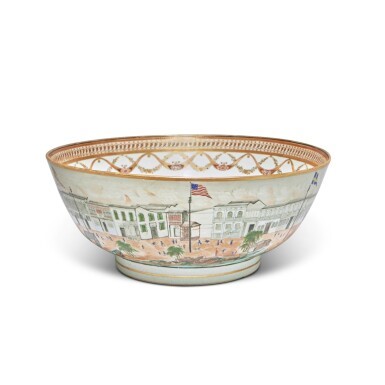
Punch bowls are among the most dramatic pieces of Chinese export porcelain found in American contexts. Large bowls were used for serving punch at gatherings, and they could be decorated with landscapes, floral designs, initials, monograms, ships, or patriotic motifs.
In American collecting, punch bowls are prized because they connect porcelain to social history. They belonged to a world of dinners, taverns, civic gatherings, family celebrations, and merchant hospitality. A large export punch bowl was not hidden away; it was meant to be seen.
Condition becomes especially important with punch bowls because their size and use made them vulnerable to cracks, rim chips, and old repairs. Even so, a visually strong bowl with historic wear can still have tremendous display appeal.
American Motifs on Chinese Porcelain
One of the most fascinating parts of the American market is how Chinese workshops adapted decoration for American buyers. Some export porcelain includes motifs associated with the new republic: eagles, shields, monograms, initials, and patriotic symbols. Others show ships, trade scenes, or family crests.
These pieces are especially appealing because they make the trade relationship visible. They are Chinese-made objects designed for American identity and taste.
Collectors should be cautious, though. Patriotic decoration can increase desirability, which means attribution and condition should be evaluated carefully. A piece with an eagle or monogram is worth close inspection: look at the painting quality, enamel wear, possible restoration, and whether the decoration fits the age and type of the porcelain.
Everyday Export Ware vs. Custom Orders
Not every piece of Chinese export porcelain in the American market was a custom commission. In fact, much of what circulated was more general export ware: blue-and-white plates, platters, bowls, and tea pieces intended for broad sale.
It helps to think in two broad categories:
General Export Ware
These pieces were made for sale in Western markets and may not have been tied to a specific buyer. They often feature popular landscapes, floral borders, Canton-style decoration, Nanking-style decoration, famille rose designs, or common table forms.
Custom or Special-Order Pieces
These include armorial services, monogrammed wares, pieces with initials, ship images, American symbols, or other personalized decoration. These can be more research-rich and may command more collector interest when documented and in good condition.
Both categories matter. General export ware shows what was broadly available and used. Custom pieces show how buyers used porcelain to express identity, family, commerce, or patriotism.
How Chinese Porcelain Shaped American Taste
Chinese export porcelain influenced what Americans expected “good” tableware to look like. Blue-and-white designs, scenic landscapes, floral borders, and symmetrical serving forms all helped shape decorative taste.
European and American potteries later produced wares inspired by Chinese porcelain, sometimes directly imitating patterns or borrowing the idea of blue landscapes and exotic scenery. This means Chinese export porcelain is not only a collecting category in itself—it is part of the story of American ceramic taste more broadly.
If you collect transferware, early American ceramics, or blue-and-white tableware, Chinese export porcelain helps explain where some of those visual traditions came from.
What American Collectors Should Look For
Chinese export porcelain in the American market can be approached through several collector lenses.

Form
American collectors often value forms connected to dining and social use:
- tea bowls and saucers
- teapots and covered sugars
- punch bowls
- platters and serving dishes
- dinner plates and soup plates
- mugs and tankards
Decoration
Look for blue-and-white landscapes, famille rose enamels, armorial or monogrammed decoration, American eagles, ships, floral borders, and figural scenes.
Condition
Common issues include:
- rim chips
- hairline cracks
- glaze wear
- enamel loss
- gilding wear
- old staple repairs
- overpainting or modern restoration
Restoration is not always a dealbreaker, but it should be disclosed and reflected in value.
Provenance
Provenance can be especially meaningful in the American market. A piece connected to a known family, estate, port city, ship captain, or old collection can become more historically interesting. Even simple documentation—a handwritten family note or old dealer label—can be worth preserving.
A Collector’s Caution: Don’t Let the Story Outrun the Evidence
Chinese export porcelain invites storytelling, and that is part of the fun. But responsible collecting means separating what is visible from what is assumed.
A plate with American-style decoration is not automatically tied to a famous owner. A punch bowl from an old estate is not automatically from the colonial period. A blue-and-white platter may have been used in America, but unless there is provenance, its exact household history may remain unknown.
The best descriptions are careful:
- “Chinese export porcelain, likely made for the Western market”
- “American eagle motif”
- “family monogram”
- “estate history suggests long ownership in New England”
- “Canton-style blue-and-white decoration”
This kind of language keeps the object interesting without making unsupported claims.
Why the American Market Still Matters
Chinese export porcelain in America is a story of aspiration, trade, taste, and use. It reminds us that American homes were connected to global commerce from an early date. Tea tables, punch bowls, dinner services, and display cabinets all became places where world trade entered domestic life.
For collectors, these pieces offer a rare combination: beauty, history, and research potential. Some are grand and expensive. Others are modest, worn, and still deeply evocative. Either way, they speak to a time when porcelain was more than tableware—it was a sign that the world was becoming larger, more connected, and more visible inside the home.
Let’s Make History—one porcelain table at a time.