
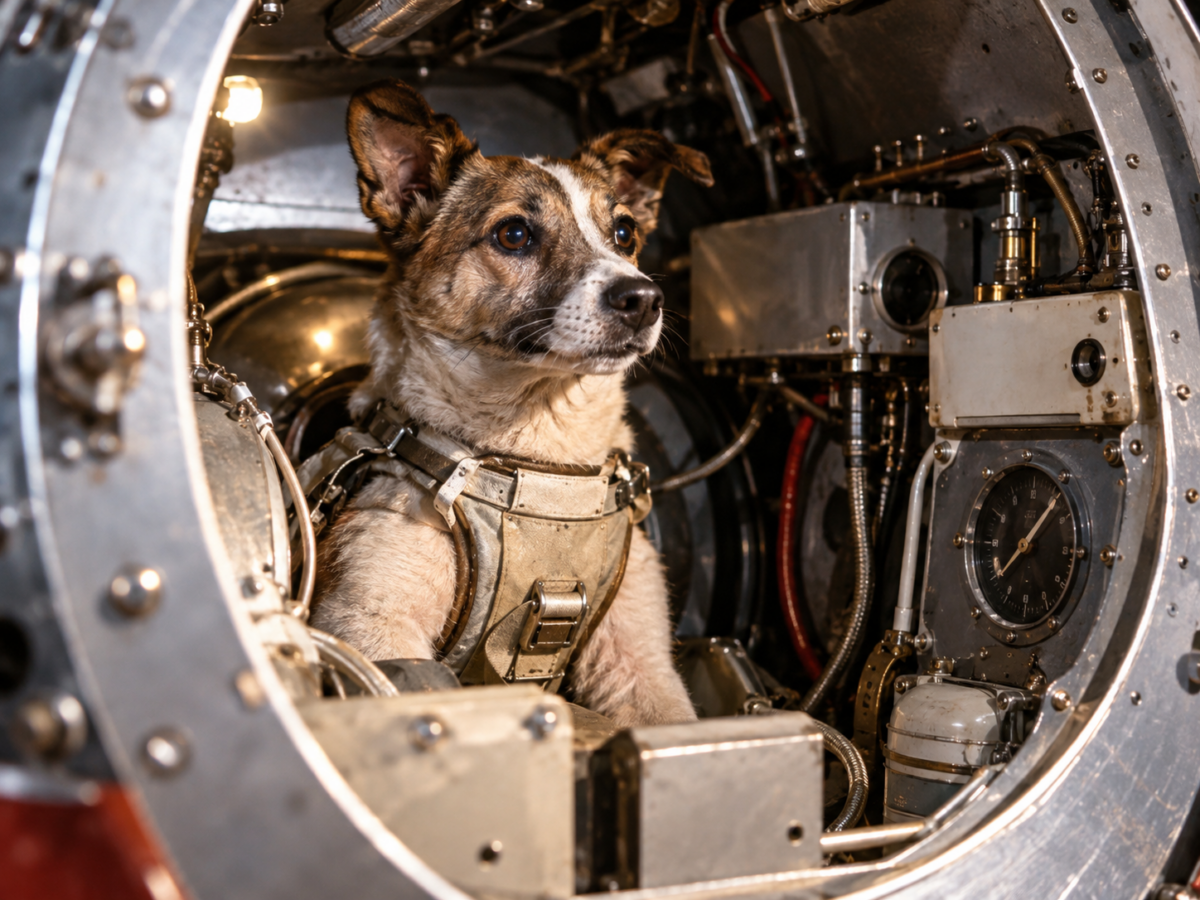
On November 3, 1957, a small dog who had once lived on the streets of Moscow became the first animal to orbit Earth.
Her name was Laika, and she traveled aboard Sputnik 2 just one month after the Soviet Union stunned the world with Sputnik 1, the first artificial satellite. Laika in orbit represented another remarkable technological achievement. It was also a Cold War spectacle, a scientific experiment, and a mission designed from the beginning without a way to bring its passenger home.
More than six decades later, the machinery of Sputnik 2 is largely remembered by space historians. Laika herself has become something more: an enduring symbol of the promise, competition, sacrifice, and ethical contradictions of the early Space Age.
From Sputnik Shock to a Second Soviet Triumph
The world had barely absorbed the significance of Sputnik 1 when the Soviet Union prepared its next surprise.
Sputnik 1 entered orbit on October 4, 1957. Its famous radio beeps announced that the Soviet Union had accomplished something no nation had done before. In the United States, the launch intensified fears that the Soviets had gained a technological and military advantage. It also helped accelerate American investment in science, engineering, rocketry, and eventually the creation of NASA.
Rather than wait for the reaction to fade, the Soviet government pushed ahead with another mission.
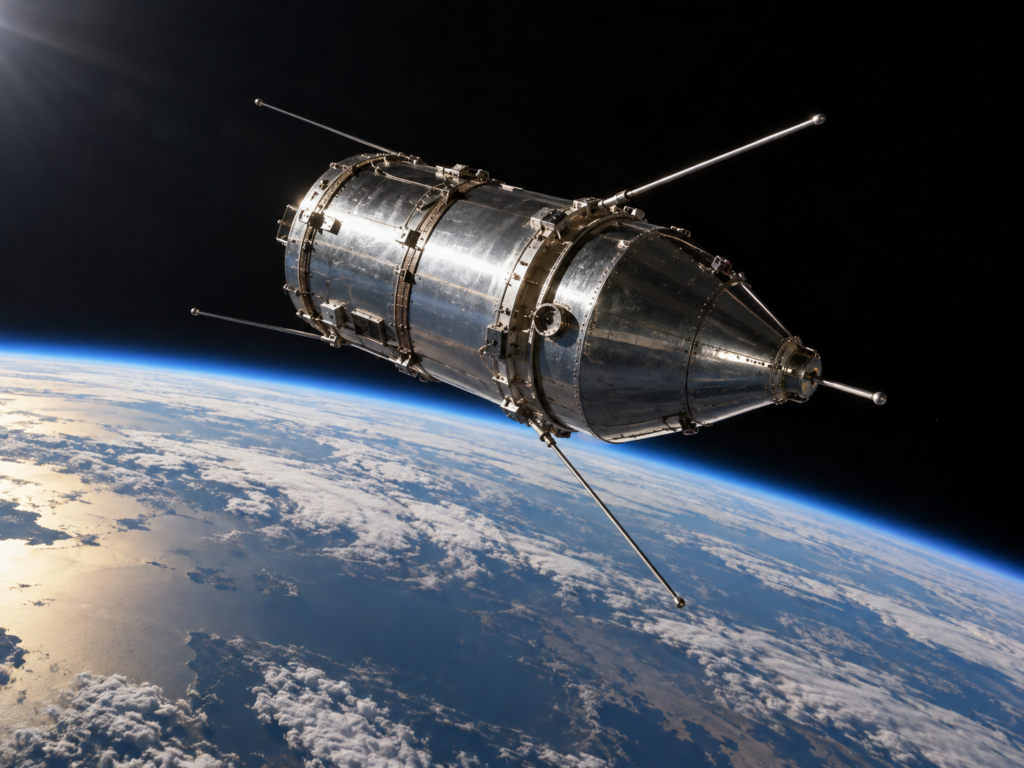
Sputnik 2 was prepared with extraordinary speed. The much larger spacecraft would carry scientific instruments and, most dramatically, a living animal.
That passenger would be Laika.
The launch on November 3 came only 30 days after Sputnik 1. NASA describes Sputnik 2 as a hurriedly prepared mission intended in part to capitalize on the propaganda value of the first satellite’s success. At roughly 508 kilograms, or about 1,120 pounds, Sputnik 2 was also dramatically heavier than its predecessor.
The message was difficult to miss. The Soviet Union had not merely placed a small radio transmitter into orbit. It could launch a much heavier payload containing a living passenger.
In the atmosphere of the Cold War, that capability carried implications far beyond science.
Who Was Laika?
Laika was not a specially bred laboratory animal with an impressive pedigree.
She was a small female mixed-breed dog selected from among Moscow strays. Soviet researchers favored relatively small dogs that could fit within cramped spacecraft compartments, and stray animals were believed capable of tolerating difficult conditions. One of Laika’s earlier names was Kudryavka, meaning roughly “Little Curly.” The name Laika—often translated as “Barker”—became the one known around the world.
She was one of several dogs considered for the mission.
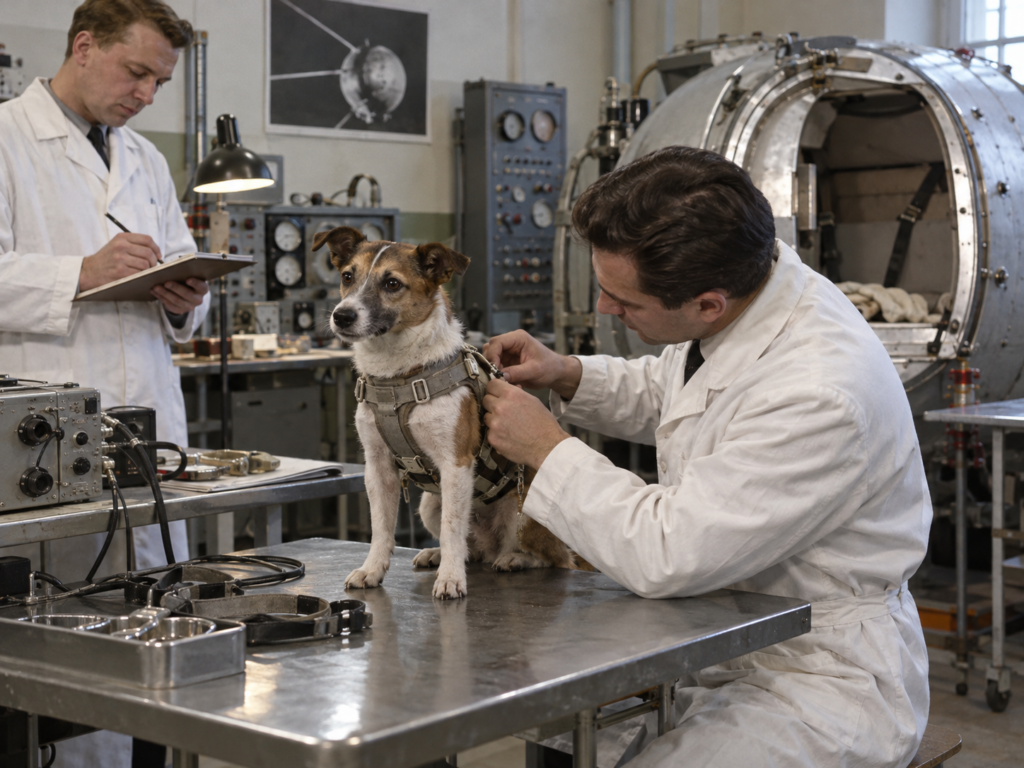
Preparation was demanding. The dogs were accustomed to increasingly confined spaces and exposed to conditions intended to simulate aspects of rocket flight. Laika was eventually selected for Sputnik 2, while another dog served as backup.
Inside the spacecraft, Laika occupied a pressurized compartment equipped with life-support equipment and biomedical instruments. Sensors monitored such measurements as her heartbeat and respiration. The National Air and Space Museum preserves examples of American recordings of Soviet biomedical transmissions from the flight.
Laika in Orbit
Sputnik 2 lifted off from the Soviet launch site now known as Baikonur Cosmodrome on November 3, 1957.
Laika survived the launch and reached orbit.
That alone answered an important question. A living mammal could endure the tremendous acceleration of launch, reach orbital flight, and remain alive—at least temporarily—in the unfamiliar environment of space. Later animal missions would provide much more information, but Laika’s flight represented an important early step toward human spaceflight.
The flight was not comfortable.
Telemetry showed dramatic physiological stress during launch. Smithsonian accounts based on the surviving data describe Laika’s heartbeat and breathing rising sharply under the forces and noise of ascent. Once she reached orbit, some measurements began moving closer toward normal.
That scientific achievement came with a fact that was known before the rocket ever left Earth.
There was no recovery system.
The rushed development schedule had left no practical means of returning Laika safely from orbit. Whatever happened aboard Sputnik 2, she would not be coming home.
What Really Happened to Laika?
For years, accounts of Laika’s death were confused by Soviet secrecy and changing official explanations.
The public was initially given the impression that she had survived much longer than she actually did. Different versions circulated about how long she lived and how her life eventually ended.
The fuller story emerged gradually.
Evidence released decades later showed that Sputnik 2 developed a serious thermal-control problem. The temperature inside Laika’s compartment rose dangerously. A report discussed publicly in 2002 established that she died within hours of reaching orbit rather than surviving for days as earlier accounts had suggested.
A later-released Soviet document recorded a substantial temperature increase inside the cabin during the early orbits, reaching about 43 degrees Celsius. The surviving telemetry is incomplete enough that historians still disagree about some precise details and timing, but overheating was central to her death.
Sputnik 2 continued orbiting long after Laika was dead.
Its batteries eventually failed and transmissions stopped. The spacecraft remained above Earth until April 14, 1958, when it reentered the atmosphere and burned up.
Science, Propaganda, and an Uncomfortable Legacy
It is tempting to tell Laika’s story either as pure heroism or pure cruelty.
History is more complicated.
Her flight contributed to the developing understanding of whether living organisms could survive launch and orbital conditions. Animal flights by both the Soviet Union and the United States became part of the experimental path toward human spaceflight.
But Laika’s mission also forces an ethical question because her death was not an unforeseen possibility. There was never a method for recovering her.
That fact caused criticism even in 1957 and has become more central to how the mission is remembered. The same achievement that demonstrated Soviet technological power also placed an ordinary animal at the center of a human political and scientific competition.
The contrast is part of what makes Laika such a powerful historical figure.
She was simultaneously a test subject, a propaganda symbol, a scientific pioneer, and a dog who had no understanding of the geopolitical struggle occurring around her.
The Dogs Who Came Home
Laika was not the end of the Soviet space-dog program.
Nearly three years later, in August 1960, the Soviet Union successfully sent the dogs Belka and Strelka into orbit aboard a later spacecraft and returned them safely to Earth. Their survival demonstrated something Sputnik 2 could not: living passengers could travel through orbital flight and be recovered afterward.
Then, on April 12, 1961, Yuri Gagarin became the first human to orbit Earth.
The technological distance between Laika’s improvised one-way compartment and Gagarin’s historic flight was enormous, even though fewer than four years separated them.
The story also fits into the broader cultural transformation of the era. Dear June’s look at the 1939 New York and 1962 Seattle world’s fairs shows how quickly American visions of “the future” shifted toward satellites, rockets, and the Space Age after Sputnik. 20th-Century Fairs—New York 1939 and Seattle 1962
NASA’s own history of Sputnik 2 places Laika’s mission among the critical early steps that preceded human orbital flight. NASA: The First Animal in Orbit
How a Stray Dog Became an Icon
Cold War history is often told through presidents, generals, engineers, missiles, rockets, and competing national programs.
Laika gives that history a face.
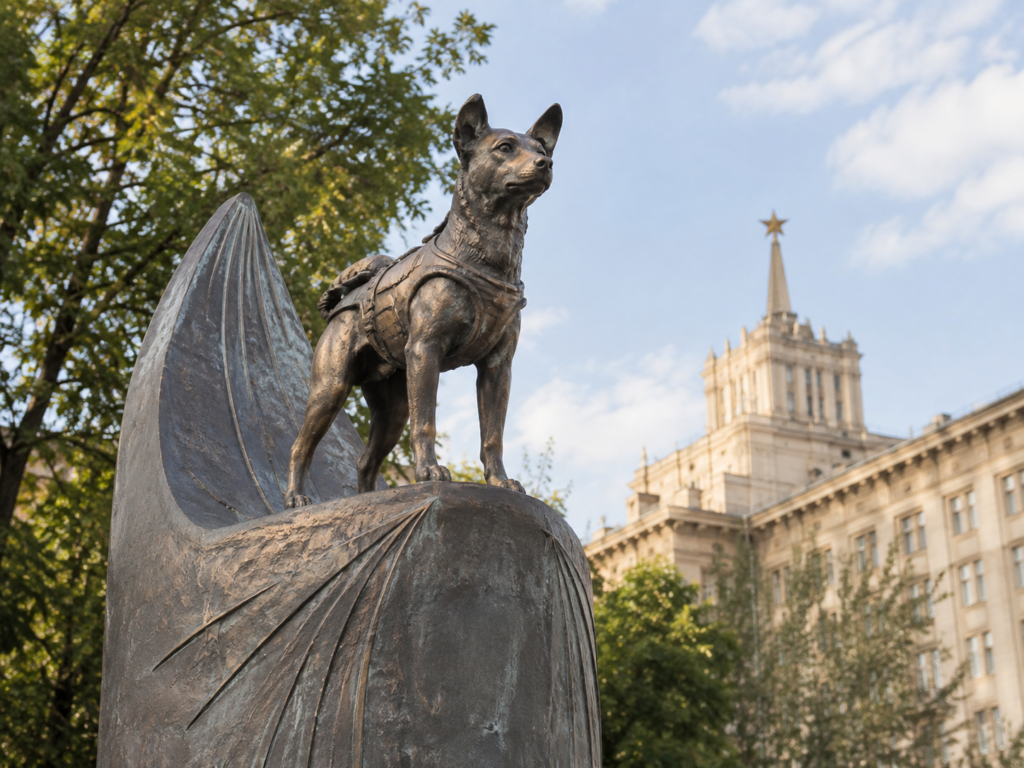
Her image appeared in popular culture and commemorative material around the world. She became one of the most recognizable animals associated with twentieth-century science, while later memorials ensured that her role was not forgotten.
Perhaps that is why Laika remains so compelling.
Sputnik 1 can be represented by a polished metal sphere. The Space Race can be reduced to launch dates, payload weights, orbital records, and competing national achievements. Laika makes the story personal.
She reminds us that technological progress is rarely as simple as the triumphant version preserved in headlines.
On November 3, 1957, humanity proved that a living creature could be carried into orbit.
But the small dog inside Sputnik 2 also left later generations with another question: not simply what humans can do in the pursuit of progress, but what we are willing to sacrifice in order to do it.
That tension transformed Laika from a passenger aboard an early Soviet satellite into one of the most enduring symbols of the Space Age.
Let’s Make History—remembering the small dog whose brief journey became part of humanity’s long road to the stars.
Discover more from Dear June Collectibles
Subscribe to get the latest posts sent to your email.