The Tupperware party became one of the most recognizable rituals of postwar American domestic life.
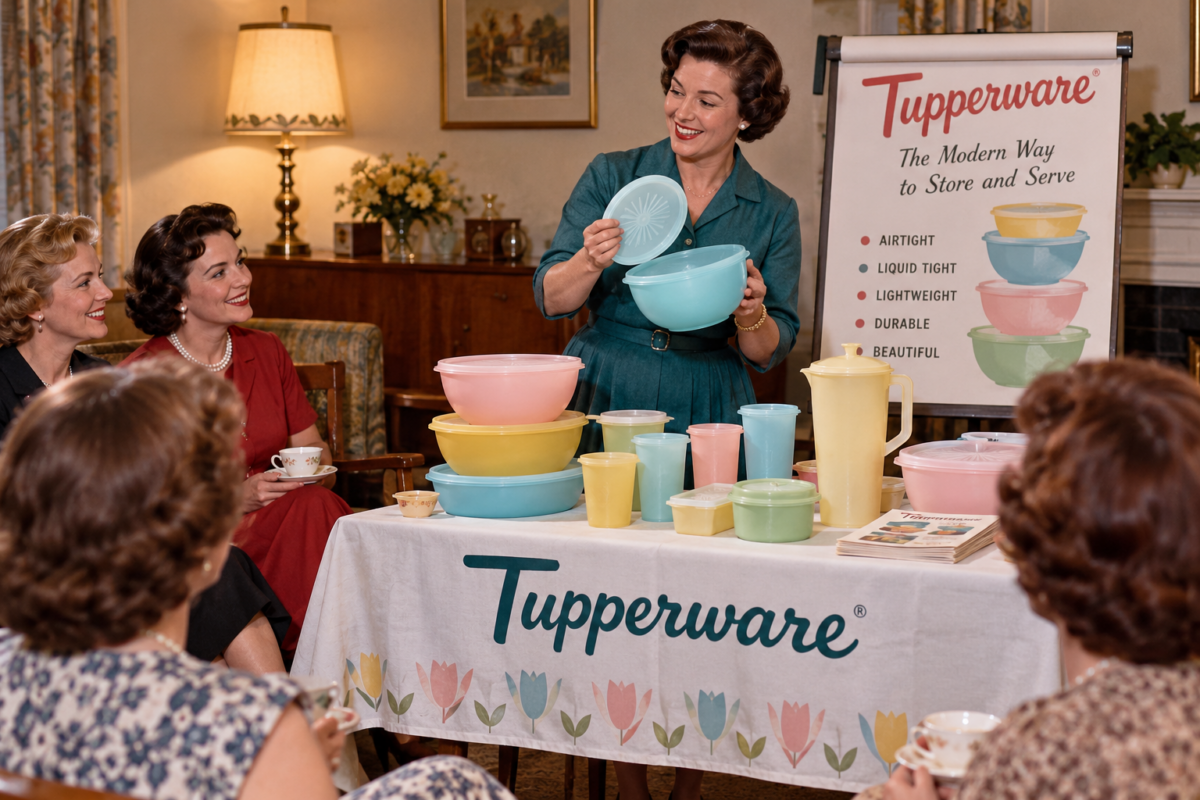
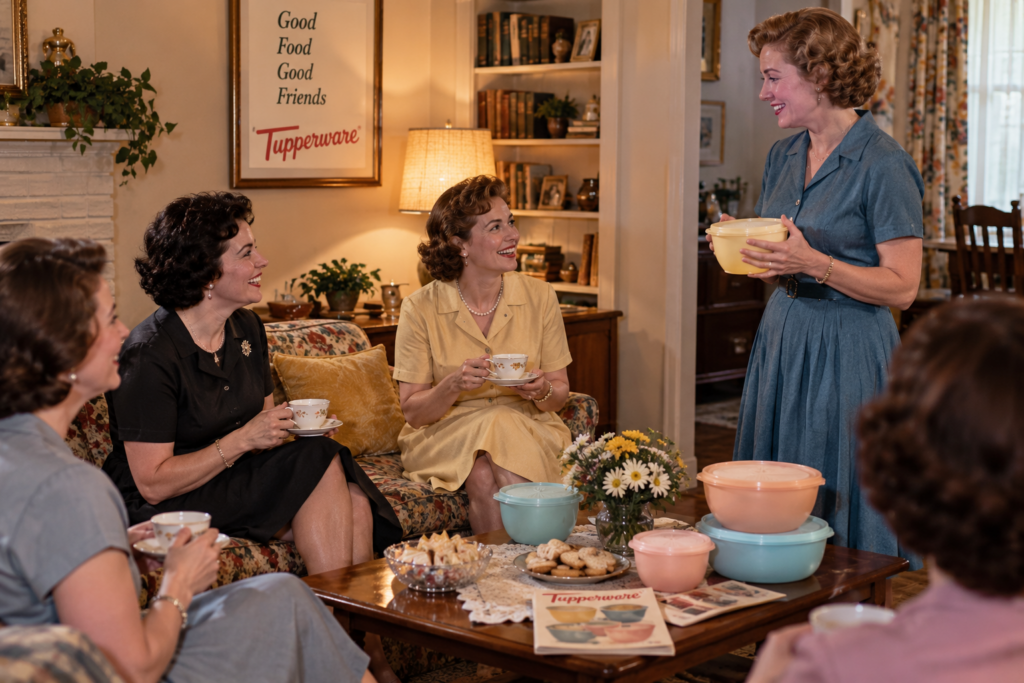
A hostess invited friends and neighbors into her living room. Coffee and snacks appeared. Colorful plastic bowls and containers covered a table. A salesperson demonstrated how the lids worked, explained new kitchen products, played games, and encouraged guests to place orders before the evening ended.
On the surface, it was a clever way to sell food-storage containers.
In practice, the Tupperware party became something much larger. It combined friendship, consumer culture, entrepreneurship, domestic expectations, and the changing economic lives of American women. At the center of its early success was Brownie Wise, a gifted salesperson who understood something that traditional retailers had missed: Tupperware needed to be experienced, not simply displayed on a shelf.
Brownie Wise and the Power of Demonstration
Earl Tupper had created an innovative product, but innovation did not automatically translate into sales.
Early Tupperware required explanation. Consumers unfamiliar with flexible polyethylene containers did not necessarily understand why they were different from ordinary bowls. Even the famous airtight seal worked best when someone demonstrated how to press the lid and release excess air—the familiar Tupperware “burp.”
Brownie Wise recognized that problem.
After World War II, Wise and her mother sold household products through home demonstrations. She had experience with Stanley Home Products, a company already using direct sales and home gatherings. Wise later began selling Tupperware through her own operation, Patio Parties.
She did not invent the home-party sales system, but she became exceptionally effective at adapting it to Tupperware.
Instead of asking shoppers to understand an unfamiliar plastic container from a department-store display, Wise put the product directly into their hands.
A dealer could show how the seal worked. Guests could handle the bowls, examine their light weight, see their colors, and ask questions. The products became the focus of a social event rather than another item on a store shelf.
The results caught Earl Tupper’s attention.
In 1951, Wise joined Tupperware as vice president of the newly established Tupperware Home Parties organization and took a leading role in developing the company’s party-plan sales system.
Soon, the living room was replacing the department store as Tupperware’s most important showroom.
Selling Through Friendship
The genius of the Tupperware party was that it blurred the line between socializing and shopping.
The hostess usually invited people she already knew: relatives, neighbors, coworkers, members of church groups, or friends from the surrounding community.
That existing social connection mattered.
Customers were not walking into an anonymous store. They were attending an event in someone’s home, often surrounded by familiar people. The atmosphere could include refreshments, demonstrations, games, prizes, and conversation.
The salesperson was not simply presenting a catalog. She was performing.
A good demonstration turned an ordinary household task into entertainment. Containers could be opened, sealed, stacked, passed around, and compared. Guests could see how a pitcher poured or how a bowl sealed.
Tupperware therefore became one of the best-known examples of what we would now call social selling.
Long before online influencers, referral links, livestream demonstrations, or social-media marketplaces, Tupperware was using personal relationships to introduce products and encourage purchases.
A Business Opportunity Inside the Home
The party system was especially significant because of who was doing much of the selling.
Postwar American culture frequently emphasized the ideal of the suburban homemaker. Women were encouraged to create comfortable homes, raise children, entertain guests, and become knowledgeable consumers.
Paid work, particularly for married women with children, could be more complicated. Childcare options were limited, workplace expectations were rigid, and many occupations remained sharply divided by gender.
Tupperware selling offered a different possibility.
A woman could potentially earn money while working within a world she already knew: kitchens, homes, neighborhoods, and social networks.
Dealers could arrange parties around household responsibilities rather than reporting to a traditional office or factory schedule. Successful sellers could recruit others and take on larger organizational roles.
That did not erase the inequalities of the period, nor did every dealer achieve substantial income. Direct selling required time, social connections, persistence, and the ability to continually generate new sales opportunities.
Still, the system created an unusual path into business for women at a time when relatively few held executive or management positions.
Wise herself became one of the most visible examples.
As Tupperware’s public face, she appeared at company events, spoke about sales and motivation, and received extensive media attention. Her prominence was particularly striking in the corporate world of the 1950s.
The Smithsonian’s Brownie Wise Papers preserve records from these years because her career complicates the familiar image of the decade as one in which women existed only as homemakers.
Some women were turning the home itself into a place of commerce.
More Than a Sales Meeting
Wise understood that motivation mattered almost as much as merchandise.
Tupperware developed large gatherings, including elaborate company jubilees where dealers and distributors could receive recognition, training, prizes, and encouragement.
These events helped create a sense of community around selling.
The language surrounding the business often emphasized confidence, self-improvement, achievement, and personal potential. Successful dealers were celebrated not merely for moving plastic bowls but for building organizations and reaching sales goals.
That culture helped turn Tupperware into something closer to a movement than an ordinary housewares company.
For many participants, there was also a social benefit.
The growth of suburban neighborhoods after World War II could create a strange combination of opportunity and isolation. Families moved into new developments where women might spend much of the day at home while husbands commuted to work.
Home parties created reasons to gather.
They brought neighbors together, introduced newcomers, and transformed the living room into a temporary social space where conversation could continue well beyond the product demonstration.
The sale was real, but so was the social experience.
The Complicated Legacy of Brownie Wise
Brownie Wise became so closely associated with Tupperware’s success that her story eventually exposed another side of mid-century business culture.
Her relationship with Earl Tupper deteriorated during the 1950s. Despite her enormous visibility and importance to the company’s marketing system, Wise was dismissed in 1958.
She did not share in the financial rewards that followed when Tupper sold the company shortly afterward.
Her departure is an important part of the story because it illustrates the limits that could still confront even an extraordinarily successful businesswoman.
Wise had helped build a sales organization centered heavily on women. She had demonstrated that women could recruit, manage, sell, motivate, and generate enormous business results.
Yet corporate ownership and ultimate authority remained elsewhere.
Her later career never reached the same public prominence, but the system she helped develop survived her departure and spread internationally.
The Tupperware party had become bigger than any one executive.
A Model Repeated Again and Again
Tupperware’s success influenced generations of direct-sales businesses.
Companies selling cosmetics, cookware, jewelry, candles, decorative goods, and numerous other products adopted variations of the home-party model.
The formula was powerful: combine personal relationships, product demonstrations, flexible selling opportunities, and incentives for recruitment or advancement.
Some later direct-sales systems became controversial, particularly when emphasis shifted heavily toward recruitment or when participants faced significant expenses and uncertain earnings.
Tupperware’s historical importance does not require ignoring those broader concerns.
What matters is that the company helped demonstrate the enormous commercial potential of selling through social networks.
Today, much of that activity has simply moved onto new platforms.
A livestream seller demonstrating an item to followers, a social-media personality showing how a household product works, or an online reseller cultivating repeat customers all use principles that would have been familiar to Brownie Wise.
The living room party became digital, but the underlying idea survived.
Collecting the Tupperware Party
For collectors, the history of Tupperware parties extends well beyond bowls and containers.
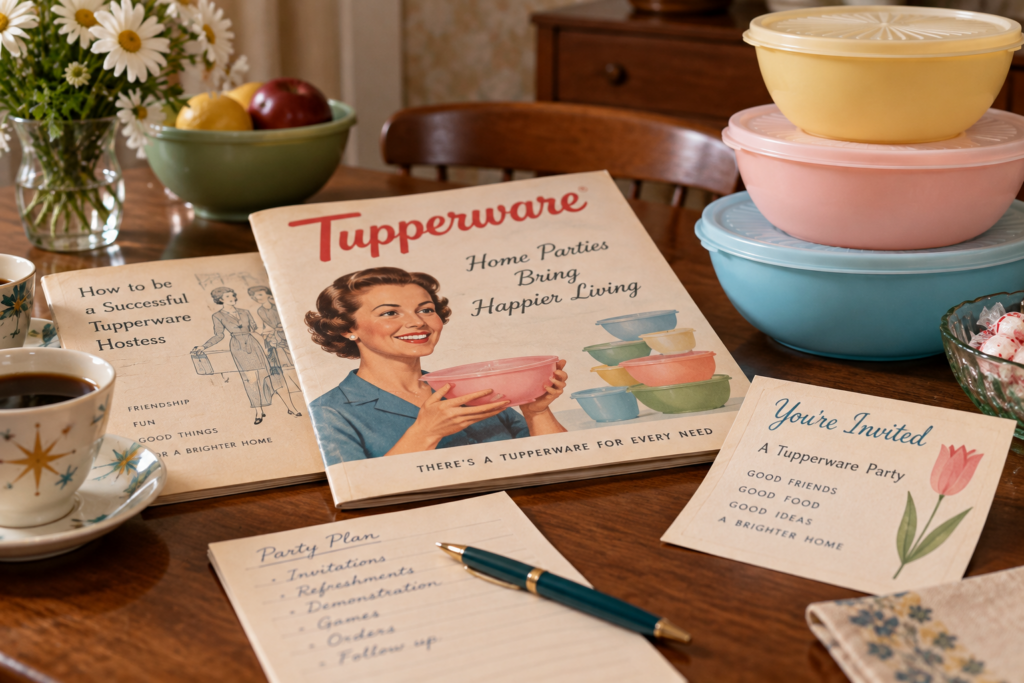
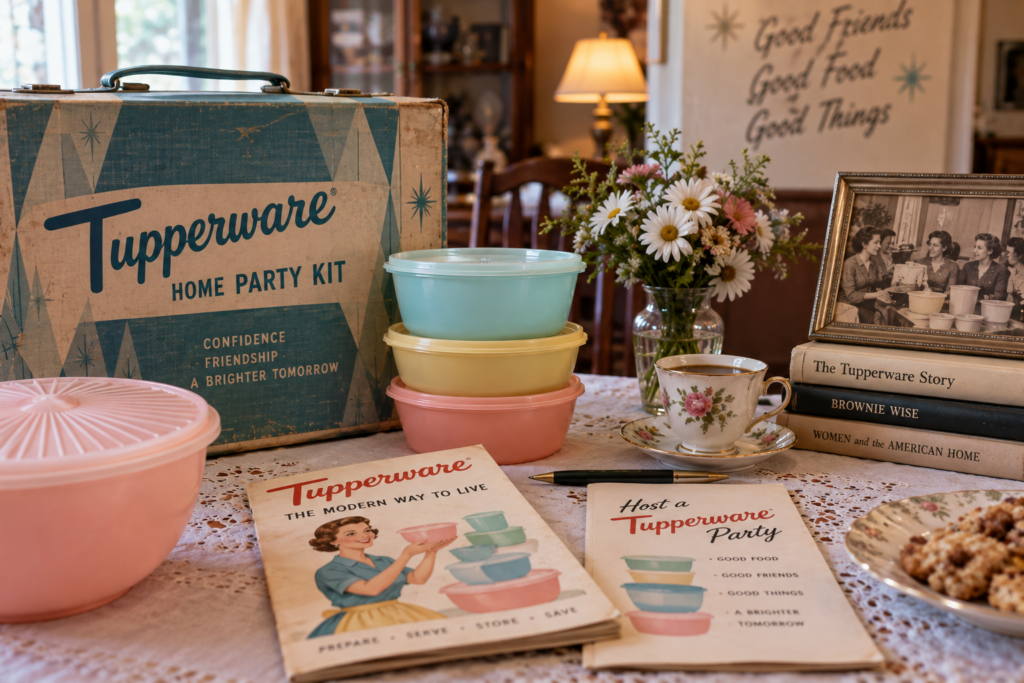
Catalogs, dealer manuals, invitations, order forms, promotional materials, sales awards, photographs, party games, and souvenirs from company gatherings all help document the culture surrounding the products.
These pieces can be especially useful because they show how Tupperware was actually marketed.
A container tells us what people used.
A sales catalog tells us how the company wanted people to imagine using it.
A party invitation tells us how products entered social life.
A dealer award reveals how the sales organization motivated its participants.
Together, these materials transform a collection of vintage plastic into a much broader record of American business and domestic culture.
When the Living Room Became a Marketplace
Tupperware’s greatest innovation may not have been plastic at all.
Earl Tupper created the product and its remarkable seal, but Brownie Wise helped create the environment in which people learned to want it.
She understood that selling could be personal, theatrical, educational, and social at the same time.
The Tupperware party turned kitchens and living rooms into temporary stores. It offered thousands of people—especially women—a way to participate in business outside traditional employment. It helped neighbors meet, turned product demonstrations into entertainment, and created a sales model that other companies would imitate for decades.
Today, the pastel bowls may be what survive in cupboards and collections.
Behind them, however, is another kind of history: the story of the women who demonstrated them, sold them, hosted parties around them, and helped transform a plastic food container into an American cultural icon.
Let’s Make History—one party at a time.
Discover more from Dear June Collectibles
Subscribe to get the latest posts sent to your email.