
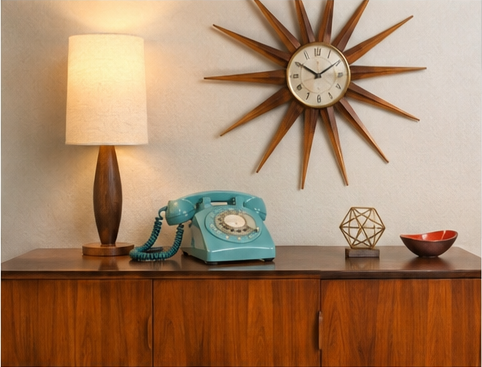
For generations, making a telephone call involved a small ritual. Lift the receiver. Wait for the dial tone. Place a finger into the correct hole. Turn the dial until it struck the metal stop. Release it and listen to the mechanism click its way back into place.
Then repeat.
The rotary telephone was slower than the push-button phones that followed, but that deliberate motion became one of the most recognizable sounds and gestures of twentieth-century life. By the middle of the century, the telephone was also changing physically. It was no longer simply a piece of communications equipment assigned a place in the hallway or office. Industrial designers were turning it into something intended to belong in the modern home.
When the Caller Took Over the Connection
Rotary dialing was closely tied to the rise of automatic telephone exchanges. Earlier subscribers generally depended on an operator to connect their calls, but automatic switching allowed the caller to control the process directly.
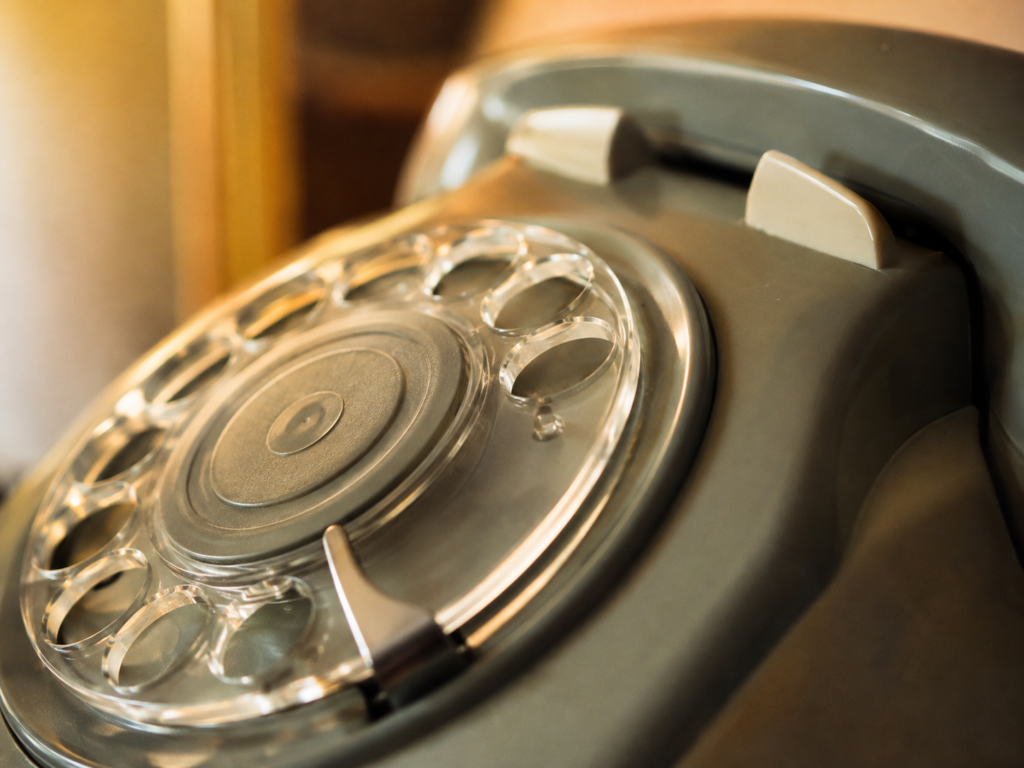
The system grew from work associated with Almon B. Strowger and the automatic exchange developed in the 1890s. Early dialing devices evolved into the familiar finger-wheel form. When a caller turned and released a rotary dial, its mechanism interrupted the telephone circuit in a sequence of electrical pulses. The number of interruptions told the exchange which digit had been selected. Bell System engineering histories describe the familiar finger-wheel dial as an improvement that emerged in the 1890s and remained the principal means of controlling automatic switching until Touch-Tone service appeared commercially in 1963.
What seemed effortless to the caller therefore concealed a mechanical conversation between the telephone and the exchange.
The dial itself also became an important part of the telephone’s visual identity. Numbers appeared around the wheel along with letters used in telephone exchange names. Older telephone numbers such as Murray Hill 5-9975 or Pennsylvania 6-5000 reflected a world in which memorable words and neighborhood exchange names were woven into everyday dialing.
For collectors, those dial cards, number plates, finger wheels, and letter arrangements can help place a telephone within a particular period of telephone service.
The Telephone Becomes an Industrial Design Problem
By the 1930s, telephone manufacturers were paying increasing attention to something beyond electrical performance: how a telephone looked and felt in everyday use.
One of the most important figures in that transition was industrial designer Henry Dreyfuss. Working with Bell Telephone Laboratories and Western Electric, Dreyfuss helped reshape the American telephone into a unified household object.
The Western Electric Model 302, introduced in 1937, provided an important bridge between earlier desk sets and the telephones most closely associated with the postwar era. Its handset rested directly on a compact body containing the dial and internal components. Cooper Hewitt credits the collaboration between Dreyfuss and Bell engineers with creating a more unified form than earlier telephone designs.
That concept reached a new level with the Model 500.
Introduced in 1949, the Model 500 became one of the defining objects of postwar American communication. Dreyfuss’s design team worked with Bell Laboratories engineers to improve not simply the telephone’s appearance but the way people actually handled it. Cooper Hewitt notes that measurements from more than 2,000 human faces informed the redesign of the handset, producing a form that was lighter, easier to hold, and better suited to being cradled between the shoulder and ear.
The Model 500 and the Mid-Century Home
The success of the Model 500 came partly from how little attention it demanded.
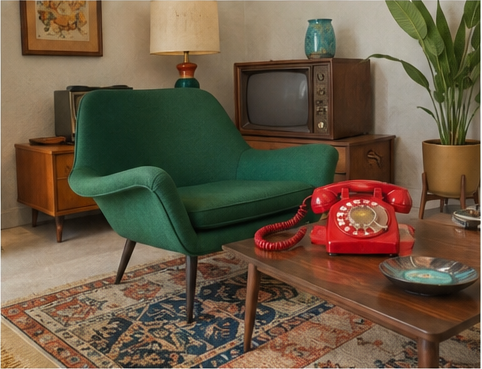
Its low, sloping body, rounded corners, prominent circular dial, and substantial handset created a form that looked modern without appearing futuristic. It was durable enough for years of everyday use and restrained enough to sit comfortably on a desk, telephone table, kitchen counter, or hallway shelf.
That mattered in the postwar period, when domestic design was changing quickly. Streamlined appliances, molded plastics, new furniture forms, and increasingly coordinated interiors were becoming part of American consumer culture. The telephone had to coexist with those surroundings.
Color helped.
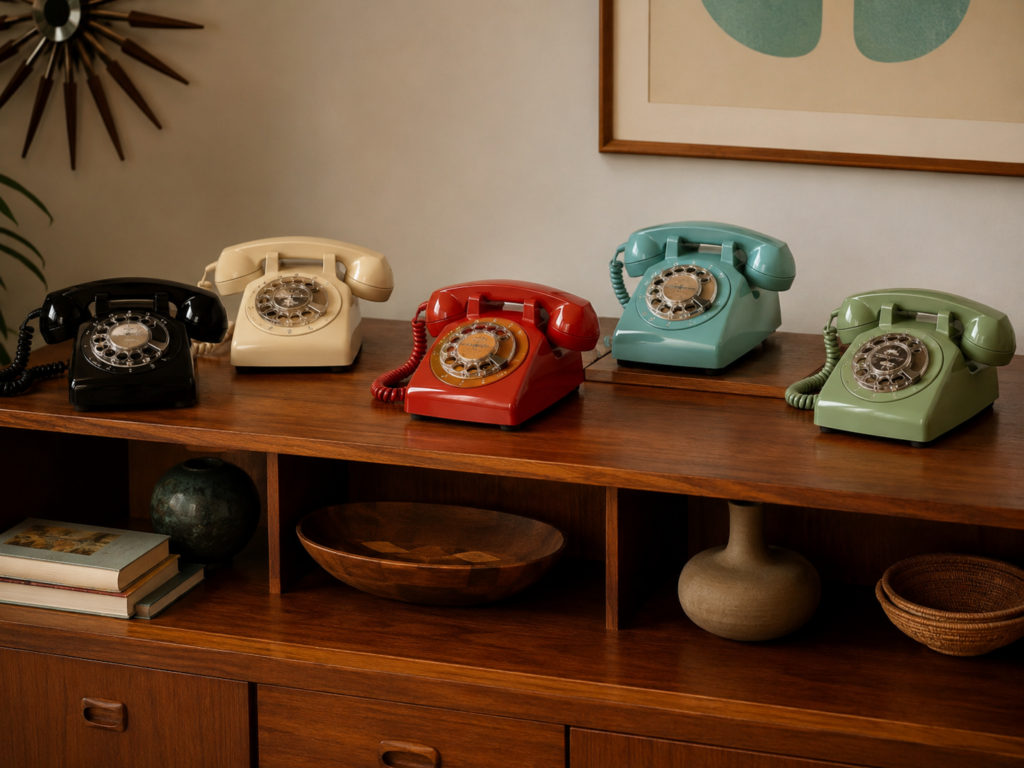
The familiar black desk phone did not disappear, but telephones increasingly became available in colors that allowed them to function as part of a room’s décor. Ivory, beige, green, blue, red, yellow, pink, and other shades transformed an object once dominated by black metal and dark plastic into something that could participate in the visual language of the home.
Today, those colors are a major part of the appeal of mid-century telephone collecting. A turquoise, pink, red, or soft green rotary phone immediately evokes its period in a way that a black example often does not, even when the underlying mechanism is substantially similar.
Color also creates complications for collectors. Telephone housings and handsets could be replaced during years of service. Cords were changed. Components moved between sets. Some phones have been painted after leaving service, while others combine parts of slightly different shades or ages.
An attractive color does not automatically mean an untouched telephone.
Smaller, Brighter, More Personal
By the late 1950s, telephone design was becoming more specialized.
The Western Electric Princess telephone, designed in 1959, represented a striking departure from the larger standard desk phone. Its compact body occupied far less space and included an illuminated dial for bedside use. The Smithsonian notes that the Princess was marketed particularly toward teenage users and was offered in colors including white, beige, pink, blue, and turquoise.
The telephone was becoming personal.
Instead of one household instrument placed where everyone could reach it, additional phones increasingly appeared in bedrooms, kitchens, dens, and other private spaces. Telephone design responded accordingly. Sets could be smaller, more colorful, and more closely associated with the personality of a room.
The Trimline continued this evolution in the 1960s. Designed by Henry Dreyfuss Associates, it moved the dial into the handset itself, placing the controls directly in the user’s hand. Cooper Hewitt dates the rotary Trimline design to 1965.
This was still recognizably a rotary telephone, but its form was far removed from the heavy desk sets of only a few decades earlier.
Mid-century telephone design therefore tells a larger story about domestic technology. The telephone moved from being equipment that happened to stand inside a house to an object consciously shaped around human bodies, rooms, furniture, color schemes, and changing habits.
What Collectors Should Look For
Rotary phones are still relatively easy to encounter, but identification can be more complicated than simply recognizing the shape.
The underside of the telephone is often the best place to begin. Manufacturer markings, model numbers, component dates, wiring diagrams, property stamps, and service information may survive there. Western Electric examples are especially common in American collecting, although Kellogg, Stromberg-Carlson, Automatic Electric, Northern Electric, and other makers produced important sets as well.
Collectors should distinguish between the date of a design and the date of a particular telephone. A Model 500-style set may have been manufactured long after the model first appeared. Likewise, an older base may have acquired a later handset, cord, dial assembly, or outer shell during repair.
That does not necessarily make the telephone undesirable. These were serviceable machines expected to remain useful for years. Telephone companies routinely repaired equipment rather than treating it as disposable.
Original cords can be especially difficult to judge. Straight cords, coiled handset cords, wall cords, strain reliefs, and connectors changed over time. A telephone may be entirely authentic to its years of service without every component dating from the same moment.
Color deserves similar scrutiny. Look inside removable housings and beneath the set for evidence of the material’s original color. Painted surfaces, overspray, inconsistent wear, or mismatched plastic can indicate later alteration.
Restoring a Rotary Phone
One of the pleasures of collecting rotary telephones is that many were engineered to survive substantial use.
Cosmetic cleaning should generally begin gently. Dust, accumulated grime around the finger wheel, and dirt in handset recesses can often be addressed without aggressive polishing. Bakelite, early plastics, painted metal, and later molded plastics do not all respond to cleaners in the same way, so identifying the material first is sensible.
The dial mechanism itself deserves restraint. A sluggish dial may need servicing, but spraying modern lubricants indiscriminately into the mechanism can create additional problems. Collectors interested in returning a telephone to working condition are often better served by learning the specific dial and network components used in that model.
Modern telephone service adds another consideration. Traditional rotary sets use pulse dialing, which many contemporary telephone systems no longer recognize directly. Converters can sometimes allow an old rotary telephone to work with newer service, but modifying a collectible telephone permanently simply to make it compatible may not be necessary.
More Than an Old Way to Make a Call
Rotary telephones occupy an unusual place in collecting because so many people still remember using them.
For some collectors, the attraction is industrial design. For others, it is color. Some want the exact telephone that sat in a childhood kitchen. Others pursue unusual models, advertising sets, hotel phones, private-label examples, telephone-company equipment, or variations in dials and markings.
The best examples preserve more than obsolete technology.
They preserve touch.
A rotary phone required the caller to interact physically with the machine in a way modern phones do not. Each number took time. A mistake near the end meant starting again. The receiver had weight. The bell rang from inside the housing. The dial returned at its own mechanical pace.
Mid-century designers took that machinery and made it part of the visual landscape of everyday life. The result was an object sturdy enough to serve households for decades and distinctive enough that, long after rotary dialing became obsolete, its silhouette remains instantly recognizable.
A turquoise Model 500, a compact pink Princess, or a black 302 does more than show how people once made telephone calls. Each reflects a moment when modern industrial design entered the home, picked up the receiver, and became part of the conversation.
Let’s Make History—one dial at a time.
Looking for something related?
Dear June Collectibles carries thousands of antiques, vintage pieces, collectibles, ephemera, books, housewares, jewelry, memorabilia, and unusual finds. Inventory changes constantly.
Found something like this while clearing a home or collection?
Before assuming it should be thrown away, tell us what you found. Dear June Collectibles helps families, collectors, executors, and homeowners sort household contents, collections, and estates and identify realistic resale possibilities.