When the World’s Columbian Exposition opened in Chicago on May 1, 1893, visitors entered something deliberately larger than an ordinary fair. Spread across hundreds of acres in Jackson Park and the adjoining Midway Plaisance, the exposition combined monumental architecture, industrial exhibits, electrical technology, fine art, transportation, entertainment, food, and merchandising into an experience that was intended to demonstrate progress on a breathtaking scale.
Officially, the exposition commemorated the 400th anniversary of Christopher Columbus’s 1492 voyage, although construction and planning pushed the public opening into 1893. By the time the gates closed on October 30, the exposition had recorded more than 27 million paid admissions. Its enormous popularity also produced an equally remarkable quantity of souvenirs.
Today, those surviving objects offer collectors something the temporary buildings cannot: tangible pieces of one of the most influential expositions in American history.
Building the White City
Chicago had been selected over competing cities, including New York, to host the exposition. The choice carried enormous symbolic importance for a city that had experienced catastrophic destruction in the Great Chicago Fire only two decades earlier.
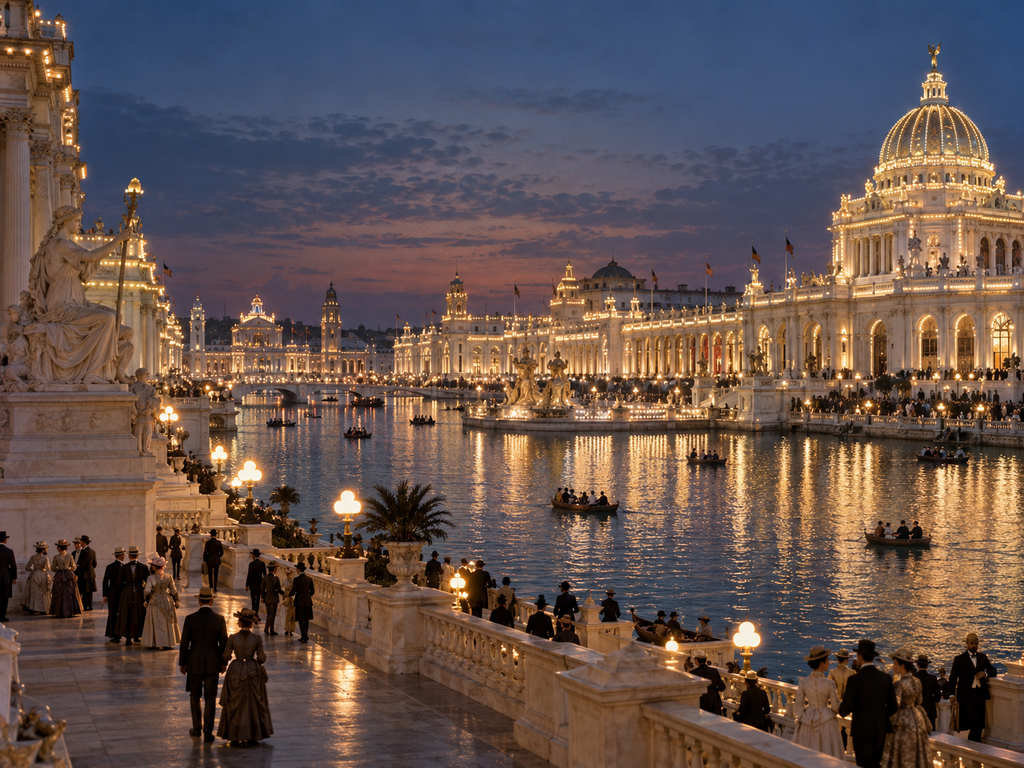
Daniel H. Burnham served as director of works, while landscape architect Frederick Law Olmsted helped shape the grounds. Architects from around the country designed enormous exhibition buildings surrounding lagoons, waterways, promenades, and the Court of Honor. Most of the principal buildings were covered in a white temporary material and designed in a grand neoclassical style, producing the famous nickname “White City.”
The effect became especially dramatic after dark.
Electric illumination transformed the grounds at a time when many Americans were still becoming accustomed to electric lighting. Thousands of visitors saw monumental buildings, fountains, and public spaces glowing after sunset. The fair was therefore not merely displaying electrical technology inside an exhibition hall; it demonstrated how electricity could transform an entire environment.
Architecture and lighting helped make the exposition unforgettable, but they also made its imagery ideal for souvenirs.
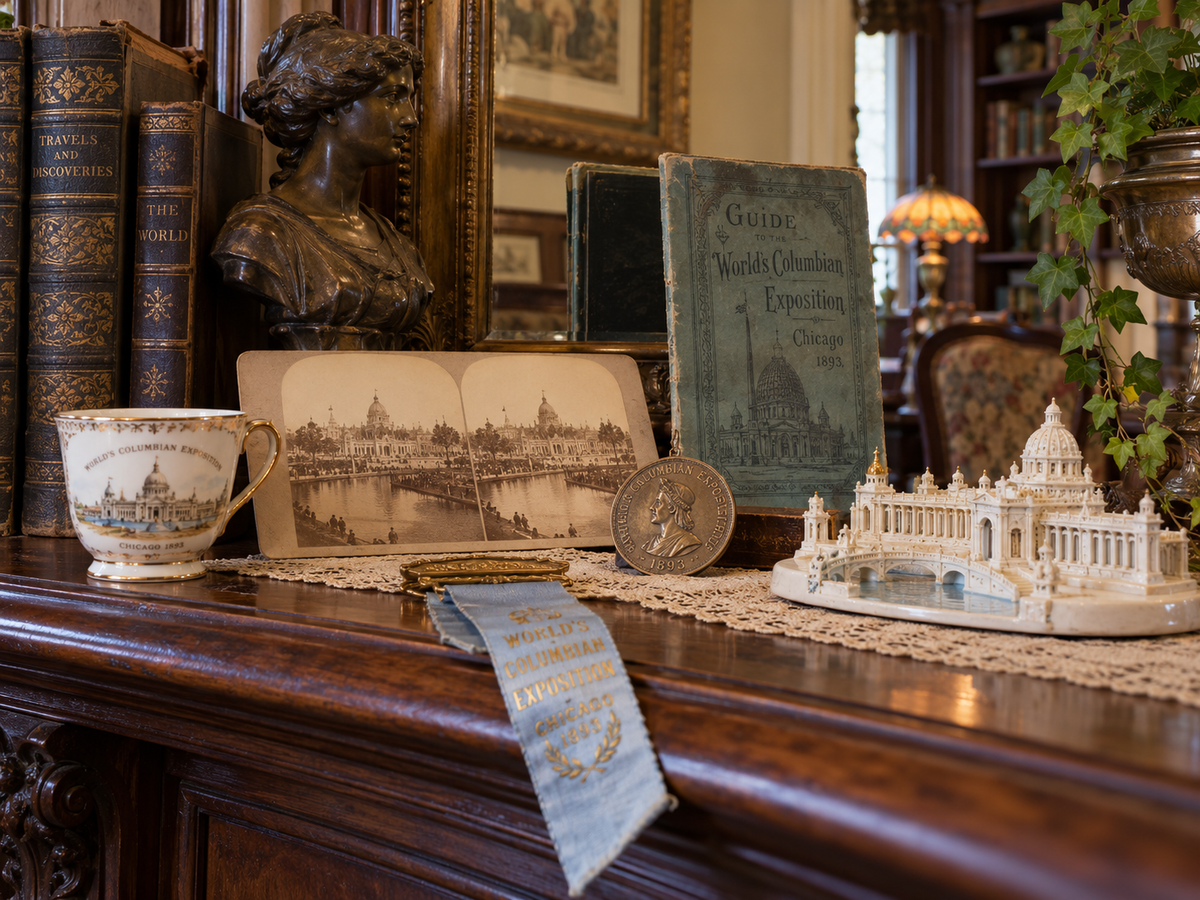
Buildings appeared on plates, drinking glasses, spoons, medals, guidebooks, admission tickets, photographs, stereoviews, maps, and countless other objects. For collectors today, identifying an exposition building can sometimes provide the quickest path toward identifying an otherwise unmarked piece.
Souvenirs for Millions of Visitors
The scale of souvenir production reflected the scale of attendance.
Visitors needed maps and guidebooks simply to navigate the sprawling grounds. The Library of Congress preserves numerous contemporary guides, including publications issued before construction was complete and extensive guides produced specifically for people attending the finished exposition.
Unlike decorative souvenirs, these publications were working objects. They were folded, carried, marked, consulted, stuffed into luggage, and eventually stored in drawers or trunks. Surviving examples can therefore show considerable wear while remaining historically interesting.
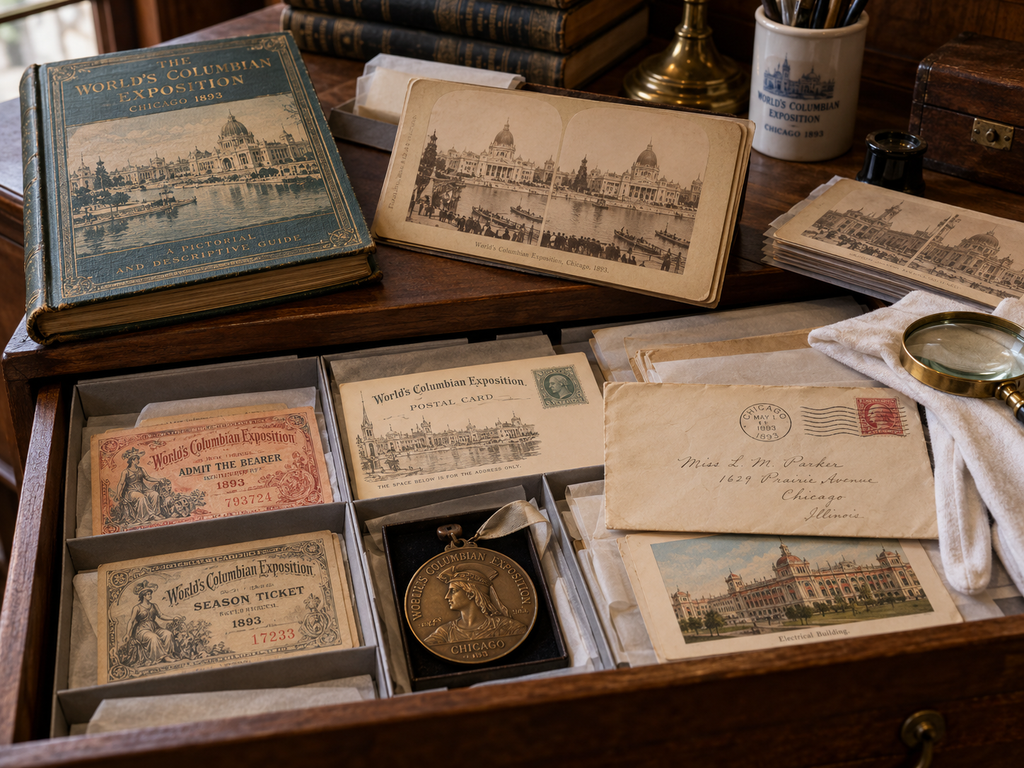
Admission tickets are another important area of Columbian Exposition collecting. Their elaborate engraving reflects an era when even temporary paper objects could receive substantial artistic attention. Maps, programs, exhibition catalogs, advertising pieces, and photographs expanded the paper trail left behind by the fair.
The Smithsonian’s Archives of American Art notes that surviving Columbian Exposition collections include photographic prints, stereocards, maps, guidebooks, publications, and exhibition tickets. These materials now preserve views of buildings, exhibits, artwork, and interiors that otherwise disappeared with the temporary exposition.
The Ferris Wheel Changes the Midway
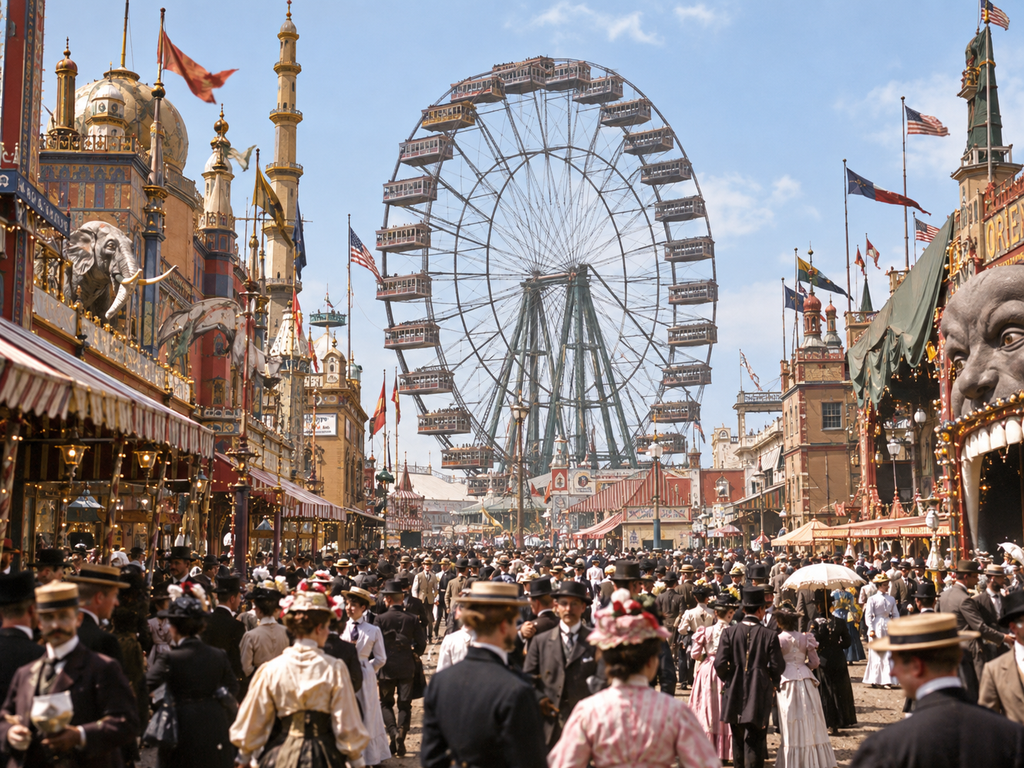
Few objects identify the 1893 fair as quickly as the original Ferris Wheel.
Engineer George Washington Gale Ferris Jr. designed the enormous wheel as an American engineering response to the attention generated by the Eiffel Tower at the Paris Exposition of 1889. The Chicago wheel stood approximately 264 feet high and became the dominant landmark of the Midway Plaisance.
Its importance is readily visible in surviving memorabilia.
Ferris Wheel imagery appears on medals and other exposition souvenirs, allowing an attraction that existed for only a limited period in Chicago to remain instantly recognizable more than a century later. The Smithsonian, for example, preserves an aluminum souvenir medal depicting the wheel.
The Midway itself provided a striking contrast with the formal White City. It mixed rides, concessions, food, shops, performances, and cultural displays. Fair organizers presented many of its international villages as educational or ethnographic exhibits, although the displays often reflected the racial assumptions and stereotypes of the period. Visitors frequently treated the Midway less as an educational institution and more as an entertainment district.
That distinction matters when studying surviving memorabilia. A formal exposition medal, an amusement souvenir, an advertising trade card, and a Midway photograph may all come from the same fair while representing very different parts of the visitor experience.
What the Fair Chose to Celebrate—and What It Left Out
The Columbian Exposition presented an extraordinarily confident vision of American progress, but that vision was far from complete.
Women secured an unprecedented official role through the Board of Lady Managers, and the Woman’s Building showcased women’s achievements in art, industry, education, and other fields. The building itself was designed by architect Sophia Hayden, the first woman to earn a four-year architecture degree from MIT.
At the same time, Black Americans faced exclusion and discriminatory representation within the exposition. Ida B. Wells and other activists publicly challenged the fair’s treatment of African Americans, while Frederick Douglass participated through his association with Haiti’s pavilion and used the exposition as a platform to address racial injustice.
For collectors, this broader history is important because souvenirs rarely tell the complete story by themselves. A beautifully decorated plate showing the White City represents what exposition promoters wanted visitors to remember. Other documents, pamphlets, photographs, and publications can reveal experiences and arguments that the official souvenirs ignored.
That is one reason ephemera can be every bit as historically important as elaborate decorative objects.
Postcards, Stamps, Medals, and the Business of Memory
The exposition arrived at an important moment in the development of mass-produced souvenir culture.
The U.S. Post Office issued the Columbian Exposition stamps in 1893, creating the nation’s first commemorative postage-stamp series. The elaborate designs made the fair part of everyday correspondence well beyond Chicago.
Souvenir postal cards also helped visitors send images of the exposition home. The National Postal Museum notes that picture postal cards sold at the fair proved extremely popular and contributed to the expanding American enthusiasm for illustrated postal cards.
Then there were the objects intended to remain in the home: souvenir spoons, medals, ceramics, glassware, miniature buildings, decorative boxes, and other keepsakes.
These objects transformed monumental architecture into something personal. A visitor could never take the Court of Honor home, but a plate decorated with its buildings might sit in a china cabinet for decades. A spoon could preserve a tiny engraved view. A medal might recall the Ferris Wheel long after the ride itself disappeared.
That process—turning an enormous temporary event into a permanent household object—is at the heart of World’s Fair collecting.
Collecting Columbian Exposition Material Today
The variety of surviving material means there is no single way to collect the 1893 exposition.
Some collectors concentrate on paper: guidebooks, tickets, maps, programs, photographs, stereoviews, advertising, and postal material. Others prefer decorative souvenirs such as glass, ceramics, spoons, medals, or architectural miniatures. Still others focus on a particular building, the Ferris Wheel, the Midway, state exhibits, transportation, electrical technology, or the Woman’s Building.
Identification usually begins with inscriptions and imagery. Look for variations of World’s Columbian Exposition, Chicago 1893, building names, exhibition departments, manufacturer information, or recognizable architectural landmarks.
Collectors should also remember that Columbian imagery remained popular long after the exposition closed. Later reproductions, anniversary pieces, and historically themed souvenirs exist, so an 1893 date printed on an object does not automatically prove that the object was manufactured in 1893. Materials, construction, printing methods, maker’s marks, provenance, and comparison with documented examples all matter.
Condition expectations also depend heavily on the object. A fragile admission ticket with honest handling wear may be entirely acceptable, while damage to an otherwise common ceramic souvenir can have a greater effect on collector interest. Original packaging, envelopes, accompanying literature, and documented family history can add context even when they do not necessarily translate into dramatically higher monetary value.
What Survived When the White City Disappeared
Most of the exposition was never intended to become permanent. Buildings were dismantled, destroyed by fire, moved, or allowed to disappear after the fair closed. The Palace of Fine Arts was one important exception; its structure survived and, after substantial later reconstruction, the building became today’s Museum of Science and Industry.
The souvenirs followed a different path.
They traveled home with millions of visitors. They entered scrapbooks, desk drawers, china cabinets, photograph albums, family trunks, and collections. Some remained treasured mementos. Others survived almost accidentally.
More than 130 years later, they allow collectors to reconstruct the fair on a human scale.
The World’s Columbian Exposition was a place of extraordinary architecture, new technology, ambitious claims about progress, popular entertainment, and very real social contradictions. A surviving spoon or ticket cannot explain all of that by itself. But place enough of these objects together and they begin to restore pieces of a world that vanished almost as quickly as it was built.
That is the particular appeal of Chicago 1893: the White City disappeared, but thousands of small reminders went home with the people who saw it.
Let’s Make History—one fairground memory at a time.
Discover more from Dear June Collectibles
Subscribe to get the latest posts sent to your email.