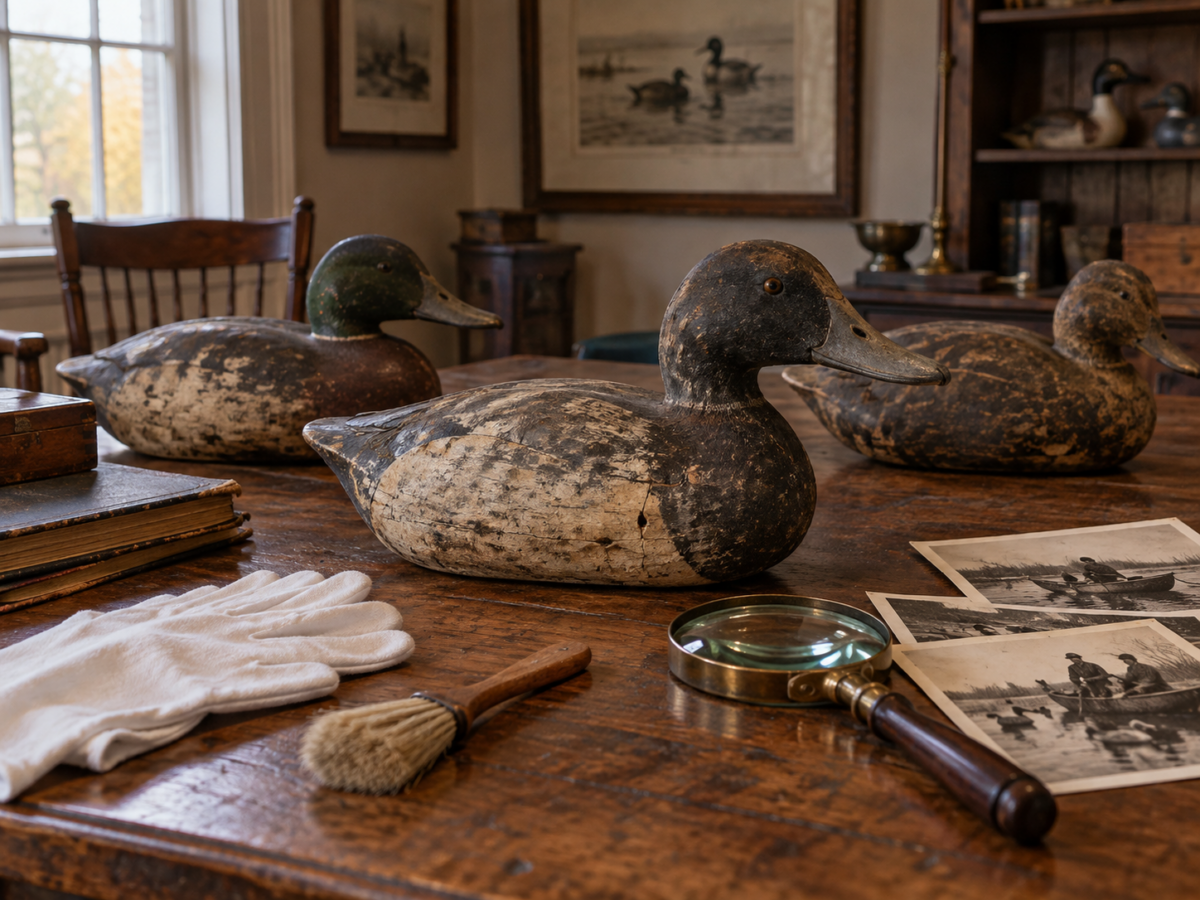
A waterfowl decoy can carry several histories at once.
There is the history of the bird it represents, the person or factory that made it, the region where it was used, and the hunting tradition to which it belonged. Then there is the history written directly onto the object: worn paint, repaired bills, anchor-line grooves, scratches from boats, replacement hardware, and perhaps a name or rig number added by a hunter generations ago.
For collectors, that history is often more important than perfection.
The challenge is learning to recognize what should be preserved, what may have been altered later, and when an attempt to “improve” an old decoy might actually erase some of the very evidence that makes it interesting.
Start With the Whole Decoy
It is easy to focus first on paint or the maker’s name, but an old decoy should be examined as a complete object.
Look at the silhouette. Turn it over. Study how the head joins the body. Determine whether the body is solid or hollow. Examine the bottom for weights, keels, anchor-line attachments, brands, stamps, nails, screw holes, and wear.
Those details can reveal how a decoy was constructed and how it lived.
Museum collections demonstrate just how varied decoy construction can be. Smithsonian examples include wooden birds incorporating metal and string, while ancient Great Basin decoys were made from rushes, feathers, cordage, paint, and grass. The word decoy therefore describes a function rather than one particular method of manufacture.
The same principle applies within wooden decoys. Two birds that look similar from across a room may have very different construction histories when examined closely.
Original Does Not Mean Perfect
One of the most important lessons in decoy collecting is that wear and damage are not necessarily the same thing.
A working decoy was expected to be used.
Paint rubbed away where birds knocked against one another in a boat. Bottoms were scraped. Bills were chipped. Heads loosened. Hunters added new weights, moved line attachments, patched cracks, or repainted birds so they could return to the marsh.
Those changes can be part of the decoy’s history.
This creates a difficult question for collectors: when is a repair desirable evidence of working life, and when is it a later alteration that reduces historical integrity?
There is no single answer.
An old neck repair made while the decoy was still part of a hunting rig can tell an authentic story. A newly replaced head created to make an incomplete decoy easier to sell is something very different.
The same is true of paint. Old working repaint may be historically meaningful. Modern repaint designed to simulate an untouched surface can obscure what remains underneath.
Collectors should therefore resist the urge to judge every decoy according to how fresh or attractive it looks.
Sometimes the battered bird is the more honest one.
Learn to Read the Surface
Paint is one of the most closely examined parts of an antique decoy because it can help reveal age, use, repairs, and maker characteristics.
It is also one of the easiest things to damage.
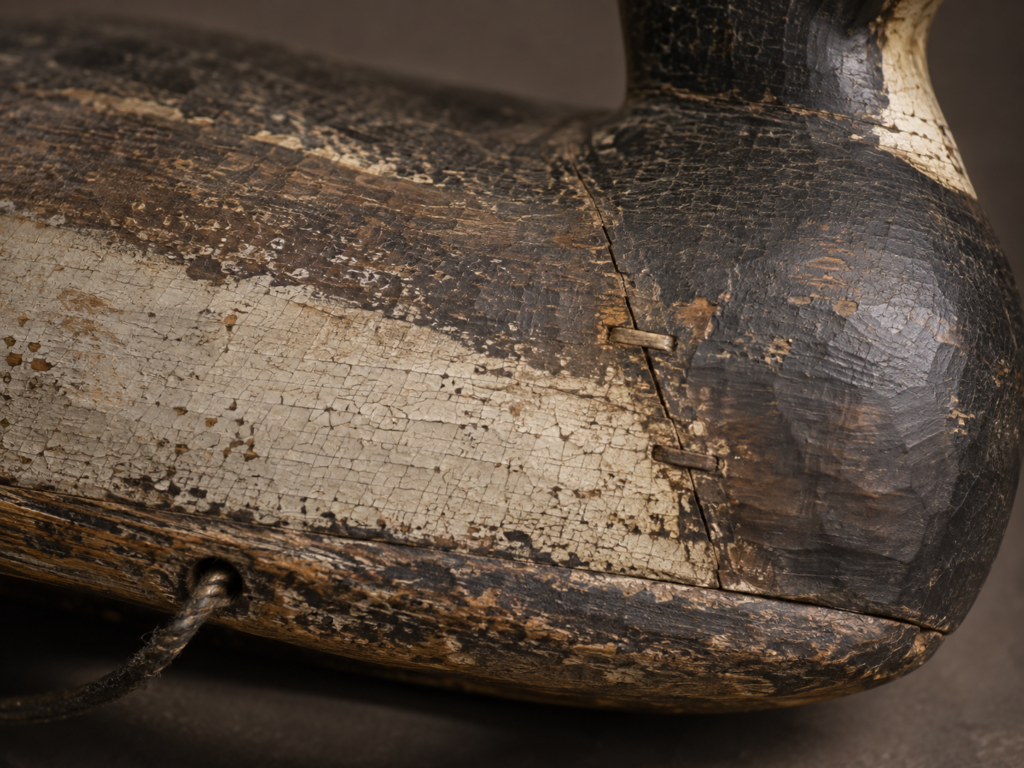
Old painted wood naturally responds to changes in its environment. Wood expands and contracts as humidity rises and falls, while the paint layer responds differently. Over time, that movement can contribute to cracking, lifting, and flaking. Light can also fade pigments and weaken painted surfaces, and the Canadian Conservation Institute emphasizes that light damage to wood and finishes is cumulative and irreversible.
Cracked paint is not automatically a problem to fix.
On an old working decoy, age-related cracking, fading, and wear may be part of the surface collectors hope to preserve.
Heavy waxing, polishing, varnishing, repainting, or aggressive cleaning can change that surface permanently.
Provenance Can Be as Important as Paint
A decoy with a known story carries something an anonymous example cannot.
Perhaps it came from a documented hunting club. Maybe it remained in one family for generations. A photograph might show the decoy alongside its original rig. A handwritten note might identify the hunter who owned it or the waters where it was used.
Keep that material together.
Receipts, auction descriptions, old photographs, correspondence, labels, family notes, and previous collection records may become part of the object’s provenance.
Even modest documentation can prevent information from disappearing.
Museums preserve this context carefully. Smithsonian catalog records, for example, do not simply identify an object as a duck decoy. They can record materials, collection history, associated places, donors, dates, and related subjects. That information allows the object to function as historical evidence rather than merely as an attractive bird-shaped artifact.
Private collectors can adopt the same habit on a smaller scale.
Write down what you know while you still know it.
Attribution Requires Patience
One of the pleasures of decoy collecting is learning regional styles and individual makers.
It is also an area where certainty can easily outrun evidence.
Body shape, head style, paint pattern, construction, hardware, wood, and rigging can all suggest a region or maker. Factory stamps and brands may provide stronger clues. Provenance can sometimes tie a bird directly to a particular carver.
But resemblance alone is not proof.
Makers influenced one another. Hunters copied successful designs. Factory birds were altered by their owners. Heads were replaced. Entire rigs were repainted. Modern carvers have also produced excellent work inspired by historic traditions.
Terms such as “attributed to,” “possibly,” “school of,” or “in the style of” exist for a reason.
Good collecting does not require turning every mystery into certainty.
Sometimes “unknown maker, probably from this region” is the most accurate—and most responsible—description.
Preserve Before You Restore
The safest preservation philosophy for many antique decoys is surprisingly simple:
Do as little as the object requires.
If the bird is stable, an old surface does not need to become shiny, smooth, or new-looking.
The National Park Service distinguishes between stabilization—work intended to maintain an object and slow deterioration—and restoration, which attempts to return an object toward a known or assumed earlier appearance. For historically important objects, that distinction matters.
Cleaning should be approached cautiously.
The Canadian Conservation Institute recommends examining painted wood closely before cleaning. If paint is powdering, lifting, or flaking, even ordinary handling can result in losses. Stable surfaces may sometimes be gently dusted using appropriate dry techniques, while more involved water- or solvent-based cleaning is best left to trained conservation professionals because historic paint layers can react unpredictably.
That old decoy does not need furniture polish.
It does not need a fresh coat of varnish.
And it certainly does not need to be stripped simply because the paint looks worn.
Light, Humidity, and the Display Shelf
A decoy that survived decades of hunting can still be damaged surprisingly quickly by poor display conditions.
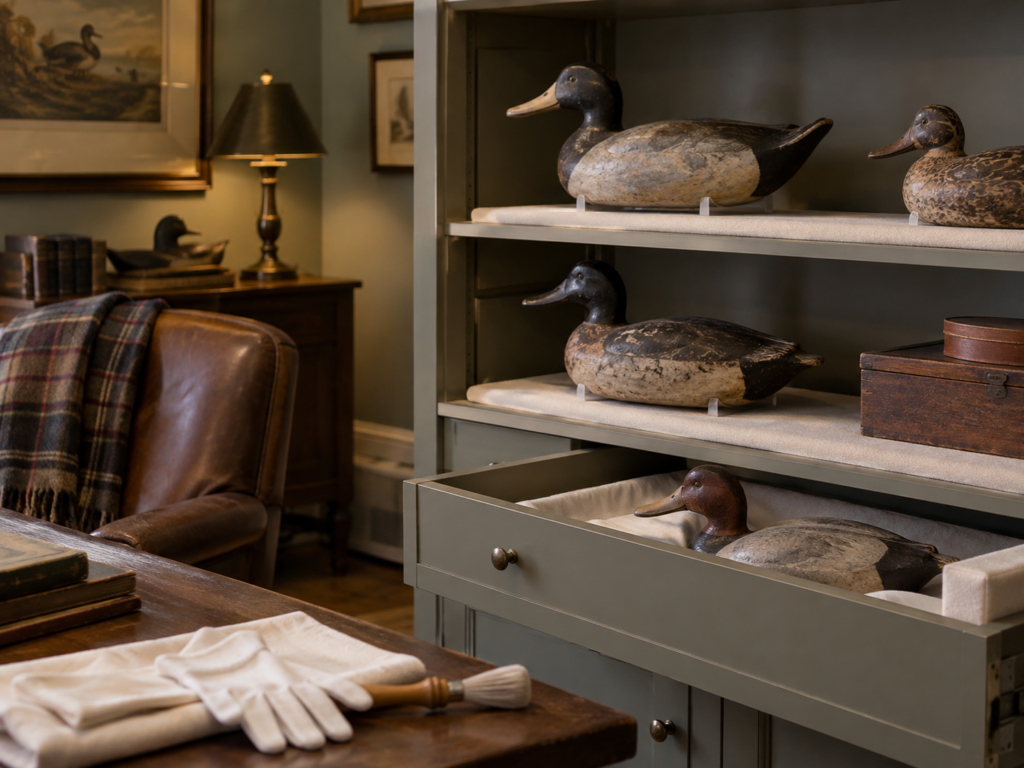
Direct sunlight is one of the easiest risks to avoid. Light can fade paint and alter wood surfaces, and the damage accumulates over time. A shelf away from strong windows is generally preferable to displaying a favorite decoy in daily sunlight.
Humidity matters because wood continually responds to moisture in the air.
Extremely dry conditions encourage shrinkage and cracking. Excessively humid conditions can cause swelling and encourage mold, corrosion, and insect activity. Rapid fluctuations can be especially troublesome because the wood and painted surface repeatedly expand and contract.
The National Park Service uses approximately 50 percent relative humidity, plus or minus about five percent, as a general museum target for many wooden objects, while acknowledging that appropriate levels vary with climate. A private collector may not maintain museum conditions, but stability is still a worthwhile goal: avoid attics, damp basements, unheated sheds, and locations subject to dramatic seasonal changes when possible.
Handle the Bird, Not Its Weakest Part
Old decoys invite handling.
They are tactile objects, and turning one over is often necessary for identification. That makes sensible handling particularly important.
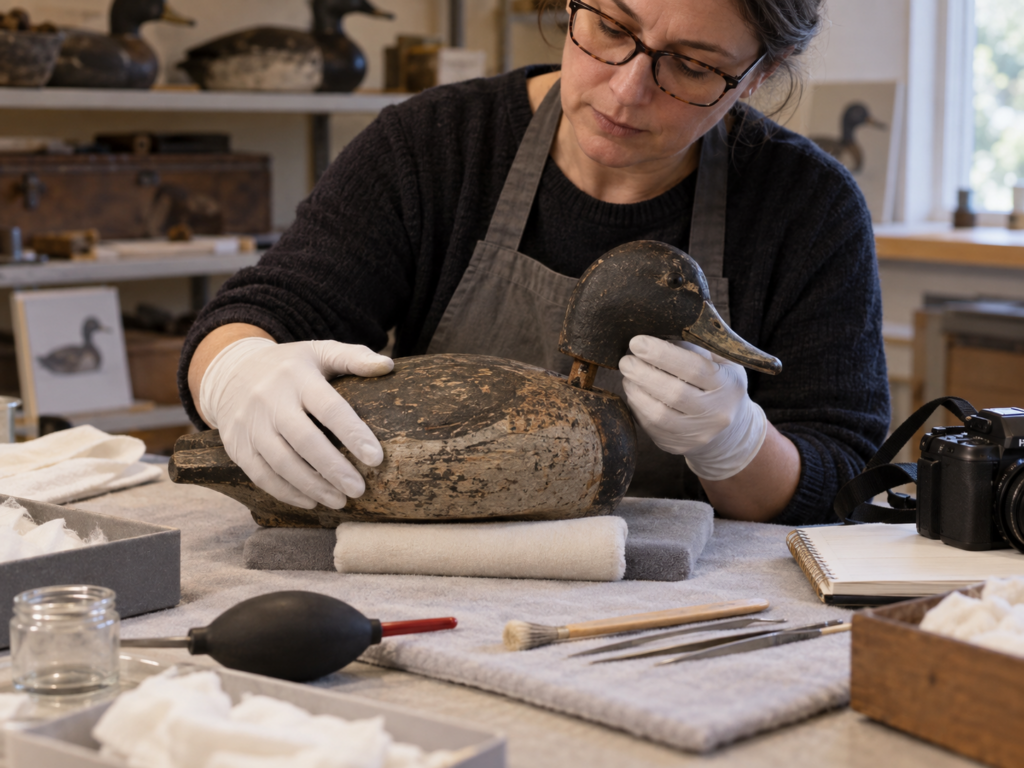
Lift a decoy by supporting its body rather than grabbing the bill, head, tail, or other projecting feature. Old head joints may already be weak, and a previously repaired bill can fail with surprisingly little pressure.
Remove loose anchor weights or dangling rigging before moving a bird if they could swing into the body.
If paint is actively flaking, handling should be minimized until the problem can be evaluated.
Storage should also prevent birds from rubbing against one another. A shelf full of tightly packed decoys may look impressive, but repeated contact can abrade fragile paint and projecting bills.
Working decoys endured rough treatment once.
They do not need to continue doing so in retirement.
Watch for Pests and Moisture
Wooden objects can attract insects, while organic materials associated with decoys—feathers, plant fibers, leather, or old natural adhesives—may create additional risks.
Small piles of fresh powder, new holes, shed insect skins, or unexplained debris deserve attention.
Mold is another warning sign.
The Canadian Conservation Institute identifies high humidity and poor environmental conditions as significant causes of deterioration in wooden objects. Catching problems early is far easier than repairing damage after it becomes extensive.
Periodic inspection is therefore one of the simplest preservation tools a collector has.
Look at the collection rather than merely looking at it.
Check bottoms. Examine shelves. Notice whether a crack has changed or paint has begun lifting.
Keep Modern Repairs Reversible
Sometimes intervention is necessary.
A loose head may be in danger of falling. A crack may be widening. An old weight could be pulling through weakened wood.
When repairs are needed on an important decoy, the goal should usually be stabilization rather than invisibility.
A professional conservator can often secure an unstable component without disguising every sign of age. Ideally, treatment should also be documented so a future owner knows what was changed.
That documentation becomes part of the decoy’s history too.
Building a Collection With a Story
A decoy collection becomes more interesting when it explains something.
That might mean collecting examples from one region, several generations of one maker’s work, factory and hand-carved birds side by side, different species, working repairs, unusual construction methods, or examples showing the evolution from practical hunting equipment to decorative art.
A collection does not have to contain the most expensive birds to be historically meaningful.
A heavily used factory decoy with its original weight may illustrate the working life of a hunter. An anonymous local carving may demonstrate regional construction. A modern signed bird may document a living tradition. An old photograph or catalog can provide context for everything around it.
The strongest collections often ask a question rather than simply accumulate objects.
Preserve What Time Has Left Behind
Collectors temporarily become caretakers.
That is especially clear with decoys because so much of their appeal comes from the evidence of the lives they already lived.
Every scratch does not need to disappear.
Each old repair does not need correcting.
Every faded surface does not need refreshing.
Sometimes preservation means resisting the instinct to improve.
The carved bird that once floated in cold marsh water has already survived hunters, boats, weather, storage sheds, changing fashions, and perhaps several generations of owners.
Our job is not necessarily to make it new again.
It is to make sure the story survives with it.
Let’s Make History—one decoy at a time.