

A weathered wooden duck sitting on an antiques table may look straightforward enough. It has a carved body, painted feathers, and the unmistakable shape of a working waterfowl decoy.
But how was it actually made?
By the late nineteenth and early twentieth centuries, American hunters could obtain decoys in two very different ways. Some birds were carved individually by hunters, guides, fishermen, craftsmen, or professional carvers. Others came from factories capable of producing dozens, hundreds, or eventually thousands of remarkably similar birds.
That distinction matters to collectors, but it is not as simple as “handmade is good, factory-made is ordinary.” Factory decoys have their own history, recognizable makers, construction techniques, grades, paint patterns, and collecting traditions. In fact, the line between factory production and hand craftsmanship can sometimes be surprisingly blurry.
When Decoys Became a Product
The working decoys explored in the previous post were often made locally because hunters needed them. A skilled hunter might carve his own rig, commission birds from someone nearby, or obtain decoys from another waterman whose patterns had proven effective.
As waterfowling expanded during the nineteenth century, demand increased.
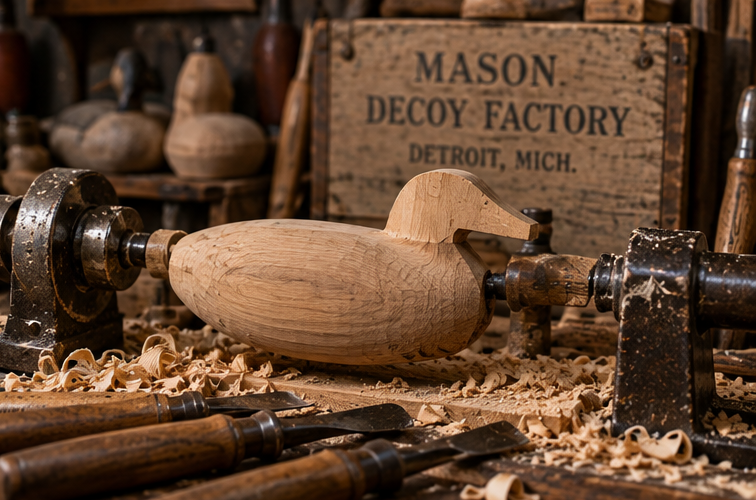
Smithsonian research notes that machine-produced wooden decoys appeared after the Civil War. Early manufacturers included the Petersen Decoy Company, Dodge Decoy Factory, and Mason Decoy Factory, all associated with Detroit. Some began with hand-carved birds and later adopted machinery, including duplicating lathes, to produce standardized forms in greater numbers.
Factories solved a practical problem.
A hunter who needed a large rig no longer had to spend winter evenings carving every bird himself. He could purchase a group of matching decoys that were ready to rig and hunt.
This was especially useful for species commonly hunted over large spreads. Dozens of birds might be needed to create a convincing concentration on open water.
Factory production turned the decoy from a primarily local craft object into a commercial sporting good.
What “Factory-Made” Actually Meant
The word factory can create a misleading image of completely automated production.
Early decoy factories were not modern plastic molding plants. Machinery helped standardize and speed the work, but people were still deeply involved.
Bodies could be shaped on duplicating lathes. Heads might be produced from patterns. Workers assembled components, sanded surfaces, attached hardware, and applied paint. Some factories employed only a handful of people, while others developed more systematic production methods. The Mariners’ Museum notes that decoy operations ranged from small shops using traditional techniques and power tools to larger businesses employing assembly-line production.
So a factory decoy was still a made object.
The difference was repeatability.
A hand carver could allow every bird to develop slightly differently beneath the knife. A factory wanted one canvasback body to resemble the next canvasback body closely enough that the product could be advertised, ordered, shipped, and replaced consistently.
That standardization is one of the first clues collectors look for today.
Mason and the Rise of the Factory Decoy
Few names are more closely associated with early American factory decoys than Mason.
The Mason Decoy Factory operated in Detroit from 1896 to 1924. Its workshops used duplicating equipment to produce turned wooden bodies at a scale that answered the needs of hunters purchasing full rigs rather than individual carvings.
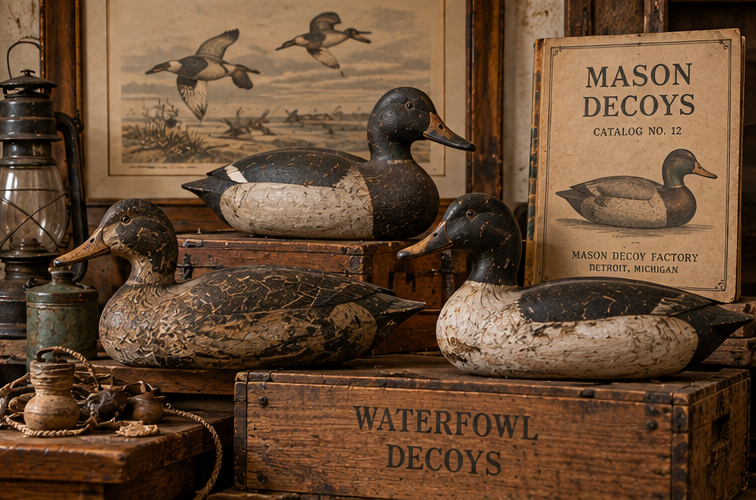
Mason produced decoys in different models and levels of finish, demonstrating that factory production did not necessarily mean a single inexpensive product.
A hunter could choose according to budget and expectations.
This is an important point for modern collectors because two factory birds from the same manufacturer may differ considerably in quality, paint, construction, and desirability.
The factory model also made decoys more widely available. A local hand carver might supply hunters within a relatively limited area. A manufacturer could advertise to customers farther away and ship birds to hunters who had never met anyone involved in making them.
Decoy style was beginning to travel.
The Hand-Carved Alternative
Hand-carved working decoys continued alongside factory production.
For hunters with the necessary skill, carving remained economical and practical. Other makers developed enough of a reputation that hunters specifically sought their work.
These individually made birds could vary even within a single rig.
Heads might turn slightly differently. Bills might be a little longer or shorter. Bodies could show differences in knife work. Paint patterns might shift from one bird to the next depending on the maker’s hand, available paint, or repairs made during use.
Those variations are part of their appeal.
A hand-carved decoy can sometimes feel more directly connected to its maker because the marks of construction remain visible. Tool marks, asymmetry, individually shaped heads, and hand-painted details may reveal decisions made one bird at a time.
But individual craftsmanship does not automatically mean elaborate craftsmanship.
Many excellent working decoys are remarkably simple.
The goal was still to fool birds, not impress future collectors.
The Factory Bird Was Still a Working Bird
Factory-made decoys were not decorative imitations of “real” hand-carved decoys.
They went hunting.
They were weighted, rigged, thrown into boats, placed in marshes, repaired, repainted, and used under the same difficult conditions as individually carved birds.
That means a factory decoy can accumulate exactly the kind of wear collectors associate with old working equipment.
Paint may be worn through to bare wood. Anchor-line hardware can cut into the underside. Heads can loosen. Bills can break. Hunters may repaint an entire rig years after purchasing it.
A standardized factory body might therefore acquire a very individual history.
This is why identification should never rely only on paint.
Body shape, construction, hardware, bottom markings, head attachment, and known factory patterns can all matter.
Marks, Stamps, and Repeated Patterns
Factory decoys sometimes offer identification clues that anonymous hand-carved birds do not.
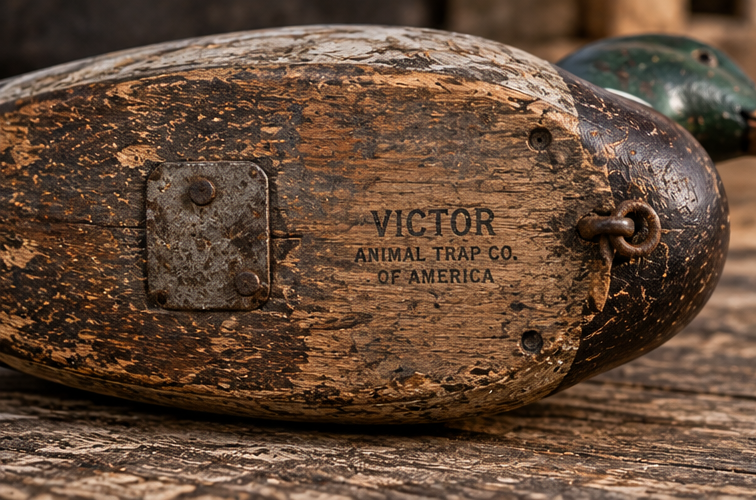
Manufacturer stamps, brands, model characteristics, consistent construction, and documented paint patterns can connect a bird with a known company.
The Animal Trap Company of North America, for example, began producing wooden decoys in 1918. Its wooden birds were made using duplicating lathes, and many were stamped on the bottom with the company’s Victor trade name. The company later acquired the assets of several other decoy businesses, including Mason, as the factory-decoy industry consolidated.
Collectors should still be careful.
A stamp does not guarantee that every other component is original. Heads could be replaced. Hunters repainted bodies. Hardware changed. Factories themselves modified products over time.
Conversely, the absence of a stamp does not automatically mean a bird was hand carved. Not every factory decoy was permanently marked in an obvious way.
Identification usually comes from several clues working together.
Individuality Versus Consistency
Put several hand-carved birds from the same maker beside several factory birds from the same model and an interesting difference often appears.
The hand-carved group may resemble a family.
The factory group may resemble copies.
Neither is necessarily better.
Consistency was useful to a manufacturer and reassuring to the customer. A hunter ordering another dozen birds knew approximately what would arrive.
Individual variation, meanwhile, can help collectors recognize a particular carver’s habits.
Some makers developed distinctive heads, bills, body contours, or paint patterns that became almost like signatures even when their work was never actually signed.
This is why studying many examples is so important.
One decoy may look generic. Twenty examples can reveal a pattern.
Factory Production Kept Evolving
The factory story continued well beyond Mason.
Manufacturers experimented with cork, papier-mâché, molded materials, and eventually plastic. The Animal Trap Company produced wooden, papier-mâché, and plastic decoys over its long history. After World War II, inexpensive mass-produced alternatives increasingly competed with traditional wooden birds.
The economic pressure was significant.
A person carving wooden working decoys individually could not always compete with factories turning out inexpensive hunting birds in large quantities.
That helped change the role of the traditional carver.
As manufactured decoys became ordinary hunting equipment, some woodcarvers moved increasingly toward more detailed work, decorative birds, competition carving, and pieces meant as much for appreciation as use.
The boundary between decoy and sculpture began shifting.
That later development will become particularly important as this series moves into decorative and modern decoys.
What Collectors Should Look For
The first question should not be, “Is it factory-made or hand-carved?”
It should be, “What exactly is it?”
A factory bird from a respected maker, in an unusual species or scarce model, with strong original paint and documented provenance can be far more interesting than an anonymous hand-carved bird with questionable age.
Likewise, an individually carved working decoy with a known maker, strong regional character, and an untouched surface can carry significance that no mass-produced bird can duplicate.
Look at the entire object.
Study the body construction. Examine how the head is attached. Look underneath for stamps, rigging hardware, weights, nails, screw holes, and wear. Consider whether the paint makes sense with the age of the wood and hardware.
Do not automatically remove old repaint.
Do not assume every irregular surface proves hand carving.
And be cautious when a common factory bird is represented as a rare handmade example simply because its surface is worn.
Reference examples matter enormously. Museum collections, established decoy literature, collector organizations, and documented auction archives can help establish what known factory patterns and individual makers actually look like.
Two Ways of Solving the Same Problem
Factory-made and hand-carved decoys represent different approaches to the same practical challenge.
One emphasized repeatability, availability, and production efficiency.
The other could preserve the habits and judgment of an individual maker.
Both had to work.
A duck flying overhead did not care whether a duplicating lathe or a carving knife shaped the body below. If the silhouette looked convincing and the rig suggested safety, the decoy had done its job.
Collectors have the luxury of seeing something more.
The hand-carved bird can preserve the touch of one maker.
The factory bird can preserve the rise of American sporting-goods manufacturing.
One speaks strongly to individual craftsmanship. The other reveals how an established hunting tradition became a commercial industry.
Neither story replaces the other.
Together, they show how the humble working decoy moved from marsh-side workshops into catalogs, factories, sporting-goods stores, and eventually collections.
Let’s Make History—one decoy at a time.