
For centuries, the waterfowl decoy existed because it had a job to do.
Whether woven from tule, carved individually by a hunter, or produced by a factory, the bird was ultimately judged by what happened when it was placed on the water. Did it float properly? Did its shape look convincing from above? Would real ducks or geese come closer?
During the twentieth century, that question began to change.
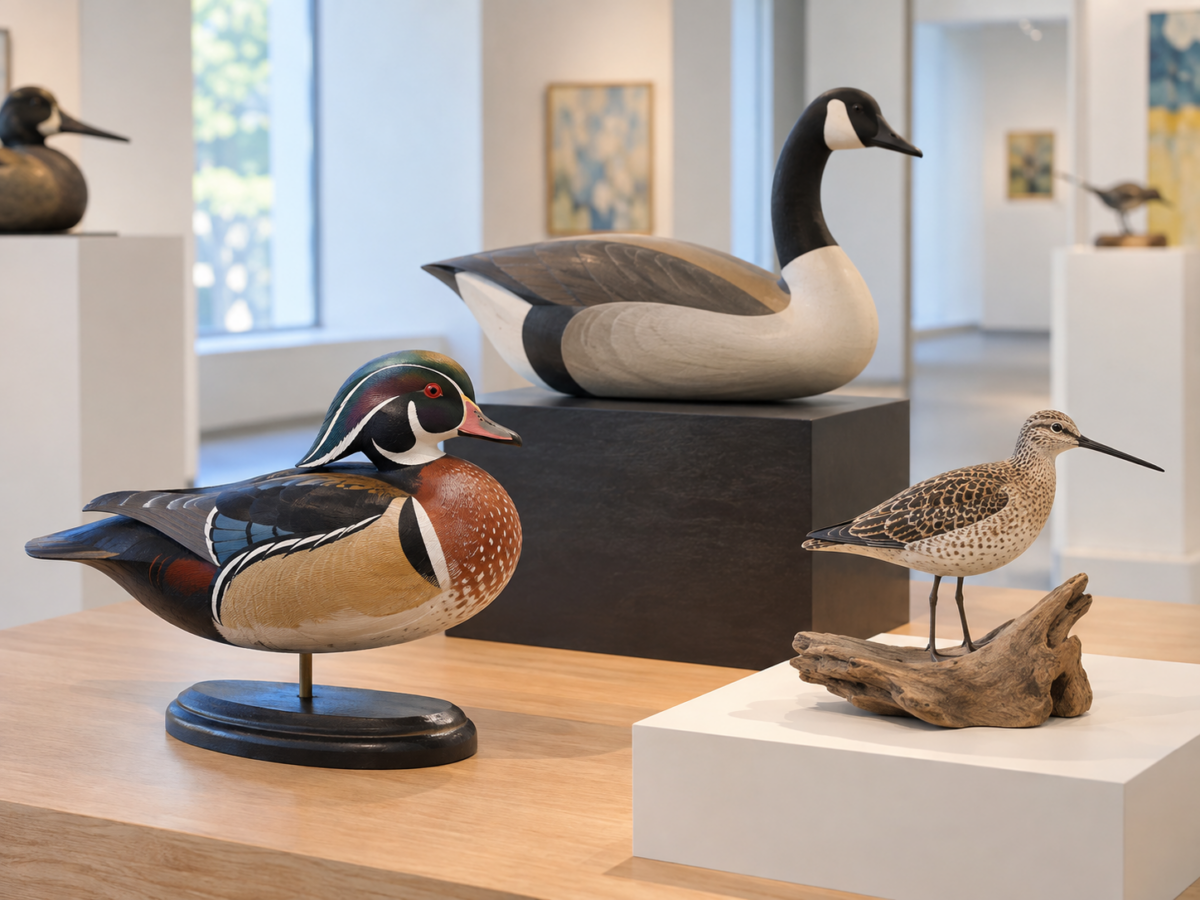
As hunting practices, conservation laws, manufacturing, and collecting evolved, decoy carving increasingly moved beyond the marsh. Some carvers continued making practical hunting rigs, but others pursued greater realism, elaborate feather detail, dramatic poses, and increasingly ambitious sculpture.
The working decoy had become the starting point for a new kind of American art.
From Market Hunting to Sporting Tradition
The transition did not happen overnight.
As discussed earlier in this series, nineteenth-century market hunters depended on rough, durable decoys as working equipment. By the early twentieth century, however, declining waterfowl populations and stronger conservation laws were changing American waterfowling.
The Migratory Bird Treaty Act of 1918 helped end the commercial market in migratory game birds. Former market hunters could continue hunting recreationally or work as guides, but the huge commercial harvests of the nineteenth century were disappearing.
That change affected decoys as well.
Smithsonian Folklife research notes that reduced bird populations and the shift away from purely utilitarian market hunting encouraged the use of more lifelike decoys. Carvers continued using regional materials such as cedar, but appearance could receive greater attention when the object was no longer simply one piece of equipment in a large commercial rig.
At the same time, factory-made decoys increasingly supplied hunters who simply needed dependable birds for the water.
The hand carver was no longer required to compete solely on practicality or price.
There was room for something else.
When the Decoy Became Sculpture
The distinction between a working decoy and a decorative carving is easiest to understand by considering purpose.
A working bird must function in the field. Its weight, balance, durability, and visibility matter. Extremely delicate feather carving may be wasted on a duck that will spend its life being tossed into a boat.
A decorative decoy does not face those same limitations.
Once the bird is intended primarily for display, the maker can exaggerate or refine nearly every aspect of the form. Feathers can be individually carved or burned into the surface. Wings may be raised away from the body. Feet and legs can become part of the composition. Paint can reproduce subtle variations of color that would have been unnecessary on a traditional hunting bird.
The decoy becomes less about creating an impression at a distance and more about rewarding close inspection.
This change did not erase the influence of working birds.
The best decorative carvings often retain the strong shapes and knowledge of anatomy developed through generations of practical decoy making. What changed was the amount of detail and the freedom available to the carver.
Lem and Steve Ward
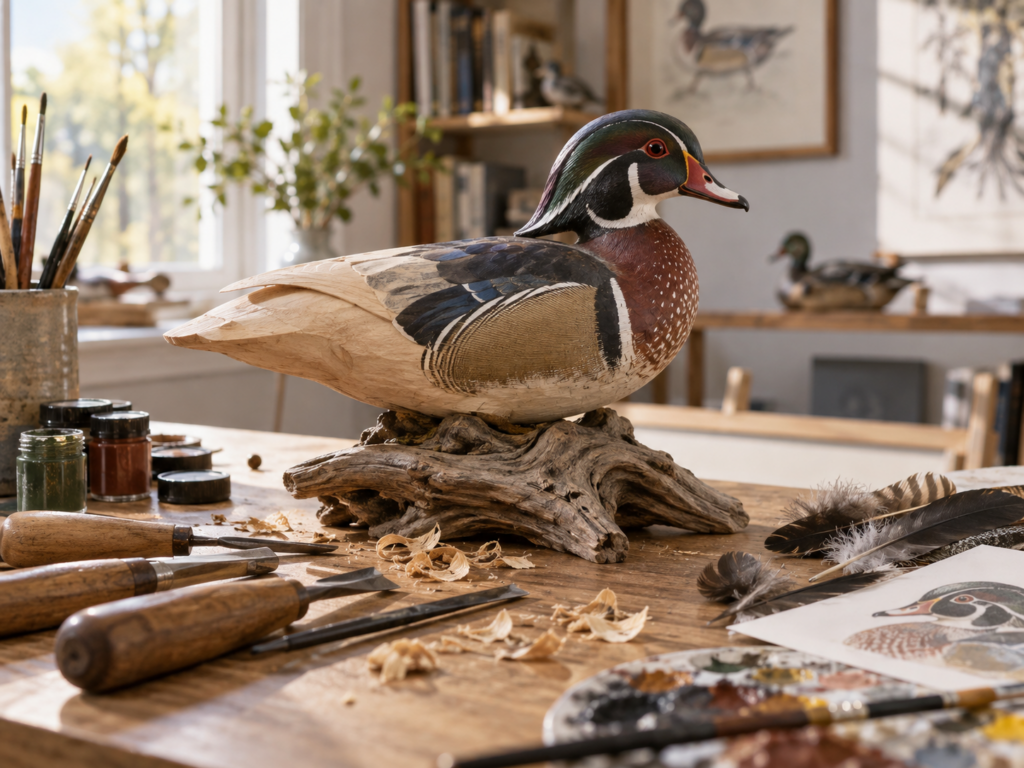
Few carvers illustrate this transition better than Lemuel and Stephen Ward of Crisfield, Maryland.
The Ward brothers grew from the Chesapeake Bay decoy tradition and became among the most celebrated names in American wildfowl carving. Salisbury University describes their work as helping pioneer the transition of the decoy from a working tool into expressive wildfowl sculpture. Their decorative carvings are credited with helping elevate decoy carving into an established art form.
That connection between function and art is important.
The Wards did not begin by ignoring the traditional decoy. Their decorative work developed from an intimate understanding of waterfowl, hunting, local carving traditions, and the appearance of working birds.
They simply pushed those forms farther.
Their influence helped demonstrate that the knowledge required to make a convincing hunting decoy could also produce sculpture worthy of serious artistic consideration.
Modern carvers continue to work within traditions associated with the Wards and other regional makers. Smithsonian documentation of Chesapeake carving, for example, notes contemporary craftsmen who continue carving in the distinctive Southern Chesapeake tradition associated with the brothers.
Competition Changed the Craft
As decorative carving grew, competitions became an important way for carvers to compare work, exchange techniques, and push the limits of realism.
One of the most influential events began in Salisbury, Maryland.
The competition that became the Ward World Championship traces its beginnings to 1971. Organizers interested in decoys and wildfowl carving created an event that expanded from traditional decoy competition into increasingly sophisticated decorative carving.
Competition gave carvers a different standard from the marsh.
A hunting bird needs to deceive a duck.
A championship decorative carving needs to withstand examination by judges standing only inches away.
That difference encouraged extraordinary attention to anatomy, feather structure, posture, surface texture, and paint.
Carvers began creating pieces that might require hundreds of hours rather than a few evenings in a workshop.
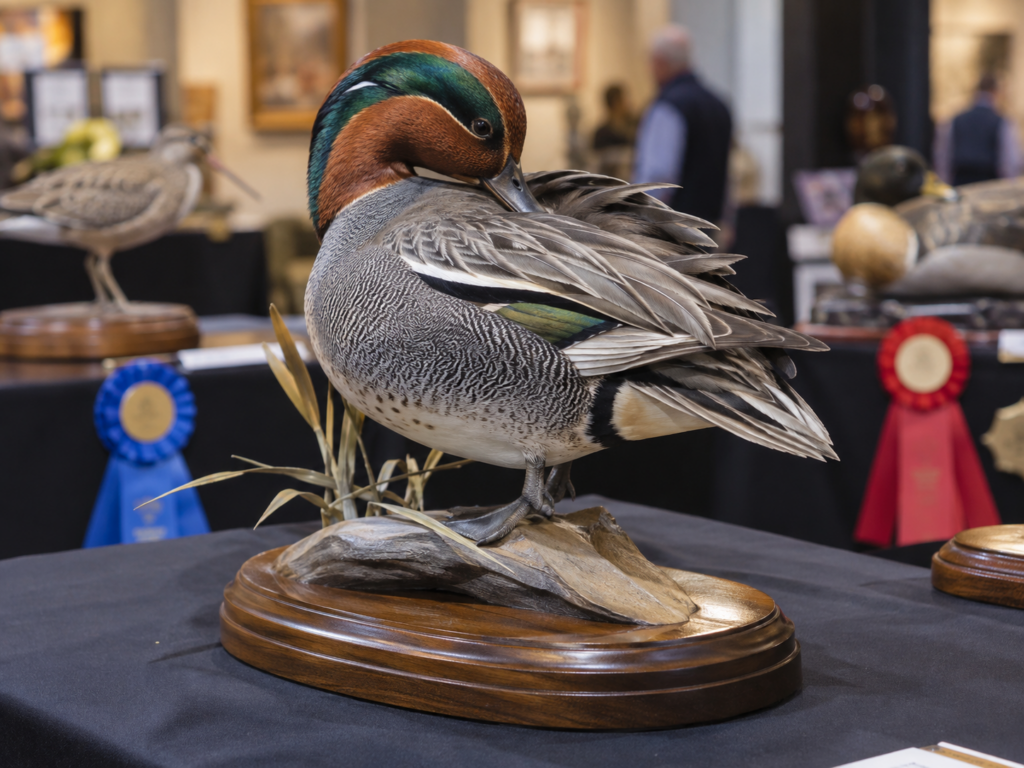
A bird could be shown preening, stretching, feeding, landing, or interacting with its environment. Bases might include carved reeds, branches, rocks, water, or other elements that transformed the bird into a complete scene.
The humble decoy had become the foundation of wildlife sculpture.
Traditional Forms Did Not Disappear
The rise of decorative carving did not mean the end of working decoys.
Traditional carving remains active.
Some contemporary makers deliberately work with hand tools and regional forms that closely resemble older hunting birds. Smithsonian programs have documented modern carvers continuing traditions associated with Core Sound, Chesapeake Bay, and other historic waterfowling areas. Competitions also continue to include working-decoy classes rather than limiting themselves to elaborate decorative pieces.
This means the word modern can describe several very different objects.
One modern decoy may be a practical hunting bird intended to go directly into the water.
Another may reproduce the simplified style of a nineteenth- or early twentieth-century regional decoy.
A third may be a highly realistic decorative sculpture that was never intended to float at all.
Collectors should understand which type they are looking at before comparing workmanship, price, or historical importance.
New Tools, Old Knowledge
Modern carvers have access to tools and materials earlier makers could scarcely have imagined.
Power carving tools can remove wood quickly. Fine rotary tools allow extremely precise feather work. Wood-burning tools can create texture. Commercially available glass eyes provide realism. Modern paints offer a broad range of stable colors.
Yet machinery does not eliminate the need for observation.
A technically elaborate bird can still look wrong if the carver does not understand anatomy.
The angle of a head, placement of an eye, length of a bill, curve of a breast, or position of a wing can determine whether the carving feels alive.
That is why modern decorative carving remains closely connected with the natural world. Skilled carvers study photographs, museum specimens, live birds, feathers, skeletal structure, and behavior.
The tools may be modern.
The fundamental requirement is the same one faced by the earliest decoy makers: understand the bird well enough to imitate it convincingly.
Decorative Does Not Mean Antique
The growth of decorative carving also creates an important issue for collectors.
A beautifully carved wooden bird is not necessarily old.
Contemporary carvers sometimes intentionally work in historic styles. Some reproduce regional patterns as a tribute to earlier craftsmen. Others create what are sometimes called contemporary antique-style decoys, using modern aging techniques to produce the appearance of an older bird.
There is nothing inherently wrong with this when the object is represented honestly.
Problems arise when artificial wear becomes mistaken for genuine age.
A modern carver can create chipped paint, worn edges, stained wood, darkened hardware, scratches, and other convincing signs of use. Those treatments may look surprisingly believable.
Collectors therefore should not rely on appearance alone.
Ask about provenance. Look for signatures, dates, brands, certificates, exhibition records, or documentation from the maker. Examine construction and materials. Compare the bird with verified examples rather than assuming that worn paint automatically means nineteenth-century use.
Modern craftsmanship should not need false age to justify its value.
Collecting Contemporary Carvers
Contemporary decoy collecting offers something antique collecting cannot: the opportunity to know who made the object.
A collector may meet the carver, attend a demonstration, purchase directly at a show, watch a bird develop through photographs, or obtain detailed documentation of when and why it was made.
That provenance should be preserved.
Keep receipts, exhibition ribbons, competition records, photographs, correspondence, business cards, and any written information supplied by the maker.
A contemporary carving may someday become an important historical object.
Smithsonian collections already include work by modern carvers such as Del Herbert, whose interest began after his wife saw a wooden decoy at a craft show. Herbert soon entered competitions and developed a career producing detailed bird carvings.
Every antique was once contemporary.
Documentation created today can prevent uncertainty tomorrow.

Display and Preservation
Decorative carvings require somewhat different care from traditional working decoys.
A battered hunting bird may tolerate handling remarkably well because it was built for field use. A decorative carving with individually shaped feathers, thin wings, delicate feet, or detailed habitat elements can be much more fragile.
Avoid lifting a carving by the head, bill, wings, or projecting details. Support it from the base or body whenever possible.
Direct sunlight can fade paint and damage finishes over time. Excessive humidity changes can affect wood. Dust should be removed carefully rather than scrubbed from textured feathers.
Original surfaces remain important even on relatively recent pieces.
A decorative carving should not automatically be refinished because its paint has begun aging. Surface changes may eventually become part of the object’s history just as wear became part of older working decoys.
From Marsh Tool to Modern Art
Waterfowl decoys have followed an extraordinary path.
The earliest examples were made because hunters needed practical tools.
Nineteenth-century carvers refined regional working traditions.
Factories transformed decoys into mass-produced sporting goods.
Then individual makers pushed the form in another direction entirely.
By the late twentieth century, wildfowl carving could range from simple working birds intended to bob among reeds to astonishingly detailed sculptures created for competitions, museums, and collectors.
Yet all of them remain connected.
The decorative bird still carries the silhouette of the working decoy.
The modern championship carving still depends on the same careful observation of living waterfowl that guided hunters generations ago.
That continuity may be the most interesting part of the story.
A form invented to fool a bird eventually became one through which artists could celebrate it.
Let’s Make History—one decoy at a time.