There’s a certain thrill to finding an early bottle in the wild—maybe a hand-finished medicine bottle with a soft, uneven lip, or a chunky old soda bottle built to survive pressure and rough handling. Even before you know exactly what it held, you can usually feel the era in the glass: the weight, the color, the seams (or lack of them), and the little manufacturing quirks that modern packaging has polished away.
Early bottles are where bottle collecting really becomes a detective hobby. They sit at the crossroads of everyday life and big change: the rise of neighborhood apothecaries, the boom of patent medicines, the growth of carbonated drinks, and the shift from handmade glass to industrial production. This post is your foundation for the early end of the hobby—what apothecary and early soda bottles are, why they look the way they do, and how to read the clues that help you date and describe them accurately.
What “Early Bottles” Means in Collector Terms
Collectors use “early” in a few different ways, but in the context of apothecaries and soda fountains it usually points to bottles made before modern mass production fully standardized shapes and closures. You’ll see early examples that are:
- Mouth-blown (handmade): formed by a glassworker using a blowpipe and finished by hand
- Mold-blown but hand-finished: shaped in a mold, then given a hand-tooled lip/finish
- Early machine-made: more standardized, often with seams that run high and consistent finishes
The goal isn’t to memorize a single cutoff year. The goal is to spot features that tell you whether you’re holding a hand-finished bottle from the age of local pharmacies—or a later bottle from the era when bottling became fully industrial.
Apothecary Bottles: The Pharmacy Shelf in Glass
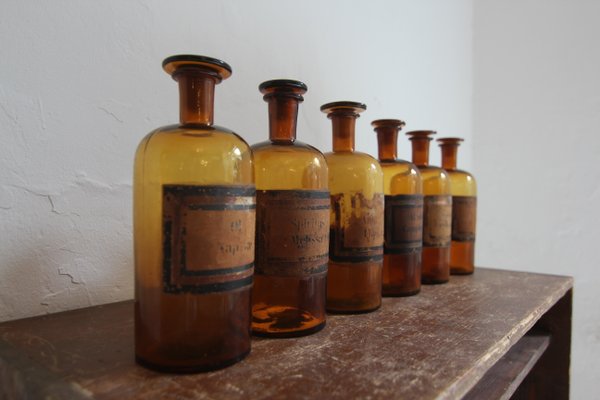
Before soda fountains became social hubs and before modern packaging took over, the local apothecary (or druggist) was where many people interacted with “medicine” as part of daily life. Bottles from this world tend to fall into two broad categories: dispensing bottles (used in the shop) and product bottles (meant to be sold or sent home).
Dispensing bottles: built for the shop, not the street
Dispensing bottles were often made to be stored upright, labeled, and reused. Common traits include:
- Stoppered tops (for corks or glass stoppers)
- Stable bases for shelf storage
- Clear, aqua, amber, or cobalt glass depending on use and tradition
- Shapes designed for quick identification and easy handling
You’ll see a lot of practical logic here. Amber glass, for example, can help protect light-sensitive contents, which is one reason it became common for certain pharmacy and chemical uses.
Product bottles: made to travel (and to sell)
As the 1800s progressed, more medicines were sold in branded bottles. These are the pieces collectors often encounter because they were produced in large numbers and discarded when empty.
Typical features include:
- Embossed names (company, product, city)
- Label panels or flat areas where paper labels once sat
- More standardized shapes as production methods improved
Collector tip: embossed glass can be a big clue, but don’t rely on embossing alone for age. Focus on how the bottle was made—lip, seams, base, and overall “handmade” character.
Early Bottle-Making Clues You Can Learn to Spot Fast
If you want to get confident quickly with early bottles, train your eye on three areas: the lip/finish, the seams, and the base.
The lip/finish: where handwork often shows
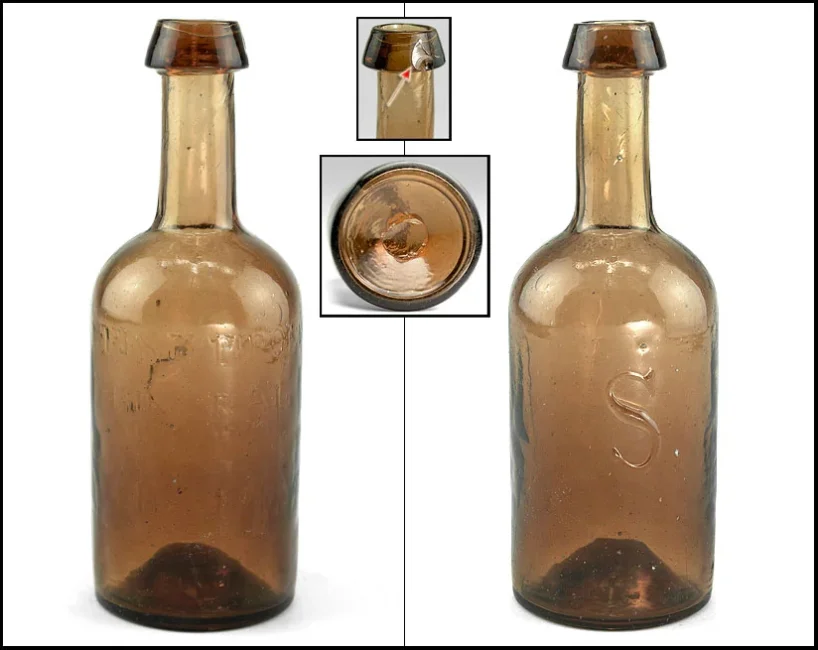
On many older bottles, the lip is a story in itself. Hand finishing can leave subtle asymmetry—slight waviness, tool marks, or a finish that looks “worked” rather than perfectly uniform.
What to look for:
- unevenness that feels natural rather than damaged
- a finish that looks applied or shaped by hand
- differences in thickness around the rim
Seams: the bottle’s “production fingerprint”
Seams are one of the most useful dating tools for bottle collectors.
General guidelines:
- No mold seams often suggests free-blown work (though there are exceptions).
- Mold seams that stop below the top can indicate a hand-finished lip.
- Seams that run cleanly up through the finish are more typical of later, more automated production.
You don’t need to claim an exact year when you see a seam type—just describe what you see. That alone is valuable for identification.
The base: pontil scars, push-ups, and wear
Bottle bases can show how a bottle was held during finishing, how it was meant to stand, and how it lived its life.
Things collectors watch for:
- Pontil scars (a rough spot or ring where the bottle was attached to a pontil rod during finishing)
- Push-ups/kick-ups (indentations that can strengthen the base and improve stability)
- Wear patterns that suggest heavy use or long storage
Collector tip: base wear can help confirm authenticity. Natural shelf wear and tiny scuffs often look different than artificially “aged” surfaces.
From “Cures” to Carbonation: Why Soda Bottles Became Their Own World
Carbonated drinks created a bottle problem: pressure. Early soda water and mineral water needed containers that could survive internal gas pressure, rough transport, and repeated opening/closing without losing fizz.
That’s why early soda bottles often look so sturdy:
- thick glass
- squat, stable profiles
- strong finishes designed for tight seals
And it’s why soda bottle closures are a whole sub-hobby. Each closure style is essentially a chapter in the story of keeping carbonation inside the bottle.
Soda Fountains and Drugstores: When Refreshment Looked Medicinal
In the 1800s, soda water wasn’t only treated as a treat—it was often promoted for its “healthful” qualities, and pharmacies were natural places to serve it. Over time, soda fountains became social fixtures in many communities, especially as flavored syrups, ice cream drinks, and fountain culture grew.
For bottle collectors, this matters because the soda fountain era overlaps with rapid changes in:
- bottling technology
- closures
- branding and embossing
- local vs national distribution
You’ll see bottles tied to small local bottlers as well as larger systems that standardized production.
Early Soda Bottle Finishes and Closures You’ll See Often
This is not an exhaustive list, but it covers several of the most common “early soda” closure families that show up in collections.
Cork-and-wire closures (including “blob-top” styles)
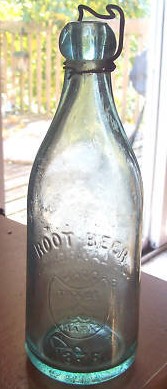
Many early carbonated beverages relied on corks secured with wire. Bottles made for corking often have robust finishes designed to hold a cork firmly under pressure.
Collector note: these bottles can show strong lip wear and tool marks from repeated opening. That wear can be a feature, not a flaw, if the bottle is otherwise sound.
Hutchinson-style internal stoppers (late 1800s into early 1900s)
One of the most recognizable soda bottle closure types uses an internal spring-and-rubber mechanism. You’ll often see these bottles associated with the late 19th-century soda boom. They’re collectible because they’re mechanically interesting and often locally embossed.
Collector note: many examples have heavy embossing and thick glass. Condition matters most around the lip and the interior stopper seat.
Marble-stopper bottles (Codd-style, especially in Britain and beyond)
Another clever solution used internal pressure to hold a marble against a gasket. These are especially associated with 19th-century carbonated drink bottling outside the U.S. and can be a fun crossover collectible if your bottle hunting turns up imported examples.
Collector note: these bottles are distinctive because of the neck chamber designed to trap the marble.
Crown caps and standardized finishes (from the 1890s forward)
Once crown caps entered the bottling world, they helped standardize bottle finishes and made sealing carbonated beverages far more consistent. This is a major transition point because it pushed bottling toward more uniform neck designs and large-scale distribution.
Collector note: crown-finish bottles are still collectible—especially early local examples—but in general they signal a move toward “modern” bottling norms.
The Big Turning Point: Mechanization and the Rise of the Machine-Made Bottle
Early bottles often carry the fingerprints of individual craftsmanship. As bottle-making mechanized in the early 1900s, bottles became more consistent in shape, finish, and seam patterns. For collectors, that shift is helpful because it creates a rough “before and after” feel:
- earlier bottles often show more variation, hand finishing, and irregularities
- later bottles tend toward standardized finishes and consistent mold seams
This isn’t about value judgment—machine-made bottles can be wonderfully collectible. But it does help you sort “apothecary-era feel” from “industrial bottling era feel” when you’re making quick decisions in the field.
Collecting Early Bottles: What to Look For (and What to Avoid)
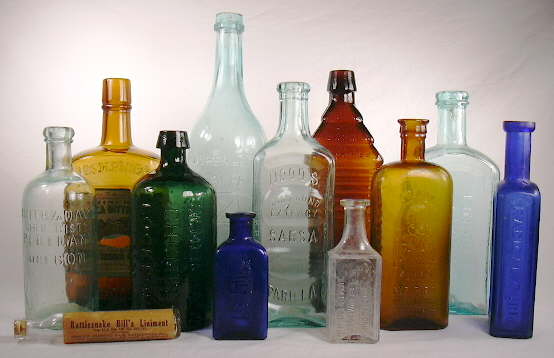
Early bottle collecting is rewarding, but it’s also a category where a little caution goes a long way.
Condition priorities
- Cracks matter more than most other flaws (especially stress cracks near the lip).
- Chips on the finish can affect display and value, but minor rim wear may be acceptable depending on age and rarity.
- Staining can be normal—many old bottles show internal haze or residue.
Safety basics
- Never taste residues.
- Handle unknown contents cautiously (especially if a bottle still contains material).
- If you dig bottles, treat that as a separate safety skill set: gloves, proper handling, and common-sense precautions.
Buy the story the bottle can prove
The best bottle purchases are the ones you can describe honestly and confidently:
- how it was made (seams, finish, base)
- what it likely held (based on form/embossing, without overclaiming)
- what condition it’s in, clearly stated
If you collect that way, your collection becomes more than a shelf of glass—it becomes a readable timeline of everyday life.
Why Early Bottles Are So Addictive
Early bottles sit at a perfect intersection: history you can hold, craftsmanship you can see, and a cultural shift you can trace—apothecaries to soda fountains, handmade to machine-made, local cures to mass-market refreshment.
Once you start noticing the clues—the hand-tooled lip, the stout soda glass, the old stopper systems—you’ll find yourself looking at every bottle differently. And that’s the moment the hobby really begins.
Let’s Make History—one bottle at a time.