Over the last few posts we’ve traced beads from cave mouths to kings’ courts—from prehistoric shell beads to powerful trade tokens, from diplomatic wampum belts to Venetian glass artistry and the personal strands people still wear today. If there’s one thing this series has shown us, it’s that beads are far more than decoration: they are portable archives of human meaning.
The Oldest Human Art Form
Archaeologists now consider beads among the earliest forms of personal adornment and symbolic expression. Long before alphabets or coinage, people drilled shells, teeth, and bone and strung them as visible signs of identity, status, and membership. The most famous early example comes from Blombos Cave in South Africa: perforated Nassarius shell beads recovered there are dated to roughly 75,000 years ago and are widely interpreted as evidence of symbolic behavior in the Middle Stone Age. These beads are not merely pretty; they are among our earliest “wearable stories.”
Beads as Global Connectors
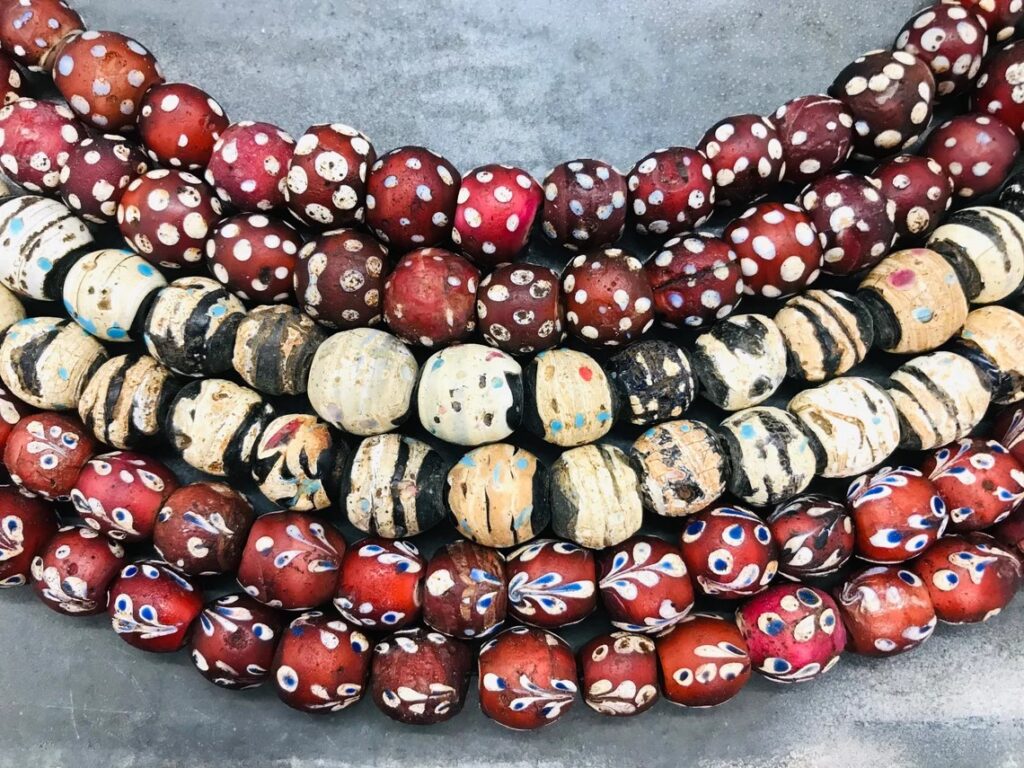
Fast forward to the early modern era and beads emerge as practical tools of global exchange. Glassmaking centers in Venice, later Amsterdam, and then Bohemia produced vast quantities of beads that traveled the world. Venetian millefiori and chevron beads carried Venetian artistry into African, American, and Asian markets; by the 17th–19th centuries, Bohemian (Czech) producers had developed methods for inexpensive, uniform seed beads that made elaborate beadwork widely accessible. These beads were small, easy to transport, and could represent enormous value in societies that lacked glassmaking traditions.
European beads entered complex local economies and social systems. In parts of West and Central Africa they became prestige objects—sometimes used in ritual or reserved for chiefs; in North America they appeared in trade networks and were integrated into Indigenous beadwork traditions. But beads also played a role in darker histories: they were exchanged during unequal trade relationships that included the transatlantic slave trade. The material fact of a bead can therefore carry both cultural beauty and a painful provenance.
Wampum, Memory, and Diplomacy
Not all beads traveled as mere commerce. In the Eastern Woodlands of North America, Indigenous peoples developed their own bead traditions with distinct social roles. Wampum — cylindrical beads made from quahog and whelk shells — were strung into belts and panels that encoded law, ceremony, and collective memory. The belts functioned as mnemonic devices: designs and sequences of beads recalled treaties, genealogies, and obligations.
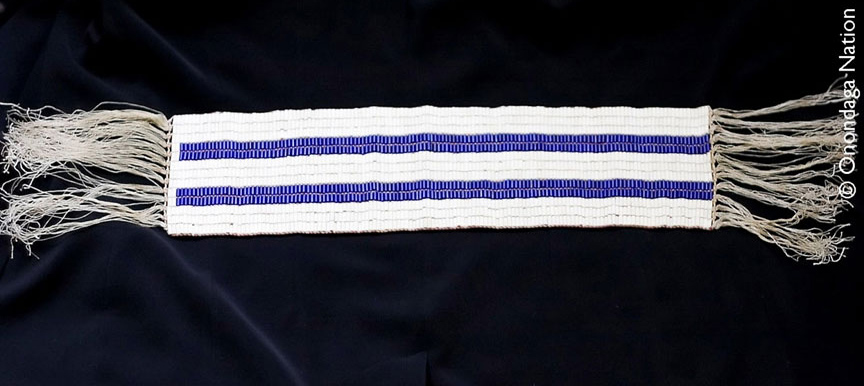
A foundational example is the Two Row Wampum (Guswenta or Kaswentha), a belt that visually represents two parallel vessels traveling the same river—one a Haudenosaunee canoe, the other a Dutch ship—signifying mutual noninterference and a relationship of peace and respect. The Two Row is central in Haudenosaunee oral history and is still invoked today in political and diplomatic contexts. It also illustrates how Europeans often misunderstood wampum’s meaning, treating shell beads as fungible currency when for Indigenous nations the belts carried sacred and legal weight.
Artistic Achievements: Murano and Bohemia
On the European side of the story, Murano glassmakers perfected techniques that made beads both artistic and highly tradeable. Millefiori (“a thousand flowers”) canes—fused bundles of colored glass sliced to reveal floral or geometric cross-sections—are one of Murano’s signature inventions. The chevron (or rosetta) bead, developed in the late 15th century, is another Murano innovation: layered canes cut and ground to display starburst patterns that became instantly recognizable across trading networks. These Venetian innovations combined technical sophistication with visual impact, which helped glass beads travel as both luxury goods and currency of exchange.
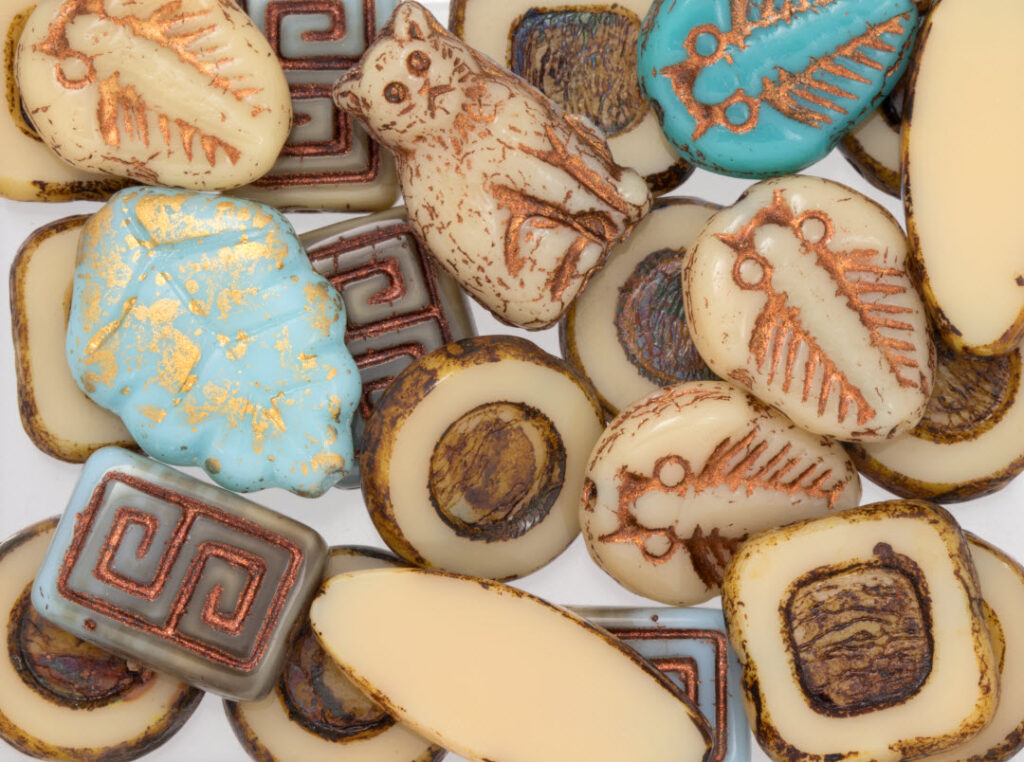
Meanwhile, Bohemian centers in what is now the Czech Republic scaled up production of small, uniform seed beads from the 18th century onward. Their affordability and consistent form made them ideal for the large-scale embroidery and geometric designs that would flourish in Africa, the Americas, and Asia. In short: Murano created dazzling artistic possibilities; Bohemia supplied the volume and uniformity that let global beadwork bloom.
Beads as Personal and Spiritual Things
Beads also function in the private sphere—as mementos, devotional tools, and personal markers. In Victorian Britain, mourning jewelry made of jet, black glass, or hair-work allowed people to carry intimate tokens of grief; some pieces included woven hair framed alongside beads or pearls. By the 1920s, beads had swung toward glamour: flapper dresses dripping in seed beads and sequins turned motion into spectacle under incandescent lights, a visual shorthand for modernity and new social freedoms. Conservators today note that heavily beaded garments can be astonishingly weighty, a reminder that ornament has material consequences.
Prayer beads—rosaries, malas, tasbihs—turn tactile repetition into spiritual practice. Tiny carved boxwood and ivory prayer beads from 16th-century Europe (and related “prayer nuts”) show the artistic heights devotional beads could reach; they functioned as both aids to meditation and miniature works of extraordinary craftsmanship.
The Common Thread
Across time and place, beads perform the same basic cultural work: they mark who we are, tell stories, and bind people together. They can be solemn or celebratory, material or mnemonic, commodity or covenant. Whether strung into a wampum belt that asserts a nation’s rights, stitched into a Yoruba ritual collar, sewn onto a flapper dress, or tucked into a family jewelry box, beads translate human relationships into objects that survive.
If you own a strand of beads—ancient, antique, homemade, or thrifted—you are holding a tiny portal into a larger story. The bead’s smallness is its power: it is portable, personal, and potent.
What’s Next?
Our journey with beads shows how even the smallest objects can hold entire histories. For the next series, we’re moving from the delicate world of beads to the dazzling world of the stage. We’ll be exploring Theatrical Memorabilia—the costumes, playbills, props, posters, and souvenirs that keep the magic of live performance alive long after the curtain falls.
From Victorian playhouses to Broadway premieres, these artifacts tell stories of performers and audiences, triumphs and scandals, and the cultural movements that shaped the theater. Just like beads, they’re small, often fragile items—but they carry the weight of big history.
So join me as we step into the wings, uncover the treasures of theatrical pasts, and—together—Let’s Make History.