When people think of campaign souvenirs, pinback buttons are usually the first to come to mind. These small, wearable circles of tin, celluloid, or plastic have been the backbone of campaign marketing for over a century. They are personal, portable, and instantly recognizable—perfect for turning everyday supporters into walking billboards.
The story of the pinback button begins in the 1896 presidential election. The innovative celluloid-covered button, patented by the Whitehead & Hoag Company, debuted in support of candidates William McKinley and William Jennings Bryan. Unlike earlier campaign ribbons or badges, pinbacks were inexpensive to produce in mass quantities, sturdy enough to last through a campaign season, and eye-catching with printed portraits or slogans. Their affordability and popularity meant they quickly became the dominant campaign item and remain so today.
Collectors prize buttons for their sheer variety. Some are simple, showing only a candidate’s name or phrase, while others display elaborate portraits, patriotic motifs, or clever slogans. Over the decades, buttons reflected changing design trends—from bold Art Deco typography in the 1920s and 1930s, to sleek modernism in the 1960s, to the flashy graphics of the 1980s.
The Jugate Phenomenon
Among button collectors, few items inspire as much enthusiasm as the jugate—pinbacks that display portraits of two candidates side by side, usually the presidential and vice-presidential nominees. The term “jugate” comes from the Latin word for “yoked together,” a fitting metaphor for a political ticket bound in partnership.
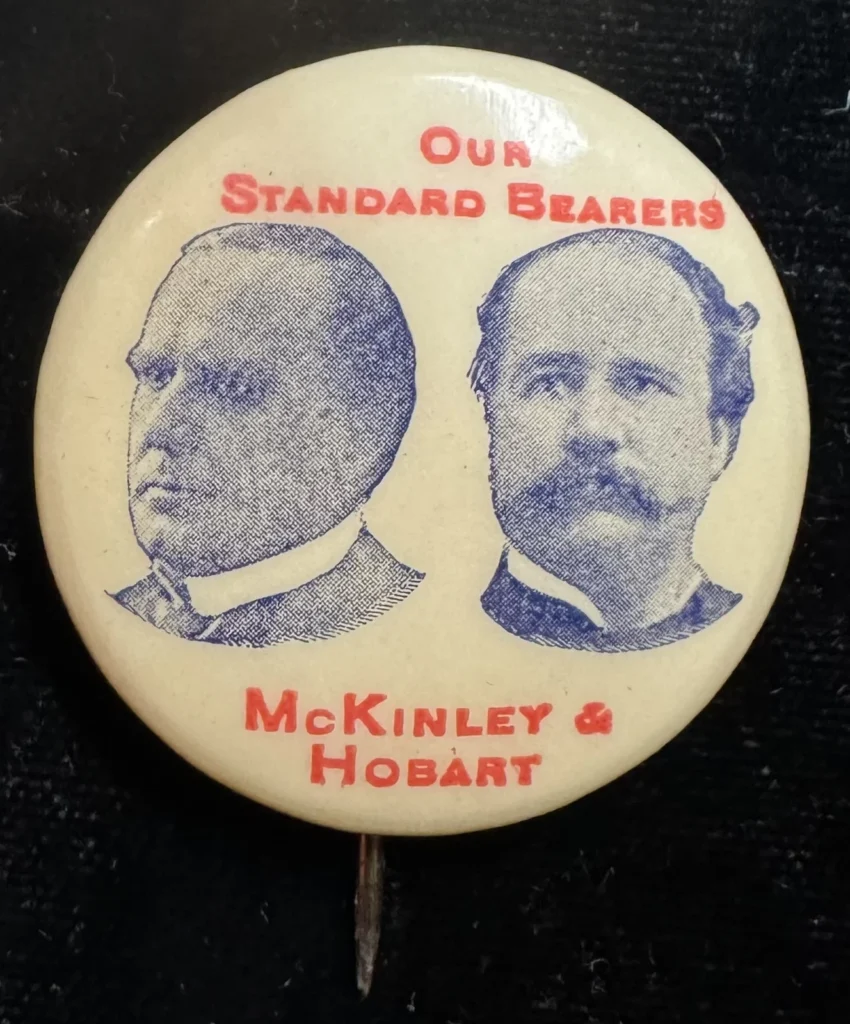
Jugates first appeared around the turn of the 20th century and remain a favorite among enthusiasts. A McKinley–Hobart jugate from 1896 is one of the earliest examples, while later campaigns produced memorable designs pairing Franklin D. Roosevelt with his running mates or John F. Kennedy with Lyndon B. Johnson.
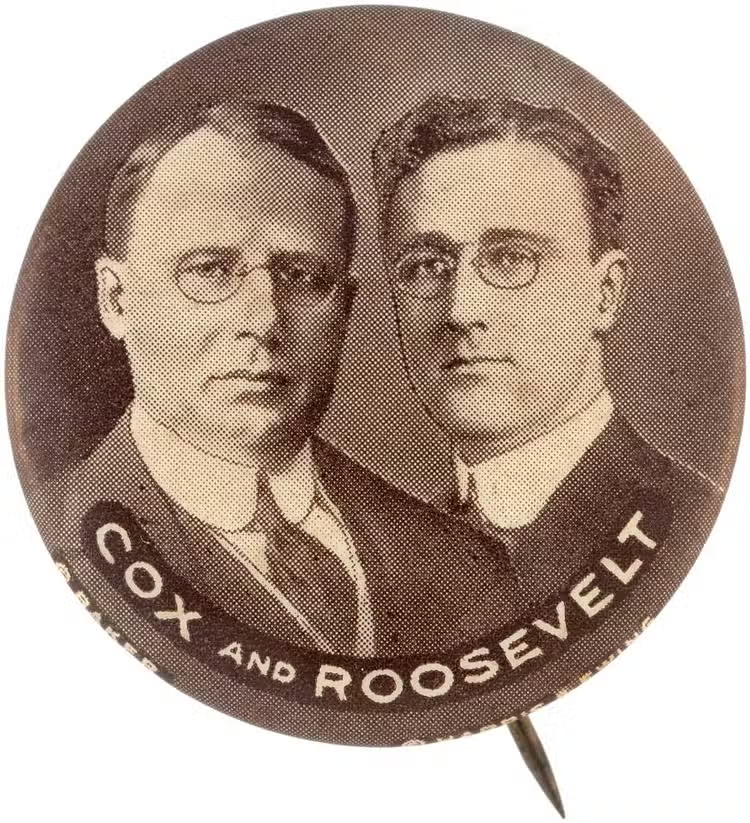
What makes jugates especially collectible is their relative scarcity. Single-candidate buttons were produced in huge numbers for mass distribution, but jugates—often considered a novelty—were printed in smaller quantities. As a result, rare jugates can command impressive prices at auction. For example, a 1920 Cox–Roosevelt jugate (featuring James Cox and his then–vice presidential candidate, a young Franklin D. Roosevelt) is considered one of the “holy grails” of political button collecting, sometimes selling for thousands of dollars.
Buttons as Cultural Snapshots
Beyond politics, pinbacks also serve as miniature cultural time capsules. They’ve carried playful slogans like “I Like Ike,” experimented with new materials such as lithographed tin in the 1940s, and even reflected broader social movements, from women’s suffrage to civil rights. A single button can reveal not only who was running for office, but also what design trends, social currents, and marketing strategies defined that moment in history.
Even in today’s age of hashtags and digital ads, the campaign button remains a symbol of personal connection to politics. There’s something enduring about pinning a candidate’s name to your lapel—an act at once public, personal, and proudly democratic.
Whether it’s a humble slogan pin from the 1960s or a rare early jugate, campaign buttons represent more than collectibles. They are wearable snapshots of democracy, preserving the voices and choices of generations past — and a reminder that together, we can always make history