While campaign buttons are subtle and personal, there’s nothing subtle about a towering banner or a flag waving above a parade route. These were political statement pieces in the truest sense—bold, visible, and impossible to ignore. Long before social media or TV ads, candidates and supporters literally took to the streets to display their allegiance.
Today, banners, flags, and ribbons from past campaigns are highly prized by collectors—both for their visual impact and their historical significance. Let’s unpack why these artifacts matter.
Campaign Flags: Patriotism—and Politics—Intertwined
Some of the oldest and rarest political souvenirs aren’t small—they’re the banners carried into rallies, emblazoned with slogans or portraits. One of the earliest examples dates back to the 1840 presidential campaign of William Henry Harrison, which featured log-cabin iconography. However, it’s during the 1860 Abraham Lincoln campaign that such flags became truly noteworthy.
These campaign flags often mimicked U.S. flags, sometimes replacing stars or stripes with the candidate’s name or image. Materials ranged from cotton to silk, and a few have survived remarkably well.
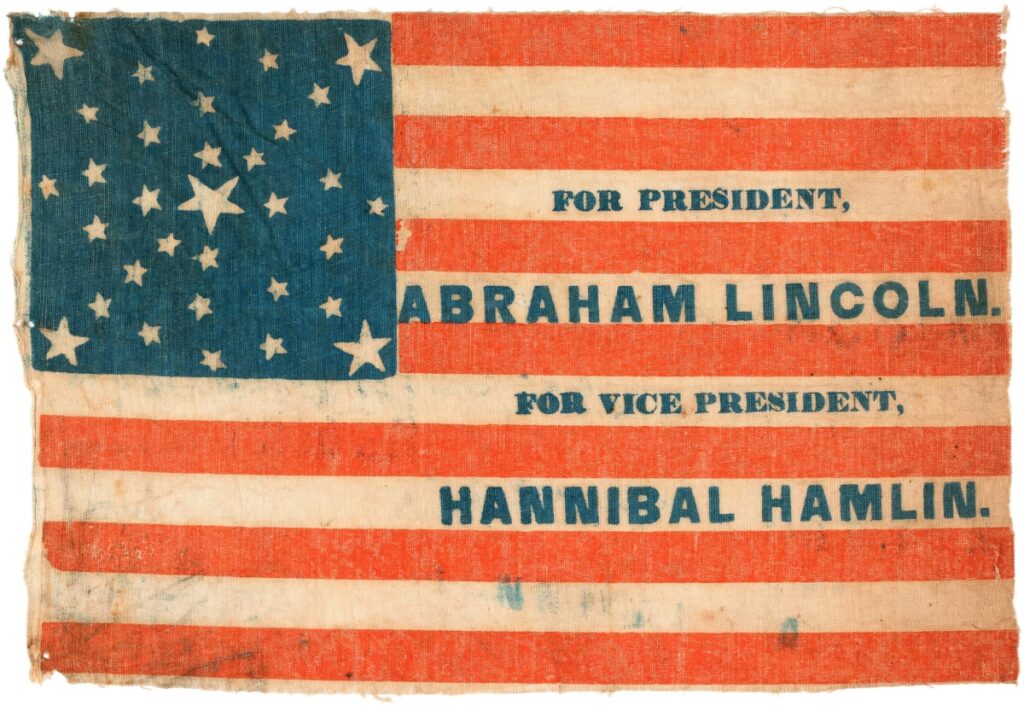
A standout example is the rare 1860 Lincoln-Hamlin glazed-cotton parade flag, inscribed “For President, Abraham Lincoln” and “For Vice President, Hannibal Hamlin.” Discovered decades after it was used—tucked away by a collector—it fetched over $40,000 at auction in 2017, a record at the time for a “name flag.”
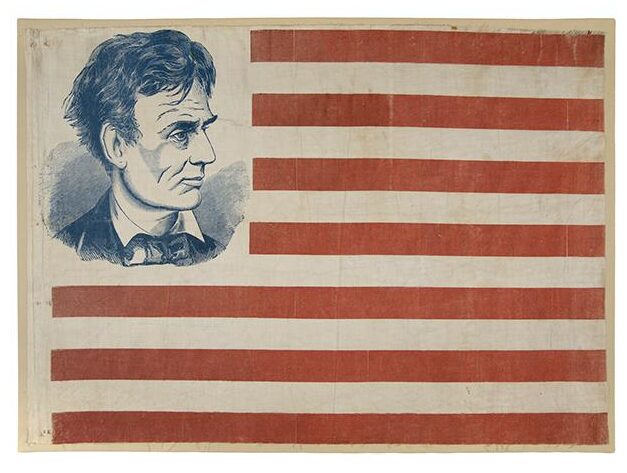
Another extraordinary piece—a beardless Lincoln portrait campaign flag—now resides in the Lincoln Financial Foundation Collection. It features a simplified portrait within the stripes and offers a visually rare glimpse into early political branding.
Ribbons: Wearable Pride and Political Flair
Before pinbacks ruled campaign wearability, there were ribbons. Silk and paper strips, often pinned to sashes or hats, served as visible signs of support.
One preserved example is a silk ribbon from Lincoln’s 1860 campaign bearing the slogan “Free Speech, Free Homes, Free Men, Lincoln & Liberty.” These were worn by supporters and passed down through families—one a few years ago was valued for over $3,000, a testament to both its fragile survival and enduring significance. While appraisals vary, this underscores how wear and provenance deeply affect value.
Banners and Parade Gear: Turning Campaigns into Spectacles
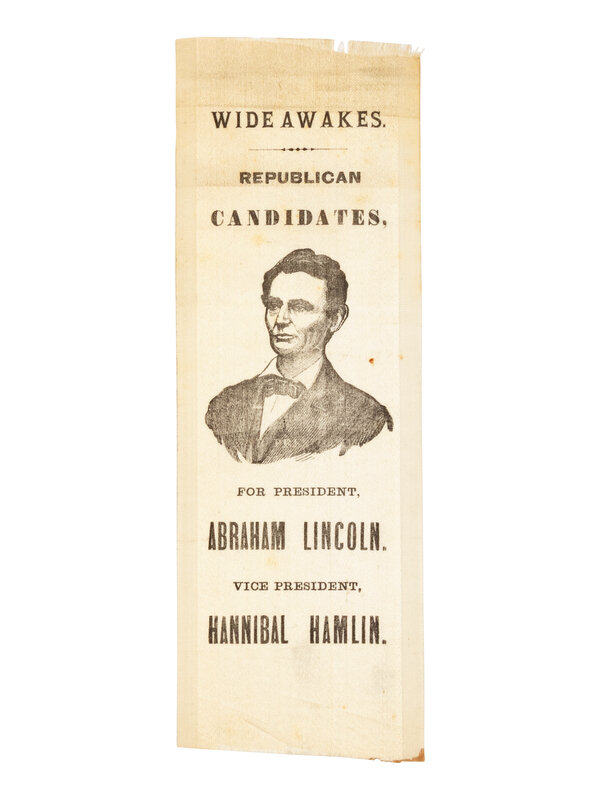
Campaigns in the late 19th and early 20th centuries weren’t just political—they were theatrical. Marching clubs, like Lincoln’s youth-oriented Wide Awakes, carried banners, flags, and blazing torches in nighttime parades—turning politics into dramatic public performances.
Souvenirs from these events—delegate badges, paper banners, and parade floats—remain rare and valuable. That said, banners themselves were working objects, often discarded or left outside after events. Most that survive today show damage—fading, tears, or stains—but that wear only adds to their historical charm.
Design, Symbolism & Era
Political textiles offer a lens into the design language of their time:
- Mid-19th Century: Flags and ribbons leaned heavily on patriotic imagery—stripes, stars, eagles—to convey unity and loyalty.
- Gilded Age: Silk ribbons often featured fine engraving and decorative details, reflecting the era’s ornate tastes.
- Early 20th Century: As print techniques advanced, simpler, mass-produced paper banners became popular—and more affordable.
Moreover, items often repeated campaign icons: Harrison’s log cabin, Lincoln’s strong leadership visuals, or visual themes aligned with reform movements around the Progressive era.
Collector Tips for Flags, Banners & Ribbons
| Tip | Description |
|---|---|
| Condition vs. Provenance | A tattered banner may still fetch thousands if it’s from a landmark campaign. |
| Beware Reproductions | Lincoln-era replicas are common—check printing and fabric age. |
| Preserve Properly | Store flat in acid-free materials to avoid folding and degradation. |
| Provenance Adds Value | A known story or photo pairing to the item boosts both historical interest and market value. |
Why These Artifacts Still Matter
Holding a campaign ribbon or banner isn’t just about possession—it’s about connection. These items once rallied crowds, inspired speeches, and signaled allegiance in crowded streets. Their remnants today—faded, fragile, and evocative—serve as touchstones to civic participation.
Each crease and fray tells its own story. In a time when politics is often digital and platform-based, these physical artifacts remind us that democracy was—and remains—a lived, tactile experience.
Share Your Findings
Have you found—or always dreamed of finding—a historic campaign ribbon or banner? Share your story, your photos, or just your aspirations in the comments. And if you’re eager to explore more—from quirky campaign giveaways to the digital-era memorabilia ahead—subscribe and stay tuned.
Let’s Make History—one grand banner at a time.