
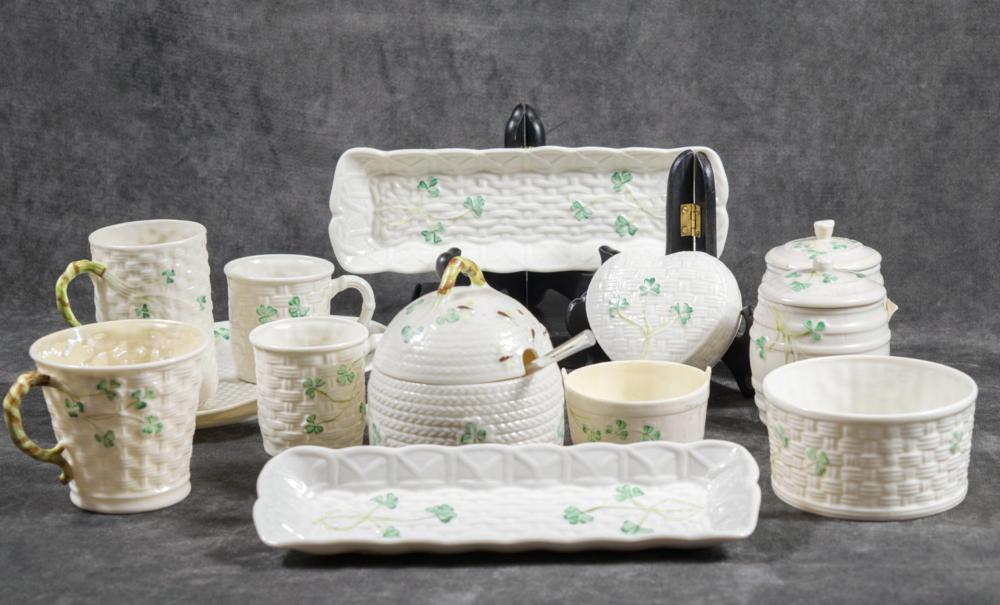
One of the joys of collecting Belleek is that it rewards both the “big picture” and the close-up glance. From across a room, you notice the glow—soft white porcelain that looks almost lit from within. Up close, you start to see why collectors get obsessed: tiny hand-painted shamrocks, shell ridges that catch the light, coral-like handles, basket strands so fine they look woven.
Belleek is often described as “delicate,” but the real collector magic is how many different looks Belleek can wear while still feeling unmistakably Belleek. This post is your field guide to the patterns and themes you’ll encounter most often—how to recognize them, how to describe them accurately, and how to use pattern knowledge to shop smarter.
Pattern vs. Shape vs. Decoration (Why These Words Matter)
When people say “pattern” in Belleek, they may mean one of three things—and knowing which one they mean helps you identify pieces more reliably.
- Shape/Form: The overall silhouette (vase forms, tea sets, baskets, figurines).
- Molded pattern (texture): The raised or embossed surface design (shell ribs, woven basket textures, relief motifs).
- Decoration (paint/finish): Hand-painted shamrocks, tinted rims, gilding, or interior luster.
A shell-textured cup with a coral handle and a pearly interior might be described as one “pattern,” but it’s really a combination: form + molded texture + finish. If you train your eye to separate those layers, you’ll spot patterns faster and describe them more confidently when buying or listing.
The Big Themes That Define Belleek
Belleek themes tend to cluster around a few enduring ideas—so even if you don’t know a pattern name yet, you can often place a piece into the right “family.”
Irish identity (without being loud about it)
Belleek’s Irishness often shows up in gentle, collector-friendly ways: shamrocks, harp motifs, and subtle national symbolism rather than heavy-handed graphics. This is part of why Belleek blends so easily into different décor styles.
Nature, translated into porcelain
Leaves, flowers, woven textures, and organic forms appear across many lines. Even when a piece isn’t decorated with florals, it often feels “natural” in structure—curved rims, petal edges, and flowing handles.
The sea and the shoreline
Shells, coral, and wave-like textures are a major Belleek theme. These designs can feel both whimsical and sculptural—especially when the porcelain’s translucence is paired with a pearly or tinted finish.
“Lacework” craftsmanship
Belleek basketweave and flower work is almost its own category—pieces that feel like porcelain fiber arts: twisted strands, pierced edges, layered petals, and intricate assembly.
Shamrock: The Most Iconic Belleek Motif
If Belleek has a “signature look” in the public imagination, it’s shamrock. The motif is simple—tiny green leaves—but the effect can be surprisingly elegant when it’s applied with a light hand on luminous porcelain.
What collectors love about shamrock pieces:
- They feel unmistakably Irish without being novelty décor.
- The hand-painted shamrocks create small variations from piece to piece.
- They mix well with other Belleek themes (shell forms, harp handles, traditional tea shapes).
What to look for when you’re buying Shamrock pieces
- Paint quality: Shamrocks should look intentional and clean, not blobby or rushed.
- Placement: Well-finished pieces tend to feel balanced—decoration placed where it complements the form.
- Surface condition: Because the look is so soft and white, scuffs and gray handling marks show easily.
Collector note: shamrock appears across a wide span of production eras. That means the backstamp/mark (which you’ll already recognize from the “Birth of Belleek” post) becomes especially important for narrowing down when a shamrock piece was made.
Harp and Shamrock: A Design That Feels Like Ireland
Another collector-favorite is the harp-and-shamrock idea—Irish symbolism expressed through form and detail rather than a big printed emblem. Many pieces in this family combine:
- Harp-inspired handles
- Shamrock decoration
- Shell-like textures worked into the body or rim details
This is a great example of why Belleek collecting can be so satisfying: the design is layered. A piece can carry national symbolism, nature texture, and porcelain delicacy all at once.
Shopping tip
When you’re browsing online listings, look for clear photos of the handle and any embossed shell texture. Handles are a major identifier in harp-themed pieces, and they’re also one of the first places damage shows up.
Shell and Sea Patterns: Limpets, Clams, and Nautical Style
Belleek’s shoreline-inspired designs are among the easiest to recognize in the wild—and some of the most fun to collect because they’re sculptural even in plain white.
Belleek’s own museum notes that their catalog history includes a small set of enduring tea ware lines that remain especially recognizable to collectors, including Tridacna, Limpet, New Shell, Neptune, Harp Shamrock, and Shamrock. If you’ve ever wondered why certain names keep popping up in listings, that’s a big part of the answer: these are patterns people return to.
Neptune: The “nautical” showstopper
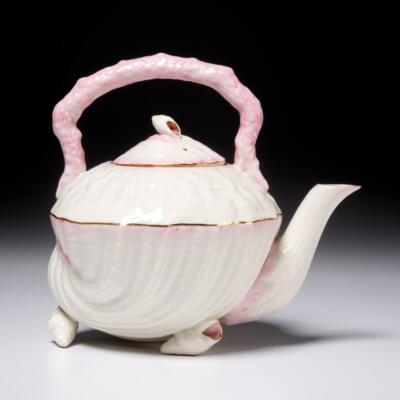
Neptune pieces often feature shell forms and coral-like elements—design language clearly inspired by the sea. Collectors love them because they look like functional tableware that wandered out of a coastal fantasy: shell textures, tiny “sea” feet, and handles that echo coral or marine shapes.
What to look for on Neptune-style pieces
- Shell ridges should read crisp and dimensional.
- Small feet and handles should be intact (these are chip-prone).
- Many pieces show finishes like pearly interiors or tinted/gilded edges—check for wear where hands and washing would hit most.
Tridacna: The giant clam inspiration
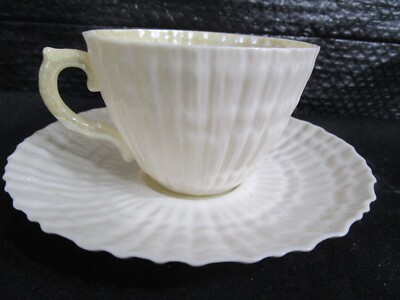
“Tridacna” refers to giant clams, and collectors use the name for Belleek pieces with bold, sculptural shell ribbing. The appeal is texture: light skims across the ridges and makes the porcelain look even more luminous.
What to look for
- Even ribbing that doesn’t look softened by heavy wear.
- Clean edges along rims and shell “flutes.”
- Consistent finish—shell ridges are high points and can show scuffs first.
Limpet and New Shell: shoreline texture with everyday usability
Limpet- and shell-themed pieces are often collected as practical favorites—plates, cups, small serving pieces—because they stack into a usable set while still feeling special.
For shell patterns, pay special attention to:
- Raised ridges and edges (where tiny chips hide)
- Handles and feet (common break points)
- Interior luster or tint (look for rubbing, fading, or “dishwasher haze” on later pieces)
Basketweave and Flowers: The Belleek Craft Showcase
If shamrock is the most iconic motif, basketweave is the most iconic skill display. Belleek baskets and floral pieces are often what make people fall in love with the brand in person—because they don’t look possible.
What makes Belleek basketwork so collectible:
- Strands are twisted and placed to mimic real weaving.
- Pierced edges add lace-like lightness.
- Applied flowers and leaves create a layered, dimensional look.
How to “read” basket quality quickly
- Strands should look deliberate. The weave reads as a pattern, not as random texture.
- Piercing should be clean. Rough openings or ragged edges can indicate damage or lower-quality finishing.
- Flowers should feel sculpted. Petals should have shape, not just thickness.
Where damage hides on baskets
- Rim points and pierced openings
- Flower petals and leaf tips
- Handle joins
- Base edges (from setting down and sliding)
If you’re shopping online, insist on clear rim and handle photos. With baskets, condition is value.
Color, Luster, and Gilding: The Finishing Touches Collectors Notice
Many Belleek pieces are primarily white, but finishes can dramatically change the look.
Common finishing effects include:
- Pearly luster (often inside cups/bowls or as a soft sheen)
- Tinted edges (subtle green or pink tones on rims and relief)
- Gilding (gold accents that elevate a piece into “dressy” territory)
What to look for
- Evenness: luster and tint should look intentional, not patchy.
- Wear patterns: gilding often rubs on rim high points and handle edges.
- Consistency within sets: if you’re building a tea set, try to match finish style so the pieces look cohesive together.
How to Identify a Pattern in the Wild (Quick Checklist)
When you’re holding a piece at an antique mall—or zooming in on listing photos—run through this simple pattern ID routine:
- Start with the silhouette: basket, vase, cup/saucer, plate, figurine?
- Look for molded texture: shells, weave, relief leaves, fluting, ribbing?
- Check the “signature detail”: coral handle, harp handle, pierced rim, flower clusters?
- Note the decoration: shamrocks? tint? gold? pearly interior?
- Flip it over: confirm the backstamp/mark and make sure it matches the overall age and wear.
This approach keeps you from getting stuck on a single clue (like a motif name) and helps you identify pieces even when sellers label them vaguely.
Building a Collection That Feels Intentional
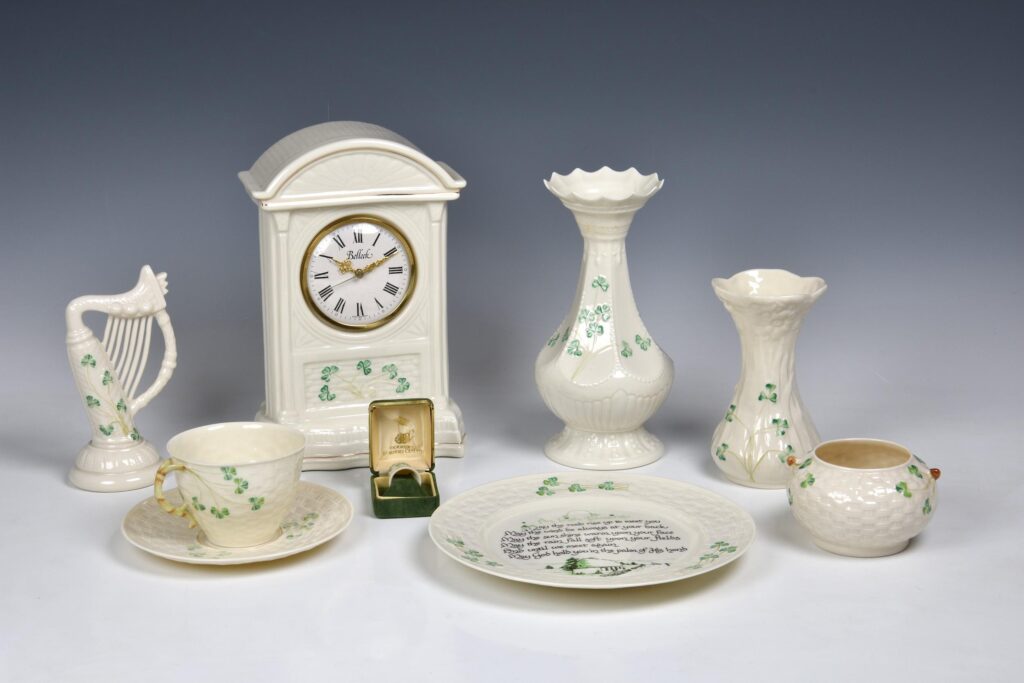
Belleek collections look best when they’re curated, not crowded. A few collector-friendly strategies:
Collect by theme
- Irish identity: shamrock + harp forms
- Coastal/sea: Neptune + shell patterns
- Craft showcase: baskets + florals
By function
- A “working tea” group (cups, saucers, small plates)
- A display shelf of sculptural pieces (baskets, vases, centerpiece forms)
- Seasonal rotation (spring florals, St. Patrick’s shamrocks, summer shells)
By finish
All-white Parian look, or a coordinated luster/tint palette. Either can look stunning—just try to keep the group visually consistent.
Care Notes for Patterned Belleek
Patterns and themes often come with delicate high points—exactly where damage happens first.
- Hand wash when possible, especially for gilded or luster finishes.
- Avoid abrasive cleaners on matte or soft-sheen surfaces.
- Store so pieces don’t touch (basket rims and petals chip easily).
- Display away from edges where sleeves and bags snag handles.
Belleek doesn’t need to be feared—just respected. Treat it like fine porcelain, and it will stay luminous for years.
The Collector’s Takeaway
Belleek patterns aren’t just “decoration.” They’re a combination of form, texture, and finish—Irish identity expressed softly, nature rendered in porcelain, and shoreline designs sculpted into functional pieces. Once you learn the pattern families—shamrock, harp, shells, baskets—you’ll start spotting Belleek from across the room and describing it with confidence when you buy, sell, or simply admire it.
Next up, we’ll take this pattern knowledge and put it to work: Collecting Belleek—Rare vs. Common Pieces, where we’ll talk about what really drives value (and how to avoid overpaying for the wrong reasons).
Let’s Make History—one pattern at a time.