There’s a reason carnival glass can stop you mid-aisle at an antique mall. It isn’t only the color shift—gold to violet to teal in one slow turn. It’s the feeling that the piece has already lived a life. Even when you don’t know the pattern name, you can imagine it on a kitchen table, catching window light while someone poured coffee or set out cookies.
Carnival glass is collectible because it’s beautiful, yes—but it’s also collectible because it’s familiar. It shows up in family cabinets, estate sales, and “Grandma’s hutch” stories more often than many other glass categories. Pieces were made to be used and displayed. They were bought as affordable sparkle, given as gifts, and kept because they made ordinary rooms feel special.
This post is about that side of carnival glass: the nostalgia, the family stories, the small rituals of display, and how modern collectors can preserve—not just the glass—but the memories that come with it.
Why Carnival Glass Feels Like Memory
Some antiques feel distant. Carnival glass doesn’t.
Part of that is the way it behaves in light. Iridescence isn’t static—it moves. Your brain reads that movement as “alive,” and that makes a piece feel present in a room rather than just decorative.
The other reason is cultural: carnival glass was made in forms people used every day—bowls, plates, tumblers, compotes, candy dishes. You don’t have to imagine a grand mansion to imagine carnival glass. You can picture a small dining room, a sideboard, a Sunday dinner spread.
For many collectors, that familiarity is the hook. Carnival glass doesn’t ask you to admire it from a distance. It invites you to set a piece out and let it glow.
The Glow at the Center of the Table
One of the simplest ways to understand carnival glass is to think about where it lived.
A lot of carnival glass forms make perfect sense as “center-of-the-table” pieces:
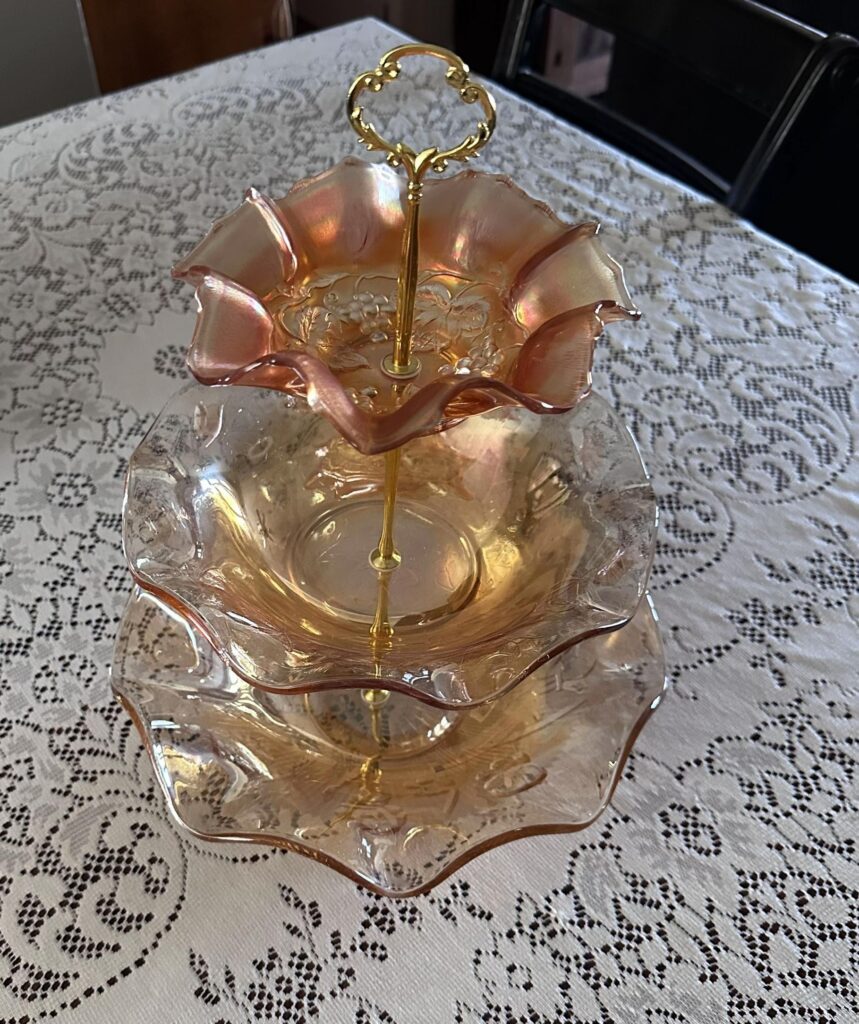
- ruffled bowls that catch light along every fold
- footed compotes that lift sparkle above the table surface
- plates and platters with bold relief that reads from across a room
- small dishes that turn candy or nuts into a display
Even when a piece wasn’t used daily, it often had a ceremonial role. It came out for company, went into the dining room cabinet, and lived on the “nice shelf.”
That’s why carnival glass has such a strong memory footprint. It wasn’t hidden away in a drawer. It was seen.
Patterns as Family Landmarks
Collectors love pattern names—and learning them is fun—but what matters emotionally is how patterns work like landmarks. You may not know what a pattern is called, but you recognize it anyway.
A grape-and-vine bowl can trigger:
- “My aunt had that exact one.”
- “We used something like that at the holidays.”
- “That looks like the dish that always held hard candy.”
A peacock-style plate can trigger:
- “We had one hanging on the wall.”
- “I remember the way it changed color when the light hit it.”
This is one of the best things about carnival glass as a collecting category: you can collect it intellectually (pattern study), visually (color and form), or emotionally (memory and recognition). Many collectors end up doing all three without meaning to.
Color as Mood
If pattern is the “language,” base color is the mood. Two pieces in the same pattern can feel like completely different memories depending on the underlying glass color.
Marigold: warm, nostalgic, and instantly “classic”
Marigold is often associated with the most traditional carnival-glass look: sunny, honeyed glow with rainbow highlights. It feels like warm lamplight and family tables.
Amethyst and deep tones: dramatic, jewel-like, display-forward
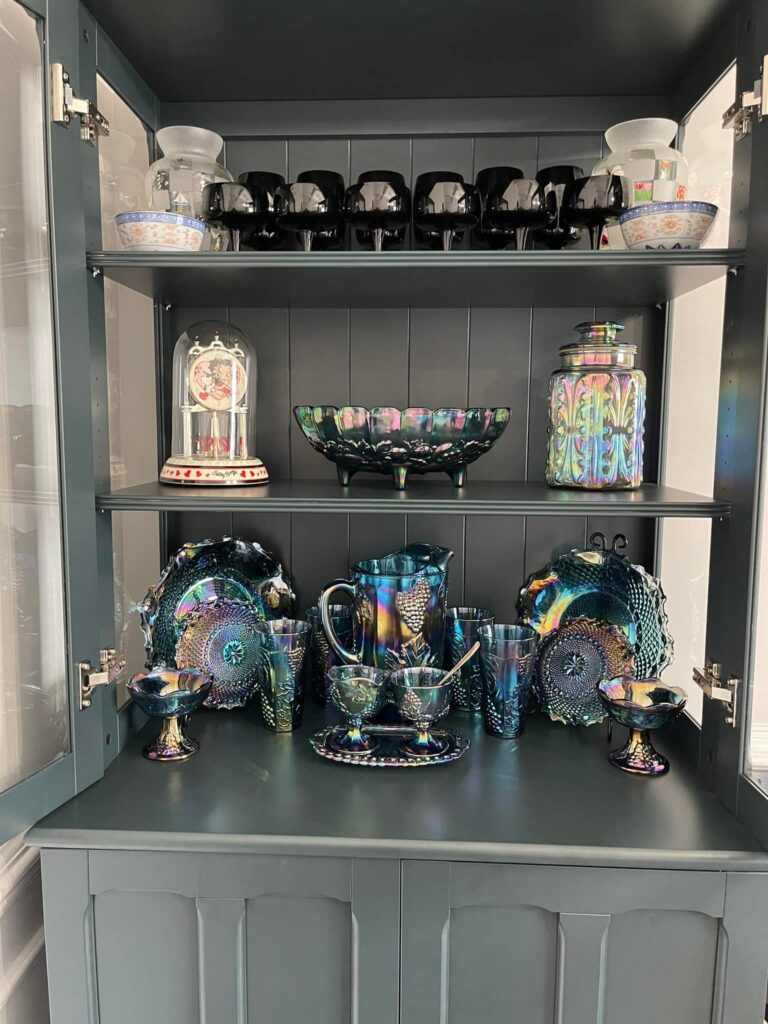
Deeper base colors make the relief feel sharper and more sculptural. They often read as “decorative object” even when the form is functional.
Blues and greens: cool sparkle and peacock-shift magic
Cool base colors tend to pair beautifully with the teal-violet flashes people associate with carnival’s most dramatic shine. These colors can feel slightly more modern in a mixed décor display.
Ambers and smoky tones: subtle, grown-up glow
Neutrals are often a sweet spot for collectors who want carnival glass to blend with wood tones, vintage books, and muted interiors. The glass still shimmers—it just doesn’t shout.
If you’re building a collection that’s meant to feel like a personal story, color is one of the easiest ways to make it cohesive. A shelf of “all warm glow” or “all cool shimmer” reads like a curated narrative, not a random assortment.
The Stories That Come With It
Some collectibles come with provenance like paperwork. Carnival glass often comes with provenance like a sentence:
- “That was my mother’s candy dish.”
- “That bowl was always out on the table.”
- “We got it when we moved into the house.”
- “Grandma called it her ‘pretty bowl.’”
That kind of story is fragile. It disappears fast unless someone writes it down.
A simple way to preserve story-provenance
If you buy carnival glass at an estate sale or inherit it from family, try this:
- Take a photo of the piece (front and underside).
- Record a short note in your phone:
- where it came from
- who owned it
- what it was used for
- any remembered nickname for it (“the candy dish,” “the holiday bowl”)
- If you’re storing it, tuck a small note near the storage box (not taped to the glass).
Collectors often wish they’d done this earlier. You don’t need a full genealogy—just a sentence that keeps the object connected to a life.
Carnival Glass as Décor Today
Modern collectors are using carnival glass in ways that would have made earlier owners smile: still functional, still decorative, but now often styled intentionally.
Cabinet display: the classic for a reason
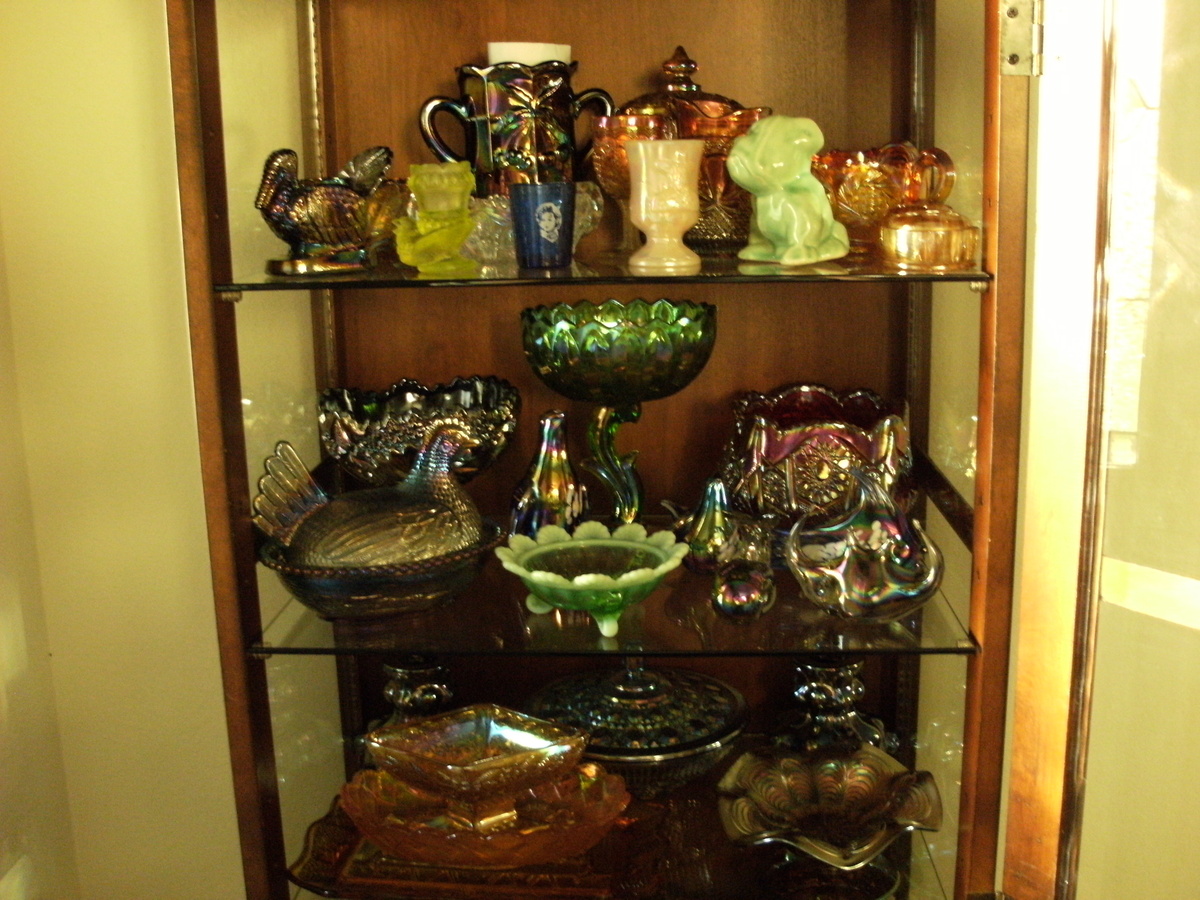
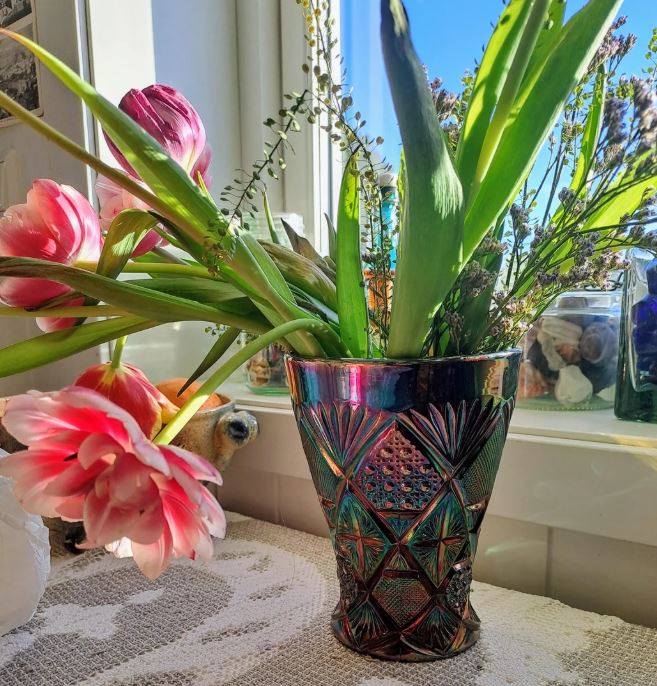
A cabinet gives carnival glass what it loves most: stable light and a clean background. If you can, display pieces where light hits them gently—near but not directly in a bright window. A dark back panel makes the iridescence pop; a light back panel makes the relief read more clearly.
Shelf styling: curated glow
Carnival glass shelves look best when they have:
- one repeated theme (color family, motif family, or form type)
- breathing room (don’t crowd the rims)
- a mix of heights (compote + plate + bowl creates movement)
Try building “triangles” of height on a shelf: a tall vase, a medium bowl, a smaller dish. The eye reads it as intentional.
Table use: small rituals bring the glass back to life
If you own carnival glass, don’t feel like it must live behind glass. Many pieces can be used gently as:
- candy dishes
- fruit bowls (with a liner if desired)
- catch-alls for keys or jewelry (soft items only)
- holiday table accents
The moment you use a piece—even carefully—you’re participating in why it was made in the first place.
Photographing Carnival Glass (So the Glow Looks Real)
Carnival glass is famously hard to photograph because the finish changes with angle. A few practical habits make a big difference:
- Use indirect natural light (near a window, not in direct sun).
- Take one photo straight-on and one slightly angled to catch the sheen.
- Photograph a rim close-up to show chips (or show that there aren’t any).
- Include an underside photo for base color and wear.
- Avoid heavy filters—buyers and collectors want the glow, not exaggerated color.
If you’re posting pieces online, a simple “turn sequence” (two or three angles) often tells the truth better than one dramatic shot.
Care That Protects the Shine
Carnival glass is tough enough to have survived decades in cupboards, but the iridescent surface benefits from gentle treatment.
- Wash by hand with mild soap and lukewarm water.
- Avoid abrasive scrubbers that can dull sheen on high points.
- Be cautious with dishwashers and harsh detergents—heat and chemicals can be unfriendly to older glass and its surface effects.
- Store pieces so they don’t rub against each other—especially rims and ruffles.
The goal isn’t perfection. A little honest wear can be part of a piece’s story. The goal is to avoid damage that happens simply because the glass wasn’t supported or protected.
Collecting for Meaning (Not Just for Completion)
Carnival glass can be a “completionist” category—pattern lists, color lists, form lists. That’s fun if you like that style of collecting. But it can also be a deeply personal category if you collect by memory and mood.
Try one of these approaches:
- The memory shelf: pieces that remind you of specific people or places
- The light shelf: pieces that perform beautifully in your room’s lighting
- The color story: one base color family that feels like “your” palette
- The centerpiece tradition: one bowl or compote that you actually use for holidays
When you collect this way, the market matters less. The pieces matter more.
Carnival glass is iridescent, but the best part isn’t the rainbow. It’s the way the rainbow becomes a bridge—between your home and the homes that came before.
Let’s Make History—one iridescent memory at a time.