
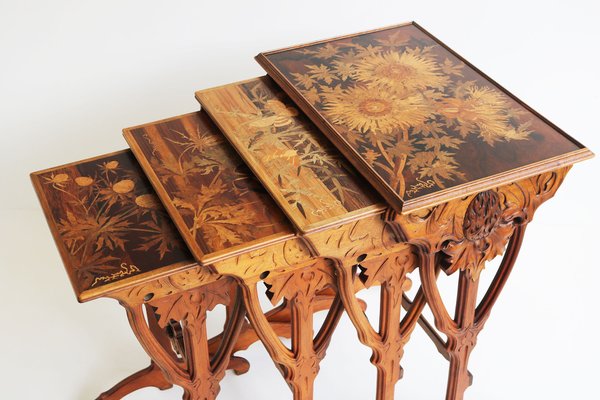
When most people think “Gallé,” they picture glass—moody vases, layered color, dragonflies and flowers rising out of the surface. But for collectors, Gallé’s furniture is where Art Nouveau becomes fully immersive. These pieces don’t just borrow motifs from nature; they’re built around them. Wood grain becomes landscape. Inlay becomes botany. A cabinet or table can carry the same atmosphere as a twilight cameo vase—only on a larger, livable scale.
Gallé made furniture that feels both poetic and purposeful: side tables that read like illustrated panels, cabinets that merge plant anatomy with architecture, and marquetry that turns humble materials into something painterly. If you’re new to collecting this side of Gallé, this post will help you understand what you’re looking at, why it matters, and how collectors evaluate authenticity, condition, and value.
What “Gallé Furniture” Really Means
Gallé furniture is broadly French Art Nouveau furniture designed by Émile Gallé and/or produced by his workshop in Nancy during the late 19th century into the early 20th century. Unlike many period pieces that rely mainly on carved ornament, Gallé furniture often uses a layered approach:
- Marquetry (pictures built from thin veneers)
- Inlay and mixed materials (multiple woods; sometimes accents like mother-of-pearl)
- Carving and sculptural shaping
- Symbolic motifs tied to plants, seasons, and landscape
- Occasional inscriptions—poetic lines or phrases worked into the design
In other words, the artistry isn’t an “extra.” It’s the point.
Why This Furniture Became a Signature of Art Nouveau
Art Nouveau aimed to dissolve the boundary between fine art and daily life. Gallé’s furniture is one of the clearest expressions of that idea: functional objects that behave like artworks.
Nature isn’t decoration—it’s structure
Many Gallé pieces echo natural forms in the way they’re built. Legs may resemble stems. Supports may flare like leaves. Frames may repeat rib-like patterns. Even when the silhouette is fairly traditional, the detailing pushes it into a botanical world.
Marquetry becomes a kind of painting
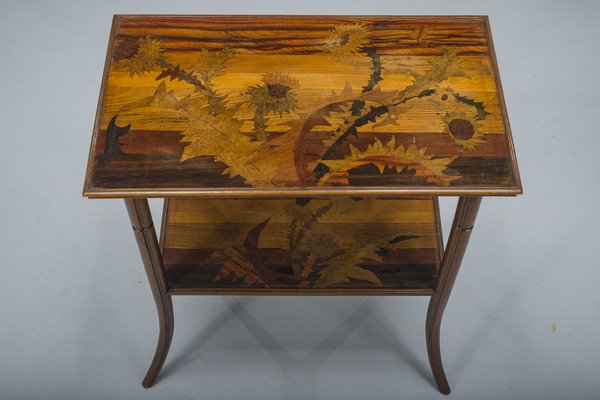
Gallé’s inlays aren’t just geometric borders. They often form recognizable scenes—thistles in a field, umbels (cow parsley and related plants), dragonflies, grasses, or landscapes. The shading isn’t done with paint; it’s achieved through choosing woods with different tones and figuring, then arranging them for depth and contrast.
Meaning is part of the object
Gallé was known for embedding ideas into his work—sometimes literally, via text. A table or cabinet can carry a message (political, philosophical, poetic) alongside the imagery. For collectors, this is a big part of the appeal: you’re not just collecting a style, you’re collecting a point of view.
The Key Techniques Collectors Should Know
You don’t need to be a woodworker to appreciate Gallé furniture, but knowing the basic vocabulary makes shopping much easier.
Marquetry: the heart of the look
Marquetry is the art of building images or patterns from thin slices of veneer applied to a surface. Gallé’s marquetry can be subtle (a few leaves, a restrained border) or dramatic (a full panel scene with depth and movement).
Collector tip: the most compelling marquetry tends to feel “designed,” not just decorative—imagery that fits the shape of the tabletop or door panel and reads clearly from a few feet away.
Mixed woods and tonal “shading”
One reason Gallé marquetry photographs so well is the natural range of wood color—creamy maple tones, deeper walnuts, warmer fruitwoods, and darker accents for outlining. Some museum-documented pieces show extensive mixing of wood species to achieve a painterly effect.
Collector tip: look for intentional transitions and crisp edges. When marquetry looks muddy or indistinct, either the craftsmanship was weaker or the surface has been heavily altered by wear, refinishing, or sun fading.
Carving and sculptural details
Gallé furniture often includes carving that pushes beyond simple ornament—ears of wheat, umbels, stems, and organic ribs that feel like growth patterns. This can show up in legs, stretchers, pediments, and frames.
Collector tip: carving should feel integrated into the structure. If a carved element looks “stuck on” or stylistically mismatched, slow down.
Inscriptions: furniture as statement
Some well-known Gallé furniture includes inscriptions—often placed where they’ll be noticed but not shouted. These can function like titles, signatures, or thematic anchors.
Collector tip: inscriptions can be a wonderful sign of the Gallé “spirit,” but they’re also something that can be imitated. Treat text as one clue among many, not the final word.
Forms You’ll See Most Often (and Why They’re Popular)
Gallé furniture exists across many forms, but collectors commonly encounter a few categories more than others.
Occasional tables and guéridons
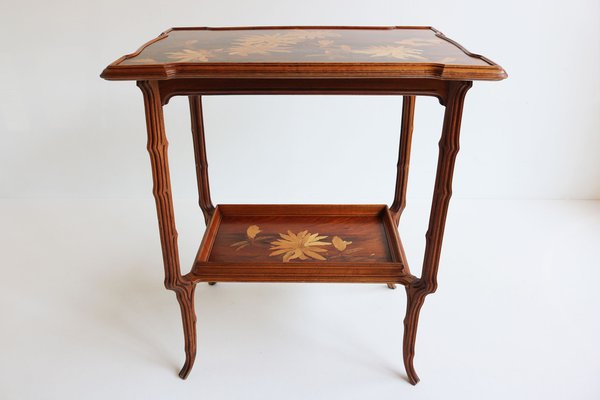
Small tables are a sweet spot for collectors: they showcase marquetry dramatically, they’re easier to place in modern homes, and they offer a strong “Gallé look” without requiring a full-room commitment.
What collectors love:
- Oval or shaped tops that frame a botanical scene
- Legs that echo leaf or stem shapes
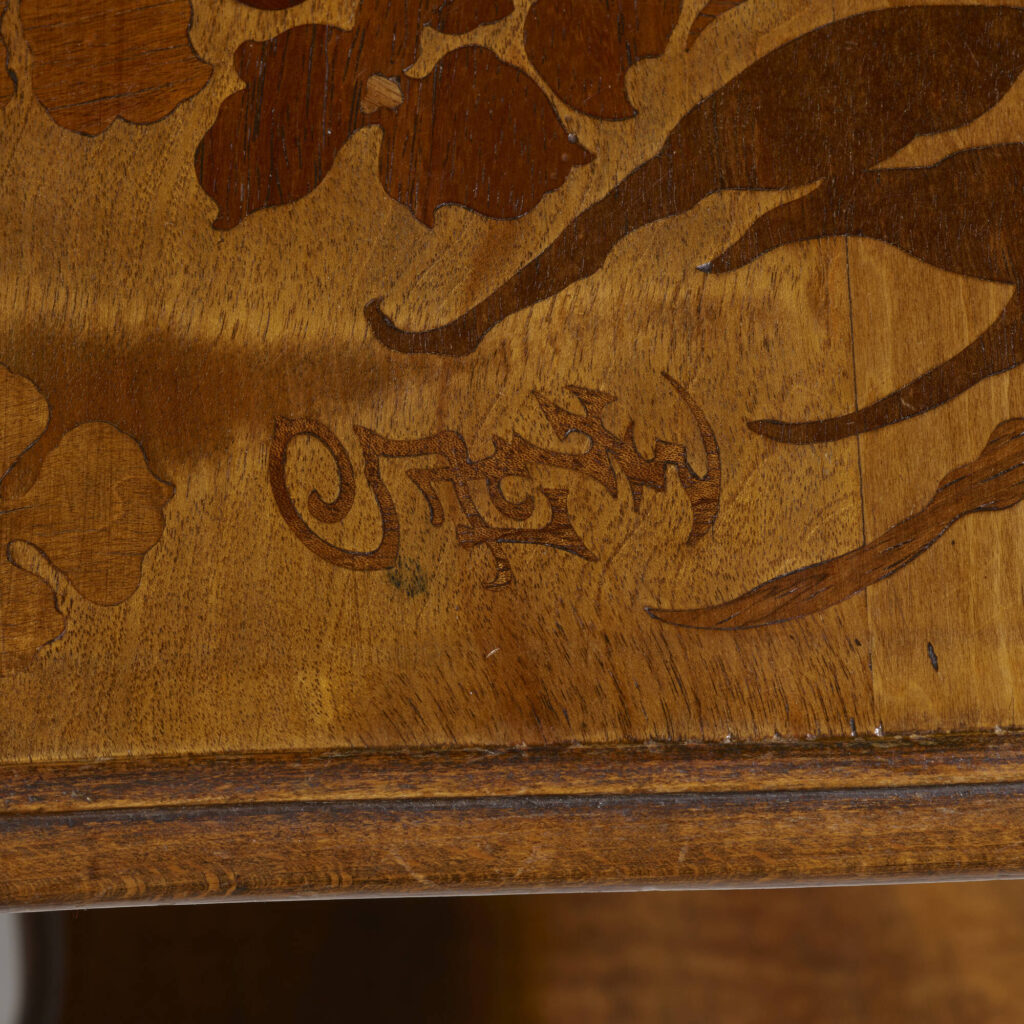
- Signatures sometimes worked into the marquetry on the top
Display cabinets and vitrines
Cabinets are where Gallé’s nature-meets-architecture approach often shines—panels of marquetry paired with sculptural framing, sometimes with glass doors or interior display functions.
What collectors love:
- Large marquetry panels with landscape + botanical motifs
- Structural details inspired by plant anatomy (ribs, sheaths, nodes)
- A “total design” feel—art, function, and symbolism merged
Desks, étagères, and shelving
These pieces often carry repeated motif systems—especially botanical families rendered across multiple panels or levels. They’re visually complex and can read like curated installations even when used normally.
What collectors love:
- Repetition of a single plant theme across the piece
- Carved elements that extend the marquetry into 3D
- Subtle inscriptions that reward close looking
Seating (rarer to encounter, but memorable)
Chairs and armchairs associated with Gallé can be striking, but they’re less commonly seen than tables and cabinets. When they do appear, they often combine sculptural shaping with inlaid detail.
Collector tip: seating is where later alteration is very common (reupholstery, replacement parts). Condition scrutiny is critical.
How to Evaluate Authenticity Without Getting Overwhelmed
Gallé is highly collected, which means the market includes originals, later workshop pieces, honest “in the style of” furniture, and outright misattributions.
A practical collector approach:
Start with overall design harmony
Gallé furniture usually feels cohesive. Form, motif, and technique support each other. If the marquetry looks like a generic floral sticker on an unrelated table shape, be cautious.
Look for craftsmanship you can’t fake easily
- Clean marquetry joins and confident outlines
- Thoughtful use of wood tones for depth
- Carving that feels intentional and structurally integrated
Treat signatures as supporting evidence
Some pieces are signed in ways that appear integrated into the work (for example, worked into marquetry on a tabletop). But signatures can be added or imitated. The safest mindset is: quality first, signature second.
Be extra careful with “too perfect” stories
If a piece looks freshly made but is being sold as a century-old original, slow down. Likewise, if an object shows extreme “aging” in one spot but is oddly pristine elsewhere, question what you’re seeing.
For high-value purchases, comparison to museum examples and/or specialist evaluation is worth the effort.
Condition: The Make-or-Break Factor in Wood Art Furniture
Furniture collecting is always condition-driven, but Gallé pieces add another layer: veneers and inlays. Condition issues don’t always shout; they can hide until light hits at an angle.
What to check on marquetry surfaces
- Veneer lift or bubbling (often along edges or near heat sources)
- Losses and fills (tiny missing pieces replaced with putty or mismatched wood)
- Cracks following the grain (can indicate movement or dryness over time)
- Heavy refinishing (can flatten contrast and blur fine detail)
Collector tip: view the surface from multiple angles. Marquetry problems often reveal themselves in raking light.
Structural checks (especially on tables)
- Wobble and joint stability
- Signs of re-gluing, replaced stretchers, or reinforced corners
- Warped tops or stressed legs
Cabinet-specific checks
- Door alignment and smooth closure
- Hinge wear or replacements
- Back panel integrity (older furniture can show shrinkage, splitting, or later reinforcement)
Pest and moisture history
Because these pieces are wood-rich and often old:
- Check for old worm holes and whether they appear inactive
- Look for staining, musty odor, or signs of water exposure
- Inspect undersides and interior corners—problems often show there first
Care and Display: Keeping Gallé Furniture Happy in a Modern Home
You don’t need museum conditions, but a few habits go a long way.
Light management
Direct sunlight can fade wood tones and soften marquetry contrast over time. Aim for indirect light or rotate placement if a piece sits near a bright window.
Climate and placement
Wood likes stability. Avoid placing pieces:
- directly over heating vents
- next to radiators
- in damp basements
Cleaning basics
- Dust with a soft cloth (microfiber works well)
- Avoid soaking cleaners or harsh sprays
- If you wax, use a gentle wax sparingly and evenly—over-waxing can cloud surfaces and attract dirt
“Use” with respect
Gallé furniture was made to function, but protect the art:
- Use coasters and felt pads
- Avoid hot dishes directly on marquetry
- Consider a protective glass top for heavily used tables (especially if you want daily practicality)
Collecting Strategy: How People Build a Gallé Furniture Collection
Because prices and availability vary widely, collectors often build in one of these ways:
- Motif collecting: thistles, umbels, dragonflies, landscapes, or one botanical family
- Form collecting: focusing on tables only, or cabinets only, or display pieces
- Room-building: selecting one anchor piece (like a cabinet) and adding complementary smaller forms
- Cross-medium collecting: pairing furniture with Gallé-style glass for a cohesive Art Nouveau display
If you’re following this blog series, furniture also sets you up perfectly for the next steps—because you start seeing Gallé’s design language as a whole, not as “just glass.”
Let’s Make History—one marquetry panel at a time.