

If you’ve ever paused in front of a glowing Tiffany lamp shade or a richly colored stained-glass panel and thought, How did someone make light look like that?—you’ve already felt the pull of Louis Comfort Tiffany. His name has become shorthand for luminous color, intricate glasswork, and turn-of-the-century design that still feels alive today.
But Tiffany wasn’t “just” a lamp designer. He was a decorative arts visionary who helped reshape what American art glass could be—by pushing color, texture, and technique in ways that made glass feel painterly and atmospheric. His work is also a reminder that collectible objects can be both practical and profound: a lamp that lights a room, a window that transforms a wall, a vase that turns daylight into a display.
In this post, we’ll look at who Louis Comfort Tiffany was, why his glass mattered, what made his studio’s work distinctive, and what collectors can watch for when they’re shopping, learning, and building a Tiffany-focused collection.
Who Was Louis Comfort Tiffany?
Louis Comfort Tiffany (1848–1933) was an American artist and designer best known for his work in decorative arts—especially stained glass, art glass, and the objects created through his studio enterprise. He was born in New York City and was the son of Charles Lewis Tiffany, the founder of Tiffany & Co., but Louis built his own creative path rather than simply stepping into the jewelry world.
Early in his career, Tiffany trained and worked as a painter. That “painter’s eye” never really left him. Even when he moved into interiors and glass, his sense of composition—how color sits next to color, how light changes an image—shows up everywhere in his designs.
From Painter to Decorative Arts Visionary
Tiffany’s shift toward decorative arts makes more sense when you remember the time period. In the late 19th century, affluent American homes were being designed as “total environments”: walls, windows, lighting, textiles, and furniture were meant to work together. Tiffany was drawn to that holistic approach. He didn’t just want to make a single object—he wanted to shape the entire atmosphere of a room.
Over time, his business evolved under multiple names as it expanded from interiors into large-scale glass production. For collectors, it helps to know that “Tiffany Studios” is the name most associated with the mature, wide-ranging enterprise—but the earlier company names and related production arms matter, too, because they show up in scholarship and sometimes in labeling and documentation.
Building a Glass Empire: Studios, Furnaces, and the Power of Production
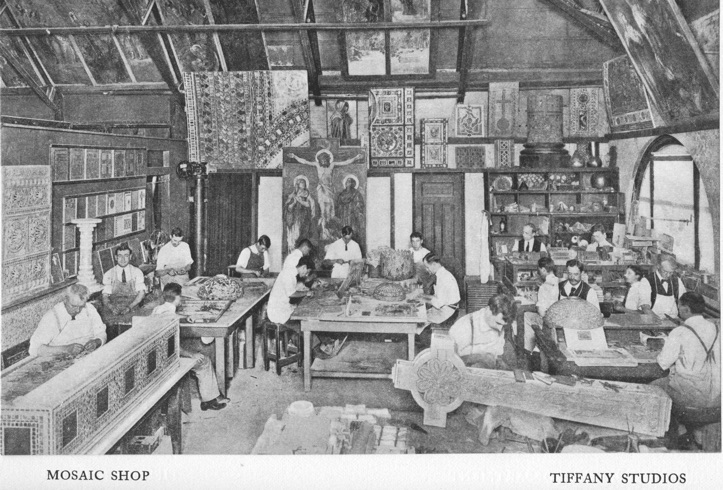
One of Tiffany’s major leaps was moving from design and decoration into controlled production—building the capability to experiment with glass itself. By the early 1890s, Tiffany established a glasshouse in Corona, Queens, and developed a system where teams of designers, glassworkers, cutters, and assemblers could translate studio concepts into finished works at scale.
That matters for collectors because it explains something you’ll see again and again in Tiffany collecting:
- Many pieces are the product of a studio system, not a single hand.
- Tiffany’s “signature” often lives in design direction, materials, and methods, not just one person’s craftsmanship.
- The breadth of output—windows, lamps, vessels, mosaics, interior elements—came from an enterprise built to produce across categories.
In other words: Tiffany is collectible not only because of beauty, but because the studio infrastructure made that beauty repeatable—and recognizable.
What Made Tiffany Glass Different?
A lot of glass can be colorful. Tiffany glass is different because it often looks like it has depth, movement, and texture built into it. Rather than treating color as something applied only on the surface, Tiffany’s approach favored glass that carried tonal variation within the material itself.
Collectors often describe Tiffany glass as having qualities like:
- Opalescence (a soft, milky glow that can diffuse light)
- Layered color and shading that feels atmospheric
- Surface texture that adds drama when lit
That “living color” effect is a huge part of why Tiffany pieces still stop people in their tracks.
Favrile: The Name Collectors Should Know
If you’re learning Tiffany, you’ll run into the word Favrile—and it’s worth understanding in plain terms. Favrile was Tiffany’s trade name for hand-wrought art glass associated with his furnaces. It’s closely linked with the iridescent, shimmering surfaces many collectors recognize immediately, but it also points to a broader idea: glass valued for being handmade, unique, and richly colored.
For collectors, “Favrile” matters because:
- It’s a key term in Tiffany scholarship and museum writing.
- It’s strongly associated with Tiffany’s art glass identity.
- It shows up in how people describe and market pieces (sometimes correctly, sometimes too casually).
A helpful collecting mindset: treat “Favrile” as a term that should invite more verification, not less. When someone calls something Favrile, it’s a cue to slow down and look carefully at the piece, the marking, and the context.
The Tiffany Lamp: Light as Sculpture
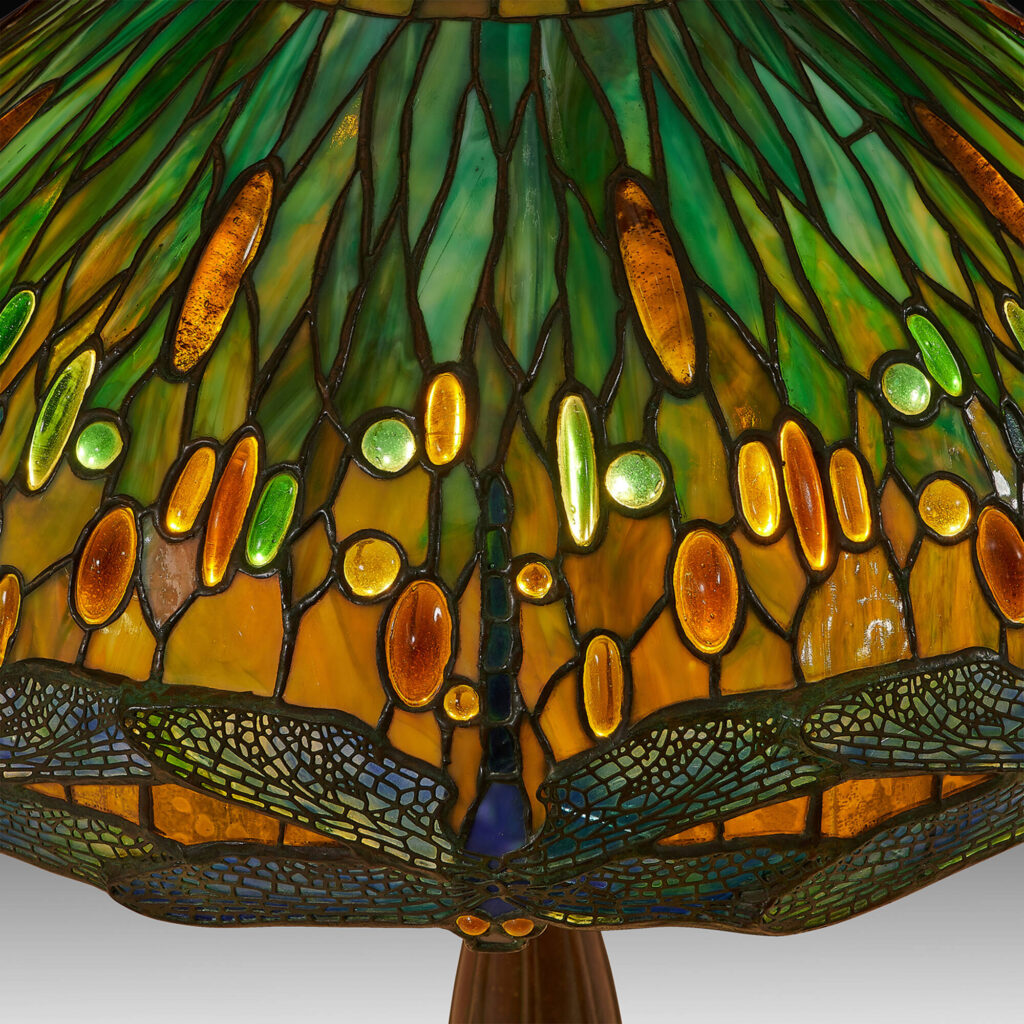
Tiffany lamps are probably the best-known branch of the Tiffany universe, and it’s easy to understand why. A good Tiffany-style shade doesn’t just sit on a base—it transforms light into color, pattern, and mood.
Many Tiffany lamp shades were assembled using a copper-foil technique rather than traditional lead channels used in many stained-glass windows. That approach can allow very small pieces of glass to be joined, which supports the intricate, naturalistic designs collectors love—dragonflies, wisteria, peonies, and other motifs that feel both decorative and organic.
Collector note: “Tiffany lamp” is often used casually in the marketplace to describe any stained-glass lamp. True Tiffany Studios lamps occupy their own category, and “Tiffany-style” lamps are a separate (often later) universe. The difference is important for value, but it’s also important for collecting clarity.
Beyond Lamps: Windows, Mosaics, and Total Interiors
While lamps get the spotlight, Tiffany’s studio output went far beyond lighting. Tiffany is deeply tied to:
- Stained-glass windows and large panels
- Architectural and interior installations
- Decorative objects that brought art glass into everyday domestic space
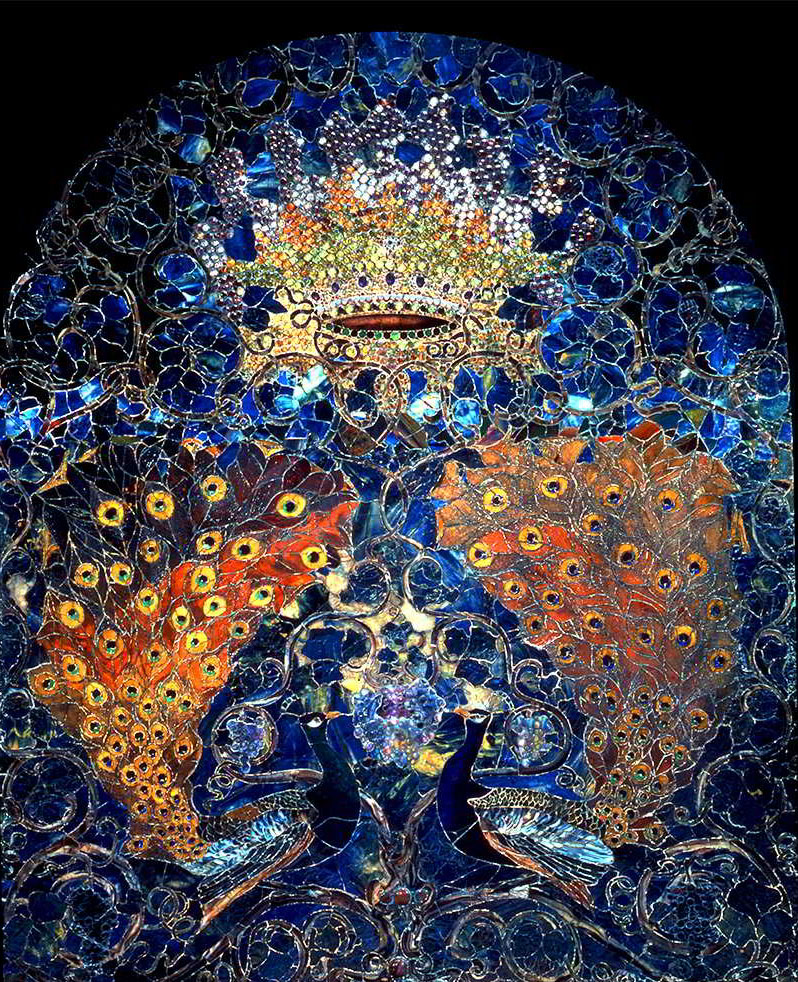
A famous example of Tiffany’s ambition is the chapel interior he exhibited at the 1893 World’s Columbian Exposition in Chicago—an installation that helped bring him significant attention and underscored his belief that decorative arts could be immersive and monumental.
For collectors, this broader view is useful because it opens up “Tiffany collecting” beyond the dream-lamp scenario. A Tiffany-focused collection can include:
- Smaller art glass objects (vessels, desk items, decorative glass)
- Books and exhibition catalogs that deepen knowledge
- Related decorative arts that harmonize with Tiffany aesthetics (Art Nouveau and turn-of-the-century interior pieces)
A Collector’s Guide: What to Look For (and How to Buy Wisely)
Tiffany is a category where enthusiasm should always be paired with caution. The market includes authentic pieces, heavily restored pieces, later interpretations, and modern reproductions. Here are practical collector-friendly checkpoints.
Condition and construction first
For glass:
- Look for cracks, chips, and repairs (especially along edges and stress points)
- Watch for “invisible” repairs that appear under strong light
- Evaluate how the piece feels structurally—stable or stressed
For lamps:
- Shade integrity matters: check solder lines, looseness, and stability
- Bases can be swapped; confirm that combinations make sense when possible
- Any rewiring should be done safely and professionally, but note that it may affect originality discussions depending on the lamp
Marks, signatures, and labels (with a reality check)
Authentic Tiffany pieces are often associated with marks or signatures, but marking practices vary by object type and era, and labels can be lost over time. Treat markings as one part of the picture—not the whole proof.
Smart approach:
- Prefer pieces with credible documentation when claims are high
- Compare construction details with known reference examples
- When in doubt, consult reputable reference books, museum catalog information, or qualified experts
Reproductions and “Tiffany-style”
“Tiffany-style” lamps and objects can be beautiful—and collectible in their own right—but they are not the same thing as Tiffany Studios production.
If you’re buying Tiffany-style:
- Buy it because you love the look and workmanship
- Price it as decorative lighting, not a studio-authenticated artifact
- Be wary of listings that blur the language to imply more than they can prove
Caring for Tiffany and Art Glass at Home
Tiffany collecting is long-term collecting, and care matters.
A few practical tips:
- Avoid direct, prolonged sunlight on glass objects and lamp shades (light can fade surrounding materials and stress finishes over time)
- Dust gently—especially around solder lines and delicate edges
- Avoid harsh cleaners; use mild, appropriate methods for glass and metal, and never scrub painted or patinated surfaces aggressively
- Keep pieces stable and protected from tipping, vibration, and stacking pressure
If you collect multiple Tiffany-related materials (glass, bronze, patinated metal, textiles in shades), consistent gentle care is usually the best strategy.
Why Tiffany Still Captivates Collectors
Tiffany’s work sits at a rare intersection: it’s decorative, functional, artistic, and technologically inventive. It turns a practical household object—like a lamp—into something sculptural and emotional. It turns a window into an experience. And it reminds us that “collectibles” aren’t only about rarity. They’re about craftsmanship, design language, and the way an object changes the space around it.
Whether you’re building a serious Tiffany-focused collection or simply learning to recognize the hallmarks of the style, the journey is the same: train your eye, learn the vocabulary, and let the glass teach you what you’re looking at.
Let’s Make History—one luminous pane at a time.