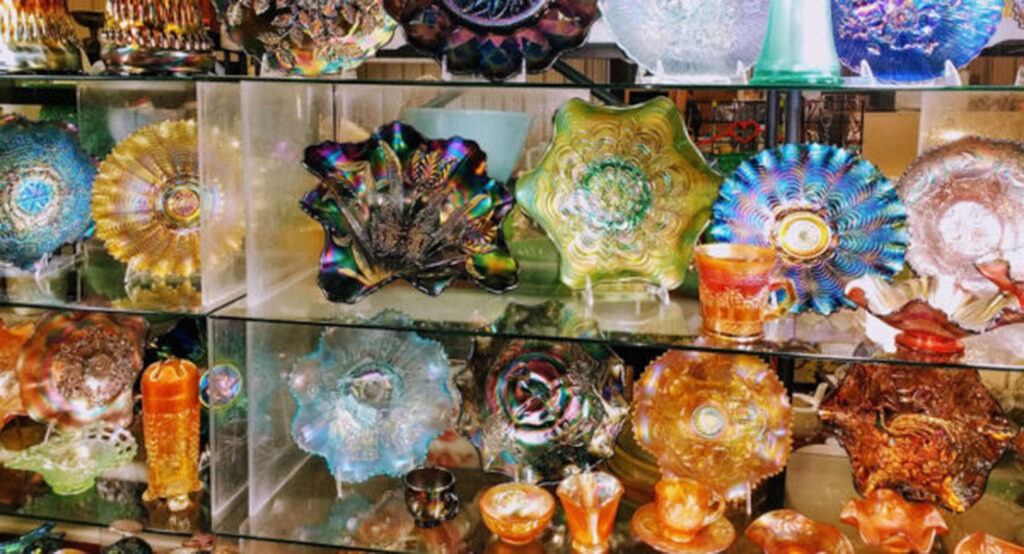
One of the quickest ways to fall in love with carnival glass is to realize it isn’t just an American story. Yes, the look took off in the United States—but the idea traveled. Factories in other countries adopted the same shimmering “everyday luxury” concept and made it their own, shaped by local tastes, local molds, and local markets.
That’s why two pieces can both be “carnival glass” and still feel completely different in the hand. One might be bold and deeply patterned, another sleek and Art Deco, another covered in unmistakably local imagery. If you collect long enough, you start to recognize those regional fingerprints—even before you can put a maker name to them.
This post is a collector-friendly world tour: where carnival glass was made beyond the U.S., what tends to look different from place to place, and a practical checklist you can use when you’re trying to identify an “international” piece in the wild.
The One Thing They All Share: Pressed Glass + Iridescence
Before we talk differences, it helps to remember what ties the category together.
Carnival glass is typically:
- Pressed (molded) glass, formed in a pattern mold
- Given an iridescent surface treatment while the glass is hot (or reheated), producing that shifting rainbow sheen
- Made in both useful forms (bowls, plates, tumblers) and display-worthy pieces (vases, compotes, covered dishes)
So “international carnival” doesn’t mean a different material or a different basic concept. It’s still a marriage of molded pattern and luminous surface—just interpreted through different design traditions.
How Carnival Glass Went Global
The early 1900s were a time when glass companies watched each other closely. If a finish or look sold well in one market, it didn’t take long for other factories to experiment with something similar—especially when the underlying technology (pressed glass production) was already widely used.
There’s also a simple collector reality: glass moved across borders. Some American iridescent pressed wares were exported, and the look also inspired domestic production elsewhere. Over time, collectors grouped many of these related iridescent pressed-glass traditions under the broad, modern umbrella of “carnival glass,” even when original factory catalogs used different naming.
In other words: the category name is modern and convenient—but the glass itself truly did become international.
Britain: Pressed-Glass Tradition Meets Iridescent Style
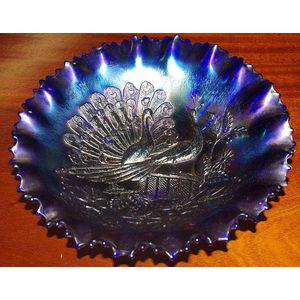
British glassmakers had a long tradition of pressed glass and decorative domestic wares, and you can often feel that lineage in British carnival pieces. Compared with many American examples, British designs can read as:
- a touch more design-forward (especially as tastes shifted into the Art Deco era)
- more likely to show sleeker silhouettes in certain lines
- sometimes found in colorways and finishes that feel distinct from the classic American “marigold everything” starter view
What’s most useful for collectors isn’t memorizing every British maker right away—it’s learning to notice when a piece has a slightly different “design accent.” If the pattern feels more architectural or the form feels more “interwar décor” than “Victorian abundance,” it’s worth exploring a British origin.
Collector tip: look for clues in the base and the mold style
British pressed glass often shows careful mold work. If you see crisp pattern edges, a well-finished base, and a shape that looks like it belongs in an Art Deco sideboard display, put “Britain” on your mental list of possibilities.
Australia: A Distinctly Local Carnival Tradition
If you want the clearest example of a country making carnival glass in its own voice, Australia is hard to beat.
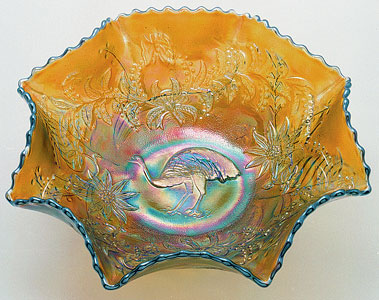
Australian carnival glass is strongly associated with Sydney-area production in the 1920s, and many pieces are decorated with Australian (and sometimes New Zealand) flora and fauna motifs. This isn’t subtle—some designs feature animals and plant emblems that make the origin feel immediately place-specific.
You’ll often see:
- bowls and compotes with raised animal or botanical motifs
- exteriors that may include complementary textures and decorative bands
- colors commonly encountered in warm marigold tones and dark bases with iridescent reflections, with additional color variants existing in smaller numbers
For collectors, the thrill here is that Australian carnival glass can feel like a mini category inside the larger carnival world. You’re not just collecting “pretty iridescent bowls”—you’re collecting a regional design moment.
Why Australian carnival looks different on a shelf
Australian motifs tend to be bold and emblematic. A shelf of grape-and-flower American carnival can be gorgeous, but a single Australian fauna bowl can immediately become the conversation piece because the imagery is so specific.
Continental Europe: Bohemia/Czechoslovakia and Germany
Continental Europe brings two things to carnival glass collecting: a deep decorative-glass tradition and strong 20th-century design sensibilities, especially in the interwar period.
You’ll often find European carnival (broadly defined by collectors) in:
- shapes that lean more Art Deco—cleaner geometry, stylized relief, and forms that feel “modern” compared with older floral abundance
- pieces made for the dressing table and home décor, not only the dinner table (think small lidded forms, bowls intended for vanity use, and display pieces)
Bohemia/Czechoslovakia: pressed-glass expertise and polished finishing
Czechoslovakia (historically part of the Bohemian glassmaking world) produced a large amount of pressed glass, and collectors often note that certain carnival pieces from this region can show very crisp molding and careful finishing, including nicely ground bases.
Germany: bold forms and strong patterning
German pressed glass traditions—especially in the early 20th century—also produced iridescent and lustrous wares that collectors group into carnival conversations. You may see:
- confident Art Deco silhouettes
- strong relief geometry
- colorways that feel slightly different from what you’re used to in American glass
If you’re building an “international carnival” shelf, continental pieces can be the ones that make your display feel less nostalgic-parlor and more design-history.
The Differences That Matter Most to Collectors
International collecting gets easier when you stop chasing every maker name and start watching a few consistent variables.
1) Motif style: local imagery vs. universal motifs
- Universal motifs (grapes, peacocks, roses, geometric fans) show up widely across countries.
- Local motifs (especially Australian flora/fauna patterns) are your fastest “regional tell.”
If the imagery feels culturally specific, that’s your first clue.
2) Form and silhouette
Certain regions lean toward particular looks:
- some lines emphasize ruffled bowls and table-center forms
- others lean into sleeker Art Deco vases, posy bowls, and decorative pieces
- vanity and dresser forms are often a strong hint you’re looking at something beyond the most common American tableware patterns
When you see a piece that looks like it belongs in a 1930s sitting room rather than a dining set, it’s worth considering British or continental origins.
3) Base color behavior and “how the glow sits”
Collectors often notice that the iridescence “behaves” differently from piece to piece. Some looks mirror-bright; some looks softer and pastel; some looks heavy and fiery.
A practical way to judge this without getting technical:
- Does the sheen look like a thin, even rainbow veil?
- Or does it look like a high-contrast metallic flash sitting on the pattern high points?
Both can be correct. The goal is to notice the “finish personality,” because it can help you group pieces and recognize what feels similar.
4) Finishing details: the base tells the truth
When you’re unsure, flip the piece over.
Look at:
- how neatly the base is finished
- whether you see a well-ground foot
- whether the underside shows clean mold work or rougher production marks
This doesn’t prove a country on its own—but it’s one of the best ways to compare two pieces that “feel” different.
5) Registration marks and wording (when present)
Many carnival pieces are unmarked, but when you do find markings, they can be incredibly helpful—especially outside the U.S., where design registration practices often left numbers or wording on certain wares.
A simple approach:
- If you see a registration-style number or country-of-origin wording, treat it as a major clue.
- If you don’t see a mark, don’t panic—most carnival glass still requires pattern-based identification rather than relying on marks.
(We’ll talk much more about identification pitfalls in the later post on fakes and reproductions.)
A Quick “International Spotting” Checklist
Use this as your five-second brain scan at a show or antique mall:
- Is the imagery local and specific? (Australian motifs are a big flag.)
- Does the form feel especially Art Deco? (Sleek geometry can point you toward Britain/Europe.)
- Does the underside show careful grinding/polishing? (Finishing style can help you group likely origins.)
- Does the color palette feel a little outside your usual American mental list?
- Are there registration marks or origin wording?
You won’t be right every time, but you’ll get better fast—and you’ll start to recognize patterns in your own finds.
How to Collect International Carnival Without Getting Overwhelmed
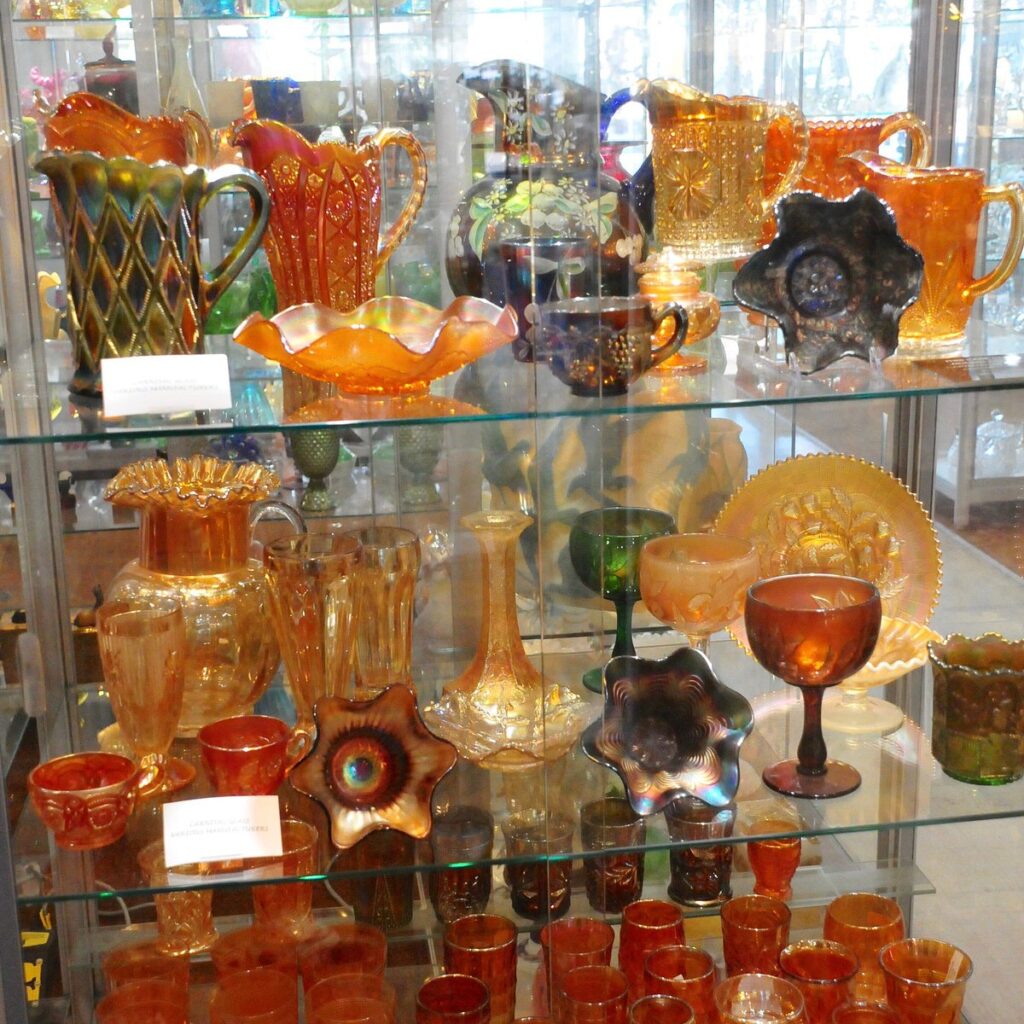
International carnival glass can turn into a rabbit hole, so here are a few satisfying approaches that keep your collection coherent.
Build a “world tour” shelf
Pick one form—say, a ruffled bowl—and collect examples from different regions. The comparison is the point: you’ll start to see differences in mold style, rim shaping, and finish character.
Collect by theme, not by country
Choose a theme (birds, geometric fans, florals) and let multiple countries contribute to it. This keeps your display cohesive while still letting you enjoy the variety.
Let one standout piece lead you
If you fall for one Australian fauna bowl or one sleek European Art Deco form, let that single piece become your “seed.” Build outward from it with pieces that echo its vibe.
International collecting works best when it feels like a story you’re telling on your shelf—not just a pile of pretty shine.
Why These Differences Make Carnival Glass More Fun
Carnival glass is already a category built on light and variation. International makers add another layer: design culture. Two bowls can have the same glow but speak completely different visual languages—one rooted in American abundance, one in British decorative modernity, one in Australian emblematic imagery, one in continental Art Deco geometry.
And once you start seeing those differences, you stop shopping only with your eyes. You start shopping with curiosity.
Let’s Make History—one iridescent world tour at a time.