
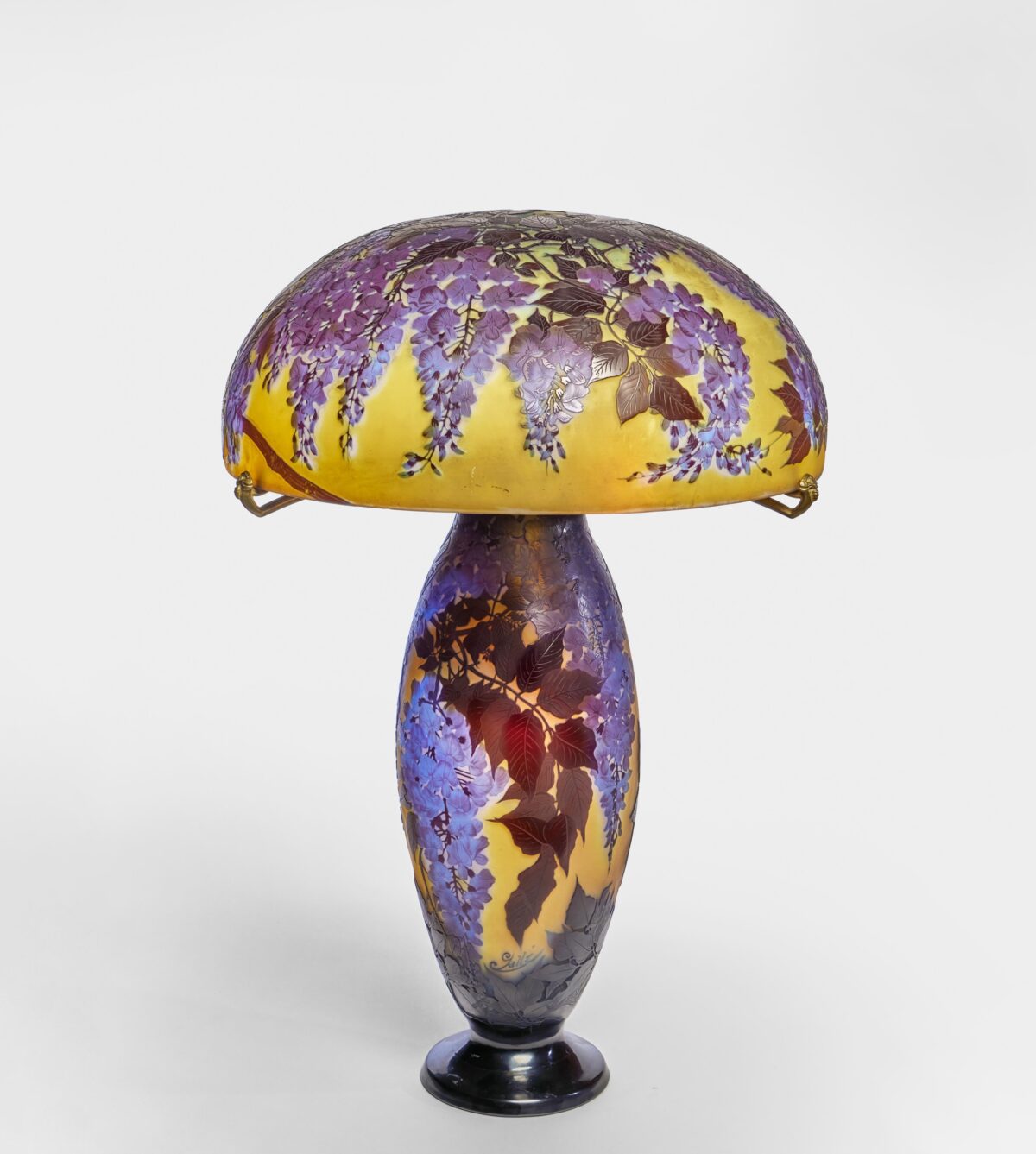
When collectors fall in love with Gallé, it often starts with a single piece of glass: a vase that looks like it’s holding twilight inside it, a dragonfly that seems to hover in the surface, a floral scene carved out of layered color. And then the next question comes quickly—sometimes right at the first antique mall case:
“Was this made during Émile Gallé’s lifetime… or after?”
It’s a fair question, and it’s one of the most important (and most misunderstood) parts of Gallé collecting. Émile Gallé died in 1904, but the story didn’t stop that year. The workshop and brand continued, styles evolved, production shifted with the times, and some later pieces became collector favorites in their own right—especially the lamps.
This post is your practical guide to what “Gallé after Gallé” means: what changed, what stayed consistent, how collectors talk about post-1904 production, and how to shop intelligently without getting lost in signature myths.
Why the “After” Era Matters to Collectors
In many categories, “after the artist” means “lesser.” With Gallé, the reality is more nuanced.
Collectors care about the post-1904 period because:
- The brand continued and produced pieces that are still admired today.
- Some of the most sought-after Gallé lamps are associated with later production.
- The “after” era helps explain why there are so many pieces on the market—and why quality varies so widely.
Most importantly: understanding the continuation keeps you from making two costly mistakes—overpaying for a weak imitation, or passing up a strong piece because it isn’t the earliest possible date.
What Changed After 1904 (and What Didn’t)
When a founder dies, three things tend to shift: leadership, design direction, and how production is organized. Gallé is no exception.
The company continued, but the creative center changed
Émile Gallé was not just a figurehead. He was a driving force—artist, experimenter, and public voice. After his death, the firm continued under family and close associates, and the work remained tied to the Gallé design language, but it naturally moved into a new phase.
The Gallé “look” remained recognizable
Even as styles evolved, collectors still see familiar signatures of the house:
- Nature motifs (florals, insects, landscape moods)
- Layered glass and etched decoration
- A preference for rich, atmospheric color
Production realities became more visible
A major collector distinction isn’t simply “before vs. after.” It’s also unique artistic works vs. pieces made in larger quantities. Gallé pieces can range from intensely personal, hand-finished artistry to more standardized production—still attractive, still collectible, but different in how they were made and marketed.
A Collector’s Timeline (Without Getting Too Technical)
You’ll see a lot of overly tidy timelines online. Real life is messier. But it helps to have a grounded framework.
The lifetime era (through 1904)
These are the pieces most people mean when they say “Émile Gallé”—the period when he was alive and deeply involved. It’s also the era that tends to be associated with the most “founder-driven” experimentation and symbolic intent.
The continuation era (post-1904 into the early 20th century)
After 1904, the workshop continued producing Gallé glass (and other decorative arts). Many collectors treat this as a legitimate continuation of the house style—often still high quality, sometimes different in emphasis.
The later factory-era shifts (especially the 1920s–1930s)
As tastes changed and the world changed (including the economic and cultural impacts of World War I), production and design trends shifted too. Many collectors are especially aware of this later period because of the popularity of mould-blown cameo lamps associated with the firm in the 1920s.
The big takeaway: “after Gallé” is not one thing. It spans multiple decades and multiple market realities.
The Star Signature Question (What It Can Indicate—and What It Can’t)
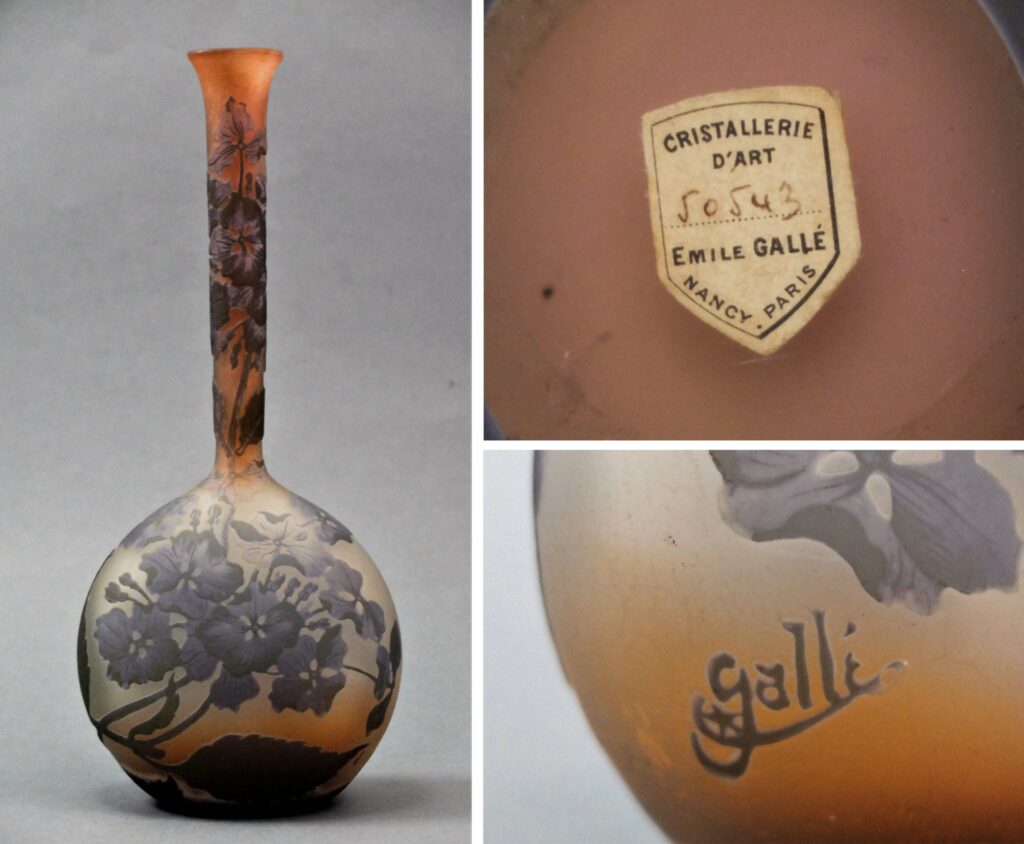
If you’ve spent even five minutes browsing Gallé listings, you’ve probably seen it:
“Signed Gallé with a star—posthumous.”
Here’s the collector-safe version:
- Many references note that some works made after Émile Gallé’s death can appear with a small star near the Gallé signature.
- The star is often discussed as an indicator of post-1904 production, but it is not a universal rule.
- Not all post-1904 pieces are starred, and not every star claim in the wild is reliable without looking at the whole object.
In other words, the star can be a helpful clue, but it should never be the only reason you buy (or the only reason you walk away).
The Biggest Distinction: “The Man” vs. “The Brand”
Gallé collecting works best when you stop thinking in absolutes and start thinking in categories.
Category 1: Founder-era artistic identity
These pieces often feel intensely “of Gallé”—botanical specificity, poetic mood, experimentation, and a certain confidence in how decoration and form work together.
Category 2: Continuing-house production
These can still be excellent. Many have strong design, skilled technique, and the Gallé visual language. They may be more standardized, but they’re often still very beautiful—and for some collectors, more attainable.
Category 3: “In the style of” (honest homage)
There are later pieces that borrow the look without trying to deceive. These can be charming decorative objects, but they should be priced as later, style-inspired work—not as Gallé.
Category 4: Misattributions and fakes
Because Gallé is famous, it is also heavily copied. This is where the buyer needs to slow down.
How to Shop the Post-1904 Market Without Getting Burned
The “after” era can feel tricky because it sits at the intersection of real continuation and a crowded imitation market. These habits help.
Start with overall quality, not the signature
A strong Gallé-associated piece tends to show:
- Cohesive design (form and decoration feel made for each other)
- Confident decoration (clean transitions, intentional depth, believable shading)
- A surface that looks worked, not printed-on
If a piece looks clumsy but has a dramatic signature, treat the signature as a sales tactic until proven otherwise.
Compare the base and pontil area
Collectors often flip Gallé glass over immediately. A base that looks unnaturally flat, overly smooth, or inconsistent with the rest of the piece can be a caution sign. This isn’t a single “gotcha,” but it’s a useful part of the whole-object check.
Learn the feel of “good cameo” versus “cameo-like”
Post-1904 Gallé-associated pieces can still show excellent cameo work. The giveaways of weaker work tend to be:
- Flat-looking relief with little nuance
- Muddy outlines where motifs don’t read cleanly
- Texture that looks uniformly sandblasted rather than artistically finished
If cameo is your focus, handling a variety of pieces in person is one of the best “education shortcuts” you can give yourself.
Lamps in the Later Era: Why Collectors Chase Them
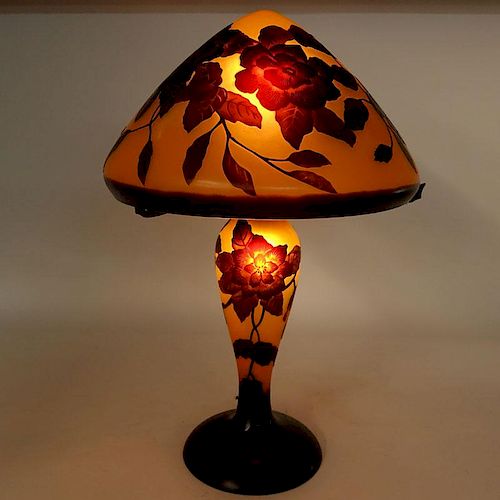
If you’ve noticed Gallé lamps dominating high-end listings, you’re not imagining it. Collectors often treat lamps as a centerpiece category, and many are associated with later production.
Why lamps are especially collectible:
- The glowing light brings out cameo depth and etched shading.
- Nature motifs (wisteria, blossoms, leaves, insects) feel alive when illuminated.
- Lamps often represent “maximum Gallé” in a room: design + mood + function.
Practical lamp note: because lamps involve mounts, sockets, and wiring, condition and safety evaluation matter more than with a vase. A lamp can be authentic and still require careful updating or conservation.
The Most Common Pitfalls in “After” Listings
Here are the patterns that cause the most collector regret.
“Star = authentic” shortcuts
The star can be relevant, but it isn’t a magic pass. Some listings lean on the star to avoid discussing the actual quality of the piece. Always bring the conversation back to form, decoration, and construction.
Overconfident date claims
If a listing gives an exact year without strong documentation, treat it as an estimate. A more trustworthy seller will describe the piece in terms of era and attributes, not just a confident date.
Fancy words that replace evidence
Phrases like “museum quality,” “rare,” and “exceptional” are common. What matters is whether the seller can show:
- Clear, detailed photos (especially of signature, base, rim, and relief)
- Accurate measurements
- Honest condition notes
- A believable explanation of why the piece is attributed the way it is
Condition Checklist for the Post-1904 Buyer
Whether you’re buying early or late, condition is value. But the post-1904 market has an extra twist: a lot of pieces are bought for display, and damage can be easy to miss in glamorous photos.
Glass (vases, bowls, decorative pieces)
- Rim chips (even tiny ones)
- Base nicks and stability
- Cracks and internal fractures (check with bright light)
- Evidence of repairs (glue sheen, filled chips, suspiciously “perfect” edges)
Lamps
- Stress around openings and mount points
- Condition of the shade rim and fitter
- Stability and alignment of hardware
- Wiring status (rewiring is common and often sensible for safety)
Signatures and marks
- Do wear patterns look consistent? (signature area shouldn’t look brand-new if the rest shows age)
- Is the signature integrated into the surface finish?
- Is placement believable? (often near base, lower body, or a discreet area)
Collecting the Continuation Era with Confidence
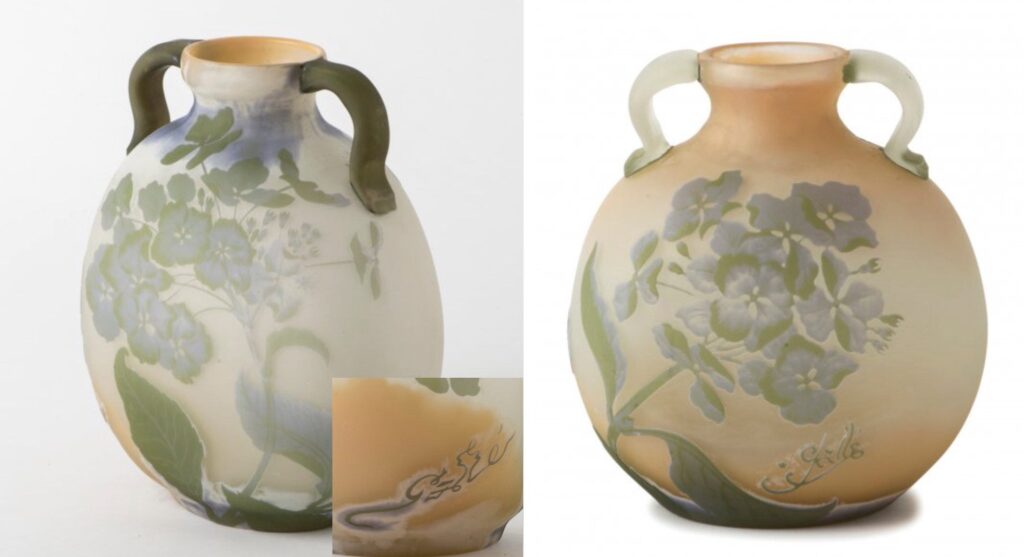
If you love Gallé, the continuation era isn’t a compromise—it’s a collecting strategy.
A few satisfying ways to approach it:
- Build a “house style” collection: choose pieces that clearly share Gallé design language, regardless of exact year.
- Collect by motif: wisteria, dragonflies, thistles, forest landscapes—let the theme guide you.
- Make lamps your centerpiece: then add smaller pieces that echo the same palette and imagery.
- Buy quality first: if the piece is beautiful and well made, it will remain desirable even if the attribution conversation gets nuanced later.
If you keep the focus on craftsmanship and cohesion, you’ll end up with a collection that feels unmistakably Art Nouveau—whether it was made before 1904 or in the decades that followed.
Let’s Make History—one legacy piece at a time.