Scrimshaw is often introduced as “whalers’ folk art,” but that phrase can be almost too neat. These pieces weren’t made in calm studios with clean tools and steady light. They were made on working ships—on voyages that could last years—by people who lived in cramped quarters, ate what the ship could carry, and learned to measure time by watches, weather, and the next sighting.
That’s why scrimshaw has such pull for collectors. Yes, it’s beautiful. Yes, it’s skilled. But more than that, it’s intimate. The best scrimshaw pieces feel like small, portable diaries: ships and whales, distant ports, sweethearts, jokes, prayers, flags, flowers, and symbols that meant something to the person who cut them into ivory or bone.
This post looks at scrimshaw as a kind of primary-source snapshot—what it can tell us about shipboard work, emotion, travel, identity, and the everyday texture of maritime life.
Why Scrimshaw Feels So Personal
Most antiques tell you something about the time they came from. Scrimshaw often tells you something about a specific person.
Even when the imagery is “common” (a ship under sail, a portrait, a heart), the act of making it is personal. Someone chose a surface, smoothed it, planned a design, and spent hours cutting lines that would only come alive when ink or pigment settled into the grooves. That time investment is part of the message.
Scrimshaw also tends to preserve the small, human details that formal history skips:
- nicknames, initials, and dates
- heartfelt (and sometimes misspelled) inscriptions
- handmade borders and decorative flourishes
- tiny “corrections” where the maker re-cut a line or adjusted a curve
Those imperfections are often the best part. They’re fingerprints.
Ships as Autobiography: What Sailors Knew Best
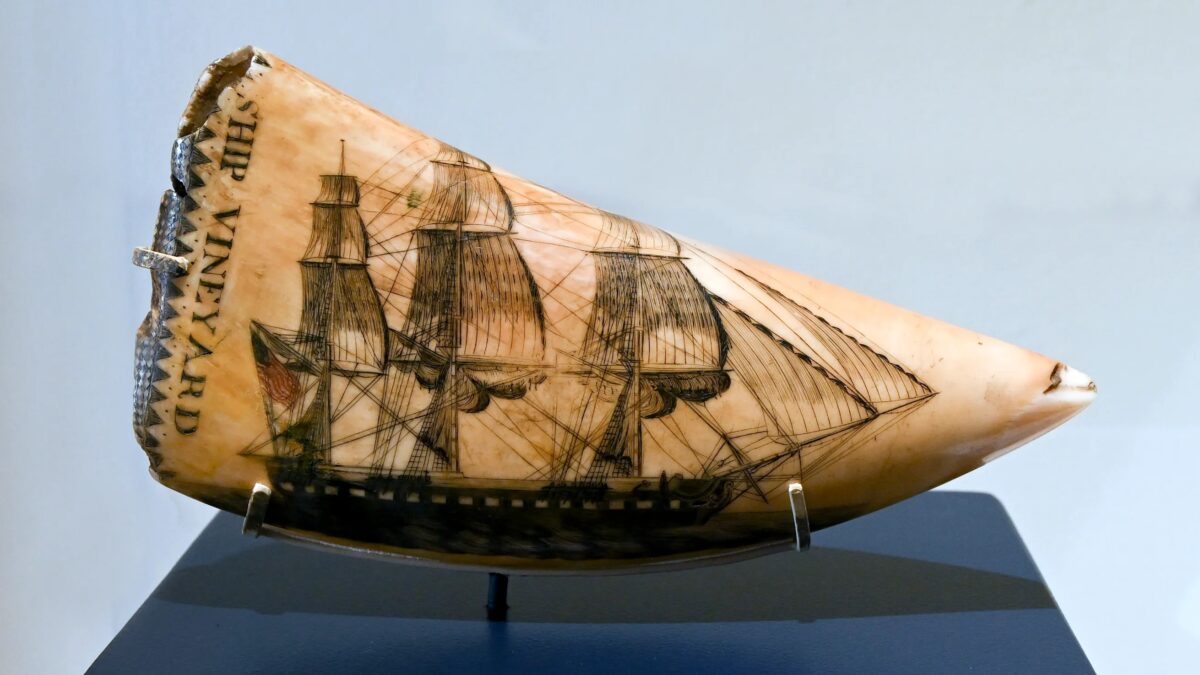
If you spend your life on a ship, the ship becomes your landscape. That’s why ship portraits show up again and again in scrimshaw—and why they can feel so convincing even when the art is simple.
Rigging, sails, and ship types
Even a folk-art rendering can reflect lived knowledge: the set of the sails, the angle of the masts, the way flags fly, the posture of a hull in the water. Some pieces seem almost like proud “portraits” of a vessel—whether it’s the maker’s own ship or an admired ship encountered at sea.
The sea as mood
Many scrimshaw ship scenes aren’t just “a boat.” They’re weather, movement, loneliness, freedom, danger, or calm. Waves, clouds, and horizon lines become emotional shorthand—especially when shading and stippling make a simple scene feel atmospheric.
Collector note: When you see a ship scene that uses the curve of the tooth well—so the ship feels like it’s sailing through the object instead of sitting awkwardly on top of it—you’re seeing a maker who understood both the sea and the medium.
Whaling Scenes: Work, Risk, and Routine
Scrimshaw’s origins are tied to whaling, and many pieces preserve what that work looked like from the deck: whales, boats, chase scenes, and sometimes the quieter moments between action.
Action scenes
Chases, boats closing in, tails breaking the surface—these images capture the drama that defined the industry and the danger that every crew member understood. Even when the scene is stylized, the basic tension is recognizable.
Work scenes and process clues
Not every whaling image is a chase. Some pieces hint at the broader reality: the ship waiting offshore, multiple boats, a whale in the distance, or the kind of “diagram-like” clarity that suggests the maker wanted to record what the work was, not just how dramatic it looked.
These scenes can be grim to modern eyes, and it’s okay to hold that complexity. Scrimshaw often sits at the intersection of human creativity and an industry that inflicted enormous harm. Collectors can appreciate the artifact while still acknowledging the cost behind it.
Home, Longing, and Love Tokens
Some of the most powerful scrimshaw images have nothing to do with whales. They’re about home.
Sweethearts and portraits
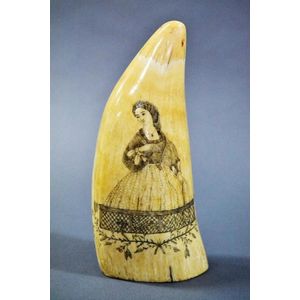
Portraits of women—sometimes individualized, sometimes idealized—appear frequently. Whether they were drawn from memory, imagination, or copied from prints, they speak to absence and longing. A sailor’s world was overwhelmingly male, hard, and confined. The portrait becomes a window into what the maker missed or hoped for.
Hearts, flowers, and inscriptions
Hearts and floral motifs show up as direct emotional language: “I remember you.” “I’m coming back.” “This is mine and yours.” Names, dates, initials, and sentimental phrases are the closest thing scrimshaw has to a signature diary entry.
Gifts with everyday intimacy
Scrimshaw wasn’t only “art objects.” Some pieces were made as gifts meant to be used or worn. When you see a form associated with clothing or personal items, it’s a reminder that maritime life wasn’t sealed off from the home world—it was in constant conversation with it through letters, gifts, and mementos.
Symbols of Identity: Patriotism, Faith, and Fraternal Emblems
Scrimshaw imagery often turns into a kind of badge. On a ship, identity could be complicated—rank, origin, religion, and affiliation mattered. Symbols helped compress that identity into something portable and recognizable.
Patriotic imagery
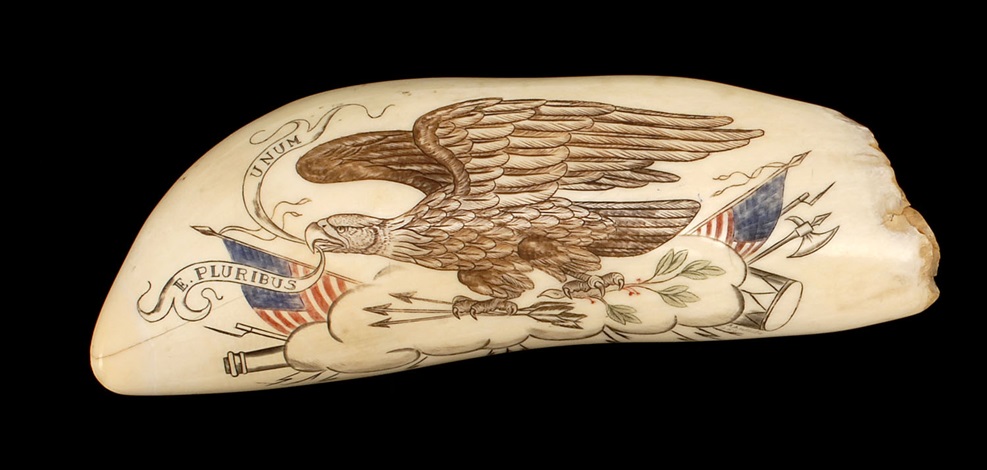
Flags, eagles, banners, and other national motifs show up often. Sometimes they read as pride, as comfort, or as a declaration: “This is where I belong,” even while far from land.
Faith and protection
Life at sea could be brutal and uncertain, and it’s not unusual to see religious motifs, moral sayings, or symbols that feel protective. Even an anchor—common in nautical imagery—can carry layered meaning: stability, hope, safety, endurance.
Fraternal symbols and personal codes
Geometric emblems, tools, crests, and formal symbolic layouts can suggest affiliation or personal significance. Even when we can’t identify a symbol with certainty, the style often tells you the maker intended it to mean something beyond decoration.
The Wider World: Ports, Travel, and Cultural Exchange
Whaling and maritime trade connected people to places many at home would never see. Scrimshaw sometimes records that reach.
Harbors and faraway shorelines
Harbor scenes, shore profiles, palm trees, or “port life” vignettes can act like souvenirs—visual proof that the maker was there, saw that, lived through that. Sometimes these images feel observational; other times they reflect the popular printed imagery of the day.
Borrowed images from print culture
Ships carried books, pamphlets, newspapers, and printed illustrations. Many scrimshaw designs were inspired by—sometimes closely copied from—images that circulated widely. This is one reason you may see a scrimshaw portrait that resembles a formal engraving, or an emblem that looks like it came from a certificate, a broadside, or a decorative print.
Collector note: “Copied from print” doesn’t make a piece less interesting. It can actually make it more revealing, because it shows what images were accessible, admired, or meaningful to sailors at that moment in time.
Humor, Whimsy, and the Sailor Imagination
Not all scrimshaw is solemn. Some of it is playful—sometimes surprisingly so.
Mermaids, mythical creatures, exaggerated figures, jokes, and odd little scenes remind us that sailors were not only workers in a dangerous industry. They were people entertaining themselves, telling stories, making fun of each other, and passing long stretches of time with whatever creativity they could scrape together.
If you’re a collector, whimsical scrimshaw can be a joy because it feels closest to a living voice: not “history,” but personality.
Reading a Piece Like a Collector (Without Overclaiming)
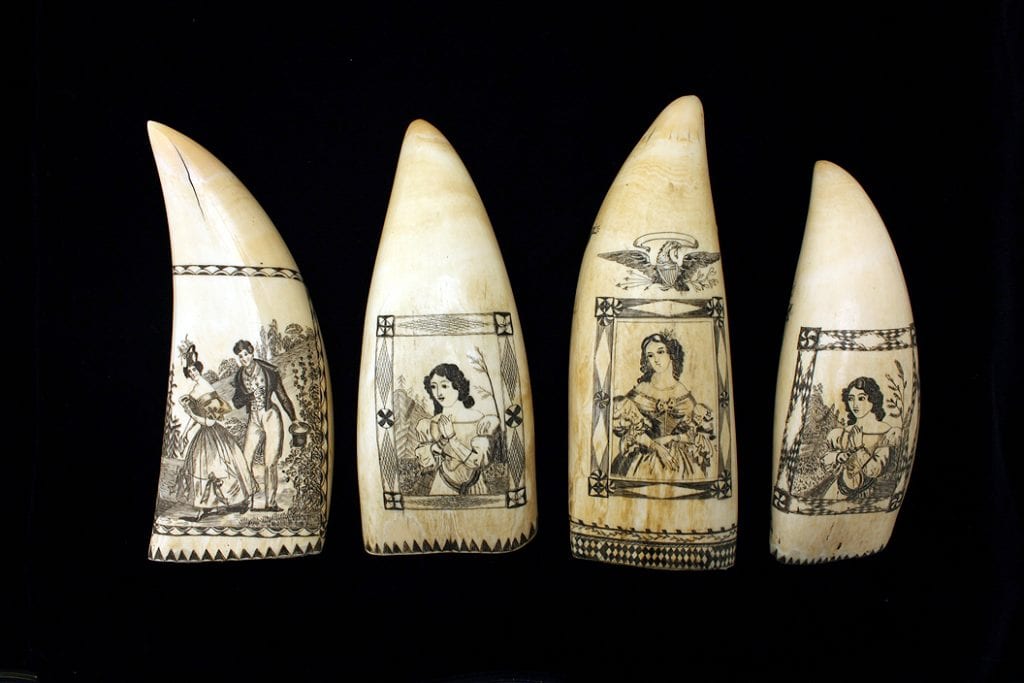
It’s tempting to look at scrimshaw and want it to be a perfect historical document: “This is the ship he sailed on,” “This is his wife,” “This is the day they made port.” Sometimes you can get close—especially when there are names or dates. But scrimshaw is often a blend of memory, imagination, and borrowed imagery.
A good collector habit is to read what’s there without forcing certainty.
Questions to ask the object
- Is the scene documentary (a chase, a ship portrait) or symbolic (a heart, an anchor, an emblem)?
- Does the imagery feel firsthand (rigging detail, work scenes) or more like print culture (formal portrait poses, decorative compositions)?
- Are there inscriptions—names, initials, dates, place references—that can be read plainly?
- Does the design use the material’s shape thoughtfully, suggesting planning and familiarity?
What scrimshaw can reliably tell you
Scrimshaw can often tell you about:
- popular maritime imagery and symbols
- emotional themes sailors returned to again and again
- the way people tried to keep home present while far away
- the mix of labor and downtime that shaped shipboard life
- the influence of print culture and shared iconography
It may or may not tell you a verifiable biography of one person. But it almost always tells you what mattered.
Why This Matters: Scrimshaw as a Human Record
It’s easy to reduce maritime history to big ideas: commerce, industry, fuel, war, exploration. Scrimshaw pulls the focus back down to the scale of a single hand holding a needle or knife.
A carved tooth or bone panel can hold:
- the pride of a ship under sail
- the fear and excitement of the hunt
- the ache of missing home
- the comfort of symbols and faith
- the curiosity of distant shores
- the simple need to make something beautiful in a hard place
That’s what makes scrimshaw such a compelling collectible category. It isn’t only maritime history—it’s maritime life.
Let’s Make History—one sea story at a time.