
One of the most captivating things about scrimshaw is that it’s rarely “just decoration.” These pieces were made by people who lived at sea for months—or years—at a time, and the images they chose often reveal what they missed, what they feared, what they admired, and what they wanted to remember.
Collectors sometimes fall in love with scrimshaw for the craftsmanship first: the fine lines, the patient shading, the way pigment settles into a cut so clean it still reads centuries later. But the real hook is the imagery. Scrimshaw is storytelling—sometimes documentary, sometimes romantic, sometimes symbolic, and sometimes surprisingly whimsical.
This post explores the most common themes you’ll see in traditional scrimshaw, what those images may have meant to the sailors who carved them, and how collectors can “read” a piece with more confidence.
Why Scrimshaw Images Look the Way They Do
Scrimshaw was created in a very particular environment: long whaling voyages, limited tools, and a lot of time. That combination shaped the art in a few predictable ways.
- Bold, readable composition: Many designs are built to be understood at a glance—strong outlines, clear focal points, and scenes that fit the curved surface of a tooth or the narrow strip of a busk.
- A mix of memory and reference: Some sailors drew from firsthand experience (ships, rigging, whaling action). Others borrowed from printed sources—book illustrations, popular engravings, newspapers, sheet music covers, and other widely circulating imagery.
- Symbolic shorthand: Certain motifs—flags, hearts, stars, anchors, wreaths—carry meaning without needing a caption.
The result is a visual language that feels both personal and widely recognizable within the scrimshaw world.
Ships: The Most Iconic Subject of All
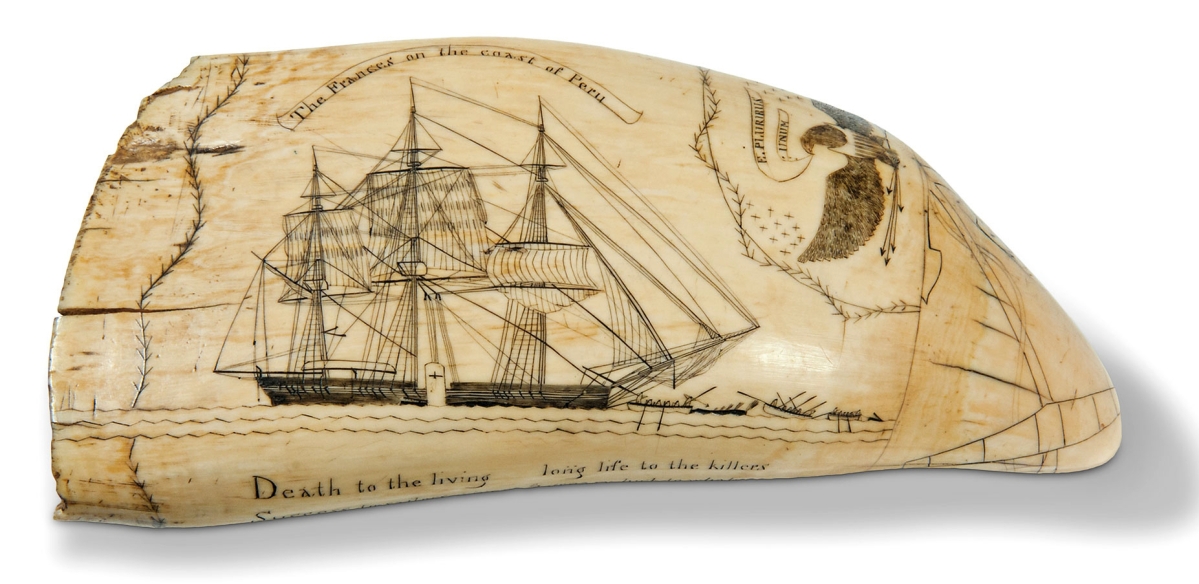
If scrimshaw had a “default image,” it would be a ship under sail.
Ship portraits
Ship portraits are common because sailors knew ships intimately. Even when the drawing is folk-art simple, you’ll often see loving attention to details: masts, sails, flags, hull lines, and sometimes a surprisingly accurate sense of proportion.
Collector tip: Ship portraits can be especially appealing when they feel specific—named vessels, distinctive sail plans, or details that suggest the artist had real familiarity with the subject.
Ships in motion
Beyond straightforward portraits, you’ll also see ships battling waves, sailing into a harbor, or anchored offshore. These compositions let the scrimshander show off movement: wind-filled sails, dramatic seas, and clouded skies created through cross-hatching or stippling.
Whales and Whaling Scenes: Work Turned into Art
Scrimshaw came out of the whaling world, so it’s no surprise that whales appear frequently—sometimes as the main event, sometimes as part of the background.
The hunt
Classic whaling scenes can include:
- A whale breaching or sounding
- A whaleboat in pursuit
- The chaos and drama of a chase
- A ship in the distance, waiting
These scenes tend to draw collectors because they’re both visually dramatic and historically rooted. They’re also often the most “insider” imagery—because sailors knew the action, the tools, and the tension firsthand.
The whale as a symbol
Sometimes whales are less documentary and more emblematic: a single whale beneath a ship, a stylized tail, a creature rendered almost like a heraldic figure. These pieces can feel quieter—more like a personal badge than a narrative scene.
Patriotic and National Symbols
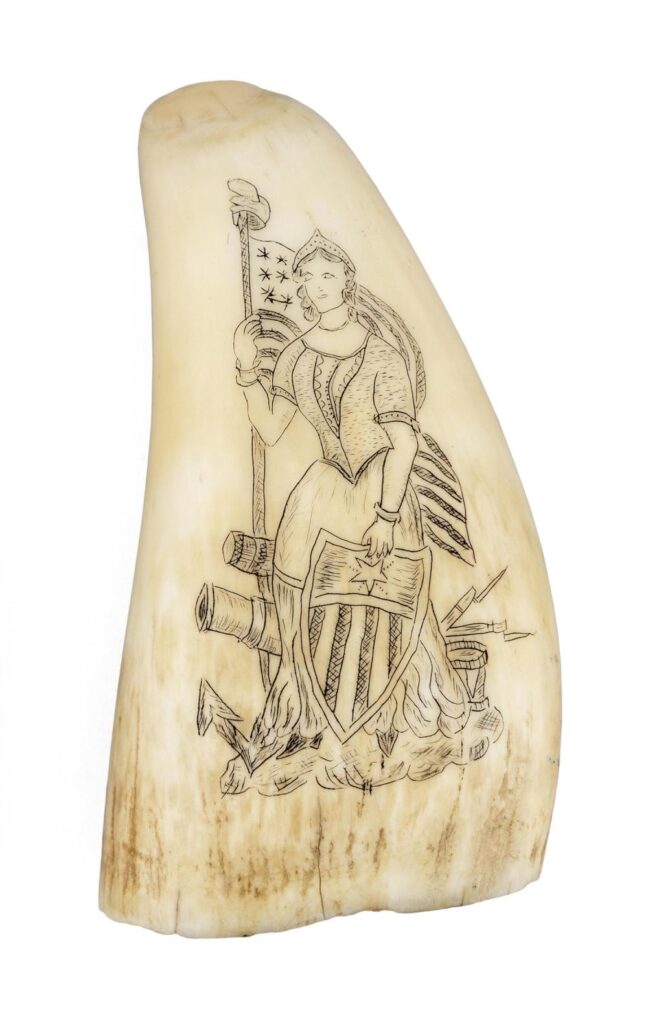
Patriotic motifs show up often, especially in pieces that were intended as keepsakes or gifts. You’ll see imagery that signals identity, allegiance, or pride—sometimes tied to a nation, sometimes to a broader ideal.
Common patriotic themes include:
- Flags
- Eagles or crests
- Liberty-style figures
- Wreaths, laurel, and banners
- Commemorative text or dates
Collector note: Patriotic imagery can be a clue that a piece was meant for display at home, not just personal enjoyment onboard. These designs often read like “presentation pieces.”
Portraits: Sweethearts, Family, and Famous Faces
Portraits are where scrimshaw often becomes deeply human. Many scrimshaw portraits are believed to represent sweethearts or idealized “ladies” drawn from popular prints and fashion imagery. Some feel individualized; others resemble a generalized romantic type.
Women as memory and longing
Portraits of women—sometimes alone, sometimes in a framed vignette—often appear alongside hearts, floral motifs, or poetic text. Whether a portrait represents a specific person or a culturally familiar “ideal,” the emotional tone tends to be clear: this is the world the sailor is dreaming of.
Men, leaders, and notable figures
Portraits of men do appear too, sometimes reflecting national pride or admiration. These may be easier to connect to published portrait sources, particularly if the pose and clothing mirror popular engravings.
Collector tip: Portrait scrimshaw is a great place to look for technique—shading in hair, subtle contouring, and how the scrimshander handles faces and hands.
Love Tokens: Hearts, Flowers, and Poetic Messages
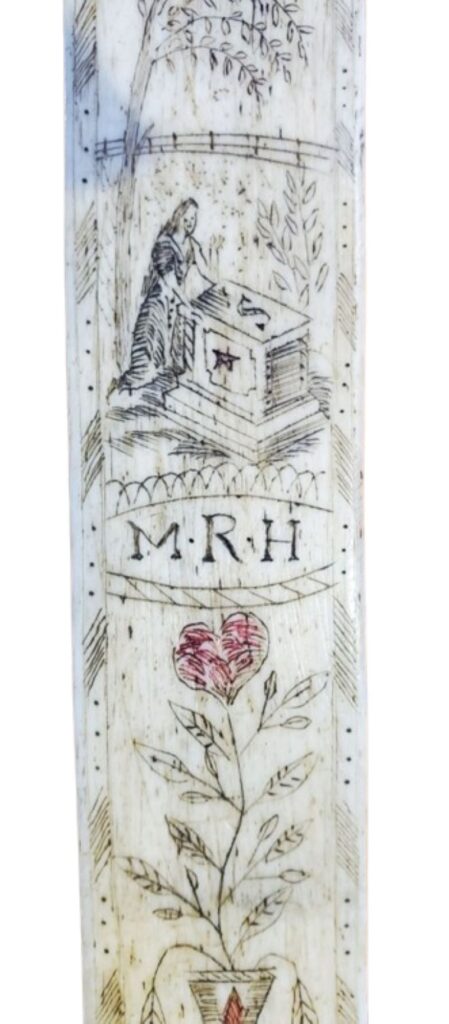
Some of the most touching scrimshaw pieces were made as gifts—especially on objects meant to be worn or used, such as corset busks. The imagery can be overtly romantic.
Common love-token motifs:
- Hearts and entwined initials
- Flowers and vines
- Birds (sometimes doves)
- Houses, churches, and symbolic “home” imagery
- Short poems, verses, or sentimental inscriptions
These are the pieces that often feel the most like direct communication across distance: “I’m here, I’m thinking of you, I’m coming back.”
Collector note: Text and inscriptions can add both charm and complexity. Spelling quirks, uneven lettering, and imperfect grammar are common and often part of the authenticity and folk-art character.
Faith, Protection, and Moral Imagery
Life at sea was dangerous and uncertain, and it’s not unusual to find scrimshaw with religious or protective themes.
This can include:
- Crosses or biblical references
- Angels or symbolic protective figures
- Moral sayings or virtue-based text
- Nautical “protection” imagery like anchors or guiding stars
These pieces can read like talismans—objects that carry reassurance and meaning when everything else feels unpredictable.
Fraternal and Symbolic Motifs
Some scrimshaw includes symbols associated with fraternal or social organizations—designs that function as insider language. Even when you can’t identify a symbol precisely, you can often recognize the intent: membership, connection, belonging.
Collector tip: When you see geometric emblems, tools, or formal symbolic layouts, consider that the image may reference an organization, trade identity, or personal code rather than a literal scene.
Maps, Ports, and the Wider World
Scrimshaw is also a record of travel. Whalers and sailors saw places many people back home never would, and some designs capture that sense of reach.
You may encounter:
- Simple map-like outlines
- Harbor scenes
- Exoticized “port life” vignettes
- Palm trees, coastal structures, and shoreline profiles
These images can be especially interesting when paired with inscriptions or dates, because they hint at the route of a voyage—even if the exact location isn’t stated.
Collector note: “Exotic” imagery can reflect the sailor’s lived experience, but it can also reflect the era’s popular stereotypes and printed sources. These designs are historically informative, but they’re not always neutral or accurate representations of the cultures depicted.
Sea Lore: Mermaids, Monsters, and Maritime Whimsy
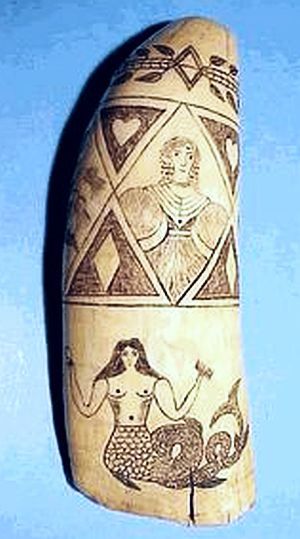
Not all scrimshaw is serious. Some of it is playful, imaginative, or mythic—especially when the maker leaned into sailor folklore.
Common whimsical themes include:
- Mermaids
- Sea monsters
- Mythical figures
- Fantastical ships or dreamlike scenes
These pieces can be collector favorites because they feel like pure creativity—less documentary, more personal mythology.
Decorative Borders and Pattern Work
Sometimes the main “theme” is design itself. Borders, geometric fills, repeated motifs, and ornamental framing show up frequently, especially on slender objects like busks.
You’ll see:
- Rope-like borders
- Zigzags and crosshatch fills
- Floral framing
- Starbursts and compass-like geometry
Collector tip: Pattern work can be an excellent indicator of patience and planning. Even when the central image is simple, an intricate border often signals a maker who cared deeply about presentation.
How Collectors Can “Read” a Scrimshaw Scene
You don’t need to be an expert to interpret scrimshaw, but a few collector habits can help.
Look for narrative clues
- Is this a moment (a chase, a meeting, a farewell) or a symbol (a flag, an anchor, a crest)?
- Does the image feel like it came from firsthand knowledge (rigging detail, ship proportions) or from a copied print (formal portrait pose, decorative framing)?
Pay attention to composition
- Teeth are curved—does the design use that curve well?
- Is the scene framed like a picture, or does it wrap naturally?
Notice what’s emphasized
Scrimshaw choices are revealing. A piece that focuses on home imagery tells you something different than one focused on whaling action. Neither is “better”—they’re different windows into the maker’s world.
Why Themes and Imagery Matter for Collecting
Scrimshaw collecting isn’t only about rarity and condition. It’s about connection. The imagery is where the personality lives, where the voyage becomes real, where the object stops being just “a carved tooth” and becomes a story you can hold.
When you learn the common themes—ships, whales, patriotism, portraits, love tokens, faith, travel, folklore—you start to see scrimshaw as a visual diary of maritime life. And that makes every piece more interesting, even before you get into fine details like technique and material.
Let’s Make History—one scrimshaw story at a time.