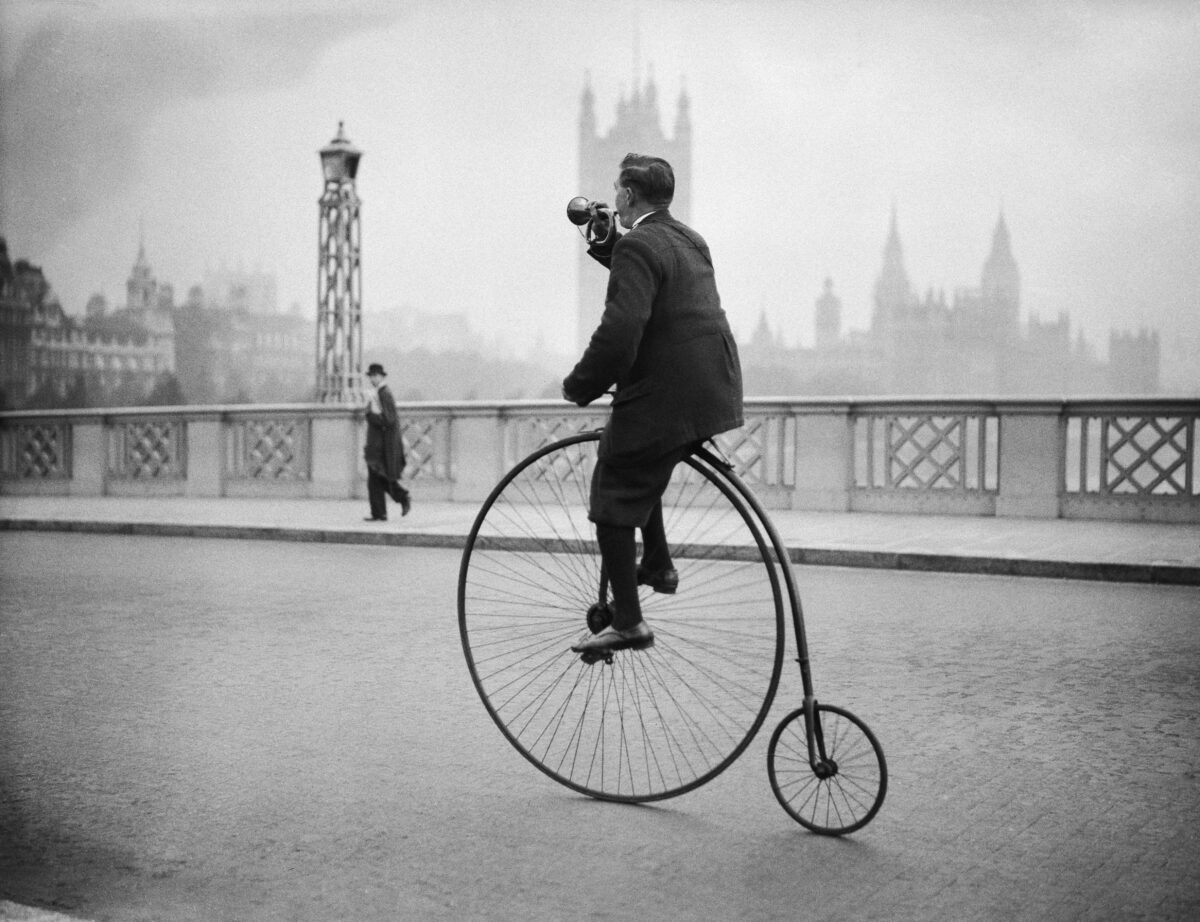
Imagine gliding down a Victorian lane perched atop a wheel taller than most people. The high-wheel bicycle – better known as the penny-farthing – was more than just an eye-catching way to get around. In the late 19th century, this quirky cycle with one giant wheel and one tiny wheel embodied innovation, status, and a dash of daredevil pride. Fast-forward to today, and antique penny-farthings are beloved collector’s items, restored and displayed with the same awe they inspired over a century ago. In this post, we’ll explore how the penny-farthing was invented and how it worked, the cultural pride it sparked in its heyday, and what it’s like to collect these high-wheel wonders now.
A Daring Design: Birth of the High-Wheel Bicycle
The penny-farthing didn’t appear out of thin air – it evolved from earlier bicycles (like the clunky “boneshaker” velocipedes of the 1860s) in a quest for speed and smoother rides. By around 1869–1870, inventive minds in Europe were crafting a new kind of bicycle with an absurdly large front wheel. Frenchman Eugène Meyer and Englishman James Starley (of Coventry) were among the pioneers who realized that a bigger wheel = a faster bike. Why? In an era before modern bike chains or gears, the pedals were attached directly to the wheel hub. One turn of the pedals meant one turn of the wheel – so a larger circumference traveled further with each pedal stroke. Starley’s aptly named “Ariel” high-wheeler (launched in 1870) became a popular model, and similar designs soon spread across Britain, the U.S., and beyond.
That enormous front wheel (often 50–60 inches in diameter) wasn’t just for show. Its size helped smooth out the ride on rough 19th-century roads – a big wheel rolls over bumps more easily than a small one. The rear wheel, by contrast, was a tiny trailer (sometimes under 20 inches) mainly there for balance. This comically uneven pair of wheels reminded people of the large British penny coin and the small farthing coin, inspiring the nickname “penny-farthing.” (Back then it was often simply called an “ordinary bicycle,” especially after new designs came along.)
Mechanically, penny-farthings were simple yet ingenious. The frame was usually wrought iron or steel, shaped in a graceful curve to support the giant wheel. Long metal spokes under tension gave the wheel strength without too much weight, and solid rubber tires helped absorb shocks (a big improvement over the wood-and-iron bone-shakers that rattled riders’ bones!). There were no chains, no multiple gears – just a direct-drive front crank. Some high-wheel models introduced innovations like hollow steel tubing (to cut weight) or ball bearings in the hubs for easier rolling. A few even experimented with gear mechanisms: for instance, the rare “Kangaroo” model used gears to allow a smaller front wheel, but by and large, the classic towering wheel reigned supreme in the 1870s and early 1880s.
Riding Tall: How Did the Penny-Farthing Work?
Riding a penny-farthing was equal parts skill, courage, and showmanship. First, you had to mount the thing: imagine trying to hop onto a bicycle seat that’s four or five feet off the ground! High-wheelers came with a small step peg above the back wheel. A rider would grip the handlebars, put one foot on the step, push off running, and then swing the other leg up over the saddle in a smooth (hopefully) leap. It took practice – and a bit of guts – to get it right. Dismounting could be even trickier, especially in a sudden stop.
Once perched up high, the rider sat almost on top of the big wheel, with knees just below the handlebars. This lofty riding position gave a great view of the road (you literally towered above pedestrians and horse carriages), but it also meant your center of gravity was high and forward. Steering was done by leaning and by turning that massive front wheel with the handlebars – which, while pedaling, also meant your arms felt every wobble of each power stroke.
Seasoned riders learned to lean slightly back on descents and keep legs ready to brace, because the biggest danger was the infamous header: if anything stopped the front wheel (a rock, a rut, or abrupt braking), the whole bike acted like a catapult and flung the rider head-first over the front. Ouch! (The Victorian slang “taking a header” was born from these accidents.) Injuries like broken wrists or worse were common for unlucky wheelmen who hit an obstacle or took a spill. There was usually a rudimentary brake – often a lever that pressed a pad against the tire – but with a high center of gravity, sudden braking was a double-edged sword.
Despite the risks, for many riders the thrill outweighed the fear. A well-built penny-farthing could actually be pleasantly smooth and surprisingly fast. With those huge wheels, experienced cyclists could maintain impressive speeds on flat roads. Enthusiasts in the 1880s often raced high-wheelers on track ovals and road courses, pushing these machines to their limits. Imagine the spectacle of a race in 1885: a dozen daredevils looping around, legs pumping furiously atop gigantic wheels, coattails flapping – it must have been a sight to behold!
Status, Speed, and Society: High-Wheelers in Victorian Life
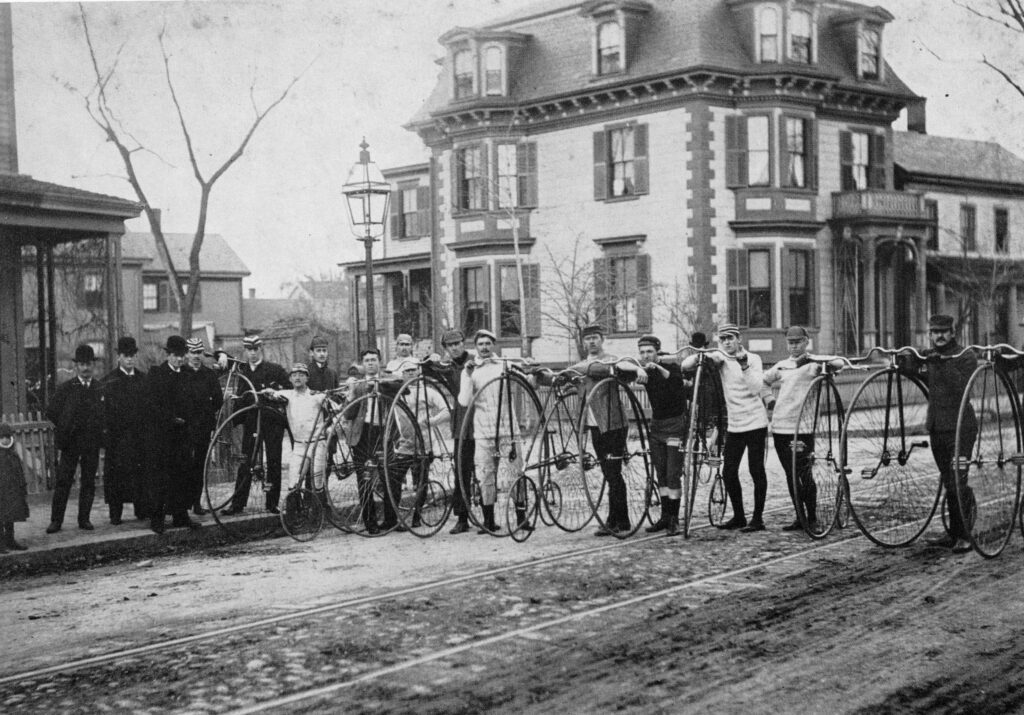
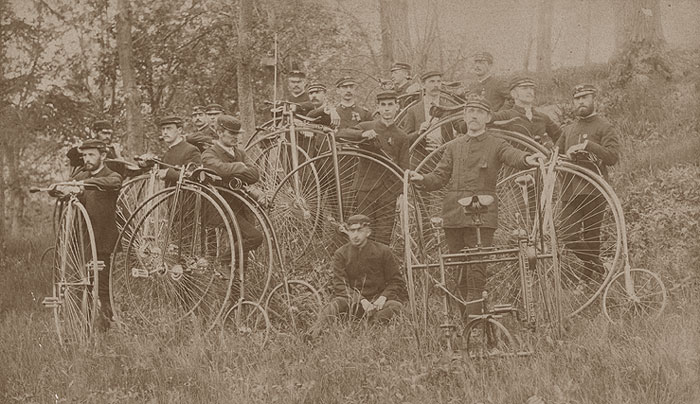
In the late 19th century, owning and riding a high-wheel bicycle wasn’t just a hobby – it was a status symbol and a lifestyle. These machines cost a pretty penny (no pun intended): a top-quality penny-farthing could equal several months’ salary for a working man. Naturally, it was mostly wealthy young men who took up high-wheel biking. If you were a strapping gentleman of the 1880s with a taste for adventure, a high-wheeler was your ticket to modern thrills. You’d join fellow riders in cycling clubs that organized group rides, races, and social meet-ups. In cities and towns, bicycle clubs (often called “Wheelmen” clubs) sprouted up, complete with their own uniforms and caps. Riding together in formation down the boulevard, the wheelmen turned heads everywhere they went.
Why did the penny-farthing scene skew so heavily male? Aside from the cost and physical demands, the Victorian social norms of the day frowned on women straddling such a high device (and doing so in long skirts, nearly impossible!). High-wheelers were seen as the realm of bold young men, a chance to show off one’s strength and courage. Mastering this precarious bicycle gave riders a certain bragging rights – it was proof you had skill and nerve. Contemporary accounts often mentioned the athleticism required. It’s no surprise that images from the era show groups of riders posing proudly with their big-wheel bicycles like trophies.
High-wheel bicycles also carried the spirit of modern mobility. For the first time in history, an individual could travel long distances on land swiftly without a horse or a train – purely under their own power. This was revolutionary! Enthusiastic cyclists even undertook long-distance tours: famously, adventurer Thomas Stevens set out in 1884 and became the first person to bicycle around the world, much of it on a Columbia penny-farthing. Such feats captured the public’s imagination and lent the bicycle an aura of progress and possibility. Cities began to take cyclists seriously; in the United States, bicycle advocates (led by people like Colonel Albert Pope, a major bicycle manufacturer) lobbied for better roads. In fact, the Good Roads movement of the 1890s, which eventually benefited automobiles, was kick-started by high-wheel riders who wanted smoother paths for their bikes.
By the late 1880s, however, the writing was on the wall for the towering “ordinary” bicycle. The development of the “safety bicycle” – with two equal-sized wheels, a low frame, and a chain drive – offered a far more practical and less hazardous way to cycle. Once the safety bike (much like today’s bikes) hit the market, the broader public, including women and older folks, eagerly adopted it.
The penny-farthing rather quickly became an antique curiosity, and by the early 1890s, it was considered old-fashioned (and even given that nickname “penny-farthing” in a slightly derisive way to contrast its big-small wheels with the equal wheels of modern bikes). Still, the legacy of the high-wheel era lived on in cycling culture. It left behind colorful stories of racing heroes, intrepid globe-trotters, and the formation of cycling clubs that endured into the next century. Even today, you might spot a penny-farthing in a parade or nostalgia event, ridden by someone keeping the 1880s spirit alive.
Collecting Penny-Farthings: Big Wheels in the Modern World
For antique bicycle enthusiasts and collectors, a penny-farthing isn’t just a bike – it’s a crown jewel of cycling history. Collecting high-wheel bicycles has its own special niche in the collectibles world. These machines are large, eye-catching, and evoke instant curiosity, making them fantastic conversation pieces in a collection. But what exactly makes an old high-wheeler valuable or desirable to a collector today?
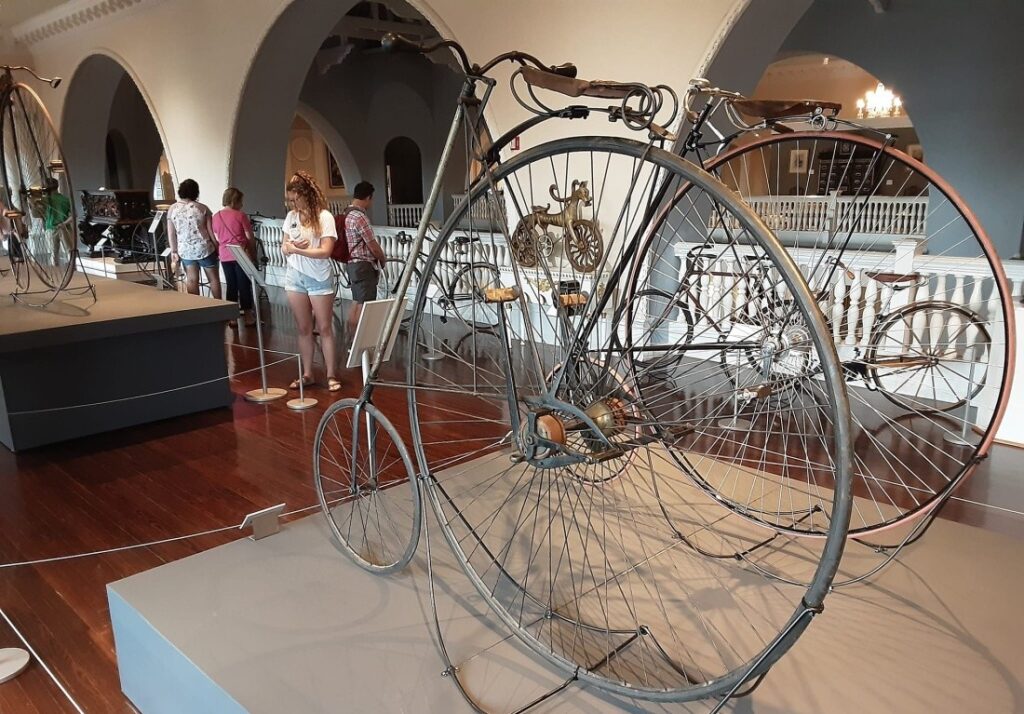
Rarity and Heritage: Authentic 1870s–1880s penny-farthings aren’t something you find in every attic. Many didn’t survive the past 130+ years (metal can rust, rubber perishes, old bikes get scrapped). Certain brands and models are especially scarce or historically significant. For example, an early Coventry-made bicycle by James Starley or a high-wheel made by Columbia (the American brand under Colonel Pope) can be exciting finds due to their pedigree. Even among high-wheelers, there were variations – a child-sized penny-farthing, or a specialized racing model, can be extraordinarily rare and pique collectors’ interest.
Originality and Condition: As with most antiques, original condition is king. Collectors love bikes that still have their original parts, paint, and finish. The gentle patina of age on a Victorian bicycle tells a story – the worn leather saddle, the faded pinstriping on the frame, perhaps even an old license plate or club badge. Of course, many penny-farthings have been through a lot: it’s not uncommon to find one that’s been repainted or repaired over the decades. Some restoration is usually acceptable (especially if it gets the bike back to a display-worthy state), but having as many original components as possible – from the handlebars and pedals to that large front wheel – definitely adds value. A high-wheeler in museum-quality original shape can fetch a premium at auction.
Mechanical Details: Collectors also appreciate the fine details of Victorian engineering. Unusual technical features can make a bike stand out. Does it have a unique brake mechanism? Is the spokes pattern unusual (for instance, tangential spokes vs. radial)? Perhaps it’s a late-model penny-farthing with a small gearing system on the front hub (a conversation piece, since it was an early attempt at making high-wheels easier to ride). These little things can be icing on the cake for a collector who adores antique technology.
Display and Restoration: High-wheel bicycles tend to steal the spotlight wherever they’re displayed. Many collectors showcase them prominently in their homes or offices – sometimes even as the centerpiece of a room. (Tip: If you’re displaying one, a common method is to use a small stand or wall hook to stabilize the big wheel, so the bike doesn’t roll or tip. Some proudly hang their penny-farthing on a wall, like artwork.) Because of their size and shape, a penny-farthing naturally draws eyes and invites questions – which is half the fun for a collector who loves to share the history with visitors.
Restoring a penny-farthing can be both challenging and rewarding. Parts for 140-year-old bicycles aren’t exactly available at the local bike shop, but there are specialist antique bike groups and even craftspeople who can reproduce things like spokes or rubber tires. Often, collectors must decide how far to go in cleaning up an old high-wheel. Do you carefully preserve the original paint and finish (even if it’s a bit rusty), or do you do a full restoration to make it look as it did in 1880? Many lean toward preservation, aiming to clean and stabilize the bike without erasing its age.
Others might do a full rebuild if a bike is very rough, especially if they plan to ride it. Yes, plenty of modern collectors also love to ride their antiques! There are vintage bicycle meets where proud owners of penny-farthings (and other 19th-century cycles) dress in period costume and take these old wheels for a spin, just as their Victorian predecessors did. The largest organization in the U.S., fittingly called The Wheelmen, encourages members to restore and ride bikes made before 1933 (focusing on the high-wheel era and beyond). Across the world, from England to Australia, enthusiasts hold high-wheel races and rallies – proving that the penny-farthing can still turn heads and bring smiles in the 21st century.
In today’s collectibles market, values for penny-farthings can vary widely. Common models from the 1880s in decent shape might sell in the low thousands of dollars, while a particularly rare or mint-condition example from a famed maker (or with an interesting history) can reach well into five figures. But for most collectors, the real appeal isn’t turning a profit – it’s owning a tangible piece of history. There’s a certain magic to holding the handlebars of a bicycle that someone bravely pedaled down a dusty road 140 years ago. It’s a direct connection to the era of top hats, handlebar mustaches, and a boundless faith in new technology.
In the end, the penny-farthing era may have been relatively brief, but its impact was huge. These high-wheelers symbolize the blend of creativity and courage that defined the late Victorian age. They pushed the boundaries of personal transportation and helped ignite a worldwide love affair with cycling that’s still alive today. For collectors and history buffs, bringing a penny-farthing into a collection isn’t just acquiring an object – it’s preserving the legacy of those intrepid riders who once pedaled proud and high. And for anyone who sees one on display or rolling by, it’s hard not to feel a childlike delight and curiosity. The penny-farthing may look like a wild old contraption, but it carries with it the timeless story of human innovation, athleticism, and the simple joy of the open road on two wheels.
Let’s Make History—ride high on nostalgia’s wheel!