
Picture this: It’s the 1840s, and you’re a crewman on a whaling ship in the middle of the Pacific. The thrill of the last whale chase has faded, and now endless weeks stretch on with no whales in sight. The days are long, the nights even longer, and boredom bites harder than the ocean wind. What do you do to keep sane? If you’re like many whalers of the time, you pull out a spare whale tooth or a piece of bone and start carving – whittling away until an image, a design, something – begins to take shape. In those idle hours, a unique art form was born.
That art form is scrimshaw – the engravings and carvings that whalers etched onto whale ivory and bone during long sea voyages. Scrimshaw started as a shipboard pastime in the late 18th and early 19th centuries, turning the tedium of months at sea into creative output. In this post, we’ll explore how scrimshaw came to be, what materials and tools made it possible, and the role these carved treasures played in maritime culture. By the end, you might just see that humble whale’s tooth in a whole new light.
What is Scrimshaw?
In a nutshell, scrimshaw is the art of engraving or carving on ivory and bone – especially the byproducts of whales caught by whalers. If you’ve ever seen an antique sperm whale tooth etched with a detailed whaling scene or a lady’s portrait, you’ve seen scrimshaw. For the whalers-turned-artists (aptly nicknamed “scrimshanders”), the most common “canvases” were the teeth and jawbones of sperm whales, the baleen of baleen whales, and even walrus tusks acquired through Arctic trade.
Typically, the scrimshander would polish the bone or tooth smooth and then scratch an image into its surface with a fine point. After carving the design, they rubbed it with a pigment to make the lines stand out. Soot from the ship’s lamps (called lampblack), tobacco juice, or charcoal from the stove were common improvised inks at sea. Wiping away the excess left the dark pigment in the engraved lines, revealing a contrasting image on the ivory. The result? A black-and-white illustration engraved in a whale’s tooth, as permanent as a tattoo. Some scrimshaw pieces were purely decorative engravings, while others took the form of small sculptures or utilitarian items – but at its heart, scrimshaw was about turning a whaler’s idle hours into something beautiful and tangible.
Born at Sea: Origins of Scrimshaw
Long whaling voyages were the incubator for scrimshaw. A typical voyage could last three, four, even five years, with weeks or months between whale sightings. Sailors had to find ways to occupy those long quiet stretches of time. Fortunately (or unfortunately), a whaling ship had no shortage of raw material to work with: the very whales they caught provided teeth, bones, and baleen that were often discarded or stored. Resourceful crewmen began to repurpose these leftovers as art supplies – turning whale ivory and bone into canvases for carving. From the tedium of life at sea, an indigenous folk art arose on those decks.
Even the word “scrimshaw” has a playful origin story. It first cropped up in a whaler’s logbook in 1826, and while the exact etymology is uncertain, many believe it comes from a Dutch or English nautical slang term meaning “to waste time”. (Leave it to sailors to coin a cheeky word for goofing off creatively!) By the time the term entered the record, the practice of scrimshaw was already in full swing on American and European whaling ships.
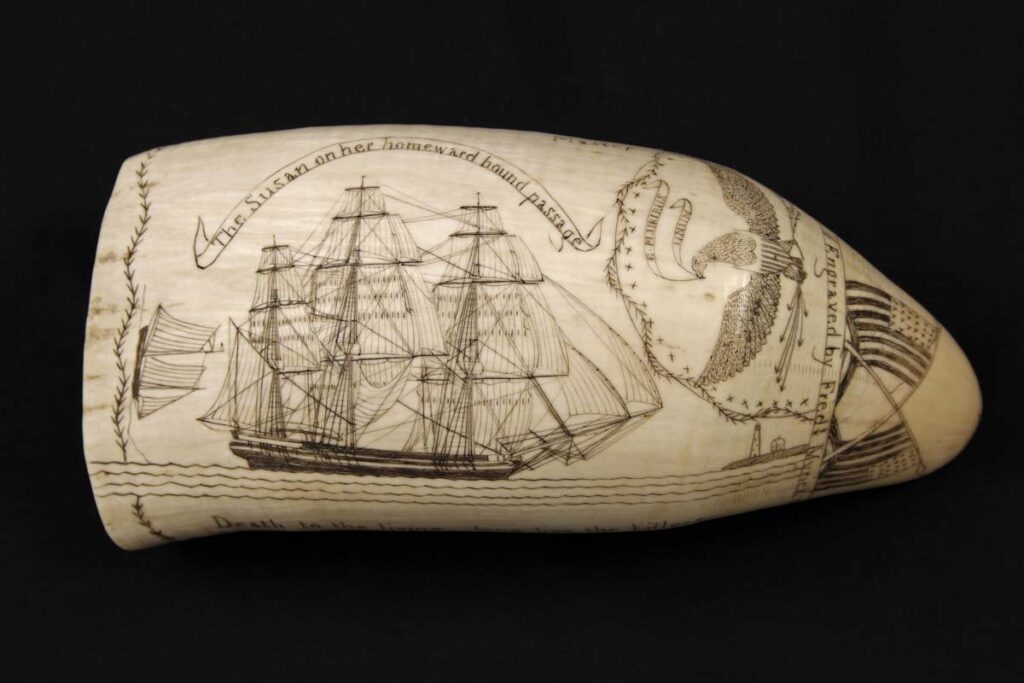
Historically, the late 18th century through the nineteenth century was the heyday of scrimshaw. Open-sea whaling expanded in the 1780s and beyond, and along with it grew this artform born of idle hands. One key moment came in 1815, when a published journal by U.S. Navy Captain David Porter revealed both a market and a source for whale teeth. Suddenly, there was a surplus of cheap whale teeth available, meaning even ordinary sailors could get their hands on quality ivory to carve. Not long after, we find the first identifiable pieces of scrimshaw – one famous early example is a sperm whale tooth from 1817 inscribed by a crew out of London, detailing the capture of a whale near the Galápagos. By the 1820s and 1830s, scrimshaw had spread to whalers across the globe, from New England to the South Pacific.
As the years went on, scrimshaw only became more elaborate. What began as simple doodles with a pocket knife evolved into finely detailed folk art. By the mid-1800s, whalemen had developed recognizable styles and technical skills that marked scrimshaw as a distinct craft within the whaling trade. In other words, scrimshaw had truly come into its own – a proud creative tradition of the whaling life.
Materials of the Trade
Whalers certainly weren’t shopping at art supply stores in the middle of the ocean. Their medium came directly from their catch. The most common base for scrimshaw was the sperm whale’s tooth – a dense, curved piece of ivory that could be several inches long. Whalemen also scrimshawed on whale bone (for example, the jawbone, or “panbone,” of a whale could be cut into panels), on strips of baleen (the flexible keratin plates from a whale’s mouth), and even on walrus tusks if they could get them. Essentially, if it was hard enough to hold an engraved line and came from a marine creature, it could be used for scrimshaw art.
These materials were plentiful byproducts of the whaling industry. After the crew rendered a whale’s blubber into oil and harvested the usable whalebone, they often had leftover teeth and bones with no industrial use. Rather than let all that ivory go to waste, sailors turned it into a creative outlet. A whale’s tooth, cleaned and polished, was ideal – it was smooth, easy to carve, and literally at hand whenever inspiration (or sheer boredom) struck. Some larger bones were fashioned into practical items first (tools, handles, etc.) and then decorated with scrimshaw engravings later. In short, the whalers made art with whatever the sea provided them.
Tools of the Scrimshander
You might be wondering how a sailor actually transformed a whale tooth into a piece of art. The tools of scrimshaw were as simple as you’d imagine. Sailors used whatever sharp implements they had on hand: typically sail needles, awls, small knives or the ubiquitous sailor’s jack-knife. These would be used to etch lines and dots into the ivory or bone surface, essentially “drawing” by scratching. If a design was intricate, the scrimshander might first sketch it in pencil or charcoal on the surface, but many just freehanded their work directly with the blade. Precision was challenging – remember, all this was done on a moving ship that could pitch and roll without warning – so the quality of the engraving often depended on the steadiness of the ship and the skill of the carver. Despite the less-than-ideal studio conditions, surviving scrimshaw shows that many sailors achieved remarkable detail in their carvings.
Once the engraving was complete, the next step was to make the design visible. The engraved lines were colorless until filled in, so whalers rubbed them with pigment to bring out the contrast. Commonly, they used whatever was available: a bit of candle soot or lamp black from the whale-oil lamps, pulverized charcoal, gunpowder, or even tobacco juice could do the trick. Ink was used as well when it was at hand, though fancy art ink wasn’t exactly standard issue on a whaleship (ink was usually reserved for logbooks). The process was simple: rub the tooth with the sooty/oily mixture, let it settle into the scratched lines, then wipe off the excess. Instantly, the picture would pop out in shades of black or brown against the creamy white ivory. A final rinse or a touch of sand to smooth the surface, and the scrimshaw was ready to be shown off. This low-tech technique produced beautifully durable images. Many 200-year-old scrimshaw pieces still clearly show the whaleman’s original etched scene, pigment and all.
(Fun fact: Many scrimshaw engravings were unsigned. The artists were ordinary sailors, not famous painters, so they rarely thought to sign their work – or they preferred to remain anonymous. For today’s collectors, this adds a bit of mystery to each piece: who was the talent behind that detailed ship or charming portrait? We may never know.)
Early Themes and Designs
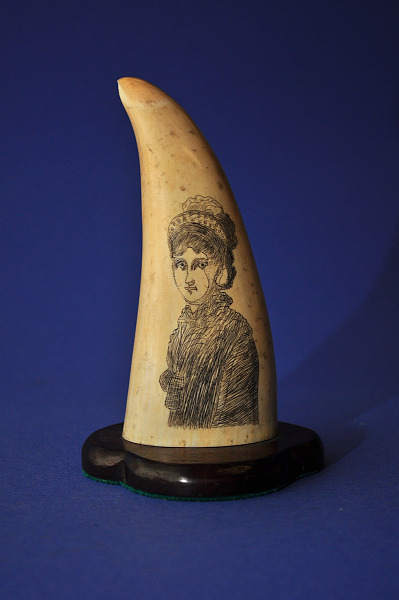
What kinds of pictures did sailors etch into whale teeth and bone? In short, a little bit of everything they cared about. Herman Melville – himself a former whaler – described seeing “lively sketches of Whales and whaling scenes, graven by the fishermen themselves on Sperm Whale teeth,” as well as scrimshawed ladies’ corset busks made from whale bone. Indeed, dramatic whaling scenes were a favorite scrimshaw subject: one might find a tooth engraved with a whaleship pursuing a breaching sperm whale, or a whaleboat crew in the midst of a hunt. Often these images were drawn from the sailors’ own experiences or from popular whaling illustrations of the day.
However, whales and ships weren’t the only things on scrimshanders’ minds. In many cases, the whales were the medium but not the message. Sailors filled their carvings with the memories and dreams of life beyond the hunt. Scrimshaw art depicted patriotic portraits and emblems, naval engagements and historic battles, family scenes, and the women back home that the whalemen longed for. It wasn’t unusual to see a whale tooth engraved with the likeness of a sweetheart, a fanciful rendering of Columbia or Britannia, or the American eagle and flag. Sailors also recorded what they saw on their voyages: exotic ports, island paradises, sometimes even fanciful creatures or mermaids born of sea lore. In this new art form there were no rules and few precedents, so each scrimshander carved whatever was most meaningful to him in the moment.
The range of artistic skill was as wide as the ocean. Some scrimshaw etchings are crude stick figures or simple symbols; others are incredibly detailed works of art that could rival professional engravings. Sailors often copied illustrations from books, newspapers, or sailor’s valentines to guide their art, while others drew completely from imagination. One scrimshaw tooth might feature a meticulously shaded portrait of a ship with every sail and rope rendered; the next might show a rough but charming sketch of a home farmhouse or a fashionable lady from a magazine. This charming mix of folk art and personal storytelling is part of what makes scrimshaw so fascinating to collectors today. No two pieces are quite alike, but each one speaks to the experiences and values of the 19th-century mariner who made it.
From Ship to Shore: Scrimshaw’s Role in Maritime Culture
For the sailors who made it, scrimshaw was more than a way to kill time – it became a form of memory-keeping and communication. Whalers often carved objects as gifts or keepsakes for their loved ones back home, pouring their feelings of longing and affection into these pieces. A long strip of whale baleen might be painstakingly engraved and polished into a corset busk, intended as a romantic gift for a wife or sweetheart waiting in New Bedford or Nantucket. A whale’s tooth might be inscribed with the name of a ship and date, destined to become a proud mantelpiece display for the sailor’s family. These intricate and heartfelt creations were often made as gifts for loved ones back home, serving as personal mementos of the voyage. Imagine a young whaleman spending weeks below deck carving a scene of home onto a piece of ivory, knowing he’d present it to his mother or sweetheart upon return – it gave purpose to those lonely hours at sea.
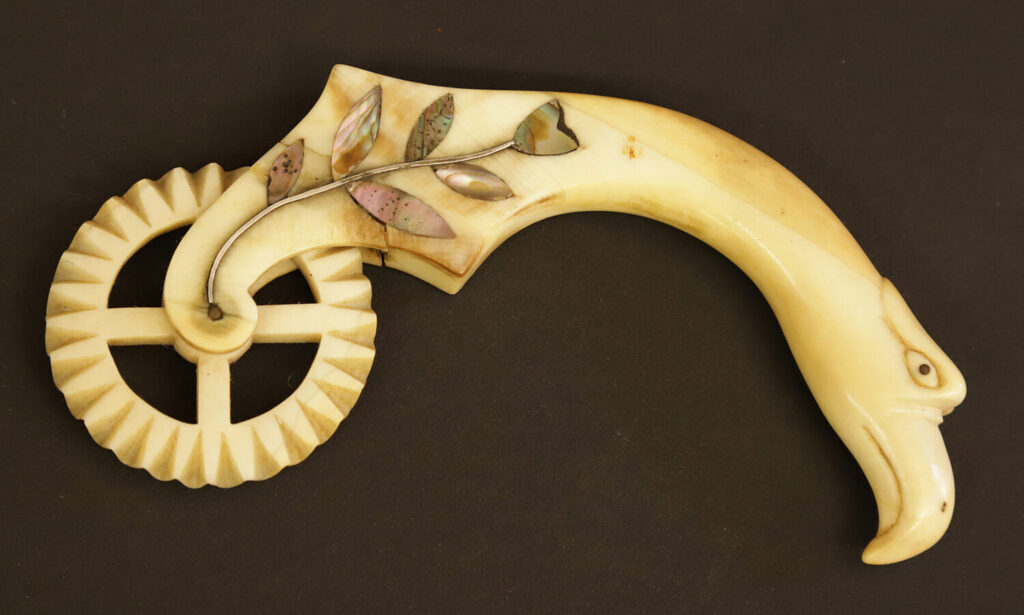
Scrimshaw also had a practical side for enterprising crew members: it could supplement a sailor’s income. During stopovers in port or upon returning home, many whalers would sell or trade their scrimshaw creations. Visiting sailors, locals, and collectors-to-be were often eager to buy these exotic handmade souvenirs from the sea. As a result, scrimshaw items ranged from purely decorative showpieces to very practical tools – whatever might fetch a good price. Common wares included engraved busks (for ladies’ corsets), swifts (yarn winders made of whale bone), elaborately carved pie crimpers (also called jagging wheels, used for edging pie crusts), cane or umbrella handles, and all manner of small boxes, utensils, and jewelry. Whalers-turned-artisans would carve anything that might sell, and in doing so they spread the popularity of scrimshaw beyond the decks of the ship. It wasn’t just a hobby; for some, it became a cottage industry on long voyages. A particularly skilled scrimshander’s work might even be recognizable and in demand among the whaling ports.
Beyond their monetary or sentimental value at the time, scrimshaw pieces today are treasured artifacts of maritime history. Each surviving piece provides a little window into the world of a 19th-century whaler – offering valuable documentation and insight into the whaler’s life that we simply can’t get from official logbooks and records alone. The folk art style of scrimshaw, with its mix of naive charm and surprising skill, lets us glimpse the human side of an otherwise brutal and industrious enterprise. We see what these sailors thought about, what they admired, what they feared, and what they cherished. From a collector’s perspective, owning an authentic scrimshaw is like holding a piece of a sailor’s story in your hand – a tangible connection to the age of sail, adventure, and industry. Many scrimshaw items are now displayed in museums and prized in private collections, valued not only for their artistry but for the rich stories they carry from the deep.
As we admire these carved treasures today, it’s amazing to think they started simply as a way for someone to pass a quiet watch at sea or send a love token home. Scrimshaw stands as a testament to human creativity blossoming in the most challenging environments. Each tooth, tusk, or bone that a whaler transformed into art has become a tiny time capsule from the golden age of whaling – a blend of craft, history, and heart that continues to captivate us. Let’s Make History—one carved tooth at a time.